zenpundit.com » counterintuitive

Archive for the ‘counterintuitive’ Category

The speeds of thought, complexities of problems

Wednesday, February 1st, 2012

[ by Charles Cameron — instinct, rationality, creativity, complexity and intelligence ]
.

Guy Claxton, Hare Brain, Tortoise Mind
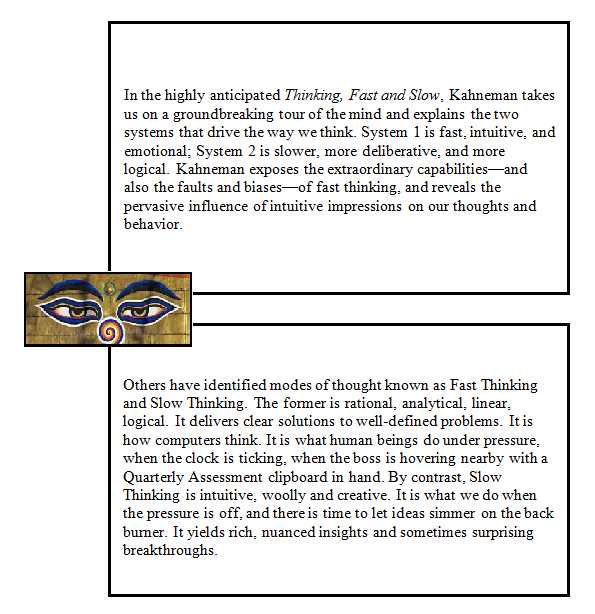
Daniel Kahneman, Thinking, Fast and Slow

You might think, taking a quick glance at their titles, that these two books would be in substantial agreement with one another about the speeds of thought. But consider these two comments, in one of which the deliberative, logical mind is “slower” than the intuitive and emotional — while in the other, it is the rational mind that is “faster” and the intuitive mind which is “slower”. Brought together, the two quotes are amazing — it would seem that either one or the other must be wrong:
\

Happily, I don’t believe either one is wrong — I think it’s more a matter of there being three speeds of thought, and the two books in question using different terminologies to emphasize different distinctions between them.

Here’s a more extended version of Guy Claxton’s position:

Roughly speaking, the mind possesses three different processing speeds. The first is faster than thought. Some situations demand an unselfconscious, instantaneous reaction. … Neither a concert pianist nor an Olympic fencer has time to figure out what to do next. There is a kind of ‘intelligence’ that works more rapidly than thinking. This mode of fast, physical intelligence could be called our ‘wits’. (The five senses were originally known as ‘the five wits’.)

Then there is thought itself — the sort of intelligence which does involve figuring matters out, weighing up the pros and cons, constructing arguments and solving problems. A mechanic working out why an engine will not fire, a family arguing over the brochures about where to go for next summer’s holiday, a scientist trying to interpret an intriguing experimental result, a student wrestling with an examination question: all are employing a way of knowing that relies on reason and logic, on deliberate conscious thinking. … Someone who is good at solving these sorts of problems we call ‘bright’ or ‘clever’.

But below this, there is another mental register that proceeds more slowly still. It is often less purposeful and clear-cut, more playful, leisurely or dreamy. In this mode we are ruminating or mulling things over, being contemplative or meditative. We may be pondering a problem, rather than earnestly trying to solve it, or just idly watching the world go by. What is going on in the mind may be quite fragmentary. What we are dunking may not make sense. We may even not be aware of much at all. As the English yokel is reported to have said: ‘sometimes I sits and thinks, but mostly I just sits’. […]

That third mode of thinking is the one Claxton identifies with “wisdom” — which is interesting enough. Just as interesting, though, is his identification of this slowest mode of thought with “wicked problems”:

Recent scientific evidence shows convincingly that the more patient, less deliberate modes of mind are particularly suited to making sense of situations that are intricate, shadowy or ill defined. Deliberate thinking, d-mode, works well when the problem it is facing is easily conceptualised. When we are trying to decide where to spend our holidays, it may well be perfectly obvious what the parameters are: how much we can afford, when we can get away, what kinds of things we enjoy doing, and so on. But when we are not sure what needs to be taken into account, or even which questions to pose — or when the issue is too subtle to be captured by the familiar categories of conscious thought — we need recourse to the tortoise mind.

I haven’t read either book, and I’d hope that Kahneman as well as Claxton actually addresses all three speeds of thought. But my immediate point is that the slowest of the three forms of thought is the one that’s best suited to understanding complex, wicked and emergent problems.

And that’s the one that can’t be hurried — the one where the Medici Effect takes effect — and the one which provides Claxton with one of his finest lines, with which he opens his book, a western koan if ever I saw one:

There is an old Polish saying, ‘Sleep faster; we need the pillows’, which reminds us that there are some activities which just will not be rushed. They take the time that they take.

More on that front shortly, insha’Allah and the creek don’t rise.

Wishcraft as Statecraft a.k.a The “And a Pony!” Doctrine

Wednesday, January 11th, 2012

A short and cranky diatribe.

Adam Elkus and his amigo Dan Trombly of Slouching Towards Colombia have been busy  poking holes into the ill-considered and/or poorly reasoned strategic conceptions of victory-free but credible influence. Dan gets very close to something important, something worth contemplating for the welfare of our Republic:

…..Rather than a world where normal victory and political decision through force of arms give way to a world of credible influence, I see this concept ushering in a world where America’s objectives remain expansive – seeking to create social and political change – but where “twentieth century” warfare continues as usual, obscured by multilateral efforts and prosecuted as much as possible by local forces. Because the objectives are essentially unchanged – overthrow of criminal regimes, integration of societies into a dynamic liberal international order, protection of civilians – one of my real fears about the Defense Strategic Guidance is that, confronted with conflicts and challenges to our interests, and with a paradigm of military aims just as expansive as before, we will slouch inevitably towards unsustainable ways of war. Already, the new objectives of civilian protection are blurring into the old objectives of democracy promotion and liberalization – just look at the title of the new State Department Office of Civilian Security, Democracy, and Human Rights.

When a statesman selects Ends that have no rational relationship to available Ways and Means we might take that as a sign of possible incompetence as a strategist.

While that’s not good it is at least normal – most politicians in a democratic society are on average, poor strategists but pretty good intuitive tacticians. After all, acquiring and keeping political power for long periods of time requires more than luck and a large checkbook. While there are always some buffoons decorating the halls of Congress, as individuals, Members of Congress are usually pretty shrewd and a minority are exceptional people.

If the Ends selected are fantastically broad open-ended, undefined or, worse, undefinable, convoluted and insensible in their context, we are left with two even less savory conclusions:

First, that the statesman has a fundamental political immaturity and narcissism the leads them to articulate their emotively generated whims as policy objectives without regard to empirical reality. Sort of a wishcraft of state that substitutes rhetorical expressions and sloganeering for thought and analysis. We see this effect on a much larger scale in the ideological atmosphere of totalitarian regimes where 2+2= 5 and only Right-deviationist mathematician, counterrevolutionary wreckers would dare suggest the answer is 4. Geopolitical goals that are created by political fantasists – like the creation of a modern, liberal democratic state in Afghanistan in a few years time – can be appended with “And a Pony!” and still be just as likely to come to pass.

American statesmen seem to be particularly predisposed to this condition in foreign affairs (and arguably, in fiscal affairs as well). Perhaps this is an intellectual legacy of Wilsonian excess but the problem was not acute until the past decade and a half, which indicates that the driving force may be, in part, generational. Men and women born into a time of record-breaking standards of living have reached the apex of power and they are no more inclined to act with restraint, responsibility or realism now than they did in ’68.

The second conclusion is that the Ends are purposefully incoherent and recklessly broad because the real strategic objective is not in our relations with country X, but for the statesman to wrest for their faction as large a grant of unaccountable power as possible.

A poignant week or so in DoubleQuotes

Friday, December 30th, 2011

[ by Charles Cameron — fictitious peoples (Israelis, Palestinians), approved and disapproved scriptures (Hindu, Falun Gong), religious violence (Afghanistan, Nigeria, Bethlehem) ]
.

So, is there some sort of contest going on between Iranian and American ex-Speakers? Perhaps Elliott Abrams‘s response to Gingrich, quoted in the Washington Post piece, applies equally well to Haddad-Adel?

There was no Jordan or Syria or Iraq, either, so perhaps he would say they are all invented people as well and also have no right to statehood.

Next up…

And okay, what’s the point here? Is it that the Russians want to please both the Chinese and Indian governments — or that they don’t like new scriptures but are okay with old ones? Or is the problem that they haven’t decided yet on a “one size fits all” approach to unOrthodox religions?

Sigh. Next…

This is brutal — and apparently intercontinental.

You might think it’s obvious what the wrong answer is, and who’s doing the killing, in Nigeria. But these things can cut both ways:

Even here, it’s not clear who threw the bomb into the madrasa, although one could hazard a guess…

And even the site of the Nativity is infected. The Guardian’s account of events there this Christmas season is harsh in tone — but consider whose Nativity is supposedly being celebrated…

I’d say the Qur’an offers a better image of Christian monks than that experienced by those Palestinian riot police… who, in the event, although they themselves were also assailed with broom-sticks, declined to arrest anyone because, as Palestinian police lieutenant-colonel Khaled al-Tamimi put it:

Everything is all right and things have returned to normal. No one was arrested because all those involved were men of God.

Still, things could be worse. It was a squabble along similar lines in which nine several Orthodox monks were killed that triggered the Crimean War: details in Raymond Cohen, Conflict and Neglect: Between Ruin and Preservation at the Church of the Nativity — h/t Juan Cole, who also has video of this year’s brouhaha.

*

Et in terra pax hominibus bonae voluntatis.

On War as an Unfinished Symphony

Thursday, November 3rd, 2011

cvcforming.jpg

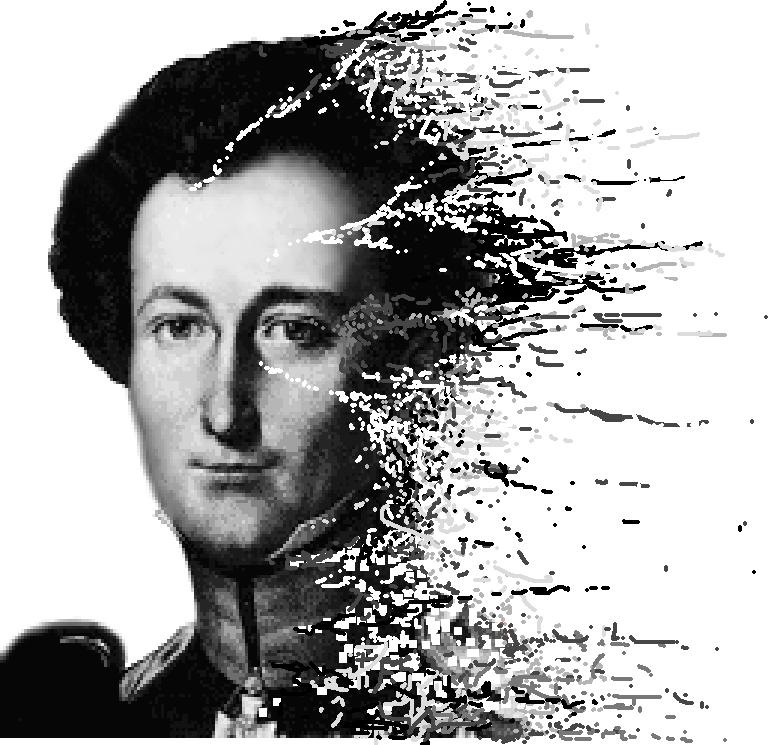
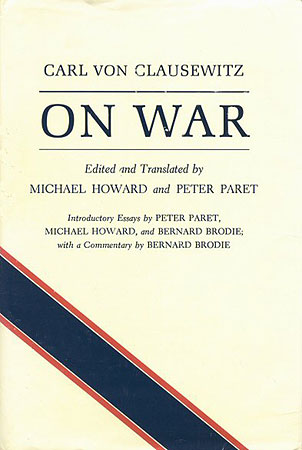
On War by Carl von Clausewitz has been the most influential book on strategy and war of all time.

We can say this because On War is the standard by which all other works of strategy are measured and only a few compared – notably Sun Tzu’s Art of War and The Peloponnesian War by Thucydides. The odd thing is that we can say this despite the fact that On War is more frequently shelved, cited or understood secondhand rather than read, even by military professionals. And furthermore, within the narrow demographic that reads Clausewitz seriously and critically, there can be heated dispute over what he meant, due to the difficulty of the text. Then there are the secondary effects, historical and military, of Clausewitz having been misunderstood, forgotten, ignored or at times, his strategic philosphy consciously rejected.

The shadow cast by On War is all the more remarkable given it’s circumstances of publication. Clausewitz died in 1831, at fifty-one, of cholera, having finally risen to a military post his talents merited. He had been writing On War since 1816 and it was far from completed or refined to his satisfaction and it is highly unlikely, in my view, that Clausewitz would have consented to it’s publication in the condition in which he left it. His determined and intellectually formidible widow, Marie von Clausewitz, further shaped the manuscript of On War, guided by her intimate knowledge of her husband’s ideas and was likely the best editor Clausewitz could have posthumously had.


Nevertheless, to my mind On War remains a magnificent unfinished symphony.

What would On War have looked like if Clausewitz had lived another twenty-five or thirty some years? Assuming continued good health, Clausewitz would have seen, perhaps commanded in, the First Schleswig War and at least studied the Crimean War from afar. He would have had another quarter-century of reading and mature reflection on his subject. Clausewitz, who had a keen understanding of history, would have also witnessed the grand European upheaval of liberal revolution in 1848 that rocked the Hohenzollern monarchy to it’s core. What new insights might Clausewitz have gleaned or expanded upon? Would his later chapters On War have evolved to equal the first?

Having outlived Marie (who died in 1836), would Clausewitz have become a deeply changed man?

What I find it difficult to believe is that Clausewitz, with his creatively driven and philosophically exacting mind,  would have been content to let the manuscript of On War rest where it stood in 1831. Or that we read today what Carl von Clausewitz ultimately intended.

[Reposting] Talking the audible talk

Wednesday, October 26th, 2011

[ previous version deleted for tech reasons, now reposted — pls comment if you were unable to do so before ]

[ by Charles Cameron — importance of suiting language to intended audience, importance of graphics, Tajikistan, Yemen, importance of poetry in conflict and conflict resolution ]

.

talking-the-talk.jpg

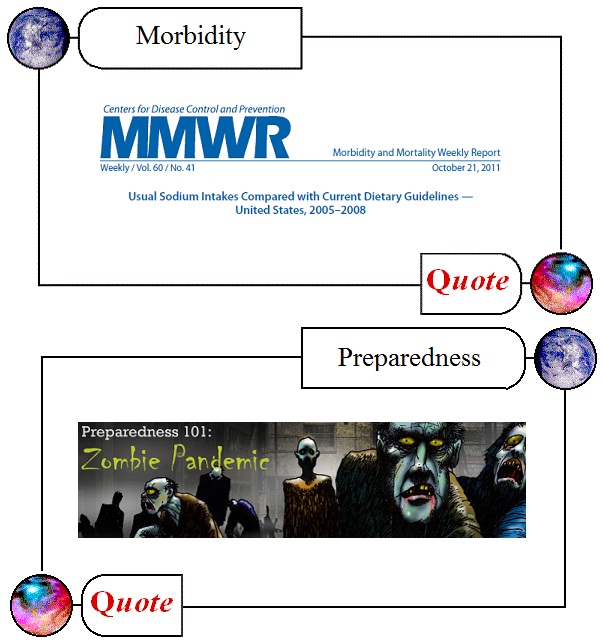
Et voila! Two publications issued this month by the Centers for Disease Control.

I’ve already stated the two lessons that I think we can draw from these, in the parenthetical header where I try to warn ZP readers of the approximate through-line and likely detours of each of my posts:

  • graphics, graphics, graphics!
  • talk the talk your intended audience can hear!

But why?

Of course I’m mildly amused at the CDC using zombies — just like Daniel Drezner — to get a serious point across. And I like the play between the seriousness of the Morbidity Report and the morbid fascination of the undead…

But I am going somewhere with all this, and on this occasion the CDC’s sense of presentation is the detour, and my through-line leads to the importance of poetry in conflict resolution.

*

I want to borrow a story from the keynote speech delivered by John Paul Lederach at the Association for Conflict Resolution’s 2004 Conference, as told to him by a Tajik professor named Abdul:

“I was tasked by the government to approach and convince one of warlords, a key Mullah-Commander located in the mountains to enter negotiations,” Abdul begins. “This was difficult if not impossible, because this Commander was considered a notorious criminal, and worse, he had killed one of my close friends.” Abdul stops while the translation conveys the personal side of his challenge.

When I first got to his camp the Commander said I had arrived late and it was time for prayers. So we went together and prayed. When we had finished, he said to me, How can a communist pray?

I am not a communist, my father was, I responded.

Then he asked what I taught in the University. We soon discovered we were both interested in Philosophy and Sufism. We started talking Sufi poetry. Our meeting went from twenty minutes to two and half hours. In this part of the world you have to circle into Truth through stories.” In the hallway Abdul’s gold capped teeth sparkle with a smile as he relays his message: “You see in Sufism there is an idea that discussion has no end.”

His point well conveyed, the Professor picks up the story again.

“I kept going to visit him. We mostly talked poetry and philosophy. Little by little I asked him about ending the war. I wanted to persuade him to take the chance on putting down his weapons. After months of visits we finally had enough trust to speak truths and it all boiled down to one concern.”

“The Commander said to me, ‘If I put down my weapons and go to Dushanbe with you, can you guarantee my safety and life?'” The Tajik storyteller pauses with the full sense of the moment. “My difficulty was that I could not guarantee his safety.”

He waits for the translator to finish making sure I have understood the weight of his peacemaking dilemma and then concludes.

“So I told my philosopher warlord friend the truth, ‘I cannot guarantee your safety.'” In the hallway Professor Abdul swings his arm under mine and comes to stand fully by my side to emphasize the answer he then gave the Commander.

“But I can guarantee this. I will go with you, side by side. And if you die I will die.’ The hallway is totally quiet.

“That day the Commander agreed to meet the Government. Some weeks later we came down together from the mountains. When he first met with the Commission he told them, ‘I have not come because of your Government. I have come for honor and respect of this Professor.’ “You see, my young American friend,” Abdul taps my arm lightly, “this is Tajik mediation.”

Think about it. Think about the Yemen.

Consider that Steven C. Caton of the Center for Middle Eastern Studies at Harvard suggests:

Every day in the Middle Eastern country of Yemen, battles are being waged that don’t involve bombs, guns or even a raised fist. Rather in Yemen, where physical violence is considered an inferior form of honor-conflict, poetry is one of the preferred weapons of choice.

If Yemen is important to you — or conflict resolution — I have a question for you:

Are you fluent in poetry?

*

Your copy of the Zombie Pandemic awaits you here. For those more interested in Morbidity and Mortality Weekly, here’s the report.

Hat-tip to Tony Judge for his paper, Poetic Engagement with Afghanistan, Caucasus and Iran: an unexplored strategic opportunity?


Switch to our mobile site