zenpundit.com » counterintuitive

Archive for the ‘counterintuitive’ Category

Autonomy, Mastery, Purpose

Tuesday, October 18th, 2011

An research-based look at human motivation by Dan Pink:

Interestingly, the direction of corporate/billionaire driven Education Reform runs counter to most of this, being centered in strongly Taylorist ethos of micromanagement and continuous quantitative measurement, rote and synchronized usage of teaching scripts and routines, with the intention of erasing autonomy of both teachers and students. Standardized competence, set at a level of basic skills, is their systemic learning objective rather than mastery – for which they wish to charge the taxpayers a boatload of money. #EpicFail.

Stay hungry, stay foolish

Thursday, October 6th, 2011

[ Steve Jobs obit — posted by CC]
.
attachmentphp.jpg

Steve Jobs, February 24, 1955 – October 5, 2011

Remembering that I’ll be dead soon is the most important tool I’ve ever encountered to help me make the big choices in life. Because almost everything — all external expectations, all pride, all fear of embarrassment or failure – these things just fall away in the face of death, leaving only what is truly important. Remembering that you are going to die is the best way I know to avoid the trap of thinking you have something to lose. You are already naked. There is no reason not to follow your heart.

— from Steve JobsCommencement Address at Stanford University, June 2005

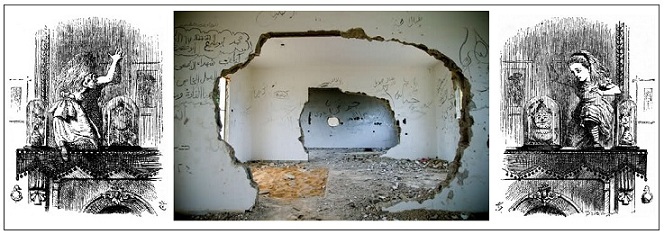
Alice’s Wonderland Battlespace

Tuesday, August 23rd, 2011

[ by Charles Cameron — terrain, IDF, inverse geometry, Necker cube, apocalyptic signs ]

.

wonderland-battlespace.jpg

I’ve just read one of those astounding paragraphs that leaves the mind reeling. Some of you will no doubt already be aware of the work of Israeli architect Eyal Weizman, but for me, his paper Lethal Territory is new ground:

The maneuver conducted by units of the Israeli Defense Forces (IDF) in Nablus in April 2002 was described by its commander, Brigadier General Aviv Kokhavi, as inverse geometry, the reorganization of the urban syntax by means of a series of microtactical actions. During the battle, soldiers moved within the city across hundred-meter-long “overground-tunnels” carved through a dense and contiguous urban fabric. Although several thousand soldiers and several hundred Palestinian guerrilla fighters were maneuvering simultaneously in the city, they were so “saturated” within its fabric that very few would have been visible from an aerial perspective at any given moment. Furthermore, soldiers used none of the streets, roads, alleys, or courtyards that constitute the syntax of the city, and none of the external doors, internal stairwells, and windows that constitute the order of buildings, but rather moved horizontally through party walls, and vertically through holes blasted in ceilings and floors. This form of movement, described by the military as “infestation”, sought to redefine inside as outside, and domestic interiors as thoroughfares. Rather than submit to the authority of conventional spatial boundaries and logic, movement became constitutive of space. The three-dimensional progression through walls, ceilings, and floors across the urban balk reinterpreted, short-circuited, and recomposed both architectural and urban syntax. The IDF’s strategy of “walking through walls” involved a conception of the city as not just the site, but the very medium of warfare — a flexible, almost liquid medium that is forever contingent and in flux.

Where do I begin?

* * *

1. For sheer creativity, this reversal of our normal understanding of space is both audacious and brilliant.

2. In terms of the way the humans living in that space experience the tactic, it must have been – must be – extraordinary – shock and awe on the scale of the individual family and its dwelling. Weizman quotes a Palestinian woman’s response:

Imagine it – you’re sitting in your living room, which you know so well; this is the room where the family watches television together after the evening meal. .. And, suddenly, that wall disappears with a deafening roar, the room fills with dust and debris, and through the wall pours one soldier after the other, screaming orders. You have no idea if they’re after you, if they’ve come to take over your home, or if your house just lies on their route to somewhere else. The children are screaming, panicking. . Is it possible to even begin to imagine the horror experienced by a five-year-old child as four, six, eight, twelve soldiers, their faces painted black, submachine guns pointed everywhere, antennas protruding from their backpacks, making them look like giant alien bugs, blast their way through that wall?

3. It has a past, there’s nothing entirely new under the sun:

Similarly, the strategy of walking through walls, as Israeli architect Sharon Rotbard reminds us, is reinvented for every urban battle in response to local conditions. It was first described in Marshal Thomas Bugeaud’s 1849 draft of La Guerre des Rues et des Maisons, in the context of anti-insurgency tactics used in the class-based urban battles of 19th-century Paris. Instead of storming the barricades from the front, Bugeaud recommended entering the barricaded block at a different location and “mouse-holing” along “over-ground tunnels” that cut across party walls, then taking the barricade by surprise from the flank. On the other side of the barricades and a decade later, Louis-August Blanqui wrote this microtactical maneuver into his Instructions pour une prise d’armes.

* * *

4. Quite apart from the notion of “inverse geometry” there’s a thread here that concerns mapping and deserves investigation. First, there’s this quote in Weizman’s essay from Walter Benjamin:

I have long, indeed for years, played with the idea of setting out the sphere of life — bios — graphically on a map. First I envisaged an ordinary map, but now I would incline to a general staff’s map of a city center, if such a thing existed. Doubtless it does not, because of the ignorance of the theatre of future wars.

Then, in a paper on forming a “coherent mental map of the Israeli-Palestinian conflict”, Weizman writes

A new understanding of territory had to be developed to govern the West Bank. The Occupied Territories were no longer seen as a two-dimensional surface, but as a large three-dimensional volume, layered with strategic, religious and political strata.

Later in the same piece, we can find Weizman’s description of a “politics of verticality” along with its vivid quote from Benveniste:

New and intricate frontiers were invented, like the temporary borders later drawn up in the Oslo Interim Accord, under which the Palestinian Authority was given control over isolated territorial ‘islands’, but Israel retained control over the airspace above them and the sub-terrain beneath.

This process might be described as the ‘politics of verticality’. It began as a set of ideas, policies, projects and regulations proposed by Israeli state-technocrats, generals, archaeologists, planners and road engineers since the occupation of the West Bank, severing the territory into different, discontinuous layers.

The writer Meron Benvenisti described the process as crashing “three-dimensional space into six dimensions – three Jewish and three Arab”. Former US president Bill Clinton sincerely believed in a vertical solution to the problem of partitioning the Temple Mount. Settlement Masterplanners like Matityahu Drobless aimed to generate control from high points.

* * *

Upside down, inside out, and topsy-turvy? Apart from Alice, of course — what does this remind me of?

Why, religion, naturally.

Take the Gospel of Thomas, logion 22 (Barnstone & Meyer, p. 51):

Yeshua said to them,
When you make the two into one,
and when you make the inner like the outer
and the outer like the inner
and the upper like the lower,
and when you make male and female into a single one,
so that the male will not be male nor female be female,
when you make eyes in place of an eye,
a hand in place of a hand,
a foot in place of a foot,
an image in place of an image,
then you will enter the kingdom.

Similar sayings are found in the poetry of Kabir, the great Indian mystic-poet, and described thus by Linda Hess (The Bijak of Kabir, p.135):

A particularly intriguing category of Kabir’s poems is the type known as ulatbamsi, poems in “upside down language”. They intrigue because they are absurd, paradoxical, crazy, impenetrable, and yet they purport to be meaningful.

In Japan, they might be given the name of koan — Hess quotes (p. 145) an early Mahayana sutra describing the world as “like a desert mirage, a celestial city, a mirror-reflection, a stone made from water hardened by a whirlwind”.
.

Here is one of the signs of the end times quote in Islamic sources:

After the night of three nights, the following morning the sun will rise in the west. People’s repentance will not be accepted after this incident.

* * *

And so perhaps the saying with which Eihei Dogen described Master Dogo‘s friend in his Shinji Shobogenzo best encapsulates both the state of mind that a sudden reality-reversal accomplishes in those who are not prepared for it — and paradoxically, the state of mind in which it can be accepted as part of the natural order of things:

He does not have a roof above his head, nor any ground under him.

One thing leads to an unexpected other

Saturday, August 13th, 2011

[ by Charles Cameron — complex situations, unexpected consequences, analysts’ need for semi-random knowledges ]
.

azelin-tweet.gif

Suppose you’re a Japanese journalist given a news report to write about a tourist who may have contracted an obscure disease on a visit to Zaire. The job seems straightforward enough, you expect your Japanese readers to be sympathetic to the plight of your Japanese tourist subject, you don’t exactly expect your readers to include one Shoko Asahara, guru of Aum Shinrikyo…

But he’s there in the penumbra, reading… as this report from the Center for Counterproliferation Research of the NDU testifies:

In 1992, Aum sent a team of 40 people to Zaire to acquire Ebola. Led by Asahara himself, the team included doctors and nurses. During an outbreak of Ebola in Zaire, a Japanese tourist visiting that country may have contracted the hemorrhagic fever. This report, which received considerable publicity in Japan, apparently inspired Asahara to mount the expedition to Zaire in October 1992. Ostensibly, this trip was intended as a humanitarian mission, called the “African Salvation Tour.” It is not known if Aum actually obtained Ebola cultures. A Japanese magazine quoted a former member of the group, “We were cultivating Ebola, but it needed to be studied more. It can’t be used practically yet.”

One things leads to an unexpected other.

*

Here’s a positive example, one that I heard on the radio yesterday, and nothing to do with terrorism — except perhaps at the cellular level:

You know, the Scottish surgeon George Beatson was walking through the highlands in England, and he heard some shepherds saying, oh, you know, when we remove the ovaries of cows and goats, the pattern — or the breasts of these animals changes; the pattern of milk production changes.

So, Beatson began to wonder, well, what is the — this was a time when no one knew about estrogen. So, Beatson began to wonder, what is the connection between ovaries and breasts? And he said, well, if ovaries are connected to breasts, then maybe they’re connected to breast cancer.

And he took out the ovaries of three or four women with breast cancer and had these spontaneous, had these, not spontaneous, but amazing remissions. And it was — this is the basis for tamoxifen, the drug that actually blocks estrogen, and thereby affects breast cancer.

I mean, who would have thought that walking through and talking to a shepherd in Scotland would affect a billion-dollar drug, which is very, very powerful against breast cancer today?

One thing leads to an unexpected other.  Listen.

*

Back to terror — and what jihadists notice, think about and discuss:

They follow the news.

If the stock-market takes a dive, the folks on the forums know about it — and crow about it.  Because, as bin Laden said, AQ’s policy is one of “bleeding America to the point of bankruptcy, Allah willing, and nothing is too great for Allah.” Inspire magazine calls it “the strategy of a thousand cuts” and claims the “aim is to bleed the enemy to death”.  Daveed Gartenstein-Ross‘ book, Bin Laden’s Legacy, is abundantly clear on that point.

So yes, they follow the news.  So they know about the riots in the UK.

There was an interesting short flurry of tweets on Twitter a couple of days ago, when Will McCants, who monitors such things and runs the Jihadica blog, noted: “Lots of pictures of #londonriots being posted to Ansar jihadi forum” and followed up by quoting a couple of forum comments: “God is burning the ground beneath the feet of the Crusaders” and “We are witnessing this aggressor nation quaking inside and out….collapsing and suffering defeat by the permission of God”.

Jason Burke of the Guardian picked up on McCants’ post and noted, “so now Islamic militants exploiting #londonriots” – and Aaron Zelin of Jihadology chimed in with the tweet I quoted at the top of this post.

The conversation continued for a bit, but it’s Aaron’s comment that I want to focus on, because it makes explicit the kind of seamless weave of knowledge that I’ve been thinking about lately — which makes cross-disciplinary awareness both so necessary and so feasible at this time.  Let’s call it Zelin’s law:

every event and issue will be exploited by every group and ideology on the net.

Here’s my corollary: one thing leads to an unexpected other.

*

So what?

So we need a supersaturated solution of knowledges where decisions are made.

So our analysts need to be speckled specialists — experts with a sufficiently wide and random assortment of additional odd knowledges to be able to frame and reframe and reframe, to shake off any group frame and suggest half a dozen plausible alternatives, to doubt each one of them in turn, to turn to the right people who are themselves specialists in those other framings, to ask, to listen, to hear…

So we also need a supersaturated solution of ignorances — admitted, and inquiring.

*

Here’s Herbert E Meyer on the non-bureaucratic qualities of first-rate analysts:

In normal circumstances people like this would never be willing to take government jobs. Moreover, any agency that hired them would soon be driven nuts by their energy, their drive, their seemingly off-the-wall ideas, their sometimes bizarre work habits, even their tempers.

Sometimes bizarre, eh?  “Embrace the maverick,” Deputy Director for Intelligence Jami Miscik advised.

And by extension, embrace the unexpected — learn to expect it.

Is there a literature of the unexpected? Read it! And I don’t just mean read Nicholas Nassim Taleb‘s Black Swan — I mean, keep tabs on the undertows, read the opposition, read the factional fights within the opposition, read the underclass and upperclass, the radical and the pacific and the merely eccentric and the totally off the wall.  Know that some people believe there is a reptile in Queen Elizabeth II‘s head — and I don’t mean people who hold some variant on Paul MacLean‘s triune brain theory!  Read the ancients as well as the moderns.

Note especially the places where two fields or perspectives or framings overlap — they’re the places where experts can most easily see that each others’ approaches have value.  Cultivate binocular vision — and I mean, vision.

And do all this with a fair amount of randomness, with curiosity.

I happen to study religion, for instance, and splatter myself with other things — epidemiology, for instance, and complexity, and lit crit, and medieval music and plenty more besides — just enough to give a vaguely Jackson Pollock look to my interest in religion.

And Aum Shinrikyo’s attempt to gather samples of the Ebola virus isn’t an epidemiology story, isn’t a new religious movements story — it’s at the intersection, it’s both.

*

How many fields of knowledge can you gossip in for a minute or three? That’s a question with profound implications in terms of networked interactions and collective understanding.

How many languages can you frame your questions in?

Hitting all the Right Notes

Thursday, July 14th, 2011

From SWJ Blog:

Irregular Adversaries and Hybrid Threats


Switch to our mobile site