zenpundit.com » ancient history

Archive for the ‘ancient history’ Category

Duel in slow time

Friday, April 1st, 2011

[ by Charles Cameron ]


In slomo –

as in the slow rotating
backseat of a hurtling flipping car –

at that most divine of speeds at which
concentration arrives and
all is revealed –

as when Krishna himself bears
each arrow loosed from his
left-handed archer Arjuna’s drawn bow
to some fine warrior’s

doom

we see: all contest is
cooperation,
each edged duel, a true duet…

More Books and Reviews to Come

Wednesday, March 30th, 2011

Going to try to catch up this week on the backlog of book reviews I need to do, particularly those books sent to me by publishers. I may have to break down and do a set of mini-reviews, so far behind I have gotten myself.

So, naturally, that was a suitable pretext to order more books 🙂

Here’s what arrived the other day….


STRATEGY: The Logic of War and Peace by Edward Luttwak

War Before Civilization by Lawrence H. Keeley

WAR: In Human Civilization by Azar Gat

The World of Yesterday by Stefan Zweig

Why the West Rules – For Now by Ian Morris

Luttwak’s book is a strategy classic and I recently enjoyed his Grand Strategy of the Byzantine Empire. I first heard of Stefan Zweig from Lexington Green but nearly everyone who has read The World of Yesterday that I have encountered has raved about it, so I am looking forward to that one. Why the West Rules- For Now is another rec from the Chicago Boyz crowd but I do not think that anyone has reviewed it there as of yet. Finally, I am pairing War Before Civilization with Azar Gat’s War in Human Civilization – have a sense that Gat’s ideas may be somewhat in tune with Martin van Creveld.

Have you read any of these?

Book Review: The Grand Strategy of the Byzantine Empire by Luttwak

Monday, February 14th, 2011

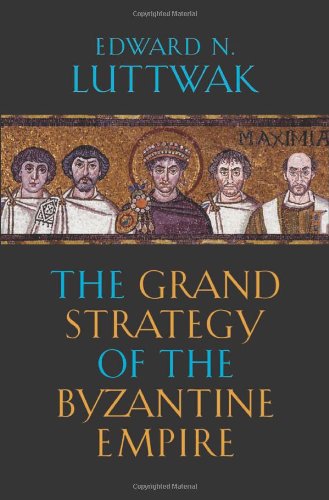
The Grand Strategy of the Byzantine Empire by Edward Luttwak

A quarter century in the making, eminent and controversial strategist Dr. Edward Luttwak has produced a tour de force work of scholarship that illuminates the little known (to laymen)  military and diplomatic vision of the Byzantine Empire while making a case for adopting some of Byzantium’s strategic posture to adapt to the challenges of today. A book intended to provoke as much as inform the reader, Luttwak’s epilogue, “Conclusion:Grand Strategy and the Byzantine ‘Operational Code”, which synthesizes the best elements of leading schools of strategic thought, is so good that it merits a separate printing of it’s own.

Luttwak’s central idea is that the Hellenic and holy Orthodox Byzantines, who forever saw themselves as “the Romans”, abandoned the grand strategic posture of the Roman Empire whose mighty legions were optimized to smash heavy infantry into the enemy, seeking not just a decisive victory, but the total destruction of the enemy. Facing a sophisticated peer rival in Persia and the endless steppes that vomited up unending waves of invading Huns, Avars, Pechnegs, Slavs, Bulghars, Bulgars, Turks and Mongols, eventually menaced by an ideologically motivated Islamic enemy, the Byzantines sought to conserve their strength by avoiding decisive battle.

As the position of the Empire meant that one destroyed enemy might be replaced by a worse successor, the Byzantines crafted a grand strategy that maximized stratregic alternatives to wars of attrition that the small, highly trained, well-armed, tactically versatile and irreplaceably expensive Byzantine army could ill afford. Diplomacy, espionage, bribery, assassination, recruitment of foreign proxies, strategic raiding, naval supremacy, manuver warfare and cunning strategems were all employed in preference to engaging in decisive battle. Today’s enemy might be tomorrow’s ally was a foremost consideration for the Byzantines, who took great care to lay down hard-won military wisdom in handbooks and manuals like The Strategikon or  De Re Strategica.

Strengths and Weaknesses:

Where you sit in reading The Grand Strategy of the Byzantine Empire is likely to determine where you stand on it. 

Luttwak has written a very interesting book about a historical subfield in which he himself is not an expert but has infused it with distillations of professional insight regarding strategy and warfare that no Byzantinist scholar and only very few military historians could have brought to bear. And importantly, never have tried to do so. Luttwak’s commentary on each of the surviving Byzantine military manuals, some only recently translated, for example, while repetitive for a lay reader is an important service for students of war and military strategy.

The empire lasted an exceedingly long period of time, as the Byzantines themselves reckoned it, from the 8th century BC to 1453 when the last Emperor Constantine died heroically fighting the final onslaught of the Ottoman Turks a mere 39 years before Christopher Columbus discovered the New World.  Luttwak is not a historian and makes no attempt to approach the subject as a historian would – something that might require multiple volumes or a very superficial treatment – and makes selections from Byzantine history to illustrate thematic points regarding strategy or, as with the digressions on the composite recurve bow and training of mounted archers, the complex relationship between technology, economics, military tactics and strategy.  To the reader interested in strategy and military history, Luttwak’s approach is efficient and sensible; for those interested in a comprehensive understanding of the Byzantines it makes for a highly idiosyncratic reading.

Nor does Luttwak make any pretense of bowing to rhetorical academic conventions. He does not soften his language anywhere, referring for example to the later wars between the Empire and Arab potentates as “jihad” and “crusade” and draws clear connections between the wars of Byzantium and the wars today with al Qaida, the Taliban and Iraq or the continuity between old  Persia and Ahmadinejad’s Iran. Luttwak freely injects modern terminology into archaic subjects and generally writes as he pleases, meandering whenever details of a topic interest him. His endnotes though, are a rich source of further commentary and observations and the bibliography runs for an additional seventeen pages.

Strongly recommended.

On the Mythic and the Historic

Thursday, February 3rd, 2011

My amigo Sean Meade ponders:

Notes: The Problem with Sparta

So here are some of the ideas and notes, for posterity.The Problem with Sparta (and Greece)

References
300 (original graphic novel by Frank Miller and better-known movie)
Gates of Fire, Steven Pressfield
The Peloponnesian War, Thucydides
A War Like No Other, Victor Davis Hanson
Sailing the Wine-Dark Sea, Thomas Cahill

The fiction glorifies Sparta while the non-fiction is more critical than laudatory. I was struck by how much the fictional Sparta, in three stories I really love, did not match the history I’d been studying.

Did Pressfield make his story more palatable to his readership by soft-pedaling Helot slavery, radical conservatism and aristocracy, oligarchy and homosexuality and pederasty?

We moderns are very critical of the real, historical Sparta. Insofar as it stands in for Greece in the fiction above, it’s an inaccurate portrayal. To say nothing of all the problems with our view of the Golden Age of Athens…

Ah, the tension between history and myth. 

Admiration for ancient Sparta was imprinted into Western culture because Sparta’s Athenian apologists, including Xenophon but above all Plato, left behind a deep intellectual legacy that includes a romantic idealization of Sparta that contrasts sharply with the criticisms leveled by Thucydides against Athens in The Peloponnesian War. The Melian Dialogue remains a searing indictment against Athens 2,500 years later but no equivalent vignette tells the tale of the Helots living under the reign of terror of the Spartan Krypteia. Plato’s Republic upholds oligarchic authoritarianism inspired by Sparta as utopia while Athenian democracy is remembered partly for the political murder of Socrates and the folly of the expedition to Syracuse. Somehow, ancient Athens lost the historical P.R. war to a rival whose xenophobic, cruel, anti-intellectual and at times, genuinely creepy polis struck other Greeks as alien and disturbing, no matter how much Sparta’s superb prowess at arms might be applauded. 

The fact that the vast majority of the ancient classic texts were lost, or as Dave Schuler likes to note, very selectively preserved and edited – at times, invented – by later peoples with agendas, may account for some of the discrepancy.

Ancient Days….

Wednesday, December 29th, 2010

Took the children, who had a fistful of gift cards, to Barnes & Noble’s yesterday and picked up a couple of books for myself:


The Spartacus War by Barry Stauss

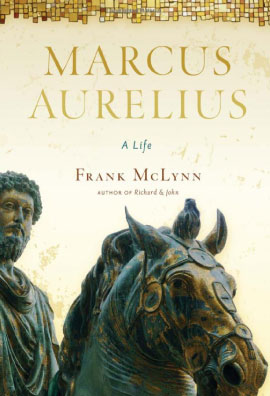
Marcus Aurelius: A Life by Frank McLynn

The legendary slave rebellion of Spartacus has yielded a relatively thin book by Strauss but it is an opportunity for me to get a fresh interpretation of “Roman COIN” (as if Caesar were not clear enough about how Romans dealt with insurgency in his Commentaries). Marcus Aurelius too has acheived almost mythic status, the stoic philosopher-Emperor who is the gold standard to whom other rulers are compared, and frequently found wanting.

Not sure when I will get to these…into the antilibrary pile they go 🙂


Switch to our mobile site