zenpundit.com » authors

Archive for the ‘authors’ Category

On the Mythic and the Historic

Thursday, February 3rd, 2011

My amigo Sean Meade ponders:

Notes: The Problem with Sparta

So here are some of the ideas and notes, for posterity.The Problem with Sparta (and Greece)

References
300 (original graphic novel by Frank Miller and better-known movie)
Gates of Fire, Steven Pressfield
The Peloponnesian War, Thucydides
A War Like No Other, Victor Davis Hanson
Sailing the Wine-Dark Sea, Thomas Cahill

The fiction glorifies Sparta while the non-fiction is more critical than laudatory. I was struck by how much the fictional Sparta, in three stories I really love, did not match the history I’d been studying.

Did Pressfield make his story more palatable to his readership by soft-pedaling Helot slavery, radical conservatism and aristocracy, oligarchy and homosexuality and pederasty?

We moderns are very critical of the real, historical Sparta. Insofar as it stands in for Greece in the fiction above, it’s an inaccurate portrayal. To say nothing of all the problems with our view of the Golden Age of Athens…

Ah, the tension between history and myth. 

Admiration for ancient Sparta was imprinted into Western culture because Sparta’s Athenian apologists, including Xenophon but above all Plato, left behind a deep intellectual legacy that includes a romantic idealization of Sparta that contrasts sharply with the criticisms leveled by Thucydides against Athens in The Peloponnesian War. The Melian Dialogue remains a searing indictment against Athens 2,500 years later but no equivalent vignette tells the tale of the Helots living under the reign of terror of the Spartan Krypteia. Plato’s Republic upholds oligarchic authoritarianism inspired by Sparta as utopia while Athenian democracy is remembered partly for the political murder of Socrates and the folly of the expedition to Syracuse. Somehow, ancient Athens lost the historical P.R. war to a rival whose xenophobic, cruel, anti-intellectual and at times, genuinely creepy polis struck other Greeks as alien and disturbing, no matter how much Sparta’s superb prowess at arms might be applauded. 

The fact that the vast majority of the ancient classic texts were lost, or as Dave Schuler likes to note, very selectively preserved and edited – at times, invented – by later peoples with agendas, may account for some of the discrepancy.

The Books Keep Arriving

Thursday, January 27th, 2011

Hey….all right….who keeps ordering these things anyway? 🙂


Michael Collins: The Man Who Made Ireland by Tim Pat Coogan

The Gangs of New York: An Informal History of the Underworld  by Herbert Asbury

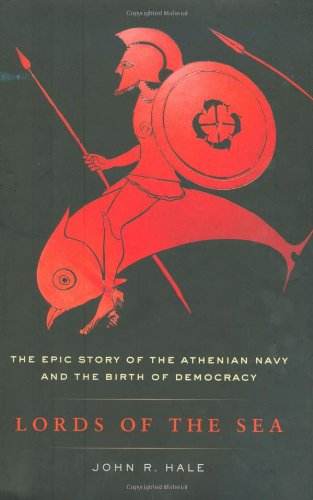
Lords of the Sea: The Epic Story of the Athenian Navy and the Birth of Democracy by John R. Hale

Lighter fare, than usual. The last, on the connection between Athenian thalassocracy and Athenian democracy was a recommendation by blogfriend Eddie.

I really need to call a halt to the manic book-buying until I address the question of….more shelf-space!

Cameron Guest Posts at Jihadology

Monday, January 24th, 2011

Charles Cameron ventures forth to conquer new blogworlds:

GUEST POST: Hitting the Blind-Spot- A Review of Jean-Pierre Filiu’s “Apocalypse in Islam”

Jean-Pierre Filiu’s book, Apocalypse in Islam (University of California Press, 2011) makes a crucially important contribution to our understanding of current events – it illuminates not just one but a cluster of closely-related blind-spots in our current thinking, and it does so with scholarship and verve.

Al-Qaida’s interest in acquiring nuclear weapons – and Iran’s – and the safety of Pakistan’s nuclear materiel – and the situation in Jerusalem – depending how you count ‘em, there are a half dozen or so glaring world problems where one spark in the Mahdist underbrush might transform a critical situation. And yet as Ali Allawi put it in his talk to the Jamestown Foundation on Mahdism in Iraq a few years back, Mahdists ferments still tend to be “below our radar”.

People are always talking about unintended consequences: might I suggest that blind-spots are where unintended consequences come from – and offer some background on apocalyptic, before proceeding to discuss Filiu’s contribution?

We already have a tendency to dismiss religious drivers in considering current events, having concluded in many cases that religion is passé for the serious-minded types who populate diplomatic, military and governmental bureaucracies world-wide – and we are even more reluctant to focus on anyone who talks about the Last Days and Final Judgment, despite the presence of both in the faith statements and scriptures of both Islam and Christianity. We think vaguely of cartoons of bearded and bedraggled men with sandwich boards declaring The End is Nigh, and move along to something more easily understood, something conveniently quantitative like the number of centrifuges unaffected by Stuxnet in Iran, or purely hypothetical, like the association of Taliban and Al Qaida in Afghanistan.

Narcos Over the Border

Friday, January 21st, 2011

Narcos Over the Border: Gangs, Cartels and Mercenaries by Dr. Robert J. Bunker (Ed.)

Just received a review copy courtesy of Dr. Bunker and James Driscoll of Taylor & Francis – could not have arrived at a better time given several research projects in which I am engaged.

The 237 page, heavily footnoted, book is organized into three sections: Organization and Technology Use by the narcos networks, Silver or Lead on their carrot and stick infiltration/intimidation of civil society and the state apparatus, and Response Strategies for the opponents of the cartels. Bunker’s co-authors Matt Begert, Pamela Bunker, Lisa Campbell, Paul Kan, Alberto Melis, Luz Nagle, John Sullivan, Graham Turbiville, Jr., Phil Wiliams and Sarah Womer bring an array of critical perspectives to the table from academia, law enforcement, intelligence, defense and security fields as researchers and practitioners.

Looks good – will get a full review here at a later date, but a work that will definitely of interest to those readers focusing on national security, COIN, 4GW, irregular or Hybrid war, terrorism, transnational organized crime and black globalization.

Best Books About Reagan

Thursday, January 20th, 2011


From my colleague, Lexington Green at Chicago Boyz:

Best Books About Reagan

ChicagoBoyz will be hosting a roundtable discussion to celebrate the centenary of the birth of President Reagan, the week of February 6th 2011.

In the meantime I would like to get the views of our contributors and readers on what are the best books about Reagan, the Reagan presidency, the Reagan era. Please leave comments with your favorites.

I note that President Obama was recently reading Lou Cannon’s book The Role of a Lifetime, which is supposed to be very good.

I have read and enjoyed several books about Mr. Reagan, his presidency and his era. I will restrict myself to one favorite. If I had to pick one, I would give the palm to Peggy Noonan’s book What I Saw at the Revolution. Used copies are available for a penny. This book captures the impact Mr. Reagan had on our national morale, which is not always captured in other writings about him. I say this despite still being mad at Ms. Noonan about her unforgivably uncritical response to Mr. Obama’s candidacy.

I am currently reading John O’Sullivan’s book, The President, the Pope, and the Prime Minister: Three Who Changed the World. I am about one third done with it and it is excellent.

As I said in the comments section at Chicago Boyz, I concur that Cannon’s The Role of A Lifetime and Noonan are the place to start.

There was a prolific outpouring of memoirs by former members of the Reagan administration in the years during and after his time as president. I think we can even divide the lit into books about (or by, at least nominally) Ronald Reagan and those about his administration.

Here are some of my recs….

On Ronald Reagan:

An American Life: The Autobiography

Reagan: In His Own Hand

The Reagan Diaries

I like starting a subject by looking closely at what they had to say for themselves. Reagan’s diaries and private correspondence put the lie to the “amiable dunce” smear made by Clark Clifford (a decidedly nasty-edged, lawyer-courtier of Democratic presidents who ended his own long public career exposed as a corrupt dotard, thus proving George C. Marshall’s ability to size up a man’s character was inerrant).

On the Reagan Administration:

Inside The National Security Council by Constantine Menges

Unfortunately, I believe this one is out of print. Dr. “Constant Menace” details the intrigue at the NSC and State by officials who were less than committed to Reagan’s foreign policy initiatives, in particular the Contras and SDI. Menges, the late brilliant, often insufferable, old-style neoconservative gets a thumbs up from me for his capacity to infuriate State Department officials and his geostrategically incompetent and socially inept boss, NSC Adviser Col. Bud McFarlane.

Casey by Joseph Persico

Liberal biographer Joe Persico paints a complicated but at times hagiographic picture of his close friend, CIA spymaster and Reagan political adviser, William Casey. Strong emphasis on Casey’s crusade against the USSR, his unprecedented role for a CIA chief in foreign policy and the ideological struggle over the control over Reagan’s foreign policy. I have a great deal of admiration for Bill Casey and wish someone like him were running the IC today. We’d all be a lot better off.

The Triumph of Politics: Why the Reagan Revolution Failed by David Stockman

The mendacious, arrogant and disloyal ex-Congressman David Stockman nevertheless manages to have an array of interesting, insightful, amusing, if unflattering, anecdotes and opinions about key domestic policy players in the early Reagan White House and in the Democratic leadership in Congress, whom Stockman called “the politburo of the welfare state”. While it was Stockman who failed Reagan rather than the reverse, this book is the most interesting memoir by far of the “dissenters” who left the administration under a cloud.

Turmoil & Triumph by George Schultz

This is not an interesting memoir. It is a ponderous, dull tome, which is surprising given Shultz’s critically acclaimed intellect and forceful persona. The reason for inclusion here is that Schultz obviously felt a duty to “set the record straight” about his battles over foreign policy with Cap Weinberger, Bill Casey and several NSC advisers and his memoir contains a wealth of minute detail about US foreign policy and national security. An invaluable resource.

What books on or about Ronald Reagan would you suggest?


Switch to our mobile site