zenpundit.com » authors

Archive for the ‘authors’ Category

Guest Post: Iran or Afghanistan? The Black Flags of Khorasan…

Thursday, September 17th, 2009

Returning as a guest-blogger, Charles Cameron, who is the former Senior Analyst with The Arlington Institute and Principal Researcher with the Center for Millennial Studies at Boston University. The topic is an update on Cameron’s previous cautionary post on the potential implications of an emerging strand of Mahdism among radical Islamists.

( Ed. There will be an update later with two supporting images when I resolve a minor technical issue….)

Iran or Afghanistan? The Black Flags of Khorasan… 

By Charles Cameron.

 i

A couple of days ago I saw a video, posted on YouTube September 12, 2009, titled “The Army Of Imam Mahdi”. It carries the subtitle: “Soon the Army of Imam Mahdi will start its march from Afghanistan towards The Holy Land( Palestine ) and liberate it from the claws of Israel”. I have embedded it for your viewing convenience at the bottom of this post.

This video suggests that I should follow-up on my previous post, “Mahdism in the News” at , in which I noted that the personal representative of Ayatollah Khamenei, the Supreme Jurisprudent of (Shi’ite) Iran, had issued a call to neighboring and sympathetic nations to a joint mobilization in preparation for the return of the Mahdi.

That was a Shi’ite affair: but Sunni Muslims also await the Mahdi’s arrival, though not as the returning Shi’ite Twelfth Imam — and this video correspondingly offers us an appropriate parallel to Ali Saeedi’s call — but IMO should not be confused or conflated with it.

ii

I would like to make this much clear at the outset.

It is roughly as likely that the Ayatollah Khamenei would accept a Mahdi from among Al Qaida or the Taliban as it is that Pope Benedict would accept a Christ who staged his Second Coming in support of the fiercely anti-Catholic Rev. Ian Paisley of the Free Presbyterian Church of Ulster.

That’s not a scholarly comparison, by the way — more of a powerful hunch. But I think it needs to be said.

The Imam Mahdi of the Shi’ites is himself their Twelfth Imam, who was born in 869 CE and then “occulted” — hidden from mundane sight — centuries ago, returning among us in the fullness of time. He is Shi’a of the Shi’a, Muhammad ibn Hasan ibn ‘Ali, the last and greatest in the great Shi’ite lineage of the Twelve Imams.

iii

It was Joel Richardson’s blog at that first alerted me to this video (hat-tip, Joel). He writes:

This is the first time that I have seen solid proof that al-Qaeda and the Taliban is thoroughly guided by Islam’s demonic eschatology. For those who claim that Mahdism is only held by Shi’a, take note that it is a Sunni group that has created this thoroughly Mahdist video and not Shi’a. Al_Qaeda and the Taliban literally views themselves collectively as the Mahdi’s army carrying the Black Flags that will march to Jerusalem to “liberate” it from the Jews. This is a full blown Al-Qaeda / Mahdi Army recruitment video.

I think that’s a bit of an overstatement. I’d say more cautiously that this is evidence that al-Qaeda and the Taliban can be construed in light of Sunni Mahdist expectation, and may view themselves as the Mahdi’s army — and definitely shows that a Mahdist current is at work in some Sunni circles.

The sheikh who is quoted in the video is from Trinidad.

In a more far reaching post at , Joel also claims that the video was ” released under the al-Sahab label” — the al-Sahab logo appears on some of the footage, but the video itself is not from al-Sahab as far as I can determine — and his subtitle, which may have been provided for him by a WND editor, claims the video contains “footage confirming unity of apocalyptic Muslims”. Given Joel’s reference in the same post to the recent Iranian “mobilization” call on which my own earlier post was also based, I think it is important to emphasize:

(a) that while Sunni and Shi’ite Muslims may both be in expectation of the Mahdi, and may indeed both (sometimes) draw on ahadith about his army coming with black flags out of Khorasan, this does not mean that the two streams of Mahdism can be lumped together as a single movement, and

(b) that this video appears to be a production of sympathizers with the Taliban, rather than an Al-Q / al-Sahab production.

iv

The key passage in the video is a discourse attributed to Sufi Shayk Imran Nazar Hossein, who says:

The true messiah will destroy the false messiah. And when that happens then a Muslim army will liberate the Holy Land. The Prophet said, when you see the black flags coming from the direction of Khurasan, go and join that army. That army has already started its march. They know it, and that’s why they demonize as a terrorist anyone, anyone who supports that army. That army will liberate every single territory in a straight line until it reaches Jerusalem said Muhammad (as). At the heart of Khorasan is Afghanistan, and that’s why they have occupied Afghanistan. When that army liberates every territory on its way to Jerusalem, there will be in that army Imam al-Mahdi, and so the liberation from oppression in the Holy Land is not going to come about through any negotiations…

This would appear to be the Islamic scholar Imran Nazar Hosein (to use the spelling of his name used on the website dedicated to his work ), and the video clip that shows him was very likely taken some years back.

His biography can be found here. He appears to have had a distinguished career, including a period spent as Director of Islamic Studies for the Joint Committee of Muslim Organizations of Greater New York, and is the author of Jerusalem in the Qur’an – An Islamic View of the Destiny of Jerusalem.

v

The video includes clips of various mujahideen firing weapons and practicing martial arts, including one with shots of riders with a black flag…

and an image of the Dome of the Rock in Jerusalem (Baitul Maqdas), which appears to be their final goal.

vi

The hadith about the “black flags of Khorasan” mentioned here are, as I understand it, not strongly supported in the hadith literature, but they are available for quotation by those who wish to suggest that the Mahdist army will come from the general area now known as Afghanistan — or Iran, for that matter — a suggestion that gains interest as Afghanistan — or Iran — gains in geopolitical prominence…

Some quick indicators:

Sheikh Salman al-Oadah — once imprisoned for criticizing the Saudi regime and now one of its approved religious spokesmen — writes:

The hadith about the army with black banners coming out of Khorasan has two chains of transmission, but both are weak and cannot be authenticated. If a Muslim believes in this hadith, he believes in something false. Anyone who cares about his religion and belief should avoid heading towards falsehood.

Some people have used this hadith to support their claim that the Mahdi is from the family of al-Abbas and that the Mahdi is from of the Abbasid dynasty. There were Abbasid Caliphs who went by the name al-Mahdi.

The banners of the Abbasid State were black. It is not hard to see how this weak hadith might have been fabricated or at least tampered with to support the Abbasid cause.

That’s the negative view, to be set against significant Sunni jihadist currents that find the hadith useful.

As David Cook notes in his Contemporary Muslim Apocalyptic Literature, p. 173-74), Abdullah Azzam, bin Laden’s mentor, “popularized the position of Afghanistan as the messianic precursor to the future liberation of Palestine” in his book, From Kabul to Jerusalem. Cook also quotes an Egyptian apocalyptic author, Amin Jamal al-Din, as identifying the Taliban with the black flags and the Mahdi’s awaited campaign.

And while Ali-Saeedi, the spokesman for Khamenei, did not mention the Khorasan and black flag hadith in his call for a general mobilization in preparation for the Mahdi’s coming, Cook notes that the hadith in question have earlier been applied to the Iranian revolution of the 1980s under the Ayatollah Ruhollah Khomeini.

Timothy Furnish, in his book Holiest Wars: Islamic Manhdis, Their Jihads, and Osama bin Laden, discusses the Khorasan (“today eastern Iran and western Afghanistan”) and “black flags” hadith together with various Western theses as to their historicity, concluding that “the mass of hadiths” in general functions like a marketplace in which there is “a saying of the Prophet available off the shelf as a legitimizing agent for just about any position”.

Combine that with the apocalyptic habit of associating apocalyptic texts with events in today’s news, and you have a field ripe for what millennial historian Richard Landes calls “semeiotic arousal”.

vii

The video itself:
Book Review: The Audacity of Help

Monday, September 14th, 2009

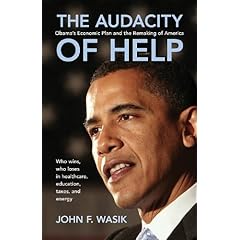
The Audacity of Help: Obama’s Economic Plan and the Remaking of America by John F. Wasik

Initially, I was reluctant to accept a review copy of The Audacity of Help because I blog primarily on military and national security issues and straight domestic politics posts tends to attract tiresome, angry, commenters who type in caps ( I do not want traffic, I want influential readers). Nor am I an expert on business or finance issues, Wasik’s forte as a journalist and an area best judged from a position of extensive personal experience, which I do not have. John Wasik though, after I checked him out, impressed me as an evenhanded and experienced reporter, so I accepted.

If you are a “political blogger”, Left or Right, order a copy of The Audacity of Help today, it’s an invaluable, factual “scorecard” on the domestic agenda of the administration of President Barack Obama, especially the outcome stimulus package and the positions of all the players, executive vs. legislative, promises vs. reality and Democrat vs. Republican.  The appendix and bibliographic resources alone will be fodder for many a blog post. Wasik offers a theme of “cui bono” from policy status quo or change that is refreshing and informative (and I say this as someone who would much rather write about Bernard Fall, the Haqqani Network or Herodotus than how Obamacare will impact senior citizens or the elections in 2010) accompanied by various textual, factoid, “asides” that extend each chapter.

Here are the chapters of The Audacity of Help, which runs 202 pages:

1. First Aid and Income Boosters

2. Rebuilding Infrastructure, Creating Jobs,

3. Bottom Up Economics: Small-Business Benefits

4. Job Creators and the Green Collar Bonus

5. Get Smarter

6. Borrowing Wisely

7. Restoring Home Ownership: Keeping the Dream Alive

8. Health Care Reform

9. Unifinished Business: Long Range Goals in Entitlement Reform

10. The Road Ahead

I don’t agree with everything Wasik has to say in terms of policy but Wasik is measured in his praise and criticism on all parties and is ultimately, a fiscal realist (“How will all this money be paid back?”). He gives a fair hearing before offering his own opinions and policy recommendations toward the conclusion of the chapters which allows me to give Wasik the ultimate compliment to a writer of non-fiction:

The Audacty of Help is useful.

Apocalyptic Vision: Guest Post by Charles Cameron

Thursday, August 27th, 2009

I am pleased to have as a guest-blogger, Charles Cameron, who is the former Senior Analyst with The Arlington Institute and Principal Researcher with the Center for Millennial Studies at Boston University. He specializes in forensic theology, with a deep interest in millennial, eschatological and apocalyptic religious sects of all stripes.

MAHDISM IN THE NEWS

by Charles Cameron

I.

What’s this about the Mahdi and a call for Islamic mobilization?

Al-Arabiya carried what seems to me to be a significant article about the Mahdi, Islam’s end-times savior on August 17th. The report stated that the personal representative of the Supreme Leader was calling on Iran’s neighboring states “to mobilize their forces in preparation for the coming of the savior of Islam”.

Ayatollah Ali Khamenei’s spokesman, Ali Saeedi, said countries like Turkey, Iraq, Lebanon, Pakistan and Afghanistan should gather together all their forces in order to make drastic changes to prepare for the coming of al-Mahdi al-Montazar, Arabic for “the awaited guided one.”

“We still have a long way to go in order to achieve this. We have to train honest forces that can stop the obstacles that may hinder the coming of the Mahdi like the United States and Israel,” Saeedi said in statement posted by the Iranian Labor News Agency (ILNA).

Muslims must unite for Islam’s Savior: Iran, Al-Arabiya, Monday, 17 August 2009

That’s a call to arms, put out by a Shi’ite nation state, and addressed to Sunni and Shi’ite alike — and it drew almost no attention in the western press.We can safely disregard it, right? After all, Mahdism is a Shi’ite phenomenon, and whereas Iran has a conservative rearguard that expects the Mahdi’s soon-coming along with President Ahmadinejad, the Sunni world has no time for that kind of thing.

Except that bin Laden seems to share the apocalyptic expectation, if not the exclusively Shi’ite details — the view that the Mahdi has already been born once, into a Shi’ite family, and is presently in occultation prior to his soon return.

So I am not arguing that we should worry too much about Turkey, Iraq, Lebanon, Pakistan and Afghanistan all deciding to join forces with the Iranian Republican Guard any time soon. But I am arguing that we should be alert to Mahdism — and more generally, Messianism — as a contemporary driver.

II.

It so happens that Steve Coll was on the radio again this week, in a rebroadcast of a talk he gave in April, and here’s some of what he had to say on the subject of Osama bin Laden:

It’s a mistake to see him entirely as a political, or even to some extent mostly, as a political leader. He has a purchase on these grievances and he understands them and I’m sure he feels them — but he’s also a millenarian: he believes that he’s been called by God to wage a war that will only conclude at the end of time. He hasn’t built a political movement, he doesn’t offer any social services, he doesn’t build a hospital — he thinks he’s fighting until the end of time, that he’s carrying out a narrative that’s pre-ordained, and that his role is to awaken God’s followers to their righteous role so that they can pass to the next phase. And so there is this interaction of millenarian, apocalyptic thinking on the one hand — which justifies all violence — and this sort of terrestrial political critique on the other. And what happens when you read his statements in the west is that, well, everyone can understand the political critique, so that gets all the attention — and people’s eyes glaze over at the rest because it’s a little bit hard to digest. But when you read it in full it’s a very, very important aspect of why he’s doing what he’s doing and who he thinks he is.

Steve Coll, talking about his book The Bin Ladens for the World Affairs Council.

Should that surprise us?

Not if we noted Bin Laden’s quotation of the “Gharqad tree hadith” — which specifies the nature of the end times conflict:

Doomsday shall not come until Muslims fight Jews. A Jew would be hiding behind a tree or a stone. The tree or the stone would say, O Muslim, O subject of God, there is a Jew behind me come and kill him. The only exception is [Gharqad] tree is a tree that belongs to Jews.

and his comment:

Whoever claims that there is lasting peace with the Jews is a disbeliever of what the prophet, may the peace and blessings of God upon him, said. Our conflict with the enemies of Islam will continue until Doomsday.

No definite timeline is given, and bin Laden also remarks that his father waited forty years for the Mahdi — and indeed set aside $12 million to support him on his arrival — but the appeal is to end-times expectation,

FWIW, this isn’t the only time bin Laden has quoted the Gharqad tree hadith, and it is also quoted in the Charter of the Hamas — for more on the topic, see Anne Marie Oliver and Paul Steinberg, The Road to Martyrs’ Square, pp 19-21, and watch this chilling MEMRI video from of Sheikh Muhammad Al-Arifi, speaking on Al Aqsa TV, September 2008.

III.

Why is eschatological or apocalyptic rhetoric significant?

It is an accelerant. Simply put, it is a force-multiplier, acting on morale via the sphere of religion, by providing divine sanction for violence — zeal with a deadline.
.
Apocalyptic expectation is in part the expectation that “all the injustices of the old world will be put right” very soon, as Damian Thompson noted, and it creates “an especially potent form of charismatic authority, one that rubs off on ordinary believers as well as the prophet.” This extraordinary empowerment of the individual believer comes about because “foreknowledge about one of the most important subjects imaginable — the fate of the planet — creates a special, even intimate, bond between those who share it”:

In every case, the most striking feature of the millennial theodicy is the contrast between present misery and the glory to come: the latter justifies and makes tolerable the formed.

It may also justify and make tolerable the use of violence in the lead-up to apocalypse, as it clearly does in both the Shi’ite call to arms and the Sunni hadith quoted above. And furthermore, in all these cases the misery is the fruit of sin, whereas the glory is the glory of God.

The nature of millennial expectation is conditioned by culture, yet cross-cultural in its basic patterns, and transcendent in its authority. Thompson goes on to note that “the anticipation of violence does not constitute a cost of millenarianism, since the blood being shed will be that of the unsaved” — and Kerry Noble put the point quite succinctly in his retrospective account of a Christian millenarian movement he later left:

I was not looking forward to the coming war, but I was looking forward to the Kingdom of God that was to follow. That’s how many of us rationalized being soldiers of God. We wanted peace, but if purging had to precede peace, then let the purging begin.

Ahmadinejad or bin Laden might say much the same.

IV.

Who is awake to this pervasive strand of eschatological thinking, among the Shi’a, among the Sunni, and among ourselves?

I cannot speak for the intelligence community, except to say that a rational, secular analyst monitoring these matters is liable to note the “blips” of open source intel but miss the fire that underlies them. Or again, as Steve Coll put it,

people’s eyes glaze over at the rest because it’s a little bit hard to digest.

That’s not a feature — that’s a bug.

Some on the Christian right get it, because they live in the apocalyptic realm themselves. The two Joels, Rosenberg (author of Epicenter) and Richardson (author of The Islamic Antichrist), were among the few to blog Ali Saeedi’s comments, with Joel Rosenberg picking up on a piece on WND that quotes Joel Richardson, whose own blog,  Joel’s Trumpet, monitors Islamic apocalyptic closely from a Christian apocalyptic perspective.

But short of actual apocalyptic belief of one’s own — which will generally cause one to disparage if not dismiss the equivalent apocalypses of others — it takes an ear open to the whisperings of myth and dream, a mind open to the logic of music and poetry to understand such thinking, such imaginings.

Michael Vlahos of Johns Hopkins, the author of  Fighting Identity: Sacred War and World Change, certainly gets it, noting that 9/11 was the work of Holy Warriors “passionately steeped in ancient Muslim apocalyptic” — and that we responded “with out own brand of American apocalyptic”. Daniel Benjamin and Steven Simon, senior members of Clinton’s National Security Council get it — noting in their book, The Age of Sacred Terror, that “so much of what was heard from al-Qaeda after the attacks sounded to Americans like gibberish that many chords of the apocalypse were missed.”
Ali Allawi knows it, and dedicated his 2007 talk at the Jamestown Foundation to noting the “under the radar” existence and significance of Mahdist millennialism in Iraq.

But who else?

V.

When the overtly millennial year two thousand CE was approaching, Boston University hosted the Center or Millennial Studies, brainchild of Richard Landes of BU and Stephen O’Leary of USC, and for almost a decade scholars gathered for conferences to share the commonalities and differences between millennial movements from before the birth of Christ to the coming century and beyond.

When the roll-over to 2000 passed without major apocalyptic incident, the Center closed — but the millennial season was not over, it has only just begun.

Just this month I saw a “birther” — someone who believes President Obama was born in Kenya, and is thus not eligible to be president of the United States — tying that position in with Joel Richardson’s “middle eastern” antichrist: apocalyptic fervor once again enhancing a political stance. There will be more…

We will keep seeing millennial outpourings of zeal — and perhaps, though not always, violence — at least until 2012, when Mayan calendar enthusiasts (and apparently some readers of the jihadist online magazine, Jihad Recollections, issue 3) expect apocalyptic changes. And if the world staggers through to 2013 then at least to 2033, when many Christians will no doubt wish to celebrate the 2000th anniversary of the crucifixion and resurrection of their Savior. And should that not suffice for an ending of an age, at least till the turn of the next Islamic century in 1500 AH or 2076 CE and arrival of that century’s mujaddid or “reformer”. Or indeed the climactic battle between Islam (represented by the Mahdi) and Buddhism, predicted, curiously enough, in one of the Dalai Lama’s preferred texts — the Kalachakra or Wheel of Time Tantra — to take place in 2424 CE..

VI.

Perhaps we should take a hint from the Kalachakra, which in addition to positing an end times war, suggests that this is no more than a “a metaphor for the inner battle of deep blissful awareness … against unawareness and destructive behavior”. Gandhi said much the same about the battle of Kurukshetra in the Bhagavad Gita.

One might wish that all apocalyptic believers felt that way: they don’t.

Three Short Reviews

Wednesday, August 26th, 2009


Emergence: The Connected Lives of Ants, Brains, Cities, and Software by Steven Johnson

This classic popular text from 2001 still holds up well as an introduction into the phenomena of emergence and the nature of self-organizing systems. Johnsaon uses a rich array of analogies and historical anecdotes to bring the reader to an understanding how bottom-up, “blind”, systems work and the principles behind them. Highly readable and next to no jargon. Probably due soon for an updated edition though, given the scientific advances in research in network and complexity studies.

How Rome Fell: Death of a Superpower by Adrian Goldsworthy

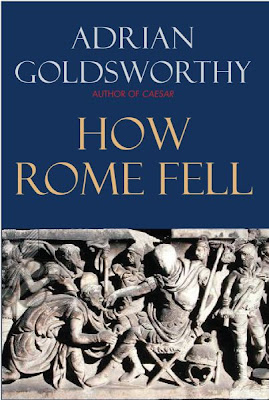
Superb overview of the decline and fall of Rome with a rejection of the traditional assertions of causations for the end of the Roman empire ( Barbarians, Christianity etc.). Goldsworthy also sharply criticizes the popular idea among postmodern classicists today that the Roman Empire was “really” as strong during the fourth and fifth centuries as it was during the golden age of philosopher-warrior-emperor Marcus Aurelius. Or that there was no fall of the empire at all, just a gentle “transformation” into something new. Goldsworthy discusses the likelihood of Late antquity  “paper legions” of Roman armies which, in any event, scarcely resembled in elan, tactics or fighting strength the ones that Julius Caesar wielded in Gaul.  A tour de force marred only by a weird epilogue that ranges from pedestrian to ( in it’s last sentences) truly awful – was it it tacked on as an afterthought? Did the editor of the rest of the book die before it was completed? Regardless, How Rome Fell is a worthy addition to an collection of popular ancient histories.

The War of Art: Break Through the Blocks and Win Your Inner Creative Battles by Steven Pressfield

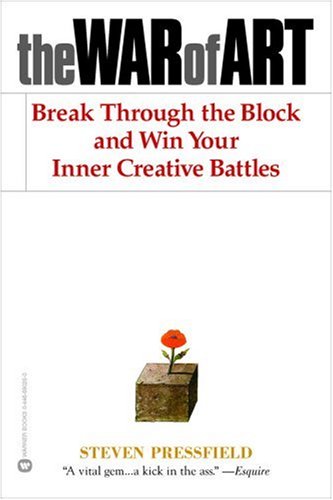
A rare, nonfiction book by novelist and blogger Steven Pressfield. The War of Art is a book that I strongly recommend to aspiring writers ( which includes most bloggers) and other people pursuing dreams, not because it is brilliant but because it is profound. Utilizing select personal vignettes and other anecdotes, Pressfield distills in everyday language the essence of what creative people need to understand if they are to succeed – concepts of “resistance”, which seductively undermine your efforts,  and being a “professional”, which is the mindset that will get you there.

Most of the readers of this blog are interested in military affairs to some extent so I will use this reference to explain why I read The War of Art from cover to cover. Pressfield captures the difference in what Col. John Boyd called the question of “To be or to do. Which way will you go?”.  By Boyd’s definition, Pressfield is a doer.

Steven Pressfield blogs on The War of Art of writing every Wednesday.

The Other Prince of Darkness

Wednesday, August 19th, 2009

Robert D. Novak, 1931 -2009

During the Reagan era, two conservatives shared the title “the Prince of Darkness” as an epithet from liberal Democrats and Washington insiders. The first was nominal Democrat turned Reagan administration assistant secretary of Defense Richard Perle, a neoconservative activist who was castigated for his ultra-hardline anti-Soviet views and skepticism about the value of arms control. The second was veteran Chicago Sun-Times reporter and columnist Robert “Bob” Novak, who passed away today at age 78.

While Novak shared many of Perle’s foreign policy views regarding the malevolence of the Soviet Union and Henry Kissinger and was (with Jude Wanniski) a firey media advocate for the emerging school of  Supply-Side economics, what made him and the Evans & Novak column a political force to be reckoned with was that Bob Novak was a dogged, old-fashioned, working reporter who regularly unearthed new information from his vast collection of sources. Most people under thirty only know of Bob Novak from the Valerie Plame affair, which began in Novak’s column,but Robert Novak had been creating havoc for politicians, and not just liberal ones, for decades:

The fact is that Novak, as he would disclose in his autobiography, actually admired very few politicians. He wrote that he found the first politicians he covered less impressive than the athletic coaches he had covered as a young reporter — “an impression of the political class that did not change appreciably in a half-century of sustained contact.”But then, many big-time politicians didn’t like Novak. Pat Buchanan relates a priceless story of being with Richard Nixon in the mid-’60s in a high-school gym in Indiana. Nixon peeked through the stage curtain, finding Novak in the first row of the press section. “Look at him,” Nixon commanded. “That’s Bob Novak. That’s the enemy.”

Not only did I read Novak growing up ( later I realized that Novak would shoehorn his pet theories on to the facts he uncovered regardless of whether it made any sense, the facts though, were always useful) but I watched him pioneer the Left vs. Right shoutfest template on CNN’s “Crossfire”, first sparring with Tom Braden then, more famously, with Michael Kinsley. When Novak did it, the concept was refreshing because the whole idea of a show that actually had political balance by including conservatives on equal terms with liberal talking heads was revolutionary at the time. Unfortunately, when Crossfire went from a clever niche on a feisty cable news station to a transmogrified, dumbed-down, infotainment as an industry standard, a lot of damage was done to public discourse and reportedly, Novak shared that view to an extent ( though he also cashed the checks – CNN helped make Robert Novak exceptionally wealthy).

Robert Novak represented the last of a generation of hard-nosed reporters who learned journalism as a craft rather than as a product of graduate school theories, who could come from any ( but usually modest) background rather than having a distinctly “bicoastal” cultural worldview and a ranking system based on what “good school” you attended. The news business, I note, has not prospered from becoming more insular.

The media could use more Robert Novaks.

ADDENDUM:

I see Lexington Green beat me to the punch with his obit post.


Switch to our mobile site