Seeing Like A State
Sunday, January 2nd, 2011Liberal-left economist Brad DeLong knew his Austrian economics better than the author of Seeing Like a State did. Amusing.
Hat tip to John Hagel.
Liberal-left economist Brad DeLong knew his Austrian economics better than the author of Seeing Like a State did. Amusing.
Hat tip to John Hagel.
[ by Charles Cameron ]
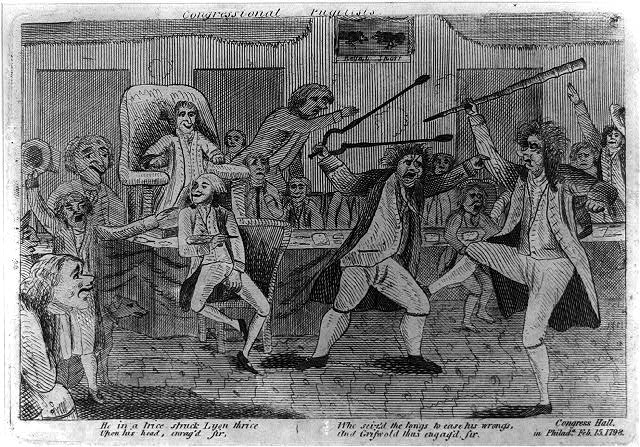
Reps. Roger Griswold of Connecticut and Matthew Lyon of Vermont practice politics by means of hickory stick and tongs in Congress Hall, 1798
It’s always interesting to watch the way one thing morphs into another, and von Clausewitz’ formulation that war is “a mere continuation of politics by other means” is instructively illustrated in the gallery of a dozen photos on the CBS News site titled Best Parliamentary Brawls of 2010.
Ukraine, Indonesia, Italy, S Korea, Nigeria, Taiwan, Turkey… that’s a pretty fair slice of gepopolitics!
Happy New Year!
image above from the Prints and Photographs Division, Library of Congress.
[ by Charles Cameron ]
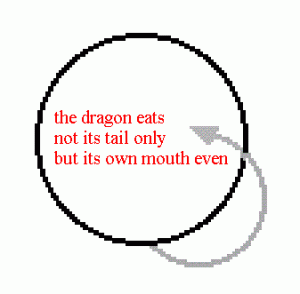
Since my “HipBone” analytical approach, like the HipBone Games which inspired it, is based on networks of linkages between one “representable” (concept, fact, quote, anecdote, sound, musical phrase, image, video clip, statistic, cultural form, person) and another, there’s a special place in my analytic thinking for those representables which are self-referential – the category that gave rise to Douglas Hofstadter’s celebrated book, Gödel, Escher, Bach.
Indeed, I have a special glyph that I use in my games to notate ideas that are self-referential:
1
Okay, enough poetry for now.
The WikiLeaks business gives rise to one such self-referential puzzle – the one famously minted in classical times under the Latin tag: Quis custodiet ipsos custodes?
Just how you tend to interpret the tag in English may depend on whether you read “custodes” as “guards” or “watchmen” – who shall guard the guards, who shall oversee the overseers, who shall watch over the watchmen…
But what does this have to do with WikiLeaks?
2
Let me rephrase it: Who will leak the leakers?
I mean, if transparency is so universal a good, will Julian Assange drop his encryption and allow us all (IC and foreign equivalents included) to access WikiLeaks databases at any time, leaking whatever we think might be of interest without consulting him?
Or is the point that some opacity, some secrecy is good — and Julian Assange believes he knows which secrecy that is, and can be trusted to reveal that which should be revealed and keep secret that which should be kept secret?
3
Perhaps the WikiLeaks paradox is a koan, eh Zen?

Colonel David Maxwell, who has probably forgotten more about North Korea than I ever knew in the first place, has an insightful analytical piece up at SWJ Blog:
Irregular Warfare on the Korean Peninsula
….This paper is written with the concepts of “military misfortune” in mind. In Eliot Cohen and John Gooch’s seminal work on military failures, they determined that militaries are generally unsuccessful for three reasons: the failure to
learn, the failure to adapt, and the failure to anticipate. This paper will recommend that the ROK-US alliance learn from operations in Afghanistan and Iraq, adapt Irregular Warfare concepts to the security challenges on the Korean Peninsula and anticipate the collapse of the Kim Family Regime and the complex, irregular threats that collapse will bring.
The conventional wisdom would postulate that the worse case situation would be an attack by the north Korean military because surely the devastation and widespread humanitarian suffering as well as global economic impact would be on a scale that would far exceed any crisis that has occurred since the end of World War II. While that could very well be the case, there is little doubt about the military outcome of an attack by the north on the South and its allies and that would be the destruction of the north Korean People’s Army and the Kim Family Regime. Victory will surely be in the South’s favor; however, this paper will argue that the real worse case scenario comes from dealing with the aftermath; either post-regime collapse or post-conflict.
Maxwell’s operative assumptions are particularly good. I especially like:
….The fifth and final assumption is that while some planning has taken place to deal with north Korean instability and the effects of Kim Family Regime collapse, there has been insufficient preparation for collapse. Furthermore, in addition to planning for collapse, actiocan and should be taken prior to collapse in order to mitigate the conditions and deal with the effects of collapse of the Kim Family Regime. Unfortunately, despite some planning efforts tocounter specific irregular threats, the ROK, and the US in particular, has been distracted by the very real and dangerous threat of north Korean nuclear weapons and delivery capabilitiesproliferation of same while at the same time ensuring deterrence of an attack by the north. Deterrence is paramount and the nuclear problem is a critical international problem; however, successful deterrence over time will likely result in the eventual collapse of the regime and the associated security and humanitarian crises that it will bring.
In other words, not only are US and ROK policy makers not preparing for the most probable second and third order effects of a North Korean collapse scenario, but the status quo on the Korean penninsula represents a wicked problem that is essentially a trajectory toward a worst case scenario collapse.
” A communication: magnificently our great Emperor soothes and pacifies China and the foreign countries, regarding all with the same kindness. If there is profit, then he shares it with the peoples of the world; if there is harm, then he removes it on behalf of the world. This is because he takes the mind of heaven and earth as his mind.” – Lin Zixu
I am no Sinologist, so I am interested in how professional China-watchers interpret this signal. Here’s my two cents:
Dr. Thomas P.M. Barnett teamed up with two highly-regarded (inside Chinese elite circles) pundits John Milligan-Whyte and Dai Min to offer a “grand strategic rebalancing” of the Sino-American relationship for the 21st century, which ran in The People’s Daily, the official newspaper of the Central Committee of the Communist Party of China. Agree or disagree with the particulars, an impressive and timely move on Tom’s part.
An excerpt – but you should really read the whole thing:
….When agreed upon by the presidents of both nations through an “executive agreement” not subject to U.S. Senate ratification, it will promote U.S. economic recovery, increase U.S. exports to China, create 12 million US jobs, balance China-US trade as well as reduce U.S. government deficits and debt. Furthermore, it will stabilize the U.S. dollar, global currency and bond markets. It will also enable reform of international institutions, cooperative climate change remediation, international trade, global security breakthroughs as well as facilitate the economic progress of developed and developing economies, the stabilization and rebuilding of failed states and security of sea transport. The essence of the grand strategy is that the United States and China will balance their bilateral trade and never go to war with each other, and the US will refrain from seeking regime change and interference in China’s internal affairs with regard to Taiwan, Tibet, Xinjiang, the Internet, human rights etc. and China will continue its political, legal, economic and human rights reforms.The Taiwan situation will be demilitarized by an informal U.S. presidential moratorium on arms transfers to Taiwan, China’s reduction of strike forces arrayed against it, a reduction of U.S. strike forces arrayed against China and ongoing joint peacekeeping exercises by U.S., Chinese and Taiwan militaries.The strategic uncertainty surrounding nuclear program in Democratic People’s Republic of Korea (DPRK) will be de-escalated by the U.S. eschewing DPRK regime change goals and China ensuring that DPRK adopt policies along the lines of Deng Xiaoping’s economic reforms and terminate its nuclear weapons program. China, U.S., South Korean and other military forces will together ensure maritime safety in the Yellow Sea….
Publication in The People’s Daily does not imply that this blue sky missive is Chinese policy, but it would never have appeared without the sanction of some important figures in China’s government and Communist Party. I am not up to speed on elite Chinese politics, but historically, the Central Committee of the CCP was a much more integrated body of elite decision makers in the sense of mixing PLA generals, state bureaucrats and Party bigwigs than was the Soviet Cenntral Committee, which served in the post-Stalin era to cement CPSU dominance over the military and KGB.
Set aside the merits of this “rebalancing” for later, as some points have not a hope in hell of seeing the light of day,and focus on what it means that the article has appeared at all.
First, I read this as a Mongolfier kind of trial balloon, a plausibly deniable rough draft of a Shanghai Communique 2.0 where Chinese rulers lay out their internal consensus “red line” vital interests and what they will put on the table in return, without any risk of “losing face”.
Secondly, while most of the critical noise will be over the security-military relationship, Taiwan and the total omission of Japan (!), I find the economics the most interesting section. Never before in history have two great powers with so little in common, who were not allies, so deeply entangled themselves in each others economies, basically to the point of no return. This piece tells me China’s leaders realize that a path of confrontation with America or pursuing beggar-thy-neighbor trade policy indefinitely, will mean the destruction of a generation of painfully accumulated surplus wealth, held largely in dollars and treasury securities. China’s elite would rather “double-down” on their bet on America instead of attempting to painfully wrench themselves free and cut their losses by cashing in devalued chips.
That concern is the apex of realism – a good variable to see at a time when nationalistic hubris and hypersensitivity have increasingly been on display in China’s foreign relations with great powers and weak neighbors alike. That kind of realism, other countries can do business with.
What are your thoughts?
ADDENDUM:
Tom has added his briefing slides

Zenpundit is a blog dedicated to exploring the intersections of foreign policy, history, military theory, national security,strategic thinking, futurism, cognition and a number of other esoteric pursuits.
Customized Web Site & Blog Design