zenpundit.com » turkey

Archive for the ‘turkey’ Category

A certain symmetry in malls

Tuesday, November 19th, 2013

[ by Charles Cameron — Gezi Park and Westgate Mall through the lens of the Garden of Good and Evil ]
.

Sheer madness, I know — but there’s a method to it.

I was watching Clint Eastwood‘s brilliantly funny film Midnight in the Garden of Good and Evil last night, and noted with delight the symmtery between two of his Savannah characters — one a gentleman who walks an invisible dog through a park on a leash [upper panel, above], and the other a fellow who attaches house-flies on threads to his lapels, so that he can walk his pets to the nearby diner for breakfast [lower panel]…

**

Here’s where the sheer madness comes in, and the method it encourages.

With symmetry still on a back burner in my mind, I was reading Michael Klare‘s post Planet Tahrir: The Coming Mass Demonstrations against Climate Change (Klare) on Juan Cole‘s blog this morning, and ran across this sentence:

on May 27th, a handful of environmental activists blocked bulldozers sent by the government to level Gezi Park, a tiny oasis of greenery in the heart of Istanbul, and prepare the way for the construction of an upscale mall.

An upscale mall.

Beth Gill‘s essay, Temples of Consumption: Shopping Malls as Secular Cathedrals details a central analogy of our time, and it’s only fitting that the desire to replace an “oasis of greenery” by building an “upscale mall” was what triggered the Gezi Park uprising, just as the destruction of an “upscale mall” in Nairobi, Kenya, was the recent target and mise-en-scene of al-Shabaab’s recent “martyrdom brigade” and their murderous rampage.

The symmetries and ratios of garden and mall, cathedral and mall, construction and destruction, paradise and consumption are thrown up for our consideration by this juxtaposition of Gezi and Westgate.

What can we learn from them?
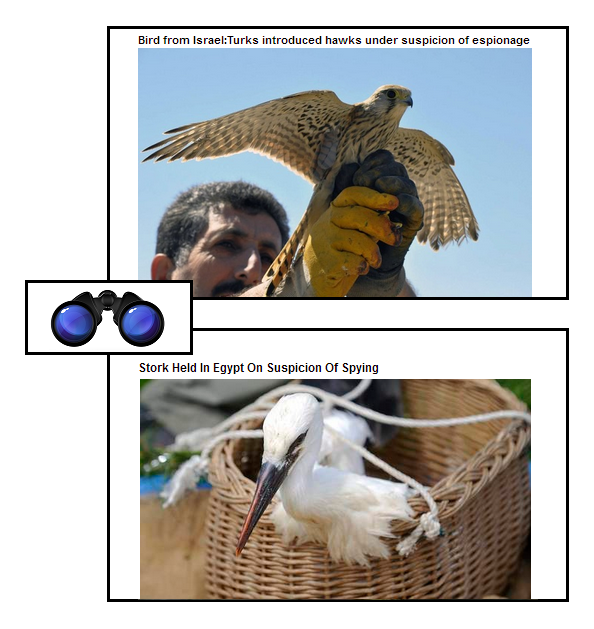
A wildlife DoubleQuote in the Wild, hat-tip Dan Trombly

Sunday, September 1st, 2013

[ by Charles Cameron — carrier pigeons, guilty, 1914, okay — dolphins, jury still out — but these storks and hawks, innocent I do believe ]
.

Sources:

  • Sky News, Stork Held In Egypt On Suspicion Of Spying, 31 August, 2013
  • National Turk, Turks introduced hawks under suspicion of espionage, 27 July, 2013
  • **

    I can claim no responsibility for this DoubleQuote, which I would never have “caught” without Dan Trombly‘s keen eye as manifest in his tweet today:

    For extra bite:

    The stork story concludes with this delicious tid-bit:

    In 2010, a series of shark attacks along Egypt’s Mediterranean coast were blamed on “GPS-controlled sharks” allegedly sent by Israeli security services into Sinai waters.

    Jumping the shark?

    Egypt: The Blame Game

    Tuesday, August 20th, 2013

    [ by Charles Cameron — not the world’s most illuminating game, but popular in some circles ]
    .

    Add these two together, and you get “Zionists and Crusaders” — with a tragic chorus chanting, “told you so”..

    **

    Sources:

  • Zach Novetsky
  • Thomas Hegghammer
  • Turkey and the unicorn

    Monday, June 17th, 2013

    [ by Charles Cameron — i don’t do much in the way of cat pics, so here’s a timely geopolitical unicorn for you ]
    .

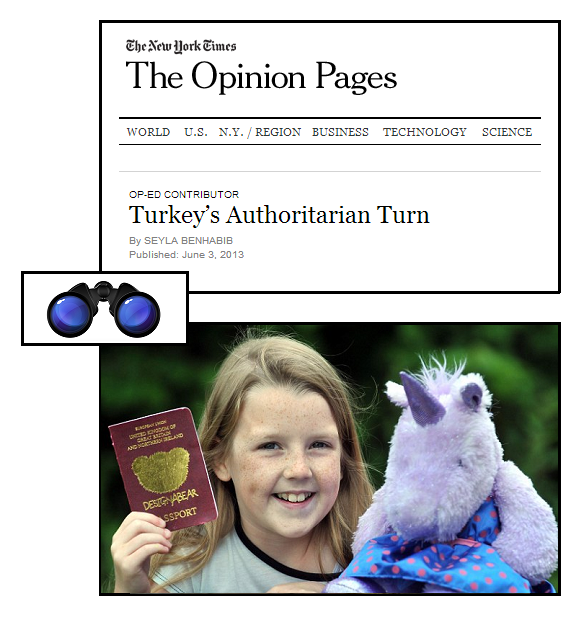
    What with the Whole Wired World looking a bit both “1984” and “Brave New” this week, and with Turkey clearly itching to up its rep as an authoritarian state, you might not think this would be the week a Turkish customs official would stamp a unicorn’s passport…

    What can I tell you? Someone did. A Turkish customs official allowed this young British girl, Emily Harris, into Turkey by stamping her unicorn’s passport.

    **

    If I was Recep Tayyip Erdogan — and I’m not, and unlikely yo be any time soon — I might want to give that man a medal for providing the one news item this week favorable to the Turkish tourist trade — at a time when images of tear gassings in hotels and water cannonades in parks can hardly be helping the country’s image as an attractive place to visit.

    Seriously — Public Diplomacy, one child’s passport at a time.

    And while you’re at it, quit gassing hotels with children in them, will you? It’s barbaric.

    The dervish and the gas mask

    Monday, June 10th, 2013

    [ by Charles Cameron — wall art, sufism and poetry in Istanbul ]
    .


    .

    I wasn’t altogether sure, when Zeynep Tufekci tweeted a stenciled image of a whirling dervish (above, right) the other day, that the dervish was in fact wearing a gas mask. Just the fact that the dervish was showing up on a wall during the events in Turkey was interesting to me — and all the more so since Zeynep pointed out that the accompanying slogan Sen de GelCome, Come Whoever you are is from Jalaluddin Rumi, the great Sufi poet and founder of the Mevlevi order of whirling dervishes.

    As the photo of a dervish whirling in the park (above, left) shows, however — and I only saw it today — the stencil is indeed the iconization — in protest art — of a dervish in gas mask in real-time Istanbul.

    There’s insight to be had there.

    **

    The version of Rumi’s poetry that I first ran across lo these many years ago, and to which I return:

    AJ Arberry, tr, Mystical Poems of Rumi 1
    AJ Arberry, tr, Mystical Poems of Rumi 2

    Rumi’s prose:

    AJ Arberry, tr, Discourses of Rumi

    Rumi’s poetry in the versions that have made this thirteenth century Afghan-born, Persian-speaking resident of Turkey “the best-selling poet in America”:

    Coleman Barks, Rumi: The Big Red Book

    Rumi’s life, as told within Sufi tradition:

    Idries Shah, The Hundred Tales of Wisdom

    Rumi’s life, teachings and poetry, in contemporary context:

    Franklin D. Lewis, Rumi: Past and Present, East and West

    Rumi explored with scholarship and depth:

    Anne-Marie Schimmel, The Triumphant Sun
    Anne-Marie Schimmel, Rumi’s World
    William C Chittick, The Sufi Path of Love
    Fatemeh Keshavarz, Reading Mystical Lyric

    **

    Come, Come Whoever you are


    Switch to our mobile site