[ by Charles Cameron — borders and distinctions from Trump to Revelation, plus one ]
.
Donald Trump‘s “three core principles of real immigration reform”:
1. A nation without borders is not a nation.
**
G Spencer-Brown wrote of his book. Laws of Form, “The theme of this book is that a universe comes into being when a space is severed or taken apart” — or as Heinz Von Foerster rephrased him, “Draw a distinction and a universe comes into being”. Indeed, his book opens with the words:
We take as given the idea of distinction and the idea of indication, and that we cannot make an indication without drawing a distinction.
He writes:
Distinction is perfect continence.
That is to say, a distinction is drawn by arranging a boundary with separate sides so that a point on one side cannot reach the other side without crossing the boundary. For example in a plane a circle draws a distinction.
Similarly, Gregory Bateson defines an idea as “A difference or distinction or news of differences”.
**
Borders are both physical and metaphysical: the border between the physical and the metaphysical passes through human beings, who are themselves both metaphysical and physical.
Borders may thus be heeded or ignored.
Smugglers don’t necessarily ignore them, they may take them very seriously, as do those who police them. Birds, however, ignore them, fishes, lizards, languages..
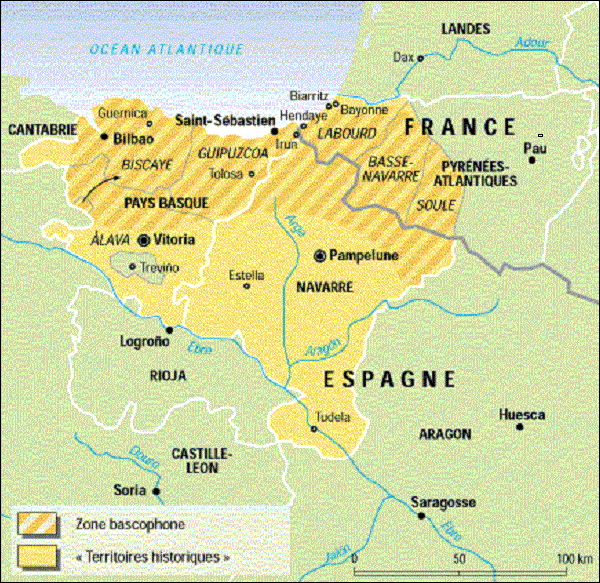
There are would-be states that straddle national borders, as the Basque peoples straddle the border between France and Spain:
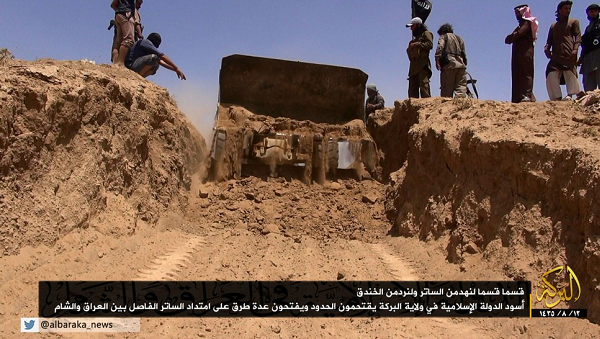
There are also would-be states that literally erase national borders, as in the case of IS bulldozing thw border between Iraq and Syria:
Thus while borders may be tidy in separating one from a second, they are also untidy in straddling them, neither one nor two, yet (like Janus) both.. They are, in short, thresholds, limina. And so wahat we know of liminality applies to them. I have discussed tthis previosuly on Zenpundit in Liminality II: the serious part — suffice it to say here that limiality is a condition that exacerbates, intensifies.
**
The anthropologist Mary Douglas, in her book Purity and Danger: An Analysis of Concepts of Pollution and Taboo, quotes Leviticus 19.19:
You shall keep my statutes. You shall not let your cattle breed with a different kind; you shall not sow your field with two kinds of seed; nor shall there come upon you a garment of cloth made of two kinds of stuff.
Why these disjunctions? Dougles notes the repeated refrain in just such contexts:
Ye shall therefore be holy, for I am holy
and points out that Ronald Knox correctly — if “rather thinly” — translates this:
I am set apart and you must be set apart like me
She then tells us:
Holiness means keeping distinct the categories of creation. It therefore involves correct definition, discrimination and order.
noting that:
The word ‘perversion’ is a significant mistranslation of the rare Hebrew word tebhel, which has as its meaning mixing or confusion.
and concludes
ideas about separating, purifying, demarcating and punishing transgressions have as their main function to impose system on an inherently untidy experience. It is only by exaggerating the difference between within and without, above and below, male and female, with and against, that a semblance of order is created.
**
The upper image, below, is taken from my recent post on Matrioshka cartography, and waas taken in turn from Say goodbye to the weirdest border dispute in the world in the Washington on August 1st..

… while the lower image is from Welcome to Liberland, the World’s Newest Country (Maybe) in the New York Times Magazine, dated Aug 11
**
Lydia Kiesling, in her post Letter of Recommendation: Uzbek in the NYT magazine today, writes:
National borders can be risibly at odds with reality, especially in Central Asia, where Turks, Mongols, Persians and others roved and mingled, where ‘‘Uzbek’’ was, for a time, more of a descriptive antonym of ‘‘Tajik’’ — nomadic versus settled — than an ethnic classification.
And why not?
They are, after all, distinctions drawn in the mind, lines drawn on paper. Thus the Sykes-Picot map:

Sykes was quite clear about the “lines dorawn on paper” part. He is reported to have said:
I should like to draw a line from the e in Acre to the last k in Kirkuk
The map, in other words, is not the territory: the map is a map.
To take another instance of importance in today’s world, the Durand Line:

Not only is the map not the territory in this case — it can be seen, as one-time Afghan president Hamid Karzai said, as “a line of hatred that raised a wall between the two brothers” — Afghanistan and Pakistan.
**
Sympathies which exist across borders can be potent forces for their dissolution. In a poem titled “Their Eyes Confer Fire” written in the 1980s about Basque country, I wrote
We have
little time,
Marie explained,
for those
who, because
it is hard
to draw
lines
across actual
mountains,
carve up
this earth on
paper.
France, Spain:
we disdain
boundaries, borders,
and border guards.
A canny reader noted that the entire poem could be read not as a description of the Basques as they exist in reality, but as a paean to the corpus callosum joining the two hemispheres of the brain — and thus the two modes of cognition of which I so recently wrote.
**
Returning to Lieberland, or Gornja Siga as the locals call it, we learn:
Gornja Siga has come, over the last few months, to assume an outsize role in the imagination of many — not only in Europe, but also in the Middle East and in the United States. Its mere existence as a land unburdened by deed or ruler has become cause for great jubilation. There are few things more uplifting than the promise that we might start over, that we might live in the early days of a better nation. All the most recent states — South Sudan, East Timor, Eritrea — were carved from existing sovereignties in the wake of bitter civil wars. Here, by contrast, is a truly empty parcel. What novel society might be accomplished in a place like this, with no national claim or tenant?
Consider one sentence alone as the key to that “outsize role in the imagination”:
There are few things more uplifting than the promise that we might start over, that we might live in the early days of a better nation.
The apocalyptic yearning here and its kinship with the Amrican dream are hard to miss — it is like a conflation of Matthew 5.14:
A city that is set on an hill cannot be hid.
with Revelation 21.1-2:
And I saw a new heaven and a new earth: for the first heaven and the first earth were passed away; and there was no more sea. And I John saw the holy city, new Jerusalem, coming down from God out of heaven, prepared as a bride adorned for her husband.
**
Plus: