Signs of the times
Monday, January 3rd, 2011[ by Charles Cameron ]
[ by Charles Cameron ]
Long overdue yet exceedingly timely. From one of the great short stories of all time.
2081 Trailer from 2081 on Vimeo.
[ by Charles Cameron ]
It seems my intuition of a Lovecraft connection with WikiLeaks was right, as was Jean’s suggestion that the MARUTUKKU quote is “more specific and extensive and ‘mythological'” than the translations of Enuma Elish she’d found on the net. I dropped Anders Sandberg a line letting him know I’d quoted him in my earlier post, and he graciously responded with this clarification of the mystery:
I think the MARUTUKKU name/description is from the Simon Necronomicon, which did its best to shoehorn mythology into the mythos, and might explain the different translation. Of course, one might argue that that book is a real, a hoax posing as real, real posing as a hoax, or both at the same time.
Anders, currently a staff member with the Future of Humanity Institute at Oxford (which name strikingly reminds me of the Bright Futures Institute in Qom, Oxford’s parallel in the Iranian universe), is also known for his writings on Mage: the Ascension and other role-playing games — see for instance this account of the Asatru in M:tA.
*

The bearded, theremin-wielding mage Steve Burnett [left] also noted the origin of the MARUTUKKU quote in the Simon Necronomicon in his comment on my no-less-bearded mage-friend [right] Bryan Alexander‘s blog Infocult — which features a rich vein of gothic imaginings and runs with the subtitle “We haunt every medium we make”.
Delighted to find an excuse to post that photo, btw. My warm regards to all…
by Charles Cameron
.
It’s easily missed. It’s part of the “small print” that most small-format paperbacks carry on the copyright page:
The sale of this book without its cover is unauthorized. If you purchased this book without a cover, you should be aware that it was reported to the publisher as “unsold and destroyed.” Neither the author nor the publisher has received payment for the sale of this “stripped book.”
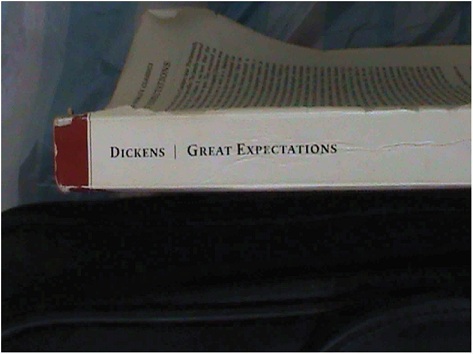
Here’s the picture that AQAP took of the copy of Dickens’ novel Great Expectations they inserted into one of their bombs recently – which they then published in issue 3 of their English language magazine Inspire:
And here’s the explanation that accompanies that photo, in a piece titled “The Objectives if Operation Hemorrhage” by their “Head of the Foreign Operations Team”:
This current battle fought by the West is not an isolated battle but is a continuation of a long history of aggression by the West against the Muslim world. In order to revive and bring back this history we listed the names of Reynald Krak and Diego Diaz as the recipients of the packages. We got the former name from Reynald de Chatillon, the lord of Krak des Chevaliers who was one of the worst and most treacherous of the Crusade’s leaders. He fell into captivity and Salahuddeen personally beheaded him. The name we used for the second package was derived from that of Don Diego Deza, the Inquisitor General of the Spanish Inquisition after the fall of Granada who along with the Spanish monarchy supervised the extermination and expulsion of the Muslim presence on the Iberian Peninsula employing the most horrific methods of torture and done in the name of God and the Church. Today we are facing a coalition of Crusaders and Zionists and we in al Qaeda of the Arabian Peninsula will never forget Palestine. How can we forget it when our motto is: “Here we start and in al-Aqsa we meet”? So we listed the address of the “Congregation Or Chadash”, a Gay and Lesbian synagogue on our one of our packages. The second package was sent to “Congregation B’nai Zion”. Both synagogues are in Chicago, Obama’s city.
.
We were very optimistic about the outcome of this operation. That is why we dropped into one of the boxes a novel titled, Great Expectations.
They may not have read the book or seen the movie, as Ibn Siqilli comments at the link above, but they do have long memories and/or a taste for history, and they are indeed sending signals with small details like the fictitious names of their addressees.
*
This is in line with one of the basic premises of Islamic thought: that the world we inhabit is a world of ayat or symbols (the singular is ayah, and the word is also used to refer to the verses of the Qur’an, each of which is viewed as a symbolic utterance). Here, for instance, is a passage from Fazlun Khalid’s paper, Islam and the Environment, from the website of Jordan’s Royal Aal al-Bayt Institute for Islamic Thought:
The Qur’an refers to creation or the natural world as the signs (ayat) of Allah, the Creator, and this is also the name given to the verses contained in the Qur’an. Ayat means signs, symbols or proofs of the divine. As the Qur’an is proof of Allah so likewise is His creation. The Qur’an also speaks of signs within the self and as Nasr explains, “… when Muslim sages referred to the cosmic or ontological Qur’an … they saw upon the face of every creature letters and words from the cosmic Qur’an … they remained fully aware of the fact that the Qur’an refers to phenomena of nature and events within the soul of man as ayat … for them forms of nature were literally ayat Allah”. As the Qur’an says, “there are certainly signs (ayat) in the earth for people with certainty; and in yourselves. Do you not then see?” (Adh-Dhariat, 51:20, 21).
*
BTW, I don’t think Penguin (or, for that matter, Charles Dickens) got paid for that book… whatever their expectations may have been.
Summer Series 2010: Reviewing the Books! continues……

Killing Rommel: A Novel
As a rule, because of my academic background and predisposition toward policy analysis, I have a difficult time picking up a novel. Not because I dislike novels, but because with so many histories and “serious” policy books in my antilibrary demanding to be read, I feel guilty indulging myself in reading fiction. Realizing that is mildly insane, I decided to shoot for a better balance in my reading this year between fiction and non-fiction and must report….that I have failed miserably. I’ve only read five novels so far in 10 months but one of the five that I read was Killing Rommel and I’m glad that I did!
I “met” the novelist Steven Pressfield online through the first iteration of his website, then a focus on the tribal aspects of the war in Afghanistan. We had some intriguing exchanges and I picked up his The War of Art, one of Steve’s few non-fiction works about becoming a professional writer ( or any creative professional) and defeating the internal psychological resistance that thwarts success and acheivement. I loved that book and read it straight through in one sitting, and later interviewed him about it. Knowing my interest in history and military affairs, Steve sent me a copy of his Killing Rommel and it sat in my antilibrary until this summer, where I read it during long stretches at poolside.
I found Killing Rommel to be a page turner.
Via a literary device, Killing Rommel is the story of “Chap” – Major Richard Lawrence Chapman, DSO, MC. – and his mission as a member of “The Desert Rats”, The Long Range Desert Group of the British Army to find and kill the legendary commander of Afrika Korps, Field Marshal Erwin Johannes Eugen Rommel, “The Desert Fox”. In pursuit of his mission, “Chap” encounters an array of reverses, hazards and adventures in a manner of an ordinary, thoroughly decent, man rising above himself to master circumstances both physically heroic and morally agonizing, leaving the field with honor and humanity intact but free neither of doubt nor memory.
What makes “Chap” remarkable and identifiable as a character in his British ordinariness of an officer doing his duty to King and country, is the uncanny and unerring way Pressfield has reconstructed a British outlook specific to Chap’s time and class – that of the “respectable” upper middle class or younger sons of younger sons of gentry, for whom education and life was bounded by the traditions of the public school and military regiments to which family history was attached. It is a quality of “placedness” and sense of self that most Americans (other than scions of Andover and similar prep schools) cannot easily relate. Where you went was part of who you were  and your whole outlook on life. Once established, Chap’s history consistently informs his actions and reactions as the plot progresses; Chap, in other words, “lived” an authentic life in Killing Rommel.
A second feature of Killing Rommel is Pressfield’s fidelity to historical realism. This is expressed both in his attention to details of military history and geographic setting and his willingness to grip war – even an unimpeachably “good” war as WWII – in all it’s moral ambiguity and unmediated violence on the human scale. It is disturbing to the reader that Rommel, the great enemy and objective of the mission, is an admirable man fighting for an evil cause; it is disturbing that dying Germans are not unrepentant Nazi beasts but are found to be men with families and lives, conscripts and volunteers, not unlike Chap and his comrades, who must persevere and fight for their lives but acknowledge these shades of gray.
Highly recommended.

Zenpundit is a blog dedicated to exploring the intersections of foreign policy, history, military theory, national security,strategic thinking, futurism, cognition and a number of other esoteric pursuits.
Customized Web Site & Blog Design

