Best Books About Reagan
Thursday, January 20th, 2011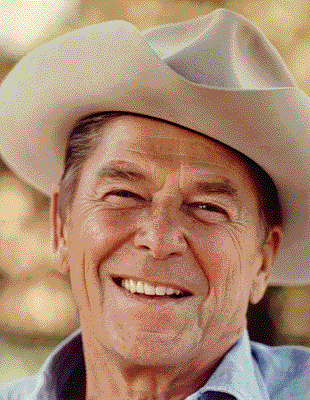
From my colleague, Lexington Green at Chicago Boyz:
ChicagoBoyz will be hosting a roundtable discussion to celebrate the centenary of the birth of President Reagan, the week of February 6th 2011.
In the meantime I would like to get the views of our contributors and readers on what are the best books about Reagan, the Reagan presidency, the Reagan era. Please leave comments with your favorites.
I note that President Obama was recently reading Lou Cannon’s book The Role of a Lifetime
, which is supposed to be very good.
I have read and enjoyed several books about Mr. Reagan, his presidency and his era. I will restrict myself to one favorite. If I had to pick one, I would give the palm to Peggy Noonan’s book What I Saw at the Revolution
. Used copies are available for a penny. This book captures the impact Mr. Reagan had on our national morale, which is not always captured in other writings about him. I say this despite still being mad at Ms. Noonan about her unforgivably uncritical response to Mr. Obama’s candidacy.
I am currently reading John O’Sullivan’s book, The President, the Pope, and the Prime Minister: Three Who Changed the World
. I am about one third done with it and it is excellent.
As I said in the comments section at Chicago Boyz, I concur that Cannon’s The Role of A Lifetime and Noonan are the place to start.
There was a prolific outpouring of memoirs by former members of the Reagan administration in the years during and after his time as president. I think we can even divide the lit into books about (or by, at least nominally) Ronald Reagan and those about his administration.
Here are some of my recs….
On Ronald Reagan:
An American Life: The Autobiography
I like starting a subject by looking closely at what they had to say for themselves. Reagan’s diaries and private correspondence put the lie to the “amiable dunce” smear made by Clark Clifford (a decidedly nasty-edged, lawyer-courtier of Democratic presidents who ended his own long public career exposed as a corrupt dotard, thus proving George C. Marshall’s ability to size up a man’s character was inerrant).
On the Reagan Administration:
Inside The National Security Council by Constantine Menges
Unfortunately, I believe this one is out of print. Dr. “Constant Menace” details the intrigue at the NSC and State by officials who were less than committed to Reagan’s foreign policy initiatives, in particular the Contras and SDI. Menges, the late brilliant, often insufferable, old-style neoconservative gets a thumbs up from me for his capacity to infuriate State Department officials and his geostrategically incompetent and socially inept boss, NSC Adviser Col. Bud McFarlane.
Casey by Joseph Persico
Liberal biographer Joe Persico paints a complicated but at times hagiographic picture of his close friend, CIA spymaster and Reagan political adviser, William Casey. Strong emphasis on Casey’s crusade against the USSR, his unprecedented role for a CIA chief in foreign policy and the ideological struggle over the control over Reagan’s foreign policy. I have a great deal of admiration for Bill Casey and wish someone like him were running the IC today. We’d all be a lot better off.
The Triumph of Politics: Why the Reagan Revolution Failed by David Stockman
The mendacious, arrogant and disloyal ex-Congressman David Stockman nevertheless manages to have an array of interesting, insightful, amusing, if unflattering, anecdotes and opinions about key domestic policy players in the early Reagan White House and in the Democratic leadership in Congress, whom Stockman called “the politburo of the welfare state”. While it was Stockman who failed Reagan rather than the reverse, this book is the most interesting memoir by far of the “dissenters” who left the administration under a cloud.
Turmoil & Triumph by George Schultz
This is not an interesting memoir. It is a ponderous, dull tome, which is surprising given Shultz’s critically acclaimed intellect and forceful persona. The reason for inclusion here is that Schultz obviously felt a duty to “set the record straight” about his battles over foreign policy with Cap Weinberger, Bill Casey and several NSC advisers and his memoir contains a wealth of minute detail about US foreign policy and national security. An invaluable resource.
What books on or about Ronald Reagan would you suggest?
 by Joseph Tainter. As I wrote recently:

 by
by  . There is a wealth of detail about terrorists, their casual atrocities and the warped morality that terrorists habitually employ to rationalize their crimes; a nihilistic mentalite shared with their intellectual groupies in universities and political law firms that will shock and inform the reader. The scattered nature of the case studies that comprise modern terrorism though, makes Blood and Rage more of a kaleidescope than microscope.
 times pass their maniacal political passions by. Only in a few instances, notably South Africa and Northern Ireland are political settlements a more feasible option than methodical police and intelligence work followed by tough-minded prosecution and a steely societal rejection of grandiose moral claims of terrorists and their fellow-travelling left-wing lawyer-advocates. Burleigh also makes clear his disdain for militarized CT and multiculturalist enablement alike.
 Kindle eBook of The War of Art. (The Amazon page has been crashing regularly since it first went up.) “Why,” the reader wanted to know, “does Amazon keep saying there’s no such book? And why can’t my wife get The War of Art for her iPad?”
 , which should be on the shelf of every aspiring writer. $ 1.99 is a steal.


 by Derek Leebaert
 by
by  by
by  by Clint van Winkle

 by James J. O’Donnell
 by Anthony Pagden
 by Christopher Hibbert

