zenpundit.com » shia

Archive for the ‘shia’ Category

A two part meditation, part i: scenario planning the end times

Wednesday, April 13th, 2011

[ by Charles Cameron ]
.

Some people like banking, I prefer religion.

I’m perennially fascinated by the way myths and rituals, meditations and sacraments can not just motivate and move people but change them. That’s just the way I am. I spent ten minutes this morning listening to a zen nun explaining on YouTube how to strike a bell (she preferred to think of it as “inviting” the bell), how to listen to it, how to wake up.

So when it comes time for scenario planning, I find the logistical and economic side of things less interesting than the tada! End of the World! excitement that seems to pop up all over the place from time to time. On billboards here in California (with a date certain: May 21st, 2011), for instance. In videos from Iran (coming soon to a theater of war near Jerusalem). And on Glenn Beck (ditto).

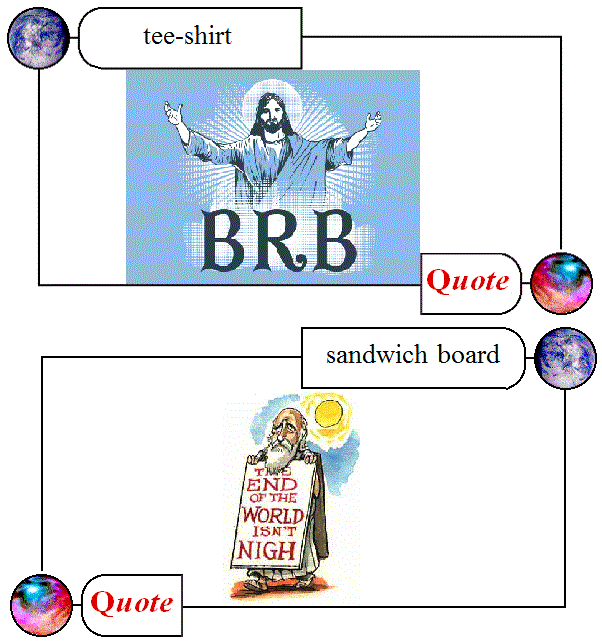
It seems to be a meme that cartoonists and satirists enjoy, too…

.
quo-end-times.gif

*

The thing is, there are two worldviews here, which we could conveniently label sacred and secular – though there’s no reason why one can’t hold a “sacred” view of the world (as I do) and not expect it to end any time soon (I don’t), or a “secular” view, and expect a new ice age or terminal global warming around the next bend in the road…

Two worldviews. And here’s where we get a “clash of cultures”.

Either there exists a definitive blueprint for the future of geopolitics – in Daniel, Ezekiel, and Revelation — or the future of geopolitics is something we’ll have to wrangle ourselves, using our best intelligence, wisdom and material resources.

On Sunday, you can go learn about the blueprint in an evangelical church – or you can kick back with the Sunday supplements and “Meet the Press”. And nobody much minds if you do one thing, and your neighbors do the other.

Things get interesting, however, when geopolitical decision times come around, and a great nation must decide what to do about the Palestinians, say, or Iran.

*

Okay.

Joel Rosenberg is a writer of popular, well-crafted thrillers – a Tom Clancy for the end times set.

Since his books are engaging, and since Glenn Beck frequently features Rosenberg on his show, his most recent novel, The Twelfth Imam, has been enjoying pretty decent sales, making it to #8 on the NYT best-seller list, #8 on Publisher’s Weekly and #10 on the WSJ hard-cover fiction lists in one week, not so long ago. And since I’m a student of comparative eschatology, I read his work with considerable interest, and follow his blog.

Today, he wrote:

As international support builds for the Palestinians to unilaterally declare their own state at the U.N. General Assembly opening session in September, I am growing increasingly concerned the President Obama is preparing to endorse such a move and even push for it. This would be a terrible mistake.Bible prophecy makes it clear that in the last days the nations of the world will divide up the land of Israel. But the Scriptures are also crystal clear that the nations will face the judgment of Almighty God for doing so. “For behold, in those days and at that time, when I restore the fortunes of Judah and Jerusalem, I will gather all the nations and bring them to the Valley of Jehoshaphat [“the Lord judges”]. Then I will enter into judgment with them there on behalf of My people and My inheritance, Israel, whom they have scattered among the nations; and they have divided up My land.” (Book of Joel 3:1-2).

Let the nations be warned by the God of Israel: they are on a dangerous and disastrous road. Let us pray they turn around before it is too late.

*

That’s actually a pitch for geopolitics by Biblical fiat — as Rosenberg explicitly points out:

One could wish the clear warning of the Bible would be enough to dissuade the President from dividing the land of Israel. I am not sure it will. Perhaps sheer politics will help.

If you believe in the sacred “Biblical blueprint” theory, and believe that the end times are very rapidly approaching, this should encourage you. If you believe in the secular “let’s hope our politicians don’t fubar this one” it might worry you – because you don’t trust some writers a couple of millennia ago to have an accurate appraisal of today’s Middle East, when even our intelligence services don’t claim to be able to predict the outcomes of various interventions in a complex situation, with unknown unknowns to boot.

And of course you might also be Israeli (and hold a sacred or secular viewpoint), Iranian (secular or sacred), or just not interested in geopolitics.

In Iran, the holders of a sacred, end times tradition are in power. In the US, the holders of a sacred, end times tradition exert some political influence. If you’re in Israel, you may hope and / or pray the Iranian end timers don’t visit their scenario on your head. If you’re a Palestinian, you may hope and / or pray the American end timers don’t visit theirs on yours.

I think it’s good to be aware of these things, but not get too excited.

*

More to follow in A two part meditation, part ii: of monks and maniacs.

Egypt: it’s the Mahdi!

Saturday, February 12th, 2011

[ by Charles Cameron ]

16_imam-zaman2-mahdi-from-tehran-times.jpg

image of the awaited Twelfth Imam from Tehran Times

*

Here’s a report on remarks President Ahmadinejad made in celebration of the anniversary of the Iranian revolution, just hours before President Mubarak quit, from this morning’s Washington Post:

The crisis that has been roiling Egypt, a key U.S. ally in the region, dominated Friday’s celebration. Ahmadinejad said that the 12th imam Mahdi, a revered 9th-century Shiite saint, had directed the uprisings in Egypt and Tunisia.”

This is a global revolution, managed by the imam of the ages,” he told the crowds gathered in and around Tehran’s central Azadi Square.

He predicted the formation of a world government, ruled by the 12th imam: “Hearts and beliefs are swiftly leaning toward forming a global governance and the necessity of the rule of the perfect human, linked to the heavens.”

h/t @IbnSiqilli

I really should have seen that one coming!

Tracking the Mahdi on WikiLeaks

Tuesday, November 30th, 2010

by Charles Cameron

A quick search for “Mahdi” and “Mehdi” and “Twelfth Imam” in the 294 messages so far published in diplomatic Wikileaks reveals some references to individuals with those names, and a couple to Moqtada al-Sadr’s Jaysh al-Mahdi (spelled “Jaysh al-Madhi” in one cable by someone who is perhaps confused by the similarity of the name to that of Mahatma Gandhi), along with three cables in which Mahdism is touched upon.

1

09ASHGABAT1182 of September 16, 2009 reports a comment by an undisclosed source who is “adamant” that the US should not enter into direct talks with Iran’s leadership:

Not only, he insisted, is the Iranian leadership “untrustworthy,” and dominated by a group of “messianics,” who base crucial decisions about domestic and foreign policy on a belief in the imminent return of the “Missing” (Twelfth) Imam.

From my point of view, any foreign policy based on or strongly influenced by belief in the imminent return of a prophesied figure of good or evil, whether that figure be Moshiach or Christ or Mahdi, Antichrist or Dajjal, should be cause for concern: from a religious perspective, because messianic expectations are precisely what Matthew is talking about when he writes that “false Christs and false prophets will rise and show great signs and wonders to deceive, if possible, even the elect” (Matt 24.24) – and from a secular perspective because such identifications have been made again and again across history, often with disastrous results (think Waco, think the 1979 siege of Mecca, think the Taiping Rebellion).

That’s why I’m interested in monitoring the various strands of apocalyptic thinking out and about in the world today.

2

A little over a month earlier, on August 3, 2009, 09RPODUBAI316 under the sub-head “A Benevolent Dictator’s Fall from Grace” discussed the idea that the “Arab street” (both Sunni and Shi’a are mentioned) initially saw some Mahdist qualities in Ahmadinejad:

A Syrian journalist and blogger, who owns a media consultancy firm in Dubai, believes that many in the Arab street initially viewed Ahmadinejad when he came to power in 2005 as a “benevolent dictator.” Citing the tradition of the Mahdi, the media consultant argued that both Shi’a and Sunni Arabs are taught from early childhood to await the arrival of a strong and unimpeachable figure who will lead the Muslim world. The media consultant maintained that even secular Arabs view the world, albeit unintentionally, with this ingrained mindset. Our contact argued that Ahmadinejad played in to this narrative, and when Ahmadinejad arrived on the international stage many Arabs saw him, in contrast to their own flawed leaders, as a humble and pious man who was brave enough to stand up for his people and the greater Muslim world by confronting Israel and the West head on. However, both the intensely competitive campaign period and the forceful reaction by the Iranian people to the official election results have led some moderate Arabs to rethink Ahmadinejad’s true disposition. The election, the media consultant said, led some Arabs to understand that despite his astutely crafted and well-marketed image in the Arab world, Ahmadinejad is resented by many Iranians for domestic mismanagement, incompetence, and corruption. Because of this public fall from grace, so the media consultant told us, Ahmadinejad is no longer the “untouchable, holy figure” in the Arab world he once was — his flaws have brought him down to the level of the Arab world’s own imperfect leaders.

I’m reminded of the way that Steve Davis of Charleston, SC, among others, projected messianic qualities onto then-candidate Obama, when he wrote:

Barack’s appeal is actually messianic, it’s something about his aura, his spirit, his soul, that exudes enlightenment in the making.

I interpret Obama’s Lebanon, NH remarks as making light of that sort of projection (McCain’s video makes light of it, too), whereas Ahmadinejad appears to take his own status within the aura of the Mahdi all too seriously.

3

The last reference allows me to end on a happier note.

The French diplo Jean-Christophe Paucelle is quoted in 09PARIS1046 of July 31, 2009 on the topic of Ahmadinejad’s inauguration.

First he mentions that since non-Muslims had not been invited to previous inaugurations, European members of the diplomatic corps might not know which door to take if they wished to walk out on the ceremony, should such an action be called for… and then he discusses an additional reason why the French would attend the ceremony, despite the contested nature of the election:

Paucelle said that the case of detained French citizen Clothilde Reiss has also influenced the EU decision to attend the inauguration ceremonies. “We think she may be released soon, and we don’t want to create another irritant,” Paucelle said. “There are enough already.” He reported that the French have reason to believe Reiss may form part of a group of detainees likely to be released on the August 7 anniversary of Imam Mahdi. Paucelle noted that a letter released July 29 by Ahmadinejad supported the idea of granting clemency to post-election protesters during Mahdi celebrations. “The Iranians will need to take face-saving measures, and so she will likely transfer to house arrest or some other status,” Paucelle said. He added that, of course, she may not be released at all next week, but the French remain optimistic that she will soon be out of prison.

Clotilde Reiss was indeed not released on that occasion — but she was in fact freed somewhat later, on Sunday, May 16th, 2010.

Book Talk from Abu Muqawama

Tuesday, May 4th, 2010

Exum has some interesting reads on his desk and in his kindle that readers might find intriguing.

 Andrew is, it would seem, a closet linguist of the vanished, old-school, variety that study real languages instead of investigating the neurocognitive building blocks of language:

Traveling and Reading and Travel Reading

1. Someone sent me a complimentary paper copy of Greg Gause’s new book on the international relations of the Persian Gulf states, and I cannot think of a better introduction to the region. I have only met Gause once, back in 2007, and thought him both really smart and also kind of a smart-ass. So naturally, I liked him. I also have a reading packet prepared by the CSIS, which is leading this trip, crammed full with useful CRS reports and such.

2. I convinced the team here at CNAS to buy me a paper copy of Buying National Security: How America Plans and Pays for Its Global Role and Safety at Home, which readers of this blog will remember I’m excited about. Cindy Williams and Gordon Adams are both really smart and write about something — the national security budgeting process — that is rarely understood by policy geeks like me but really important.

3. I’m also about halfway through an advance copy of Megan Stack’s beautifully written new memoir, Every Man in This Village is a Liar: An Education in War. More on this book later.

4. On the Kindle, I have two new books on Lebanon written by two journalists I very much respect. Both David Hirst and Michael Young have taken the time to tutor me on occassion during my time in Lebanon, and I answered a few technical military questions for David when he was writing his book. Their two books are, respectively, Beware of Small States: Lebanon, Battleground of the Middle East and The Ghosts of Martyrs Square: An Eyewitness Account of Lebanon’s Life Struggle. You can read a glowing review of the former here and a glowing review of the latter here.

5. Also on the Kindle are two books that have nothing to do with the Middle East: Louis Begley’s Why the Dreyfus Affair Matters and Hilary Mantel’s Wolf Hall.

6. Finally, I downloaded the ESV Study Bible and Phil Ryken’s commentaries on Ecclesiastes alongside Tarif Khalidi’s new translation of the Qur’an. That may seem like an odd combination of books, but both Ryken and Khalidi have been mentors* of sorts through the years: Ryken was a pastor at the church I attended in college, and Khalidi is, well, my scholarly hero. Despite his wicked sense of humor and light-hearted spirit, Khalidi is the most intimidating intellectual I have ever met. His command of English, Arabic, Greek and Latin is simply awe-inspiring, especially for someone like me who struggles with all four, and his new translation of the Qur’an is a remarkable achievement. I’m not about to get into the different ways in which Protestant Christians and Muslims approach their respective holy texts, but I will say that I someday hope to approach at least the New Testament with the erudition with which Khalidi tackles the Qur’an. Really impressive. Khalidi’s humility** and interest in younger scholars also sets an example for others to follow.

Battleground Yemen

Wednesday, January 27th, 2010

An informative post by Curzon at Coming Anarchy

Yemen: Geography Matters!

….The Saudis are guilty of aggravating and prolonging the conflict. Wary of taking too many losses on the ground and unable to do much by air and sea, they have recruited the Hashed, a local tribe, to fight against the Huthi, the tribe central to the Shia rebels. The Hashed have several incentives to continue fighting for as long as possible-they have a long-standing feud with the Huthi, and make a great deal of money from fighting for the Saudis, and may be coming up with schemes to prolong the conflict. According to a source of Al Jazeera:

If [the Hashed are] given the mission of taking a particular mountain, for example, they’ll call up the Huthi leaders and tell them: ‘We’re getting five million riyals to take the mountain. We’ll split it with you if you withdraw tonight and let us take over’… After the tribesmen take charge, they hand it over to the Saudis… The next day, the Huthi return and defeat the Saudis and retake the mountain… It’s been happening like this for weeks.


Switch to our mobile site