zenpundit.com » bin laden

Archive for the ‘bin laden’ Category

Trial of a Thousand Years, by Charles Hill—a review

Thursday, August 11th, 2011
 trial of thousand years

by J. Scott Shipman 

Trial of a Thousand Years, World Order and Islamism, by Charles Hill

Ambassador Charles Hill’s Grand Strategies, Literature, Statecraft, and World Order was the best book I read in 2010, so I had high expectations for this volume and was not disappointed. Ambassador Hill provides a 35,000-foot view of the relationships between the West and Islam in history focusing on the subtitle of his earlier work in the form of “world order.”

Unsurprisingly, as in Grand Strategies Hill goes back to the roots of modern order in the Treaty of Westphalia (1648). He provides a brief review of the world ushered in by the men who negotiated, and quotes another historian who said, “men who were laboring, each in his own way, for the termination of a terrible war. They had no idea of progress. The word “innovation” was anathema to them. The last thing on their minds was the creation of a new system of sovereign states…” Here we are 363 years later and “from the seeds sown at Westphalia” the system they set in place is has grown, but has been under siege many times from many fronts.

Westphalia was distinctive because it was “procedural, not substantive” and required a minimum number of procedures/practices to which to adhere and allowed disparate parties with different, “even mutually antagonistic, substantive doctrines and objectives” to work together. Hill points out four distinctions:

  • Religious arguments were not allowed in diplomacy.
  • The State was the fundamental entity.
  • Interstate/international norms and laws were encouraged, absent “divine sources” but based on mutually beneficial/positive agreements.
  • Use of professional military and diplomats with “its own set of protcols.” [Personal note: In another life, I was an arms control inspector enforcing the START I and INF Treaties—protocol was very serious and the true measure of the actual treaty language. There was also a strong and consistent application of reciprocity that made each party think before stretching protocol—this happened to my teams more than once.]

For Hill a central mission of the United States is the defense of the Westphalian world order. In less than 165 pages and six chapters, he outlines the origins of modern Western order and correspondingly covers Islamic order. From the beginning to the end Hill provides ample evidence of challenges to Westphalia, often from indigenous Western sources, but focusing mostly on our trials with Islam.

Hill sets the sources from whence the Western and Islamic world orders arose, where the West was grounded in Christianity, and the Islamic in the Caliphate. For two religions claiming Abrahamic roots, their worldviews were, and in many instances remain diametrically opposed. Central was the question of duality or unity. For the West, the State and religion were two complementary systems/powers—following the teaching of Christ ““Render unto Caesar the things which are Caesar’s, and unto God the things that are God’s” (St Matthew’s Gospel 22:21) For Islam there was no distinction, and the very thought was hateful to Islamists. Islam’s “unswerving devotion to monotheism” continues to this day among those groups and states using terror to upend existing world order.

I am sympathetic to Hill’s ideas; however recognize with globalization and the internet tweaks may be required. And I’ll take this segue to introduce an idea for consideration.

Westphalia’s removal of religion made trade possible among former religious enemies. Unambiguous rules for contracts and dispute resolution evolved. What if we could bridge the gap between Western jurisprudence and tribal, or non-Western legal systems? What if, instead of insisting our way or the highway we design a solution that would allow both sides to keep their respective legal processes and procedures, thereby opening untapped markets?

At least one person has already considered these alternatives. Michael Van Notten (1933-2002) was a practicing lawyer in the Netherlands and married into a Somali tribe. Van Notten used his legal training and insights gained as a member of his new family to design a method of contracting where tribal law and Western jurisprudence could peacefully and prosperously coexist. Van Notten recorded his ideas in a book called The Law of Somalis, A Stable Foundation for Economic Development in the Horn of Africa. I’ll not review this book, but wanted offer this as a teaser alternative.

After reviewing the history of the West and Islam, Hill identifies seven Clausewitzian centers of gravity for both: legal, military, the State, women, democracy, nuclear weapons, and values. Hill makes the distinction between the use of diplomacy by Islam and the Islamist (the fundamental variety). No surprises, to the Islamist a secular State is an “apostasy,” as is international law (Sharia being the single source), democracy and the rights of women.

Hill concludes, “Islamic civilization entered the international system under duress,” which he believes has contributed to the current situation of failing states and lagging economies that establish conditions where radicalized Islam can flourish. The radicalized elements reject the secular Westphalian world order, however Hill points out that some in Islam insist that sharia imposed by the state “cannot be the true law of Islam. It is not possible to apply sharia through the state; it can only be applied through acceptance by human beings (An-Na’im).” Another alternative is the Medina polity established by the Prophet (“later called the Pact—kitab—of Medina) “guaranteeing each tribe the right to follow its own religion and customs, imposing on all citizens rules designed to keep the overall peace, establishing a legal process by which the tribes settled purely internal matters themselves and ceded to Muhammad the authority to settle intertribal disputes…Although this document has been called the first written constitution, it was really more of a multiparty treaty” (Ansary).

Hill convincingly demonstrates that more often than not, rulers have co-opted Islam as a way to dominate the people (Iran comes to mind.). He quotes Professor L. Carl Brown of Princeton, “nothing exclusively “Islamic” about this Muslim attitude towards politics, any more than the politics of feudalism or of imperial Russia was distinctly “Christian.” It is the political legacy of Muslims, not the theology of Islam…”

For the Islamist, secularism is the booger man, but secularism in the Westphalian order has its own set of problems. Hill writes, “A new phenomena arose: wars motivated by religious convictions were replaced by wars driven by ideologies—surrogates for religion—each aimed to oppose, undermine, destroy and replace the Westphalian system. The greatest of these was international communism, the latest is international Islamism.”

In many respects, Trials is as good as Grand Strategies. Ambassador Hill is to be commended for his insight, courage, and conviction—this little book packs a big, enlightening punch. Strongest recommendation.

References you may find of interest (links to quoted authors above are links to the respective reference):

The Incoherence of the Philosophers, Abu Hamid Muhammed Al-Ghazali

The Crisis of Islamic Civilization, Ali A. Allawi

The Caliphate, Thomas W. Arnold

Sayyid Qutb and the Origins of Radical Islamism, John Calvert

Crimea: The Last Crusade, Orlando Figes —Figes’ The Whisperers was very good.

The Morality of Law, Lon L. Fuller

The Muqaddimah, Ibn Khaldun (Translated Franz Rosenthal)

The Clash of Empires: The Invention of China in Modern World Making, Lydia H. Liu

The Government of the Ottoman Empire in the time of Suleiman the Magnificent, Albert Lyber

Byzantine Civilization and The Fall of Constantinople, both by Steven Runciman

The First World War, Hew Strachan

Mozart and the Enlightenment; Truth, Virtue and Beauty in Mozart’s Operas Nicholas Till

Muslim Intellectual: A Study of Al-Ghazadi, W. Montgomery Watt

Dialectic of Enlightenment, Max Horkheimer and Theodor W. Adorno 


Reviews coming up shortly

Tuesday, August 2nd, 2011

[ by Charles Cameron — so many really good books, eh? ]

.

daveed-cover.jpg

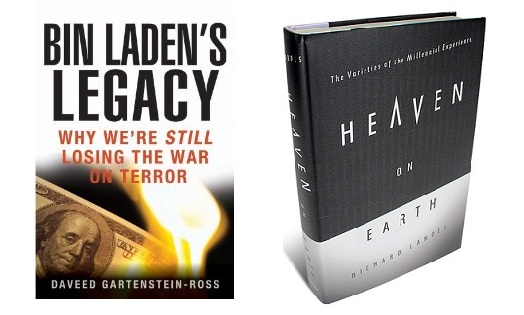
Two very important books:

Daveed Gartenstein-Ross brings us up to speed on Al Qaeda by understanding what they say and do. Richard Landes gives a breathtakingly wide-angle view of the critical importance of apocalyptic — secular versions included.

Book Review: JM Berger’s Jihad Joe

Monday, June 20th, 2011

[ by Charles Cameron — “homegrown” jihad ]

.

41nibyw1jbl_sl500_aa300_.jpg

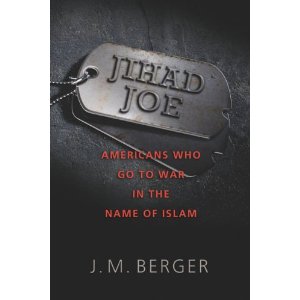
Jihad Joe: Americans who go to war in the name of Islam

by JM Berger

Potomac Books, Inc, 2011, hard back, $29.95

*

The title by itself is striking — Jihad Joe – and captures nicely the somewhat surreal blend of the normal and the utterly strange that we encounter when we think about “Americans who go to war in the name of Islam” – the subtitle and topic of JM Berger‘s book. And think about them, know a bit about them, we should.

The big question, of course, is Why?

Berger writes early on of young men who gather “to focus their rage through a religious filter” and while noting that jihadists comes from varied backgrounds and travel for varied reasons, correctly zeroes in on the sense of obligation that a jihadist interpretation of Islam imposes:

While all major religions have rules that limit or justify war, a small but significant minority of Muslims believe that under the correct circumstances, war is a fundamental obligation for everyone who shares the religion of Islam. When war is carried out according to the rules, it is called military jihad or simply jihad. [emphasis mine]

The rage may spring from many sources, social, economic, political, but when religion is used to focus it, as Berger nicely puts it, that obligation is what provides divine legitimacy — and the promise of miracles, martydom and a paradisal afterlife – and the sense of serving a higher purpose, to otherwise quieter lives.

*

Berger starts at the beginning. After a brief mention of the presence of many Muslims under slavery, two early and distinctly American expressions of Islam (the Moorish Science Temple and the Nation of Islam), and the beginnings of Muslim Brotherhood activity as Egyptian and other Muslim immigrants brought more orthodox strands of Islam to the States, Berger alerts us to the idea that Americans leaving to fight jihad may have deeper roots than we think.

Bin Laden‘s mentor Abdullah Azzam, for instance, was in the US in the 1980s appealing for Americans to help the mujahideen in their resistance to the Soviet occupation of Afghanistan – a cause supported by President Reagan, who took tea with muj leaders for discussion and photo op, and by the wily Charlie Wilson of Charlie Wilson’s War. Azzam’s calls for volunteers were successful:

No one kept track of how many Americans answered the call, and no one in or out of the U.S. Government would venture a guess on the record. More than 30 documented cases were examined for this book. Based on court records and intelligence documents, a conservative estimate might be that a minimum of 150 American citizens and legal residents went to fight the Soviets.

Implications for today: this has been happening for a long time, it’s not something Anwar al-Awlaki invented just yesterday — and there have been times when the US was no too displeased at such activities.

Azzam’s appeal was precisely to the sense of a general, compulsory obligation for Muslims – fard ayn in Arabic – buttressed by tales of the miraculous and promises of paradise. I emphasize these points because their appeal is real. The day Al-Qaida was founded, an American was present, Mohammed Loay Bayazid, aka Abu Rida al Suri, and it was his reading of Azzam’s account of miracles among the jihadists in Afghanistan – apparent supernatural protection from and/or paralysis of superior forces, the “odor of sanctity” on martyrs’ bodies – that turned him from a not very pious Muslim into a volunteer jihadist. You can read the stories yourself — Azzam’s book is now available for download, in English, on the web.

I’m focusing in on the religious element because that’s my area, others will comment better than I on the military or historical aspects that Berger deals with. But Berger makes it clear that from its inception, Al-Qaida numbered Americans among its higher echelons, and bin Laden was “strangely enamored of Americans and people who had spent time in the United States” – if only for the very practical reason that their passports allowed them access most anywhere.

*

The first act of violence on American soil generally attributed to AQ, Berger tells us, was the 1990 killing of Rashad Khalifa in Tucson, AZ. Khalifa was the numerologically inclined leader of a Tucson mosque and translator of the Qur’an whose apocalyptic date-setting (2280 CE) I mentioned in my Zenpundit post Apocalypse Not Yet? a week ago.

Khalifa’s story leads into that of Al Fuqra, a group that Berger describes in some detail, writing of their “rural compounds and small private villages” and their “covert paramilitary training grounds” and noting that while they have been implicated in “at least thirty-four incidents … from bombings to kidnappings to murder … the government has never moved against the group in an organized manner.”

Berger turns next to the blind Sheikh Omar Abdel Rahman and his followers, soon joined by the AQ-trained bomb-maker Ramzi Yousef, and the 1993 bombing of the World Trade Center – which failed to topple the towers — leaving the task for Mohammed Atta to complete in 2001 under bin Laden’s command

1992 sees several thousand US troops in Arabia given briefings on Saudi culture – largely a matter of Wahhabist Islam – and four-day passes to visit Mecca at Saudi expense were available for converts. As the Bosnian crisis began to unfold, ex-military Muslims converted by these means formed a natural pool for recruitment as jihadists to defend their Muslim brothers against ethnic cleansing and genocide at the hands of their Serb neighbors.

With the combination of the first WTC bombing and the Bosnian jihad, the “far enemy / near enemy” combo was in place: jihad could draw on both local and global events to fuel its global plans, and find both local and targets to take down…

By the beginning of the 1990s, America was in AQ’s sights, though AQ was barely known to a handful of Americans. The 1993 Black Hawk Down incident in Mogadishu featured AQ-trained forces, and the Nairobi and Dar es Salaam embassy attacks were soon in the planning stages. In 1996, bin Laden publishes his declaration of war on America, and the CIA put together a first plan to kidnap him…

*

Anwar al-Awlaki enters the picture around this time, a complex man Berger calls “a study in contradictions” – “a gifted speaker who was capable of moving men to action”.

If the power of religion to focus rage, and the concept of jihad as a compulsory obligation, fard ayn, are two of our first take-aways from Berger’s book, here is a third: rhetoric is the tool that transforms the curious (pious or not so much) into the committed. Anwar al-Awlaki had “a powerful cocktail of skills” but they boil down to this: the ability to talks Islam casually, in the American manner, to American kids — in American English, in a way that appears pious and scholarly, presents jihad as both obligation and adventure, and moves them to action…

Three of the 9-11 hijackers were al-Awlaki contacts… Nidal Hasan, the army psychiatrist who massacred his fellow soldiers at Fort Hood… Umar Farouk Abdulmutallab, the suspected “underwear bomber”… Faizal Shazad, the Times Square bomber… the list of those who have known and been influenced by al-Awlaki goes on…

The history of AQ by now is well known, covered in such books as Lawrence Wright‘s The Looming Tower and Peter Bergen‘s The Longest War, so Berger can concentrate on the “home grown” side of things, featuring — alongside al-Awlaki — his clumsier precursor the AQ propagandist Adam Gadahn, and paying considerable attention to another less-than-widely reported aspect of the jihad – the Pakistani Lashkar-e-Taiba group and its ISI-assisted 2008 attack on Mumbai, India, for which the intelligence scouting was done by the Pakistani-American sometime DEA agent David Headley, and the subsequent planning of an attack in Denmark…Berger turns next to Somalia and al-Shabab – but you get the drift, he is offering us a thoroughgoing, fully researched tour of the various Americans and groups joined by Americans across the world, involved in waging jihad, against scattered local enemies, or against the “far enemy” – the United States.

*

Berger’s work is detail-packed and focused, and a useful resource for that reason alone. But it is also and specifically the work of someone who has read and talked with and listened to the people he is writing about, and his work carries their voices embedded in his own commentary. It thus joins such works as Jessica Stern‘s Terror in the Name of God: Why Religious Militants Kill and Mark Juergensmeyer‘s similarly named and similarly excellent Terror in the Mind of God: The Global Rise of Religious Violence.

Bringing us up to date, Berger offers an overview of jihadist use of the internet, paying special attention to English-language sites – Islamic Awakening, Revolution Muslim — emphasizing the peripheral nature of “forum” activities, but also crediting them as an active doorway to recruitment. Zach Chesser, Samir Khan, Jihad Recollections and Inspire magazine, they’re all here. Read Berger’s recent blog post on “gamification” after this chapter, follow him at @intelwire, and you’ll be ongoingly up to date on his thought…

Berger closes with a look at future prospects. The opening of this chapter – an overview of the history so far covered – speaks volumes:

The journey of the American jihadist spans continents and decades. Americans of every race and cultural background have made the decision to take up arms in the name of Islam and strike a blow for what they believed to be justice.

Many who embarked on this journey took their first steps for the noblest of reasons – to lay their lives on the line in defense of people who seemed defenseless. But some chose to act for baser reasons – anger, hatred of the “other,” desire for power, or an urge towards violence.

In the early days of the movement, it was possible to be a jihadist and still be a “good” American…

Berger neither condemns nor excuses: he sees, he asks, he researches, he reports. His observations of the current situation can thus be trusted to be driven by insight rather than ideology – not the most common of stances, but one we very much need.

He pinpoints as the first element that almost all American jihadists have in common as “an urgent feeling that Muslims are under attack”. Foreign policy implications? Yes indeed – but Berger is also looking to the Muslim community to take an approach less focused on what he terms a “litany of grievances” – valid though some of them may be – which in effect helps perpetuate a “counterproductive narrative” of how the US views and treats Muslims.

Once a narrative that America is at war with Islam is established, the argument for jihad as fard ayn can be made – and all manner of shame, frustrations, rage, violent tendencies, alienation and idealism can be unleashed under the jihadist banner.

Berger’s conclusion:

We must preserve the constitutional rights and basic human respect due to American Muslims while changing the playing field to create conditions in which extremism cannot thrive. These goals are not mutually exclusive – they are independent.

If principle and pragmatism are not enough reason to change the tone of the conversation, there isx one more thing to consider. It would be not only dangerous but shameful to prove that our enemies were right about us all along.

Berger’s is a book to read, certainly — and more significantly perhaps, a book to admire.

Gamification: al Awlaki loses big points

Friday, May 13th, 2011

[ by Charles Cameron ]

.

There’s been talk about “gamification of jihad” recently, the idea being that on the jihadist forums you get points and seniority for posting often, your posts getting thumbs up from others, etc — reputation, in a nutshell.

tweet-quilliam-on-obl-on-awlaki.png

Well, the guys at Quilliam include Senior Analyst Noman Benotman, one time leader of the Libyan Islamic Fighting Group (LIFG) and bin Laden comrade-in-arms, who later disbanded the former and criticized the latter in an open letter — if he’s getting the sense that al-Awlaki didn’t impress bin Laden, hopefully some jihadi wannabes will get rapidly less impressed, too…

“Trust, but verify” and Pakistan: III

Sunday, May 8th, 2011

[ by Charles Cameron — third of three parts ]

*

.

David Ronfeldt said something in a recent comment here on strategy that to my mind maps very nicely — like one of those zooms in films from a very long view of a New York cityscape right in through the window of a brownstone onto a particular book on a certain someone’s bedside table or desk – onto this week’s questions about Pakistan:

as others have noted better than i, strategic relationships may involve competition in one area, collaboration in another, and a potential for serious conflict in yet another.

Bingo.

That seems to be pretty much the attitude of the ISI retiree Michael Wahid Hanna described on the Afpak channel two days ago:

“As for duplicity, I would say that diplomacy is not single tracked. We all follow many different tracks; sometimes, apparently, working against each other,” a retired senior official from Pakistan’s Inter-Services Intelligence Directorate (ISI) told me and my colleagues during a private gathering in Islamabad in July 2010 that was organized as part of The Century Foundation’s International Task Force on Afghanistan. “Double games or triple games are part of the big game.”

*

Time magazine gives the argument from both the “they must have known” and “honest, we didn’t” sides:

The most damaging accusation against the Pakistani military, of course, is that it must have known bin Laden’s was hiding in the small garrison town where army personnel at frequent checkpoints demand identification. “They knew. They knew he was there,” wrote Dawn columnist Cyril Almeida, echoing the suspicion of many Pakistanis. Kayani had driven past bin-Laden’s bolt-hole literally a week earlier, on his way to tell a gathering at the military academy that the “Pakistan army is fully aware of internal and external threats.”
.
Kayani was adamant that the Pakistanis had no idea that bin-Laden was hiding in Abottabad. “We had no clear, actionable information on Osama bin-Laden,” he told the journalists. “If we had it, we would have acted ourselves. No one would have questioned our performance for ten years. It would have raised our international prestige.”

That’s fair and balanced with, if you’ll excuse the pun, a great deal hanging in the balance…

*

Pat Lang at Sic Semper Tyrannis, accordingly, tries to weight the the US and Pakistan in terms of their respective affordances to each other…

Let’s see… What does Pakistan do for the US? … Pakistan’s military keeps it’s existing and future nuclear capability out of the larger world game. As has been discussed at SST many times, Pakistan either has or will soon have the real world CAPABILITY of ranging Israel’s target set. They have around 100 fully engineered and manufactured deliverable nuclear weapons. They have aircraft and missiles (Shahiin 2 improved) that would do the job. The missile launchers are fully mobile. The US has zero control over this nuclear strike force. Logically, the willingness of the Pakistan military to keep this “piece” off the chess board is a major boon to the US. We do not want to see that willingness change to something else.
.
On the other hand … The Pakistani security services support many of our worst opponents in Afghanistan. This is so well documented that I won’t bother to do so again.

*

Are you dizzy yet?

Lawrence Wright at the New Yorker – he wrote The Looming Tower, simply *the* book about AQ’s road to 9-11 – drops one of those tidbits that just might be the exact detail we need to pursue, in one of those long shot zooms in through the window I was talking about. He tells us:

Within the I.S.I., there is a secret organization known as the S Wing, which is largely composed of supposedly retired military and I.S.I. officers. “It doesn’t exist on paper,” a source close to the I.S.I. told me. The S Wing handles relations with radical elements. “If something happens, then they have deniability,” the source explained. If any group within the Pakistani military helped hide bin Laden, it was likely S Wing.

So.

Are we getting closer to that starkly phrased remark of Zen’s that I quoted at the outset of this three post series, “Osama bin Laden was caught and killed in an ISI safe house in Abbottabad” ?

I trust Lawrence Wright quite a bit — but I would like to verify


Switch to our mobile site