zenpundit.com » analytic

Archive for the ‘analytic’ Category

2083 — the 36 Stratagems

Wednesday, July 27th, 2011

[ by Charles Cameron — analysis of “deceptive means” in 2083 manifesto / borrowings from Chinese 36 Stratagems ]

.

I don’t know if anyone has commented on this yet, and a quick search proved inconclusive — but section 3.40 of Anders Breivik‘s 2083 manifesto, “Applying deceptive means in urban guerrilla warfare” (pp. 925-930) contains a number of tricks drawn from the Chinese “Thirty-Six Stratagems” – without, I believe, an acknowledgment. These are:

4. Make a sound in the east, then strike in the west
5. Hide a knife behind a smile
6. Sacrifice the plum tree to preserve the peach tree
7. Take the opportunity to pilfer a goat
8. Do not startle the snake by hitting the grass around it
9. Borrow a corpse to resurrect the soul
10. In order to capture, one must let loose
11. Avoid the servant forces and go for the neck of their chiefs
12. Befriend a distant state while attacking a neighbour
13. Replace the beams with rotten timbers
14. Make the host and the guest exchange roles

I imagine there are other readers here more familiar with this material than I, so I’ll just post a few quick notes and express the hope that others will chime in.

*

Breivik doesn’t name it as such, but in fact his first “deceptive means” is the Chinese first stratagem, Deceive the heavens to cross the ocean.  Breivik writes:

Always mask your real goals, by using the ruse of a fake goal that everyone takes for granted, until the real goal is achieved. Tactically, this is known as an ‘open feint’; in front of everyone, you point west, when your goal is actually in the east. By the time everyone realised it, you have already achieved your goal.

Compare the closely similar Wikipedia text accompanying this stratagem:

This stratagem means that you can mask your real goals, by using the ruse of a fake goal that everyone takes for granted, until the real goal is achieved. Tactically, this is known as an ‘open feint’; in front of everyone, you point west, when your goal is actually in the east. By the time everyone realised it, you have already achieved your goal.

Breivik uses the variant Do not startle the snake by hitting the grass around it rather than Stomp the grass to scare the snake which is the primary version in Wikipedia — Wikipedia’s source apparently has both.

Borrow a corpse to resurrect the soul is an interesting stratagem:

Take an institution, a technology, a method, or even an ideology that has been forgotten or discarded and appropriate it for your own purpose. Revive something from the past by giving it a new purpose or bring to life old ideas, customs, or traditions and reinterpret them to fit your purposes.

Isn’t that what Breivik is doing with the Knights Templar?

And lastly, Avoid the servant forces and go for the neck of their chiefs appears to be Breivik’s variant on the Chinese Defeat the enemy by capturing their chief – his wording perhaps influenced by the Qur’an (sura Muhammad) 47.4 “So when you meet in battle those who disbelieve, then smite the necks until when you have overcome them”.  I imagine that’s a verse he’d have encountered often enough.

*

Someone with the appropriate background should do a more thorough job of checking out these particulars, tracking down exactly which text Breivik seems to be borrowing from, etc.  Comments and corrections are welcome.
2083 Graphics — a couple of details

Tuesday, July 26th, 2011

[ by Charles Cameron – graphic from 2038 manifesto compared with UBL martyr graphic & US “hunting permit” ]

.

I should say first off that I am grateful to Chris Anzalone aka Ibn Siqilli for his “In Pictures” series of posts of Islamist and related graphics, and especially his “martyrsseries, all which inspired my own first post on 2038 graphics a couple of days back.

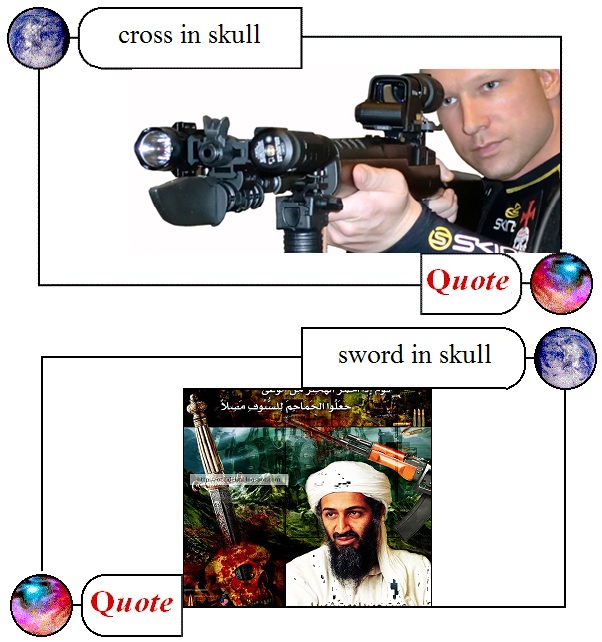
It was his post on “Usama bin Laden, the Martyr, As Seen in Jihadi-Takfiri Artwork” today that gave me the idea for this post, when I noticed something familiar-but-different in one of the bin Laden graphics, and went back to check the portraits of Anders Breivik at the end of the 2083 manifesto.

Let’s call this pair of images Symbolic Analogy:

dq-symbolic-analogy.jpg

Once you start looking at the details, of course, other things pop out…

Like these two Hunting Permits:

dq-hunting-permits.jpg

As they say on this eHow page on How To Identify Military Insignia:

Military insignia make for good collector’s items because there are a variety of patches and badges, many with interesting, funny or bizarre imagery. If you happen to inherit some insignia, or a patch at a flea market or antique store catches your eye, identifying your treasure could take some work. Before you take your insignia for a professional appraisal, see if you can figure out what it is on your own. …

Examine your military insignia and note every detail. Figure out what the imagery is, whether you are looking at a pirate or unicorn, and whether it is a fabric patch or metal badge. Take special notice of any text or numbers on your insignia, even if you can’t understand them.

Chet on TEMPO….Rao on OODA

Tuesday, July 26th, 2011


At Fabius Maximus, Dr. Chet Richards reviews TEMPO by Dr. Venkat Rao, enjoying the book as much as I did, if not more. Chet has some particularly incisive comments, positive and critical, in his review, which I suggest you read in full:

Book Review: Tempo

…Rao draws on Boyd in several places, as well on sources ranging from the topical, such as Gladwell and Taleb, to the foundational (e.g., Camus and Clausewitz), to the downright obscure – know anything about The Archeology of Garbage? Do the words wabi and sabi ring a bell?

The result is a synthesis, what Boyd called a “snowmobile,” that combines concepts from across a variety of disciplines to produce a cornucopia of new ideas, insights and speculations. You may be confused, challenged, outraged, and puzzled (some of the language can be academic), but you’ll rarely be bored because every chapter, often every page, has something you can add to the parts bin for building your own snowmobiles.

Let me highlight just a couple, of special interest to folks familiar with Boyd’s concepts. Near the end of the book, Rao introduces an expanded version of “legibility”:

A piece of physical reality is legible if it is obviously the product of coherent human agency, a deliberate externalization of a mental model. When human and natural sources of order are harder to tease apart, you get greater illegibility (p. 133 – and I warned you about the academic language).

Then a couple of paragraphs later, he claims that:

Used with adversarial intentions, Boyd’s OODA can be understood as a deliberate use of illegibility to cause failure.

At first, this seems silly. Boyd only considers conflict between groups of human beings (Patterns of Conflict, 10), so all uses of his strategic concepts would seem to be prima facia examples of legible phenomena. On the other hand, and this is an example of what makes Rao’s little book so valuable, some commentators, such as Stalk and Hout in 1990’s Competing Against Time, point out that victims of a Boyd-style attack can rarely identify the cause of their problems – often blaming bad luck or incompetent, self-serving and treacherous idiots in their own organizations. Boyd made this clear in his own work, such as in Patterns of Conflict, 132, when he suggested that his victims would exhibit a variety of traumatic symptoms including confusion, disorder, panic, chaos, paralysis and collapse – indicating unrelenting attack by forces outside the scope of their own mental models…

Chet concludes with a suggestion for Venkat (with which I concur):

…As for where to go from here, Rao might write more about tempo. This will seem strange to him, I’m sure, but pages go by with hardly a mention of the concept. This means that we need another book from him. I’d suggest expanding on some of the concepts that he raises but doesn’t find space to develop. Here are three ideas: […]

But you will have to go over to Fabius Maximus to read the rest. Venkat, in turn responded to Chet over at his blog, Ribbonfarm:

Chet Richards’ Review of Tempo on Fabius Maximus

….Overall, Chet comes to the conclusion that Tempo resonates with the Boydian spirit of decision-making. I don’t entirely get out of jail free though:

Perhaps his unfamiliarity with the original briefings, however, led him to  make one characterization that is incorrect, although widely believed:

The central idea in OODA is a generalization of Butterfly-Bee: to simply operate at a higher tempo than your opponent. (118)

Guilty as charged. I didn’t spend enough time exploring how OODA gets beyond merely “faster tempo” to “inside the adversary’s tempo.” That’s something I hope to explore in a more nuanced way in a future edition. Over the last 6-8 months, I think I’ve come to understand the subtleties a lot better, and the challenge is to now spend more time thinking through clear definitions and examples….

I think everyone who has explored the OODA Loop concept, including John Boyd himself, initially gravitated to the aspect of cycling “faster” than one’s oponent because it is a natural assumption that resonates with our own experiences. We have all seen competitions where one player or athlete was “quicker” in reading situations and arriving at the right intuitive decision – usually most of us have been both the faster as well as the slower and more hesitant person. It’s the first scenario that springs to mind and being “faster” gives an obvious comparative advantages. Obvious does not mean “only” though.

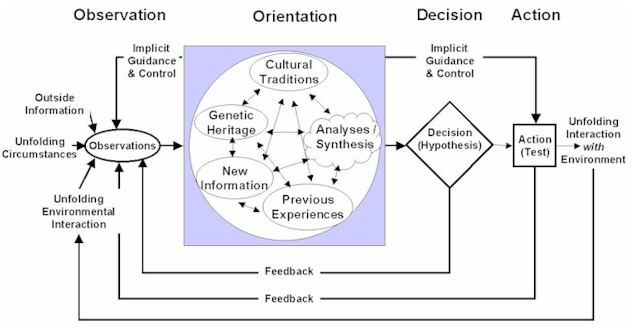
What made the “faster” interpretation of OODA Loop really stick in the culture though, IMHO, was this unfortunate but easily understood graphic:

NOT THE REAL OODA LOOP

As a result, we get critical arguments that the OODA Loop is really something germane only to binary situations similar to the high pressure aerial combat that Boyd experienced in the Korean War or as a tactical fighter pilot instructor (or Musashi’s sword fighting) and not something generally useful in military strategy. An odd argument, given that Clausewitz liked to use binary metaphors to describe the nature of war.

The next graphic, which better illustrates the simultanaeity and dynamic nature of the OODA Loop, with other potential avenues of exploitation than just going “faster” (which will swiftly hit diminishing returns in any event) does not lend itself as easily to nearly instant comprehension:

THE ‘OFFICIAL” OODA LOOP:

With these cognitive relationships operating continuously, mostly subconsciously with automaticity and in an iterative fashion, a different set of meanings to the phrase “inside your oponent’s OODA Loop” than just going “faster”, like a formula one race car zooming around a track.

Oslo and Utoya: open source warfare

Sunday, July 24th, 2011

[ by Charles Cameron — analysis of 2083 manifesto, John Robb ]

.

Just a quick note — section 3.18 of the 2083 European Declaration of Independence reads as follows:

3.18 “Open source” warfare – clandestine cell systems – the most efficient way of warfare in Phase 1

A clandestine cell structure is a method for organising a group in such a way that it becomes virtually immune to detection, penetration and decapitation. As such, it is a critical strategic element of our operations. It is not in any way lead under a fixed, fragile hierarchy but works as an extremely distributed movement, a resilient network made up of small, autonomous groups or cells. Each group is lead by a cell commander, often working solo, who makes all the decisions based on fixed fundamental principles. We therefore avoid the use of electronic communications (including mobile phones, email and internet chat), because electronic intelligence, signals intelligence, ELINT, SIGINT, is a strength of conventional militaries and counterintelligence organisations.

Solo Martyr Cells are completely unknown to our enemies and has a minimal chance of being exposed. The relatively indestructible and impenetrable nature of the Cell System allows the individual to stay hidden until he is ready to “activate” himself. Even then he will escape the scrutiny often reserved for young men of Arab descent. Optimally he should not have any affiliations to “extremist networks” or to any extreme right wing movements for obvious reasons. This will disallow the National Intelligence Agencies to place the individual on their “radar”/under surveillance. As with the “open source” concept in general our core principles which include armed resistance against the cultural Marxists/ multiculturalists are made available for public collaboration. Our evolving approach to conducting warfare makes it extremely quick to innovate and share tactics rapidly from cell to cell without the direction of a vulnerable leadership hierarchy.

Each European country has tens of thousands individuals who are affiliated with far right conservative movements (from moderate to extreme). In addition, there are several thousand individuals who sympathise with armed resistance groups against the cultural Marxists/multiculturalists (many of them being in the police force and the intelligence agencies themselves).

National Intelligence Agencies have very limited resources and will not be able to monitor tens of thousands of people efficiently (they will not waste excessive resources on individuals who are not considered an immediate threat). They will not have any chance whatsoever to implement efficient means against Solo or even Duo cells because you are not on their “priority watch list”. Even if you are on a watchlist you have several opportunities.

Weaknesses

Groups and individuals who use terror (spreading fear and means of intimidation) as its primary weapon (even if concentrated on specific individuals or government buildings only) will always have limited “open” support in the population.

The rather excessive secrecy and decentralised concept of our command structure can contribute to a reduction or distortion of information about our goals and ideals. This would only be a problem if f. example a cell commander fails to send an announcement to predefined news agencies and blogs. The biggest threat is that media or government agencies might attempt to distort our messages and material and present it to the media as NS or racist in nature in an attempt to de-legitimise us. This has the potential to prevent the wanted effect of our operation, support for our cause and political pressure on current regimes (to halt Muslim immigration and Islamisation). However, if the cultural Marxist/multiculturalist governments attempt to falsely give credit to racist organisations they risk creating more activity among the NS movements so it is a double edged blade even for them.

There appear to be two references to “open source warfare” in the document: this one is the main one, on p. 840 of my downloaded .docx version. There’s also a mention of “open source intelligence”.

I haven’t found a reference to John Robb in this context — but given that John pioneered the concept of OSW in his writings, I will be interested to see his comments on the brief version described above.

Oslo and Utoya — short version

Saturday, July 23rd, 2011

[ by Charles Cameron — leads related to Anders Breivik, suspected in Oslo bombings / Utoya shootings ]

.
I may follow this post up with a longer and more detailed version, time permitting – but for now, this presents the lines of inquiry I am following.

The alleged Oslo bomber and Utoya Island shooter, with 90+ deaths to his credit, was not a Muslim jihadist, as many at first suspected, and as at least one Islamist-identified group claimed. Anders Behring Breivik was a Norwegian with strong anti-Islamic views.

Large gobbits of his posts on the Norwegian blog site “document.no” are now available for serious study: there’s an English translation (possibly mechanical) on ScribD and a better one appearing in sections on Leo’s Passagen blog.

Juan Cole titled his blog comment, White Christian Fundamentalist Terrorism in Norway, referencing a Norwegian police spokesman who called Breivik a “Christian fundamentalist”. Breivik was not a Fundamentalist. He was a Protestant – but one who hoped individual Protestants would gradually join the Catholic Church, and one who was himself (paradoxically) active in Freemasonry. But his religious views, as expressed in his document.no postings, were peripheral to his main concerns.

He was an entrepreneur, a millionaire, and a political “conservative” who claimed to be anti-racist. His major political emphasis seems to have been on resisting the “Islamization” of Europe, which he regarded as a form of “demographic warfare” waged by Islamists with passive facilitation by the “multikulti” or multiculturalists. In one of his posts, he suggested the formation of a “cultural Euro-version of a Tea Party movement”.

He was also the owner of a successful farming enterprise, with a reported 700 employees — hence his ability to obtain large quantities (6 tons) of fertilizer of a kind useful in making bombs.

According to the Swedish “Expo” site, he was affiliated with a Nazi web forum.

Two other possible sources for information:

This is not standard evangelical behavior, this is not standard white, male, or white male behavior, this is not standard blogger behavior, this is not standard Norwegian behavior, this is not standard gamer behavior, this is not standard right wing behavior — but it is all too tragically human, this behavior…

There’s a lot to untangle here; this is one complex individual, and we’d do well to get a detailed and nuanced understanding of the various drivers in play…


Switch to our mobile site