zenpundit.com » metacognition

Archive for the ‘metacognition’ Category

On Super Mario Brothers and mental parcours games

Wednesday, October 3rd, 2012

[ by Charles Cameron — cross-posted from Sembl, side-scrollers for the mind, light but deep ]
.

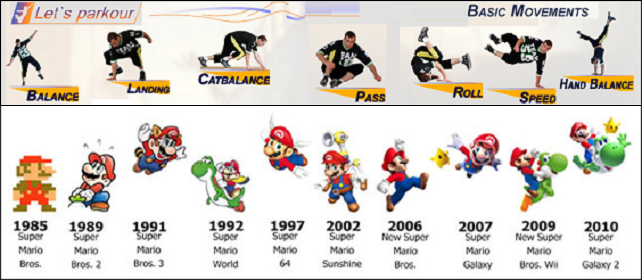
According to 25 Years of Super Mario Bros: A Look Back Through Mushroom Kingdom History, from which I grabbed the Mario Bros portion of the graphic at the foot of this page, “Since 1985’s release of the second-most selling console game of all-time, over 200 Nintendo titles have featured the eponymous Mario Bros” — on which I’ve played perhaps three or four levels of one or two early versions.

The Super Mario Bros side-scrollers (image above, left) are the work of the brilliant Shigeru Miyamoto, and part of what I find so fascinating about them is the way in which they resemble the mind-blowing practice known as Parcours (image, right), which apparently developed from the work of one David Belle, born in 1973 — who would have been 12 when the first Super Mario Bros game came out.

Let’s take a look at Super Mario Bros and Parcours, and then move on to the issue of parcours for the adventuring mind.

**

First, for those of you who don’t remember them, here’s what the early Mario Bros games were like…

I don’t think there’s much doubt that the Super Mario Bros games are essentially digital versions of Parcours, and you can see by comparing the video above with this next one:

Finally, this video from Jesse La Flair confirms the comnnection, at least in the mind of one top flight traceur:

**

My own question is: what would a mental parcours game look like?

I was thinking for a while last week about what a Mario-like side-scrolling game of mental parcours would be like. We already have the “creative leap” side pretty well covered with the various variants of Sembl we’ll be developing, so I thought about other types of mental agility, and what a game might look like if it incorporated a bunch of them — induction? deduction? causality? the sorts of pattern skills that go into IQ tests? — in a side-scroller with playful graphics…

Two things:

One: my friend Derek Robinson pretty quickly informed me that the actual build of such a game would be enormously complex — I resisted him, saying I wasn’t aiming to build the entire game, just to get the idea down on paper to see whether we could get the initial phases funded…

And two: I ran across Lumosity:

Let’s just say Lumosity seems to have a variety of cognitive skills well in hand, which leaves me free once again to concentrate on what Derek calls the mind’s opposable thumb.

**

That’s a brilliant concept, I think, and gets to the heart of what we’re working on with Sembl.

The various other conceptual skills that essentially add up to linear thinking — Zen calls it vertical thinking, see this helpful diagram — are important, and well-studied. They work best where what you are talking about is quantifiable and amenable to logic and cause and effect analysis, and is explored within fields, not across them.

But lo, that approach may help you quantify the trees and evaluate them as board feet of lumber, but consistently misses the forest, the greater context, the big picture –the combined systemic impact of many tiny details, insects, mosses, the tree as ecosystem within an ecosystem, and the ecosystems within that – the time scale, the slow growth, the root system, the transformation of mulch into nourishment, the sudden spurt of tiny leaves in spring, the photosynthesis — and the human wonder — the glory, dappled sunlight on fallen leaves, the shelter afforded to lovers by a weeping willow (I’m thinking of one willow in an Oxford college garden, but I’m time-traveling and I digress) – the poetry, of beech and birch, copper beech and silver birch, the trees, the words, the metals…

Context, quality, complexity, systems, dynamics, process, simplicity, value, passion, poetry – these are the things linear thinking has problems with. Poetry, passion, value, simplicity, process, dynamics, systems, complexity, quality, context – these are the things horizontal thinking does best.

**

That’s it.

Oh, and hey — just because I like the tiny antics they’re getting up to in the graphics:
Let not thy left hand know what thy right hand doeth

Tuesday, October 2nd, 2012

[ by Charles Cameron — this post is about comparisons — what you make of them, and what they make of you, death calculus, and Handel ]
.


.

Scraped from my morning read, these two quotes — a tweeted headline from Breitbart and a gobbit of the Jerusalem Post — neatly illustrate a paradox I’ve been wrestling with, the way more profound souls wrestle with angels [link is to Rilke].

It’s the paradox of comparison.

**

On the one hand, I can barely imagine what it would be like to build — with, say, enough funds for a latter-day Manhattan Project — a Department whose job it was to monitor all activities and ensure even-handedness in the allocation of resources.

So that not ever would a Presidential aide on vacation receive a security detail until each and every ambassador had an equivalent force of marines around them at any given moment, in embassy or out.

I mean, what about consuls, or CIA heads of station — are they ambassadorial enough? Members of the cabinet on vacation? Members of the National Security Council? How far do we need to go with our even-handedness? Is Benghazi different from London? Londonistan?

How would one possibly assure oneself that no “hand” of government, left, right, center, upper, lower, or oblique to all of the above, ever arranged things in a way that compared foolishly with the way some other “hand” of government had arranged something more or less similar?

**

Let’s go to what my friend Bryan Alexander calls the death calculus. Since we’re interested in terrorism here, I’ll pull quotes from a couple of pieces that you can read in full if this topic interests you. Two paras from TomDispatch:

In 2008, 14,180 Americans were murdered, according to the FBI. In that year, there were 34,017 fatal vehicle crashes in the U.S. and, so the U.S. Fire Administration tells us, 3,320 deaths by fire. More than 11,000 Americans died of the swine flu between April and mid-December 2009, according to the Centers for Disease Control and Prevention; on average, a staggering 443,600 Americans die yearly of illnesses related to tobacco use, reports the American Cancer Society;5,000 Americans die annually from food-borne diseases; an estimated 1,760children died from abuse or neglect in 2007; and the next year, 560 Americans died of weather-related conditions, according to the National Weather Service, including 126 from tornadoes, 67 from rip tides, 58 from flash floods, 27 from lightning, 27 from avalanches, and 1 from a dust devil.

and:

The now-infamous Northwest Airlines Flight 253, carrying Umar Farouk Abdulmutallab and his bomb-laden underwear toward Detroit on Christmas Day 2009, had 290 passengers and crew, all of whom survived. Had the inept Abdulmutallab actually succeeded, the death toll would not have equaled the 324 traffic fatalities in Nevada in 2008; while the destruction of four Flight 253s from terrorism would not have equaled New York State’s 2008 traffic death toll of1,231, 341 of whom, or 51 more than those on Flight 253, were classified as “alcohol-impaired fatalities.”

Two paras from a Salon piece [copied here sans links and emphases]:

“The number of people worldwide who are killed by Muslim-type terrorists, Al Qaeda wannabes, is maybe a few hundred outside of war zones. It’s basically the same number of people who die drowning in the bathtub each year,” said John Mueller, an Ohio State University professor who has written extensively about the balance between threat and expenditures in fighting terrorism.

Last year, McClatchy characterized this threat in similar terms: “undoubtedly more American citizens died overseas from traffic accidents or intestinal illnesses than from terrorism.” The March, 2011, Harper’s Index expressed the point this way: “Number of American civilians who died worldwide in terrorist attacks last year: 8 — Minimum number who died after being struck by lightning: 29.” That’s the threat in the name of which a vast domestic Security State is constructed, wars and other attacks are and continue to be launched, and trillions of dollars are transferred to the private security and defense contracting industry at exactly the time that Americans — even as they face massive wealth inequality — are told that they must sacrifice basic economic security because of budgetary constraints.

**

My points?

On the one hand, that the world is far too complex to avoid disparities that can draw mockery down on the heads of those one might wish to mock.

And on the other, that comparisons also have an invaluable role to play in giving us a sense of the relative peaks and valleys of the terrain we live in — and may be literally or metaphorically mountaintop removal / valley fill coal mining in preparation for our children’s children…

**

Here’s a “DoubleQuote” for you:

Or for the musically inclined:

Now there’s a fascinating comparison (between the mining and the music) that doesn’t tell you much. Or does it?

**

Onwards to the issue of that sacred plateau in Jerusalem, featured as my second “reading for the day” at the top of this post.

It appears that you can be arrested for carrying a concealed knife on the Noble Sanctuary — or tallit or tefillin on Temple Mount — same place, different perspective.

That’s the sort of comparison that makes me catch my breath with wonder.

As the Famous Thinkers School might ask, giving you a pencil and a blank sheet of paper: can you draw this conclusion?

**

The full text of Matthew 6.3 reads in the KJV:

But when thou doest alms, let not thy left hand know what thy right hand doeth:

Marangolo P and associates uses a significant variant of that verse in the title of a learned paper: Let not thy left hand know what thy right hand knoweth. The case of a patient with an infarct involving the callosal pathways.

Brain malfunctions (and brain surgeries) can provide windows of considerable interest on our human condition, as the writings of Oliver Sacks so eloquently demonstrate.

Pussy Riot VI: counterpoint and counterfactuals

Wednesday, August 22nd, 2012

[ by Charles Cameron — compare and contrast as a means of contextualizing, suggesting a tool that might be of use to the IC in any number of circumstances ]
.

In this particular case, Pussy Riot is the topic, comparison with is the method, and some form of graphic the appropriate medium around which to build a presentation.


.

Both these statements have been made recently by Catholic priests, and they portray opposite positions on the matter. Again, it is my sense that the graphical representation of these remarks calls forth in the reader both similarities and differences, as Cath Styles nicely put it:

A general principle can be distilled from this. Perhaps: In the very moment we identify a similarity between two objects, we recognise their difference. In other words, the process of drawing two things together creates an equal opposite force that draws attention to their natural distance. So the act of seeking resemblance – consistency, or patterns – simultaneously renders visible the inconsistencies, the structures and textures of our social world. And the greater the conceptual distance between the two likened objects, the more interesting the likening – and the greater the understanding to be found.

From my point of view, the direct juxtaposition in a DoubleQuote or equivalent format does the job nicely when two fairly simple quotes are considered together.

Things can get more complex than that when a variety of discourses come together, but the same general principles can still be applied, and a graphical representation sought.

Bearing Cath’s point in mind, then, I’d like to examine some of the ways in which people have contextualized the Pussy Riot event in the Cathedral with counterfactual instances (ie by contrasting it with instances that in some ways parallel the factual instance, but in “what if” style alternate universes.

**

Here, then, are the documents I’ll be drawing on. First, from Khanya, a blog I’ve praised in an earlier post:

An Amnesty International petition site (Take Action Now – Amnesty International USA) urges people to send an email with the following text to the Russian prosecuting authorities:

I respectfully urge you to drop the charges of hooliganism and immediately and unconditionally release Maria Alekhina, Ekaterina Samutsevich and Nadezhda Tolokonnikova. Furthermore, I call on you to immediately and impartially investigate threats received by the family members and lawyers of the three women and, if necessary, ensure their protection. Whether or not the women were involved in the performance in the cathedral, freedom of expression is a human right under Article 19 of the Universal Declaration of Human Rights, and no one should be jailed for the peaceful exercise of this right. Thank you for your attention to this serious matter.

Now imagine, for a moment, that the boot was on the other foot.

Imagine that it was a Western European country, and that the act of “hooliganism” concerned was daubing swastikas on a synagogue. If that were the case, would Amnesty International be urging its members and the general public to send messages saying:

Whether or not the women were involved in writing the graffiti on the synagogue, freedom of expression is a human right under Article 19 of the Universal Declaration of Human Rights, and no one should be jailed for the peaceful exercise of this right. Thank you for your attention to this serious matter.

I think that in Western Europe such a petition would be widely regarded as “hate speech”, and “anti-Semitic”, as would the graffiti. So why does Amnesty International think that it is OK to encourage people to send such things to Russia?

And then, of course, one can put the boot back on the first foot again. If these same three young women had daubed graffiti on a synagogue in Moscow, would they have been prosecuted for the same offence and in the same way as they have been in this case?

So there are differences between Russian culture and Western culture, and differences within Russian and Western culture.

That’s a pretty impressive example of the counterfactual genre — and doubly so, it seems to me, because of the final reversal, the twist in its tail.

**

Next, here’s another quote from the same Fr. Hogan we quoted above. In this case, the mosque is used as the primary contrast to the cathedral, but the synagogue also makes an appearance — and Fr. Hogan throws at least one other interesting contrast into the mix — comparing Putin and western leaders:

Protest is fine, the day will come, I’m sure, and not too far away either I think, when we Christians may be protesting against our governments and engaging in civil disobedience, but protest must always respect others and the faith of others. As some have asked, would these ladies do the same in a mosque? They would not for two reasons – it would not be politically incorrect and they might end up being stoned to death before they had a chance to get out of the building. Is it legitimate to mock faith and descecrate places held sacred by people in order to protest against a political regime?

Some will say these ladies did so because the Orthodox Church is too close to the Russian government. Okay, well Judaism is considered by many to be too close to Zionism and the State of Israel – well, where are the lewd feminists dancing in the synagogues mocking Abraham and Moses? They are not there because they know it is inappropriate and wrong – just as it is inappropriate and wrong to desecrate a place of Christian worship.

What interests me here is that he uses multiple counterfactual contrasts, which perhaps makes his paragraphs a little less elegant than Khanya’s — but interesting in the complexity it adds to his analysis.

I’ll return to that remark about “we Christians may be protesting against our government” later.

**

My last text — and I’ve quoted it here on ZP before — is Josh Shahryar‘s tweet:

I wonder if #PussyRiot would get so much attention if they were a band of men called #DickMob.

That comes at the Pussy Riot issue from a completely different angle, and is very elegantly done.

**

Our next task is to see what oppositions we can find in these three statements.

  • Kanya uses Amnesty’s concerns regarding freedom of expression vs appropriateness of expression by comparing the cathedral incident with women “in a Western European country” daubing swastikas on a synagogue, thus also proposing a comparison between eastern and western European mores.
  • Then, in a reversal, Kanya uses the same cathedral incident vs daubing graffiti on a synagogue specifically in Moscow this time, to explore the degree to which Moscow might be more tolerant of anti-Semitism than of anti-Orthodoxy, both in terms of public opinion and via political and legal systems.
  • Fr Hogan’s question poses a contrast between the cathedral (and Orthodoxy and Putin) and a hypothetical mosque (and Islam and, say, a militant faction in Pakistan).
  • His second comparison is between two church-and-state collaborations, Orthodoxy with the Russian state and Judaism with the Zionist, and again the question he raises is whether similar behavior in a parallel situation would be tolerable.
  • Then there’s his intriguing third comparison, which I said I’d return to, in which he suggests that the “not too far” future may hold the need for civil disobedience and anti-government protests by Christians – in the west presumably. Fr Hogan hails from Ireland, which has had its own share of Church troubles and no longer wields the power it once did over Irish people and politics. Present day Russia, then, contrasted with a hypothetical future Ireland.
  • But the malaise is more widespread, and to add a comparison of my own into the pot, Fr Hogan’s remark reminds me of something Cardinal George of Chicago said not so long ago, looking at the looming battle between an increasingly secular state and his own moral stances on such issues as abortion and same sex marriage:

    I expect to die in bed, my successor will die in prison and his successor will die a martyr in the public square.

  • But that’s oblique to our narrative here…

  • Finally, there’s Josh Shahryar’s contrast between a factual girl band named Pussy Riot and a counterfactual boy band called DickMob.

**

What sort of a graphic would allow us to rotate all these polarities in our minds?

One answer is a Sembl-type game board — see design below — but with concepts rather thyan objects in the “positions” on the board:

But I’m also after other possibilities here. What would our fine artists, engineers, architects, dancers, cartographers, logicians, musicians, data visualizers and computer scientists suggest?

**

It would of course be nice if we could wrap this whole business of counterfactuals with a nice British cuppa tea, eh? Perhaps we can…

From a comment in the Guardian:

With the best will in the world I can’t see that if a bunch of noisy youngsters stood up in Westminster Abbey and screamed obscenities about the Queen to the accompaniment of electric guitars turned up to eleven, that the rest of the world would throw up its hands in horror if they were first stopped and then charged with an offence.

What’s that? We endured the Blitz, for goodness sake!

Writer’s Block

Friday, August 3rd, 2012

Lately, I have been struggling with a moderate case of writer’s block.

Some of the problem stems from a growing weariness of returning time and again to limited number of subjects.  I admire those who can drill a very narrow topical field day in a day out , but to me that feels like a rut and a rut soon leads to boredom.  Consequently, I now find myself staring at a computer screen rather more often than typing away at the keyboard and not enjoying it.

A second problem, I suspect, is too often trying to persevere in writing in an unsuitable, chaotic, environment full of distractions. As anyone who writes with seriousness knows, loved ones will ignore you for hours on end, but should you sit down to write anything you will suddenly become a magnet for children, the dog, your spouse, phone calls from old friends and neighbors at the door . Stringing words coherently becomes difficult because writing is an art, not a component of multitasking.

So today, I did something different.

Instead of sitting at my desk, I went outside and sat at the patio table in the sun and fresh air. The electronic devices were left inside, but I brought a long, yellow legal pad and a medium thickness blue sharpie ( I’d have preferred black). I lit a Cohiba and had an ice cold beer with me and a couple of books, in case I felt like reading ( The Makers of Strategy and Everitt’s bio of  Hadrian). It was unusually quiet.

And then I began to write. Bullet points, notes, phrases, diagrams interspersed with some sketching. Some notes were connected to others with arrows. Ideas were flowing (some were crossed out later) and the rough approximation of an argument took shape. It was’t a moment of epiphany – just a solid, uninterrupted, focused, productive hour of writing and deep reflection that filled a couple of pages on my legal pad. How uncommon that has become.

And after that, I felt much better.

The most important post about Aurora doesn’t mention Aurora

Thursday, July 26th, 2012

[ by Charles Cameron — futurism, making, printing, printable guns, time of your life, intersecting timelines ]
.


.

We only have one mouth, so we’re linear speakers, confined to speaking one thought at a time. And we only have one body, so we tend to think of our lives along a single timeline — although other people with their own uncontolled timelines are constantly crisscrossing our paths and making things better (hey, thanks!) or worse (damn it!) or just plain interesting (okaaay) or boring (unhh)… but the world itself includes the crisscrossing of all those paths in its own timeline, and what this means in practice is that linear thinking doesn’t catch the drift.

Which is why it’s interesting that the most important blog-piece on the Aurora tragedy today doesn’t mention Aurora once.

It’s by John Robb, and it’s about printing these:

And it’s important because the world-line it talks about will cross the path of the Columbine > Virginia Tech > Utøya > Aurora timeline at some point.

**

It begins like this:

Printing Weapons at Home for Fun and Mayhem

.
It’s now possible to print functional weapons at home. This is going to progress rapidly now.

Think: global file sharing of designs for servicable weapons, from pistols on up to ?, that can be printed at home. What you can print — from the materials to the size/quality of the object to the completeness (snap together construction) — is already moving forward quickly. The weapons effort will just be along for the ride.

But read the whole thing. And read Duncan Kinder and the other comments there, too.

**

That’s John Robb’s message for the day — and apart from the fact that it talks about reliable home-printed weaponry, a line of development which will I suggest will cross that Columbine > Virginia Tech > Utøya > Aurora line some time in the not too distant, there’s one unremarkable little remark in there that’s well worth remarking on. John says:

The weapons effort will just be along for the ride.

**

Along for the ride. Side effects. Adverse reactions. Serendipity. Unintended consequences. Unknown unknowns. Black swans.

We have a variety of terms we use for the things that blindside us, for better or worse. Our future is full of them, our past is littered with the results…

So it’s interesting that if a bunch of us are thinking along the broad line of maker-printables, a few will be thinking printable guns. A bunch of us will be making films, a bunch more will be going to the movies to see them. And some will have far darker thoughts in mind.

**

Crisscross your thinking. Weave your world with care for the future, please.


Switch to our mobile site