zenpundit.com » music

Archive for the ‘music’ Category

Sunday surprise: Eucharist above, below and beyond

Sunday, July 15th, 2018

[ by Charles Cameron — have you time to spare for a little beauty? ]
.

Prof Emily Steiner of the University of Pennsylvania posted this image, which she described as of the “Stunning mosaics in the apse of S. Maria in Trastevere, attributed to Pietro Cavallini (c.1240-1330)”:
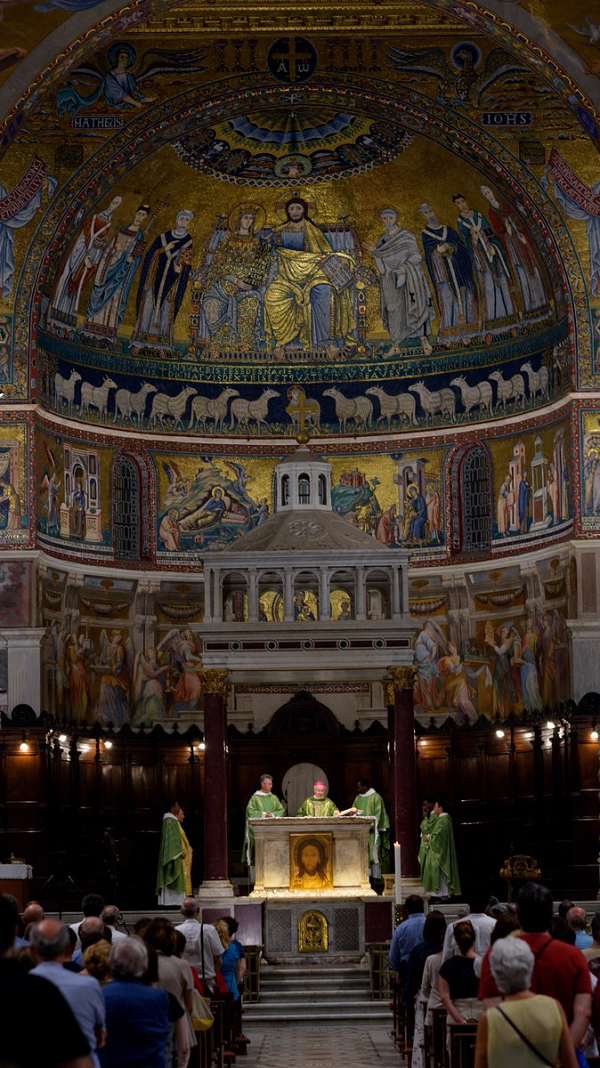
Dr Steiner attributed the photo to “the talented @pdecherney” — her colleague at U PEnn, Dr Peter Decherney.

**

When I first saw this image, only the top half was visible on my screen, a fine, and I’m no expert, possibly world renowned, and yes, as Dr Steiner says, stunning mosaic of Christos Pantokrator, Christ the ruler of the universe if I’m not mistaken — and again, I’m no expert, and willing to take instruction.

But stunning, yes. Christ, a mosaic, stunning. Art at the service of praise, beauty as a window on the divine, .

And then, perhaps an hour later, but lapses of time are mended in this realm, I saw the whole image, sized to fit my screen.

**

And thus the bottom half —

— with, brightly lit, even moreso if it were possible than the Christ in mosaic above it is, a small table — an altar, with three priests, and more in the wings, celebrating what looks to be the Eucharist — thought I suppose it might also be Vespers — and again, some expert could say whether the central celebrant is, by his zucchetto or skullcap, a cardinal, bishop, or maybe monsignor.

No matter the celebrant’s rank, he is, as celebrant, at the vanishing point — both the central point of attention photographically, and the point where the priest acts in the person of Christ, in persona Christi, thus himself, his persona, vanishing at the vanishing point.

Do this in memory of me, Christ said to his disciples at the Last Supper before his crucifixion, in words of sacrifice, previsioning his body about to be broken on the cross the next day — and down the centuries priests have broken bread as he did, speaking his words in his place, Take, eat, this is my body.

In the consecration, with these wrds, bread and wine become invisibly the body and blood of Christ, which we may remember, digest and allow to transform us.

It is this which makes the celebration of the Eucharist, in Catholic terms, “the source and summit of the Christian life”.

**

And then, between this focus on the priest celebrant below, and the Christ all-ruling above, there is a mysterious relationship, each reflecting the other as in duet of mirrors — above, below and I invite you to envision, beyond.

Taking us, to switch religious traditions.. into the upper room with that one and self-same Christ

**

Eucharist: literally, thanksgiving!

May your Sunday bring you cause for such thanksgiving..

Sunday surprise, the selfsame song

Sunday, July 8th, 2018

[ by Charles Cameron — whether willed by the brain or torn from the heart, the one, same cry for mercy — in chant, by Bach, and by Ray Charles & BB king ]
.

A stranger in my Twitter-stream just tweeted a link to a current Australian report on an opening window for rescue operations for the boys trapped in that cave in norther Thailand, two and a half miles under ground:

[ the video in this tweet is from a continually updated news feed — at time of writing, the rescue op was just beginning ]

Fate may be fate, prayer may or may not influence events — perhaps prayer may only help us, the watching world ouiside that cave, those circumstances, that peril — the urge to pray is no respecter of particular religions, Christians, Buddhists, Atheists, we all may feel the instinct to pray.

The prayer is the most basic cry, as we shall see in three versions: the timeless Gregorian chant, the beauty of the Erbarme Dich from Bach‘s Matthew Passion, and that selfsame song as Ray Charles sings it with BB King.

**

Gregorian chant:

Kyrie XI [ Lord, Have mercy ] from the choir of St Pierre de Solesmes, my favorite haunt when I was seventeen, with the greatest chant scholars and choir in the world:

That floating, swooping melody is characteristic of the chant.

**

Erbarme dich, mein Gott [ “Have mercy Lord, My God, for the sake of my tears” ] by JS Bach

If we lose have mercy, Lord from our conceptual vocabulary, we lose a higher octave of hope, of the necessity of surrender.

Erbarme Dich may be the single sweetest moment in Bach‘s The Matthew Passion, itself arguably the greatest piece of church music ever written — a monumental, gloriously beautiful, grief-stricken work.

**

Pure blues: Sinner’s prayer, Ray Charles and BB King:

If neither Bach nor the chant speak to you, perhaps the blues will — and if all three touch you, how wonderful the variety of expressions of the one prayer:

Lord please have mercy .. have mercy if you please..

**

Footnote: Other unforgettable versions:

  • JS Bach, Kyrie from the B Minor Mass
  • WA Mozart, Kyrie from the Requiem Mass
  • **

    Lord have mercy on the boys in the cave — knowing that the rescue task will be arduous, we ask mercy with hope and a readiness to surrender, to greet whatever outcome with our hearts flung open to grief or joy as the case may be.

    The Trojan War, revisited

    Saturday, June 30th, 2018

    [ by Charles Cameron — a feminist reading — The Trojan wars resemble ISIS among the Yazidi ]
    .

    Rebecca Solnit is an acute, insightful writer, who first noted the genre of unlistening overtalk that came to be known as mansplaining — her example being men who praise and explain the brilliance of a book for fifteen or twenty minutes, based on having read a review, without pausing to find out they are addressing the author in question.

    During my research for incels (for an Incels & Rajneeshis post that I still hope to complete one of these days), I ran across her Guardian post, A broken idea of sex is flourishing. Blame capitalism.

    Her key expositional para, IMO, is this one:

    Feminism and capitalism are at odds, if under the one women are people and under the other they are property. Despite half a century of feminist reform and revolution, sex is still often understood through the models capitalism provides. Sex is a transaction; men’s status is enhanced by racking up transactions, as though they were poker chips.

    s

    That struck me, besides its meaning, for its poker chip metaphor. But it was the para immediately precesing it that I wanted to bring here to ZP, since it described the Trojan War in a way I had not seen before:

    The Trojan war begins when Trojan Paris kidnaps Helen and keeps her as a sex slave. During the war to get Helen back, Achilles captures Queen Briseis and keeps her as a sex slave after slaying her husband and brothers (and slaying someone’s whole family is generally pretty anti-aphrodisiac). His comrade in arms Agamemnon has some sex slaves of his own, including the prophetess Cassandra, cursed by Apollo for refusing to have sex with him. Read from the point of view of the women, the Trojan wars resemble ISIS among the Yazidi.

    That really brings things classical and venerable home to us, occupied as we are with the contemporary and terrible:

    The Trojan wars resemble ISIS among the Yazidi.

    **

    This is one of those posts where I expose my own ignorance, and pray for a lively comments section.

    What say you? Is this a misreading? Truth, already widely known? Or an original and useful, perhaps provocative, insight?

    Duel and duet? I dunno.

    Wednesday, June 27th, 2018

    [ by Charles Cameron — includes a rationale for my recurring arts orbits on Zenpundit, a strategy site ]
    .

    Conflict:

    Stop, Do Not Go On, from The Gospel At Colonus.

    Oedipus — played here by Clarence Fountain and the Blind Boys from Alabama — although accursed, has been promised an eventual resting place to which he will bring blessings, and is accordingly attempting to enter Colonus — resisted by the good people there — represented by Sam Butler and the Soul Stirrers — on the grounds that he is Oedipus, who killed his father and slept with his mother, a man accursed..

    **

    Love in union and separation:

    So very different from the battle of the bands above, yet such a close twin..

    Etta James & Dr.John (Dr John the Night Tripper) sing and enact I’d Rather Go Blind — a love song of great beauty and cruelty.. (he’ll never leave, he’s walking away)..

    There, that’s the music.

    **

    Now, strategy and conflict:

    Strategy has to do with the navigation of conflict, and since this blog is concerned with strategy, and our lives for that matter with the navigation of conflict, I try to remember strategy and conflict even during my flights (or fugues) into glass bead games, music and poetry — so that I may stray far from our central theme, but as with certain comets, always return on an elliptical orbit, no matter how extended.

    My sense that forms such as parallelism (rhyme, fugue or canon) and the ouroboros serpent (infinity symbol, paradox) are markers (when found in analytic materials) of likely analytical significance is also tied in with OSINT work — although the patterns themselves extend across the cultural, anthropological, psychological, historical, religious and artistic realms. It is in this spirit, which I seldom spell out, but which guides my writings here, that I offer the above pairing of musical events, each of them theatrical, dealing with human relations in conflict and in love respectively, one with an overt clash over territory, the other with love in its two phases of union and separation.

    It seems, in any case, that some at least of Zenpundit‘s original hard core strategists, as well as those whose interest was equally or more in creativity, which we at ZP “minor” in — and which is relevant as per Adm. Stavridis, Safranski and others to keeping strategic thinking cutting edge — have been kind enough to follow along with some or all of my eccentric orbiting, and I thank them / you.

    **

    Enjoy, Fcamer, but also ponder.. Or should I say, Ponder, then –but hey, also enjoy!

    An Invitation to the Church of the Open Question

    Saturday, June 23rd, 2018

    [ by Charles Cameron — announcing a new blog for matters quasi-religious, poetical ]
    .

    The Church of the Open Question is the name of my church.

    I have held this domain name, churchoftheopenquestion.com, for some years now, and a blog-church by that name should be coming online shortly — this is its first announcement.

    My church bears that name because it expressly questions dogmatic formulations, while encourageing depthful exploration of the possible resonances of dogma that might go missing if all such formulations are dismissed out of hand.

    Push open a question, leave it open, and what you have is possibilities.

    The marvelous, beautiful, well-spoken Elizabeth Mattis Namgyel has titled her book on Tibetan Madhyamaka philosophy, The Power of an Open Question: The Buddha’s Path to Freedom, and I find myself to have come by a natural unfolding to a position very sympathetic to that which she has attained by the disciplined enterprise of Madhyamaka Buddhism under the tutelage of her husband, Lama Dzigar Kongtrül — a delightful homecoming for me.

    I view my church — and the swing-doors that are its central feature — as offering a place where, for instance, Catholics who are leaving Catholicism may find certain doctrines illuminated as imaginative or poetic vehicles for wonder, which they can then carrry with them as spiritual values in an overwhelmingly secular and monteized societty, while those approaching the Church from outside it may find means of delighting in poetic or imaginative readings of texts that, stated in plain prose as definitive beliefs, are difficult indeed to swallow.

    **

    As an example, here’s a poem I wrote in this spirit, exploring the central symbolism of thr Christmas story..

    Christmas for Buddhists

    Suppose the full radiance inhabiting all things,
    on the specific occasion we now celebrate,
    finding itself as fond of narrative as of symmetry,
    of emptiness as of fullness, decided
    for the sake of teaching its selves a thing
    or eight, to take on a newborn form,
    while letting its nature shine forth visible
    to its mum, sundry animals, three visiting kings

    and an assortment of invisible winged beings —
    what better place than the animal stall
    outside an inn, where no room was available
    for a pregnant visitor to give birth, could
    that master of story, Original Face, choose,
    to tell humanity: humility is the necessary virtue?

    or it’s close cousin, exploring the Mass:

    To suppose the Eucharist

    Suppose the hypothetical all of everything
    in unspooling itself chose to exhibit itself in
    one human, suppose further all the sun’s
    light were caught in wheat and baked into
    bread, all the world’s pains and passions
    crushed like grapes into wine, suppose the
    one person took loaf and cup and with
    word and gesture raised them blood, body

    of his own self to be supped and sipped,
    thus woven into his one flesh, blood, mind —
    just when his flesh is torn, blood spills —
    suppose then that his mind to love were to
    entrain this new body of many bodies to
    heal with all radiance each instance of pain..

    That one certainly owes something to Teilhard de Chardin, as the first may to Thomas Merton — this, then, will be above all a gathering or congregation of friends..

    **

    I’m encouraged by Dr Jordan Peterson‘s claim that he “wanted to establish a church .. in which he would deliver sermons every Sunday” — although in my own case, every now and then will have to substitute for every Sunday.

    I have a first sermon lined up, too, in which I want to ask “What did Mozart see as Christ‘s life” when chosing the words “Ave verum corpus natum” to set to some of his most wondrous music? The answer’s a bit surprising, and suggestive of the many devotional moods the contemplation of that life can give rise to..

    Coming shortly.. Clapton, too. And Anthony Bourdain.


    Switch to our mobile site
