[ by Charles Cameron — Blake, Britain, and Blake again — among the angels ]
.
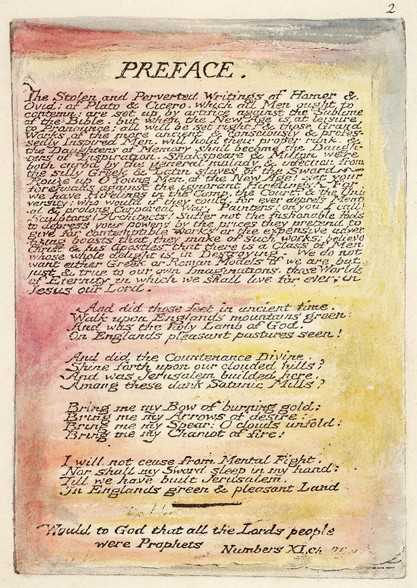
The irrepressible William Blake can’t keep himself from coloring outside the words:
**
Okay, here’s the poem as poem — a very curious poem celebrating “arrows of desire” to have made its way into the hymnary of England, its royalty, and the Proms:
And did those feet in ancient time.
Walk upon Englands mountains green:
And was the holy Lamb of God,
On Englands pleasant pastures seen!
And did the Countenance Divine,
Shine forth upon our clouded hills?
And was Jerusalem builded here,
Among these dark Satanic Mills?
Bring me my Bow of burning gold;
Bring me my Arrows of desire:
Bring me my Spear: O clouds unfold!
Bring me my Chariot of fire!
I will not cease from Mental Fight,
Nor shall my Sword sleep in my hand:
Till we have built Jerusalem,
In Englands green & pleasant Land
Happily the United States — whose birthday is tomorrow — didn’t exactly lose ye olde English tradition, as is readily apparent in this rendition — this one by the West Point Cadet Glee Club:
**
Oops, but England, my England — see what has become of it!
Like every generation since Ahab begat Behab right in the beginning, I fear for our young, even those now middle-aged, I fear for their young.. I fear for the future so fast spiraling out of our past.
**
Blake himself had a high esteem of his work and purpose. He wrote:
I am more famed in Heaven for my works than I could well conceive. In my Brain are studies & Chambers filled with books & pictures of old, which I wrote & painted in ages of Eternity before my mortal life; & those works are the delight & Study of Archangels.
And he could paint the archangels’ likenesses by memory, too, with angelic felicity:
**
A tip-of-the-hat here to David Auerbach.
And a shout-out to Michael Horovitz, who published my first poems in book form in his richly Blake-influenced 1969 Penguin anthology, Children of Albion.
— however, a polarization of youth against the elderly is hardly an improvement. There’s something intangible the Leavers are loving, and perhaps Blake‘s Jerusalem, sung at the wedding of Kate Middleton and Prince William, captures that love without the hateful rhetoric that has accompanied Farrage‘s side of the exit campaign:
**
Speaking of which, I’m no great admirer of Bill Maher, who is too snide to be considered much of a wit in my book — but this little jewel of an aphorism may be the best haiku-like summation of Remainer’s regret I’ve seen.
Bill Maher line last night: Pride and Prejudice beat out Sense and Sensibility in #Brexit
Civilization requires civility — and polarization seems to encourage incivility on both sides of many, many issues. Sorry, folks.
**
My friend Michael Robinson posted this elegaic comment the other day:
Flabbergasted | “The fearmongering and outright lies of Boris Johnson, Michael Gove, Nigel Farage, The Sun and the Daily Mail have won. The UK, Europe, the west and the world are damaged. The UK is diminished and seems likely soon to be divided. Europe has lost its second-biggest and most outward-looking power. The hinge between the EU and the English-speaking powers has been snapped. This is probably the most disastrous single event in British history since the second world war. …
The UK’s decision to join the EU was taken for sound reasons. Its decision to leave was not. It is a choice to turn its back on the great effort to heal Europe’s historical divisions. This is, for me, among the saddest of hours. ” (Martin Wolf FT)
[ by Charles Cameron — religions taking other religions apart, stone by stone, image by image, song by song ]
.
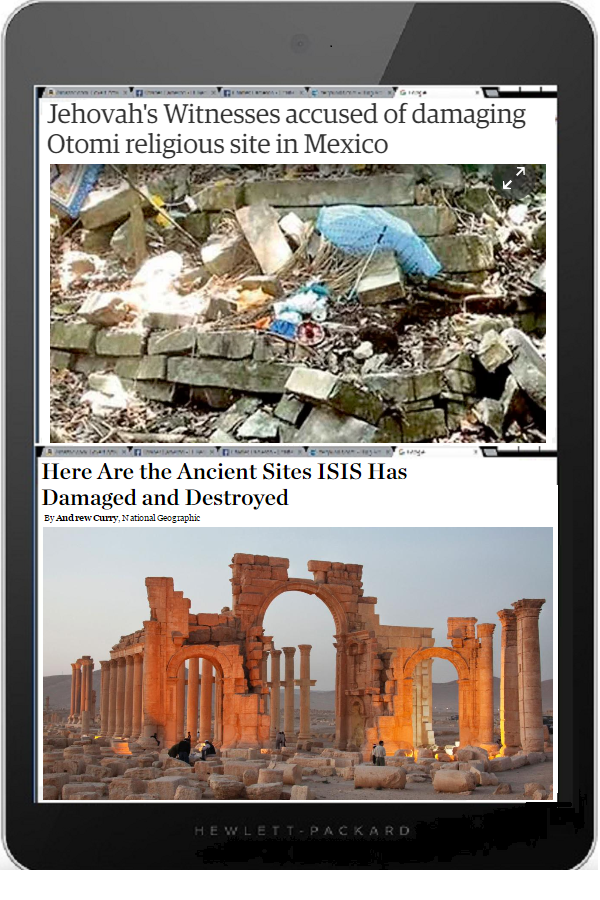
Some recently converted Jehovah’s Witnesses appear to have destroyed the altars of indigenous Otomi people in Mexico, an anthopologist has stated:
Assailants have damaged an ancient Otomi Indian religious site in Mexico, toppling stone structures used as altars, breaking carved stones and scattering offerings of flowers, fruit and paintings at the remote mountain shrine known as Mayonihka or Mexico Chiquito. [ .. ]
“I don’t know what religion they belong to, but they destroyed several images that were there,” said Daniel Garcia, the municipal secretary of the nearby township of San Bartolo Tutotepec. “The thing is, there are some religions that don’t believe in using idols.”
Luis Perez Lugo, a professor at the University of Chapingo, visited the site in May and talked to residents of a nearby hamlet, El Pinal, whose residents said they had carried out the attack.
“I was there, and the Jehovah’s Witnesses said they had done it,” Perez Lugo said, noting some were recent converts to the religion who used to go to the site for Otomi ceremonies.
See upper panel, below:
In the lower panel, above, we see a detail from a National Geographic listing of sites attacked by the Islamic State. Three quick notes:
the JWs, if they were JWs, were recent converts; converts often have a zeal all their own
the IS, like the Taliban at Bamiyan, destroys ancient religious sites even if no longer in use
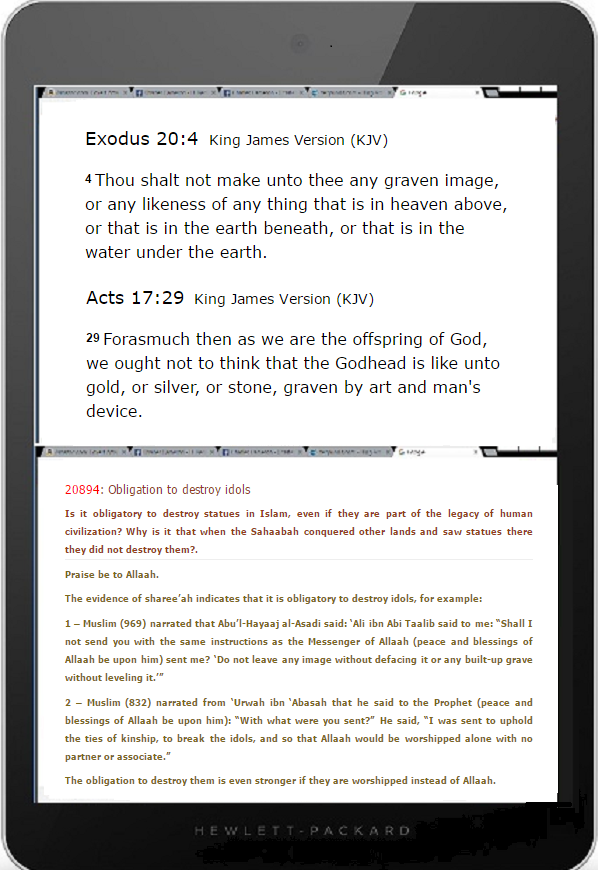
You already know this, but for the record — because Scripture:
In the upper panel, Jewish and Christian scriptures — from the Jewish Ten Commandments in Exodus, and St Paul‘s address to the Athenians, as recounted in the Acts of the Apostles.
In the lower panel — a hard-line contemporary Islamic commentary, citing two ahadith.
**
So it’s Jehovah’s Witnesses and hard-line Muslim literalists who approve of the destruction of monuments to false gods, is that what this means?
They are not alone. In the upper panel, below, recent news of the Chinese — avowed atheists — continuing their attacks on Tibetan Buddhism, this time by mandating the dismantling of Buddhism’s largest monastic university at Larung Gar:
In the lower panel, above, we see some of what remains of the great Abbey of Glastonbury, torn down during the Dissolution of the Monasteries under King Henry VIII.
Glastonbury has strong associations with Arthurian and Christian traditions:
William Blake’s dramatic poem ‘Jerusalem’ familiar nowadays as an inspirational hymn, draws on the myth that Christ himself may have visited Glastonbury with Joseph of Arimathea and ‘walked on England’s mountains green’.
The Gospels record that Joseph of Arimathea was a wealthy follower of Christ who buried Christ’s body in his own tomb after the Crucifixion.
In the Middle Ages Joseph became connected with the Arthurian romances of Britain. He first features in Robert de Boron’s Joseph d’Arimathie, written in the twelfth century, as the Keeper of the Holy Grail. He receives the Grail (the cup used by Christ at the Last Supper) from an apparition of Jesus and sends it with his followers to Britain.
Later Arthurian legends elaborated this story and introduced the idea that Joseph himself travelled to Britain, bringing the Holy Grail with him and then burying it in a secret place, said to have been just below the Tor at the entrance to the underworld. The spring at what is known as Chalice Well is believed to flow from there. In their quests King Arthur and the Knights of the Round Table searched for the Grail.
Glastonbury retains its place in English hearts to this day, albeit in contemporary guise — it is the Yasgur’s Farm of England’s ongoing Woodstock — mud, sex, drugs, rock and all — the yearly Glastonbury Festival —
It is also — in the form of Blake‘s hymn “And did those feet in ancient time” — a part of such ceremonial events as the Last Night of the Proms — and Royal Weddings:
But more on Blake’s poem — known as Jerusalem, and taken from his preface to Milton a Poem — in an upcoming post, Creek willing.
**
Finally, what an exceptionally lovely early DoubleQUote is this, returning us to the topic of sacred places and images and their destruction:
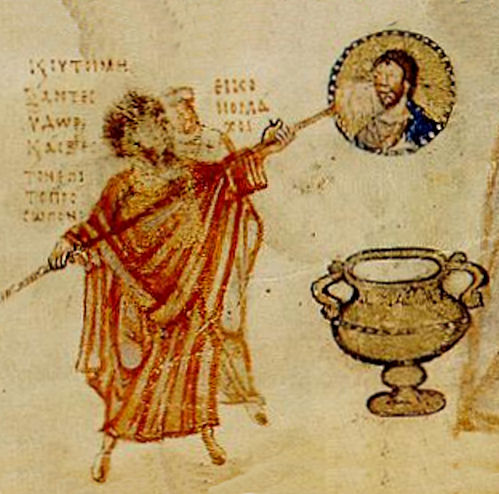
What we have here is a page from the Chludov Psalter — ask Wikipedia for that what means, I only just ran across it in the course of writing this piece — but it’s a 9th century Byzantine prayer book, illuminated with illustrations attacking the iconoclasts — those Christians who wanted to destroy icons and other Christian images for reasons not dissimilar ton those of the Taliban.
In the illustration to the right, the miniaturist illustrated the line “They gave me gall to eat; and when I was thirsty they gave me vinegar to drink” with a picture of a soldier offering Christ vinegar on a sponge attached to a pole. Below is a picture of the last Iconoclast Patriarch of Constantinople, John the Grammarian rubbing out a painting of Christ with a similar sponge attached to a pole.
Let’s take a closer look:
Both verbally and visually, then, we have a direct comparison of the Roman soldier mocking the dying Christ, and the icon-hating Patriarch erasing Christ’s image from a wall.. And they call him the Grammarian!
But let’s proceed:
John is caricatured, here as on other pages, with untidy straight hair sticking out in all directions, which was considered ridiculous by the elegant Byzantines.
No punks, apparently, these Byzantines!
And the coup de grâce? House the sacred book in a state museum..
Nikodim Kondakov hypothesized that the psalter was created in the famous monastery of St John the Studite in Constantinople. Other scholars believe that the liturgical responses it contains were only used in Hagia Sophia, and that it was therefore a product of the Imperial workshops in Constantinople, soon after the return of the Iconophiles to power in 843.
It was kept at Mount Athos until 1847, when a Russian scholar brought it to Moscow. The psalter was then acquired by Aleksey Khludov, whose name it bears today. It passed as part of the Khludov bequest to the Nikolsky Old Believer Monastery and then to the State Historical Museum.
[ by Charles Cameron — in homage to Admiral Lord Nelson turning a blind eye ]
.
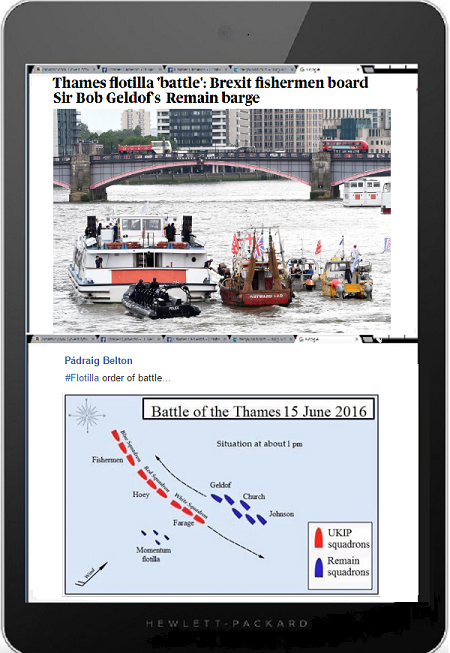
Foolish persons, having no understanding of Britain’s long and cherished history of naval warfare, nor of the contemporary relevance of the Monty Python mode of doing battle, have had the temerity to mock today’s splendid outings or innings on the Thames:
Foolish persons may be satisfied with the visual splendor depicted in the upper panel, but Zenpundit‘s core strategic following will also appreciate the order of battle below.
[ by Charles Cameron — the heart speaks for itself; the recusant pyx to truth of a higher order ]
.
**
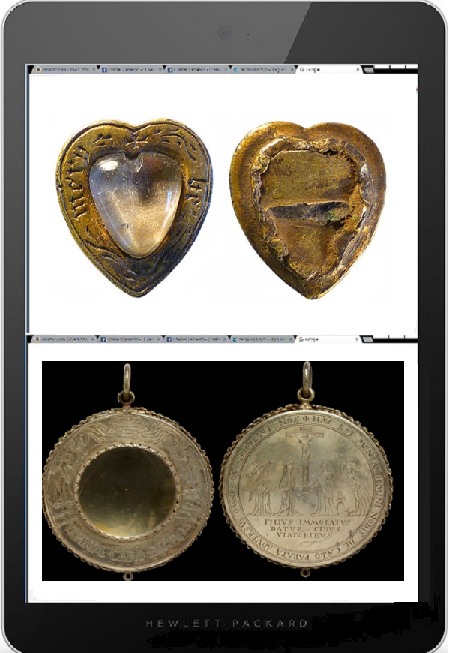
It’s the second of these that really takes my breath away.
Recusants were the British subjects who remained Catholic in faith and practice at a time when the newfangled Protestantism made that behavior a heinous offence, punishable at times by death.
It has been the life and martyrdom of the Jesuit scholar and priest Edmund Campion in Elizabeth‘s reign and under her increasingly repressive laws — as Evelyn Waugh describes him in his book of that name — which engraved in me the heroic role of the recusants, and among them of their “massing priests” and the sacrament they brought to their faithful recusant remnant.
The Catholic majority did not submissively acquiesce to Elizabeth’s scheme. Much has been written of the fate of the priests, educated and ordained abroad, who were accused of treason, tortured, then hung, drawn and quartered; but as the Catholic Church went underground the laity also began to take enormous risks. Catholic gentry opened their stately homes up to the missionary priests. Escape routes were devised, with the diminutive Jesuit layman St. Nicholas Owen leading the way in ingenious acts of carpentry. He created hiding-holes for priests, their vestments and other liturgical items, that were so effective that centuries passed before some of them were discovered. In 1620 he died in the Tower of London under torture, taking his secrets with him.
Campion himself gets to the heart of the recusant matter, though, in the first salvo of his celebrated Brag — addressed before his capture to those who might capture him, the “Right Honourable, the Lords of Her Majestie’s Privy Council”:
I confesse that I am (albeit unworthie) a priest of ye Catholike Church, and through ye great mercie of God vowed now these viii years into the Religion of the Societie of Jhesus. Hereby I have taken upon me a special kind of warfare under the banner of obedience, and eke resigned all my interest or possibilitie of wealth, honour, pleasure, and other worldlie felicitie.
Waugh emphasizes, in turn, the significance of a priest as one who says Mass, ie whose sacramental act “in the person of Christ” continues the sacrifice of Christ on Calvary, turning the very bread and wine of the offering into the body and blood of Christ, while they retain their outward and physical form, following the words of Christ at the Last Supper:Take, eat; this is My body and Drink ye all of it; For this is my blood.
It was this transformation, this transubstantiation of bread into the very body, wine into the very blood of Christ, which so frightened and infuriated the Protestants. As Waugh notes:
Whatever the sectional differences between the various Anglican groups, they were united in their resolve to stamp out this vital practice of the old religion. They struck hard at all the ancient habits of spiritual life — the rosary, devotion to Our Lady and the Saints, pilgrimages, religious art, fasting, confession, penance and the great succession of traditional holidays — but the Mass was recognized as being both the distinguishing sign and main sustenance of their opponents
To be a priest, a Jesuit, and above all the great scholar Edmund Campion SJ, was to court death for treason. But the priest’s duty was to bring that sustenance, the blessed sacrament, to the faithful — and when they could not attend Mass, it could be carried to them in just such a silver box on a string as is illustrated above. This pyx, as it was called, would have carried the body of Christ to the needy, hidden on a chain under the shirt, and on pain of most painful and drawn out death.
It is for this reason that the recusant pyx, beautiful as it may be, means so much to me, and I hope to have conveyed something of that sense to you also: seldom if ever has a container carried a freight so exalted in service to a people so spiritually hungry, under so grave a threat.
**
But to relax a little…
The situation was fraught, and increasingly so, for those who remained loyal Catholics — and yet just as there were pockets of recusants still faithful to the old ways, there were pockets of allowance made for them in certain circumstances. Waugh puts it nicely:
In many places the priest would say Mass in his own house for the Catholics before proceeding to read Morning Prayer in the parish church; occasionally, it is said, he would even bring consecrated wafers and communicate his Catholic parishioners at thesame time as he distributed to the Protestants the bread blessed according to the new rite.
Thus also Queen Elizabeth I herself favored the composer William Byrd enough that he was able to compose not only works suited to the Protestants (Anglicans) such as his four Services, but also Masses for specifically Catholic use, in three, four, and five voices.
**
Byrd for Her Protestant Majesty, Queen Elizabeth:
The Nunc dimittis (Lord, now lettest thou thy servant depart in peace) from the Great Service
Byrd the faithful Catholic, for his fellow recusants:
The Agnus Dei from the Mass for five voices, Westminster Cathedral, Pope Benedict XVI celebrating
Zenpundit is a blog dedicated to exploring the intersections of foreign policy, history, military theory, national security,strategic thinking, futurism, cognition and a number of other esoteric pursuits.