zenpundit.com » music

Archive for the ‘music’ Category

The zen of Cage II: from the A Train to Liverpool Street Station

Wednesday, August 15th, 2012

[ by Charles Cameron — two performances of Cage’s 4’33” in the New York and London Times: an interlude in my review of Where the Heart Beats, with a brief meditation on contrapuntal listening ]
.

I began to review Kay Larson‘s Where the Heart Beats in a post here last week, and am not done yet.

**

London:

photo credit: Chris Harris for the London Times

In John Cage’s sound of silence… at Liverpool Street station [London Times, subscription required], Igor Toronyi-Lalic describes performing John Cage‘s silent work 4’33” in what Cage himself — but few others — would have recognized as a concert venue, London’s Liverpool Street Station:

My rendition isn’t going down well. “This is doing my head in!” groans a drunken West Ham supporter as he watches me at the piano outside Liverpool Street station. I hear shuffling. “I can’t dance to this,” someone shouts. The restlessness is in danger of turning to anger. And I probably should have guessed it would. Presenting a performance of one of the most controversial works of music yet written in a rowdy Central London station forecourt on a Friday night on a public piano (one of several that made up the City of London Festival’s Play Me, I’m Yours artwork) was always going to be ambitious.

The work itself is hardly over before it begins — again, a paradox Cage would have enjoyed:

At my Liverpool Street Station performance, there was a symphony of rush-hour noise: commuter patter, train announcements, drunken heckling and the screeching of taxis stopping to pick up fares. Not everyone appreciated the music in this.

“When’s he going to start?” asked one lady as I finished the final movement. Others felt like they’d been had. “I thought you were going to play,” they shouted.

There’s more, and if you can get past the pay-wall you should read it all. I’ll just quote one more snippet here, though, because it leads directly into one strand of the book that I’ll be discussing in Part III of my review of Larson’s book:

“Classical musicians don’t know about Cage. They don’t perform it. We aren’t taught it in schools,” Volkov says.

But, for visual artists, Cage is a revered figure, a key part of the 1950s and 60s New York arts scene and godfather to conceptual and sound art, a connection cemented by Cage’s 40-year creative relationship with his lifelong partner, the late choreographer Merce Cunningham. “Cage worked with Rauschenberg and Cunningham and, at Black Mountain College, he mainly taught music to artists,” observes Volkov, “So, today, in art schools, they teach Cage properly. They teach his ideas.”

**

New York:

photo credit: Christian Hansen for the New York Times

From London’s Liverpool Street Station we pass to New York City’s subway system. I don’t know what it is about trains, but there you are and there you go. Or perhaps the transit is from Times to Times?

Allan Kozinn‘s John Cage Recital? Take the A Train [New York Times] starts by defining “Cage moments”:

You know about Cage moments, don’t you? We all have them, whether we think of them that way or not. They occur when happenstance kicks in, and surprising musical experiences take form, seemingly out of nowhere. They can happen anywhere at any time.

Listening. Listening as though all life is music.

Kozinn is a listener, a listener to music — but he doesn’t always listen for the music in his daily life. This time, as it happens, he did:

On the A train I wasn’t thinking about Cage at all. I had just heard an exquisitely turned, energetic performance of Schubert’s String Quintet in C at a church in Greenwich Village, and Cage could not have been further from my thoughts. Nor did the crowded subway car bring him to mind at first. But I noticed that it was unusually noisy.

**

Then something shifted:

Typically, most of the noise you hear comes from the subway itself: its din drowns out conversations, and people tend to stare at their feet, or at whatever they are reading, and listen to their portable music players. But this Tuesday evening just about all the people were talking, and working hard to drown out both the subway and the chats taking place around them.

I would normally have tuned all this out, but instead I sat back, closed my eyes and did what Cage so often recommended: I listened. I made no effort to separate the strands of conversation or to focus on what people were saying. I was simply grabbed by the sheer mass of sound, human and mechanical. It sounded intensely musical to me, noisy as it was, and once I began hearing it that way, I couldn’t stop.

Okay, this is where it get’s interesting. You remember that I pointed to the pianist Glenn Gould in my Said Symphony posts, and quoted this passage from David Rothenberg‘s Sudden Music:

Gould set himself up to hear the world in a new way. In diners he ate his lunch alone, eaves dropping closely on the voices around him. He learned to hear conversation as music, the lilting lines, the rhythms everywhere up, down, and around, what Bach does to our sense of talk. There are two part inventions in words, themes and variations in the quarrels of couples and the tales told by friends. Gould met the world on his own terms, and he was fascinated by this way of listening to human voices as if they were a musical interplay, not participating in a conversation but taking it all in, as an audience.

What Gould sets out to do — and records for Canadian Broadcasting — Kozinn finds himself doing:

Strand upon strand of the chatter was animated and midrange: there were neither basso profundos nor soaring sopranos in this choir, but after a moment the pitch levels began to sort themselves out as a kind of orchestration. Argumentative voices created driving, punchy rhythms that sailed over more smoothly floating narrative tones.

At least three languages were being spoken, each with its own melodic lilt and rhythmic character. To my left, a woman’s laughter momentarily changed the coloration of this vast choral tapestry and offset the argument to my right.

Within it all, squeaking metal yielded a high-pitched ostinato, and the ever-so-slightly-clattery rumble of the train was the high-tech equivalent of a Baroque basso continuo. As the train pulled into each station, the muted squeal of the brakes, the opening and closing of the doors and the slight shift in the balance of voices as some people left and others entered, already talking, suggested shifts between connected movements.

Again, I recommend reading the entire piece, but will close with just one more short clip:

I have heard “4’33” ” performed by pianists, percussion ensembles, oboists, cellists and orchestras, but none of those versions were as exciting as what I now think of as “4’33”: The Extended Subway Remix” by the A Train Yakkers, an ensemble so conceptual that its members had no idea they were in it.

Cage would have understood.

**

And wherever:

Listening — and listening to the world around us as music — can happen anywhere and everywhere. But as usual, I’d like to take this a step further.

As I never tire of repeating, Edward Said — pianist and music critic as much as writer on Israeli-Palestinian issues — carries the idea of listening to multiple voices a step further, when he suggests:

When you think about it, when you think about Jew and Palestinian not separately, but as part of a symphony, there is something magnificently imposing about it. A very rich, also very tragic, also in many ways desperate history of extremes — opposites in the Hegelian sense — that is yet to receive its due. So what you are faced with is a kind of sublime grandeur of a series of tragedies, of losses, of sacrifices, of pain that would take the brain of a Bach to figure out.

Said’s proposed manner of listening to the many voices of life in counterpoint involves listening to the words, their meanings, their stories, their histories, and thus to a simultaneous listening across time itself — not just to a harmonious blur, “Strand upon strand of the chatter .. a kind of orchestration .. driving, punchy rhythms that sailed over more smoothly floating narrative tones.”

It goes way deeper: my life and concerns, and yours, and yours, heard together — separate and interwoven — in polyphony, in a many-voiced music — in counterpoint.

In conflict, and in hope of resolution.

Book review: Kay Larson on the zen of Cage

Friday, August 10th, 2012

[ by Charles Cameron ]
.

Kay Larson, Where the Heart Beats: John Cage, Zen Buddhism, and the Inner Life of Artists, Penguin, $29.95

.

Dropping silence into a concert turns things upside down: it brings the solo performer or group of performers into the position of audience, makes listeners of them – and makes keener listeners of the audience — perhaps with a touch of unease or self-consciousness, but with an unusual attentiveness, too.

Dropping John Cage‘s piece of silent music into a book right around the beginning… well, it has a similar impact. And that’s what Kay Larson‘s book Where the Heart Beats does, on the page numbered xiii so you’ll know the book hasn’t even started properly yet. Larsen points you, without giving you the URL, to YouTube, where you can find Cage’s most shocking, and thus his most famous piece, 4’33”, performed by the London Symphony at the Barbican, in three movements, all silent as demanded by the composer’s score – with breaks in between the movements for the usual coughing and fidgeting.

And how to say this? During the silence, you could have heard a pin drop? Or you could hear, as Tom Service said on the BBC, the “very distinct high hum” of the Barbican’s electrical system, and the occasional cough too – “you could cut the atmosphere with a knife, and every cough, every tiny noise was absolutely amplified, made into a massive musical event”.

Listen:

You can tell the audience was delighted – self-satisfied perhaps, too? – from the hearty applause, and they had listened, had presumably taken onboard the idea that pauses – silences – are as much a part of music as sounds.

But what if I said that wine was just as much a part of drinking as glasses, and poured wine for my guests with no glasses to contain it?

The thing about John Cage’s 4’33” is that it straddles the line between the emperor having and not having clothes, between group assent and dissent, between “either” and “or” -– if it turns us from self-obsessed self-expressives into attentive listeners, it has reached into us musicically and carried us beyond the limits of music. And if it’s a bunch of boring minutes while an orchestra gets paid to SFU, it’s plain idiotic.

Which means that John Cage composed it right at the tipping point between the stupid and the profound.

I want to express it that way, and not tell you that Cage composes where the mind is fresh and inspiration flows, because it is stupid as well as fresh and profound.

As Hitler might have said, if he’d been asked…

And we haven’t really begun the book yet.

**

There are three stories here:

There’s the rigorous thread of western classical music, from its origins in the mist via Jewish cantillation and Gregorian chant into Polyphony and the Baroque, Classicism proper, Romanticism and the Modern. The music of Cage is the culmination, here, of this theme.

There’s the circling yet nonexistent circle, drawn as it were on glass with an ink brush dipped in water, of Zen, a “rebirth with neither beginning nor end”…

And there’s the world of the contemporary arts, centering in New York, with Cage a leading light.

They comes together when various characters have what Larson calls “life altering moments” — Larson herself, John Cage, Gary Snyder, Allen Ginsberg, Jack Kerouac in the first few pages alone, with the two Suzukis, DT Suzuki and Shunryu Suzuki Roshi and their experiences hovering in the background.

Zen is the pond, the emptiness, the silence, the stillness waiting into which like so many varied pebbles, the themes are character off the book will drop, in which their ripples will intersect…

Or to put that another way: silence, the stillness, is the pond into which Cage’s life and influence is dipped, and music and the arts the shingle on the beach from which the pebbles are dropped.

**

And Cage played in that shingle, sent notes from “prepared piano” and other instruments… formal and informal… skipping across the silence.

Cage not only invited silence into the concert hall, he also theorized it at length. I’d like to quote here a celebrated passage from his book, aptly named Silence: Lectures and Writings:

What happens to a piece of music when it is purposelessly made? What happens, for instance to silence? That is, how does the mind’s perception of it change?… Silence becomes something else — not silence at all, but sounds, the ambient sounds… Where ears are in connection with a mind that has nothing to do, that mind is free to enter into the act of listening, hearing each sound as it is, not as a phenomenon more or less approximating a preconception.

**

Zen is the simplest thing, it’s human nature. It is also the most difficult — it’s what we instinctively shy away from. And it can take all our resources, as those who “sit while going round in circles” well know — to break from the “boredom” of silence into listening, to dip into the sound stream, to hear the stillness.

Somehow, I’m hoping to nudge you into that kind of awareness, so that you can understand from within the taste of silence, the importance of Cage’s life, and of Kay Larson’s book.

Here’s another nudge, from a different angle — the Scottish poet Edwin Morgan‘s poem in homage to one of John Cage’s sayings:

Opening the Cage: 14 Variations on 14 Words
“I have nothing to say and I am saying it and that is poetry.” — John Cage

I have to say poetry and is that nothing and am I saying it
I am and I have poetry to say and is that nothing saying it
I am nothing and I have poetry to say and that is saying it
I that am saying poetry have nothing and it is I and to say
And I say that I am to have poetry and saying it is nothing
I am poetry and nothing and saying it is to say that I have
To have nothing is poetry and I am saying that and I say it
Poetry is saying I have nothing and I am to say that and it
Saying nothing I am poetry and I have to say that and it is
It is and I am and I have poetry saying say that to nothing
It is saying poetry to nothing and I say I have and am that
Poetry is saying I have it and I am nothing and to say that
And that nothing is poetry I am saying and I have to say it
Saying poetry is nothing and to that I say I am and have it

Edwin Morgan, The Second Life
Edinburgh University Press, 1968

**

In a follow up post on Monday or Tuesday, I shall describe Larson’s book in more conventional terms, and offer you some details from Cage’s intricate life and extraordinary network of friends..

For now, I just want to give you again that taste of silence from which this whole endeavor springs. Here is the pianist David Tudor, for whom the piece was written, playing 4’33”:

Techno-Mahdi?

Saturday, August 4th, 2012

[ by Charles Cameron — of no practical importance, yet curious indeed, Mahdism, Pakistani history, shamanism, magic, the Kwakiutl / Tlingit, religion ]
.

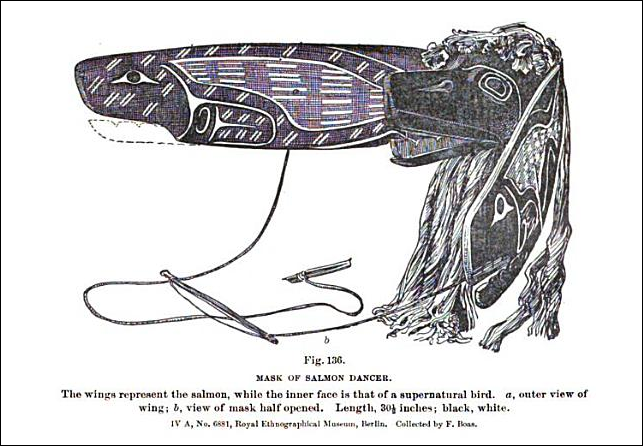
Kwakiutl Salmon Dancer's mask

.

I really don’t have much to say about this, but I’d like to note it as one more instance of Mahdism cropping up in unlikely places. And a h/t to Scott McWilliams @macengr for pointing me to the story. I can’t entirely vouch for its accuracy since I don’t have easy access to 1970s Pakistani newspapers, but I’ve seen allusions to the same story dating back a couple of years

When the Pakistani army and bureaucratic establishment realized that Mujib-ur-Rehman’s Awami League and Zulfiqar Ali Bhutto’s PPP were attracting people—with no other party able to draw even 5000 to its rallies—they imported Zohra Fona, a woman from Indonesia, pregnant with Imam Mehdi. She had visited several Islamic countries, it was propagated, where rulers had offered prayers in her Imamat [i.e. she led the prayers even if a woman is not supposed to do that].

Many Muslim intellectuals and scholars claimed through their writings and lectures that the time for Imam Mehdi’s appearance had arrived. A new Islamic world was about to emerge. During this period the Islamic parties, including Jamat-e-Islami, perpetrated violence. Members started attacking liberal and progressive professors, doctors, writers, journalists as well as their houses. They also burned many libraries and collections of books.

Zohra Fona claimed that the child in her womb recited Azaan [call for prayers] and could lead the prayers. Ulema like Maulana Okarvi and Ehtesham Ul Haque went to see Zohra Fona and listened to Azan with ears close to lady’s womb. Prayer events were arranged for her in open places as well as in the larger mosques, and the Ulema [religious scholars] were praying behind her. She would stretch her legs towards Kaaba [Mecca], directing her womb toward the pulpit. Suddenly Azaan would start coming from her womb or from another private part. The Ulema were so shameless that they were offering prayers while focusing their eyes on her private parts.

Back then the left was very organized so it was difficult to explain this farce. Finally the Pakistan Medical Association and doctors at Jinnah Hospital, Karachi decided to unearth the drama. Several lady gynecologists were asked to help; they knew that this kind of thing could not happen. But Zohra Fona was very clever. Whenever doctors were pursuing her to take a medical examination she avoided with help from the Pakistani security forces. But one day, when she was unable to escape, the doctors of Jinnah hospital, Karachi conducted an examination. The doctors recovered a small tape recorder from her womb.

Does the bit about the tape-recorder in the womb sound a bit far-fetched? Here’s another version, this one from The [International] News:

Zohra Fona, a blessed Indonesian woman, arrived in Pakistan just ahead its first general elections. She was said to be expecting a child who would be Imam Mehdi. She had visited several Islamic countries where, and it was propagated, that rulers had offered prayers in her imamat. Many ulema began to claim that the time for Imam Mehdi’s coming had arrived.

Zohra Fona claimed that the child recited Azaan. Reputed ulema like Maulana Okarvi and Ehteshamul Haque met Zohra Fona and listened to the Azaan with ears close to the lady’s stomach. She began to draw huge crowds to mosques and parks where she led prayers. Our reputed ulema would join the prayers.

Woe betide this country! Some leftist and agnostics at Karachi’s Jinnah Hospital decided to put the legend to scientific test. It was revealed that the holy woman was not even pregnant with an Azan-reciting messiah but had a recording device tied to her body. She immediately left for Indonesia once the farce was exposed.

That sounds more plausible.

**

A word of caution here.

Just as theater and film sometimes deploy “deux ex machina” interventions to immerse their audiences more deeply into their created micro-worlds, so have shamanic performances.

I’ve written about this before in an email to a religious scholars’ list, and in these days when even self-plagiarism is disdained, I am going to repeat here what I wrote then, with very minor changes:

It’s my recollection that [Tlingit / Kwakiutl winter ceremonials] were both entertainment for the long winter nights and “schooling” for the young, and I have a vivid recall of reading somewhere a shaman’s admission to an anthro of the exact nature of the dramatic means by which the shaman’s capacity to defeat death was demonstrated.

I read this in the early eighties, but searching on the web I’ve found something that comes close — Clellan Stearns Ford’s record of Charles James Nowell’s memories in _Smoke from their fires: the life of a Kwakiutl chief_. Around p 120, there are two stories, the first about a girl who “turned the wrong way” during a dance, the second about a girl who is put in a box and burned. In both cases, the nature of the trickery is described but in the version I read all those years ago, the two stories were one — the girl who was put in a box in the fire pit and “burned to death” escapes through a false bottom to the box along a tunnel into the adjoining room, and her voice then issues as if from her ashes, via a kelp tube that goes from the tunnel to the adjoining room where she’s now standing.

She describes her descent into the sea realm, where she is chastened and eventually granted a boon to return to the tribe. A canoe sets out to fetch her, but by the time the audience sees it set out, she’s already secured by rope to the far side of the boat, and at a suitable distance is hauled aboard and brought back to shore, alive.

A child seeing this would be mightily predisposed to believing the shaman had healing powers, and by the time the ruse was revealed, that underpinning of faith is already in place.

In the Nowell version, even the adults, who “know” the deception involved, are deceived: “The fire burned and the box burned, and she was still singing inside, and then the box go up in flames, and they can see her burning there in her blue blanket, and all her relatives just cry and cry. Although they know it is not real, it looks so real they can’t help it. It was all a trick. There was a hole under the box with a tunnel leading out of the house, and the woman went out of the box and put a seal in her place wrapped in a blue blanket, and then someone sang into the fire through a kelp tube, her song. Oh, it looked real!”

The Winter ceremonials of the Pacific Northwestern tribes are by turns opera, history, religion and “general education” to the children of the tribe, and “continuing education” to their elders…

Do we have anything to equal them?

Bearing such things in mind, we may want to consider trickery — a quality of the trickster gods, after all, in many mythologies — a not entirely illegitimate activity for a religious performer…

The Olympic Truce

Sunday, July 29th, 2012

[ by Charles Cameron — the Truce, great gospel music, and athletes in ads in slomo — a personal view ]
.


.

If there are two things about the Olympics I like, they would be the Olympic Truce, and athletes in slow motion.

Here’s what the IOC’s site has to say about the Truce:

The tradition of the “Truce” or “Ekecheiria” was established in ancient Greece in the 9th century BC by the signature of a treaty between three kings. During the Truce period, the athletes, artists and their families, as well as ordinary pilgrims, could travel in total safety to participate in or attend the Olympic Games and return afterwards to their respective countries

and it’s relevance today:

Taking into account the global context in which sport and the Olympic Games exist, the International Olympic Committee (IOC) decided to revive the ancient concept of the Olympic Truce with the view to protecting, as far as possible, the interests of the athletes and sport in general, and to encourage searching for peaceful and diplomatic solutions to the conflicts around the world.

Through this global and symbolic concept, the IOC aims to :

  • mobilise youth for the promotion of the Olympic ideals;
  • use sport to establish contacts between communities in conflict; and
  • offer humanitarian support in countries at war ; and more generally :
  • to create a window of opportunities for dialogue and reconciliation.

**

To be honest, I don’t care in the least what human runs fastest or jumps highest, and if I did I wouldn’t have a huge investment in what territory he or she comes from or lives in.

The Games are the Games though, they affect people’s lives, and are affected by them. I have, here in my room, a copy of the official book of the 1936 Games which I picked up in a swap meet for a dollar or two:

American Olympic Committee Report, 1936, Games of the XIth Olympiad, Berlin

Somewhere, also, I have the official English playbook for the 1934 Oberammergau Passion Play — two stark reminders of how we are sometimes suborned from the better angels of our nature by the worse…

If I have a minute of silence, then, it is for the Israeli athletes killed at the 1972 Munich Games.

**

breath,
breath

**

Again, corporate sponsorships, banking industries and advertising are not generally among my favored interests, but slow motion is — and while I care little for the athletic record-setting and patriotic rivalrous sides of the Olympics, great athletes are often beautiful, something the Greek sculptors understood, and slomo can capture that beauty for us.

Besides, I have always been a fan of Morgan Freeman, ever since I heard him play the role of the Preacher opposite Clarence Fountain in Gospel at Colonus — undoubtedly the most joyous theatrical experience of my life…

Here to give you a taste is Freeman’s opening sermon:

and perhaps the most audacious musical moment of all, the great battle of the bands as Oedipus attempts to enter Colonus:

**

breath,
breath

**

Here, then, are three VISA ads for the Games this year, accompanied by that unmistakable Freeman voice, and offered here for the beauty, sheer joy and creative excellence they present.

First, the audience speaking to the heart of the athlete — itself a remarkable insight:

Second, the way running itself runs like a thread through the life of Lopez Lomong:

And third, the difference a hundredth of a second makes — and again, the roar of the crowd:

That last clip has Morgan Freeman saying:

A hundredth of a second – it’s faster than the blink of an eye, faster than a flash of lightning – and it was the difference between Michael Phelps winning eight gold medals instead of seven – a hundredth of a second – just think of the cheers if lightning strikes twice!

I know — that’s the speed thing, not the beauty thing. And I’m an ideas man — an aesthetic man, not an athletic man.

So I take my long jumps sideways, in the mind…

**

Wikipedia tells us:

US National Park Ranger Roy Sullivan has the record for being struck by lightning the most times. Sullivan was struck seven times during his 35-year career. He lost the nail on one of his big toes, and suffered multiple injuries to the rest of his body

Again I think of the poet Randall Jarrell, whom I quoted here not so long ago as saying:

A good poet is someone who manages, in a lifetime of standing out in thunderstorms, to be struck by lightning five or six times; a dozen or two dozen times and he is great.

Only the Muse knows what damage that does to the poet’s mind.

**

breath,
breath

**

To sum up:

If I were God — and friends, that’s not in nay way a risk we need to concern ourselves about, flat out impossible — I would be watching the Olympics in slomo from a dozen angles simultaneously, without commentators.

And I’d be praying everyone world-wide would take the Truce as seriously as the Games.

At the round earths imagin’d corners

Friday, July 20th, 2012

[ by Charles Cameron — mapping, holding two worldviews in mind at one time, a conductor’s score, complexity thinking ]
.


.

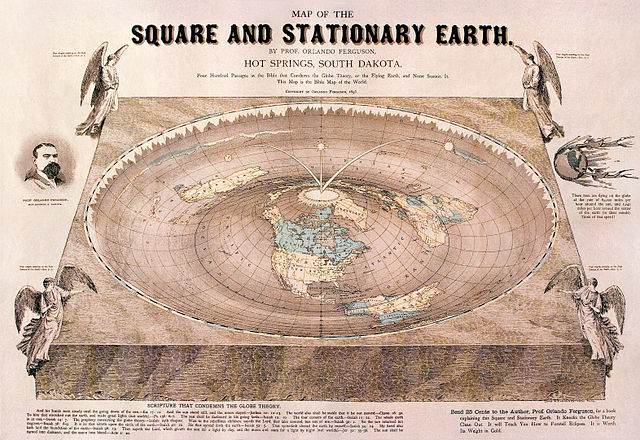
About a year ago, the Atlantic reported that the Library of Congress had been given a map of the flat earth, designed according to Biblical principles — yet showing knowledge of the border between the United States and Canada…

Thanks to a post from Jason Wells, I saw it today.

The view that the earth is flat is one worldview, of course, and no longer the prevailing one. As Nicholas Jackson noted at the Atlantic:

The interesting thing about the map is that it was created about 120 years ago by Orlando Ferguson, then a practicing physician in Hot Springs [South Dakota]. This is more than 500 years after most educated people gave up on the idea of the Earth as flat and accepted the spherical viewpoint first expressed by the Ancient Greeks.

**

It is, however, possible to hold two worldviews in mind at the same time. John Donne manages it in the first line of his extraordinary poem, written at a time when the two views were clashing:

At the round earths imagin’d corners, blow

AT the round earths imagin’d corners, blow
Your trumpets, Angells, and arise, arise
From death, you numberlesse infinities
Of soules, and to your scattred bodies goe,
All whom the flood did, and fire shall o’erthrow,
All whom warre, dearth, age, agues, tyrannies,
Despaire, law, chance, hath slaine, and you whose eyes,
Shall behold God, and never tast deaths woe.
But let them sleepe, Lord, and mee mourne a space,
For, if above all these, my sinnes abound,
‘Tis late to aske abundance of thy grace,
When wee are there; here on this lowly ground,
Teach mee how to repent; for that’s as good
As if thou’hadst seal’d my pardon, with thy blood.

Donne accomplishes the task of holding two worldviews in mind at one time with four simple words: “round earths imagin’d corners”.

**

I don’t know how many melodic “lines of thought” the mind can hold in counterpoint at once. I do know it’s an important cognitive skill for us to cultivate. A classical conductor must surely be able to hold as many lines as there are in this page of Olivier Messaien‘s Oiseaux:

As I pointed out in a recent comment here, “somewhere above three and before eleven there’s a point — Miller’s ‘magical number seven, plus or minus two‘ where the human mind can’t hold any more detail, so that’s a cut-off of sorts.”

Well, Messaien clearly imagines the conductor’s mind can follow more than eleven paths…

**

And then there’s Bob Milne.

I’ll let the Philosophy Compass take it from here:

Bob is predominantly known for his piano concerts of Ragtime and Bogie-Woogie music – and was given the moniker of ‘National Treasure’ by the United States Library of Congress. It was at one of these concerts that drew the attention of Penn State neuroscientist Kerstin Bettermann. At his concerts, Bob often carries on conversations, telling stories and jokes, while simultaneously modulating key signatures over the polyrhythmic Ragtime music. In their broadcast, Radiolab discusses with Dr. Bettermann why this is so surprising.

Language use and musical competency often use the same neural resources: the prototypical language areas in the left hemisphere of the brain, and the working memory circuit that keeps information available and rapidly accessible for a short-period of time. Our ability to use language and engage with music should, on most models of the brain, be competing for these neural resources and interfere with one another. Not so with Bob – he appears to be able to tackle both tasks with ease. Further, while most people can approach this kind of competency in multi-tasking, it usually involves many learning trials, a process of sedimenting the learning into what psychologists call procedural memory, which may have its roots in a different brain region, the cerebellum. But Bob can hear a tune just once, and play it back with commentary.

But that’s not all Bob can do.

In their interview, Dr. Bettermann heard Bob claim something extraordinary. He claims not only to be able to hear a symphony in his head, but that he normally does this with two symphonies simultaneously. Where most individuals would only hear a cacophonous mess – Bob claimed he could dial the relative volume of either symphony up or down, and could zoom in or out of individual instrumentations. To return to the considerations above, Bob further states on the Radiolab website that he does this while driving – another procedural memory task and presumable source of interference. But when Dr. Bettermann challenged him, Bob reluctantly claimed that he could probably do the same (not while driving, mind you) with four simultaneous symphonies.

The claim is something like this: Bob states that he can hold and listen to four symphonies with different keys, instrumentation, tempo and style in his working memory at the same time. And what is stunning is that when they put Bob into an fMRI machine, they verified his claim. Bob could be stopped at any time during his imaginative trip through the four simultaneous symphonies, and hum out the exact phrase that the original recording would be on. Remarkable.

**

This in turn takes us back to that point Edward Said made, which gave me the basic concept for my Said Sympohony (must get back to that soon):

When you think about it, when you think about Jew and Palestinian not separately, but as part of a symphony, there is something magnificently imposing about it. A very rich, also very tragic, also in many ways desperate history of extremes — opposites in the Hegelian sense — that is yet to receive its due. So what you are faced with is a kind of sublime grandeur of a series of tragedies, of losses, of sacrifices, of pain that would take the brain of a Bach to figure out. It would require the imagination of someone like Edmund Burke to fathom.

Edward W. Said, Power, Politics, and Culture, p. 447 — from the section titled “My Right of Return,” consisting of an interview with Ari Shavit from Ha’aretz Magazine, August 18, 2000.

I asked in a post yesterday how good we now are at modeling or simulating ideas in the “war of ideas” — just for a moment, suppose we could think through all complex geopolitical issues in this polyphonic, contrapuntal way…

**

Okay, you deserve a reward for faithful reading if you’ve come this far with me. Here’s the incomparable Richard Burton reading Donne’s poem — the text is up above, if you want to follow along:


Switch to our mobile site