zenpundit.com » arab world

Archive for the ‘arab world’ Category

DQ Egypt: impact on Israel

Wednesday, February 2nd, 2011

[ by Charles Cameron [hoping Zen’s ISP will be back up shortly] — cross-posted from ChicagoBoyz ]

Someone posted an excerpt from an interview with Khaled Hamza, the webmaster of the Muslim Brotherhood, as a comment on an earlier post of mine on ChicagoBoyz, where I also blog, and I was interested enough to track the original interview down, and have presented the key points of the excerpt here in Quote #1.
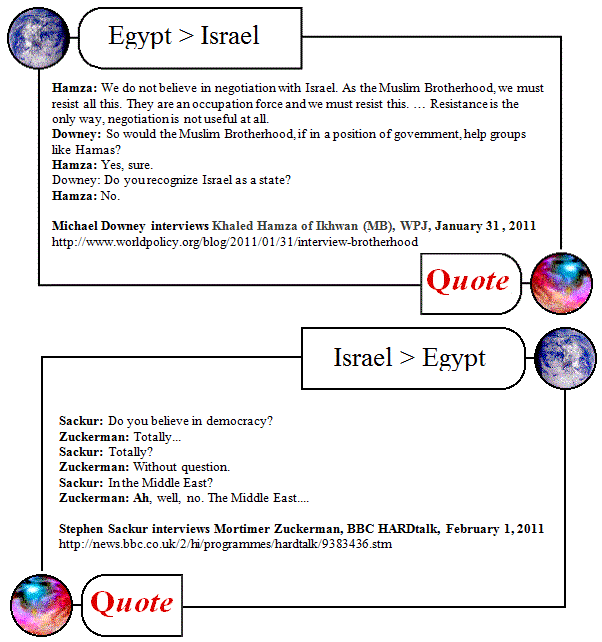
I am pairing it, in Quote #2, with an excerpt from an interview the BBC recently conducted with Mortimer Zuckerman – because I find the two quotes taken together suggest something of the complexity of the breaking situation in the Middle East.

*

I’d like to float a trial balloon / try a though experiment, if I might. And since I’m more “tail” than “left” or “right wing”, I’ll be posting this in more than one place, and hope to get comments from all sides…

On the face of it, Zuckeman is applying what’s arguably a racist double-standard. He advocates democracy, “totally” and “without question” – but not for the Egyptians, or at least not today or tomorrow.

On the face of it, the Egyptian public seems distinctly unenthused by Mubarak’s regime and will, in a democratic election, presumably vote in a fair number of Muslim Brotherhood representatives – though it’s by no means clear that they would be in the majority, and their present ideology in any case is closer to the processes of electoral politics than those of violent jihad.

So there is reason for Israel to be concerned, and reason for those who support democracy to see some hope for democracy, in the ongoing events in Egypt.

Let me put it this way: Quote #1 illustrates why Zuckerman might make the remarks quoted in Quote #2, while Quote #2 illuminates why Hamza might make the remarks quoted in Quote #1.

*

And here’s the thought experiment — I’d like to come at this from a Maslovian angle.

Maslow’s Hierarchy of Needs

I’d like to suggest that “democracy” is an ideal, or to get away from that word with its somewhat ambiguous political connotations, an activity of the “the better angels of our nature” – and thus, from a Maslovian perspective, an aspect of a group or nation’s “self-actualization” level of interest, whereas “stability” would fall under “safety” or even “physiological”.

If that’s right, Zuckerman is at least arguably articulating a “stability first, eventual democracy would be ideal” position.

Does that “Maslovian” formulation throw any additional light on the situation?

*

The problem with the position I just described is nicely articulated by Mohammad Fadel at the very end of a Foreign Policy post, Can Black Swans lead to a sustainable Arab-Israeli peace? — and it’s only his conclusion I’m quoting here:

Tunisia and Egypt have demonstrated categorically that any peace which relies on the stability of police states is doomed from the outset.

If a butterfly flapping its wings in Brazil can in theory cause a tornado in Texas – heaven alone knows what someone blinking in Cairo or Jerusalem or Washington can do.

Myself, I pray for empathy, which seems a reasonable request, I hope for wisdom, which seems a great deal more chancy — and I long for peace.

In the current environment of hatred and mistrust, that seems entirely beyond the capacity of anyone’s present thinking to achieve.

Egypt: tear-gas and hotels

Monday, January 31st, 2011

[ by Charles Cameron, cross-posted from Brainstormers on the Web ]

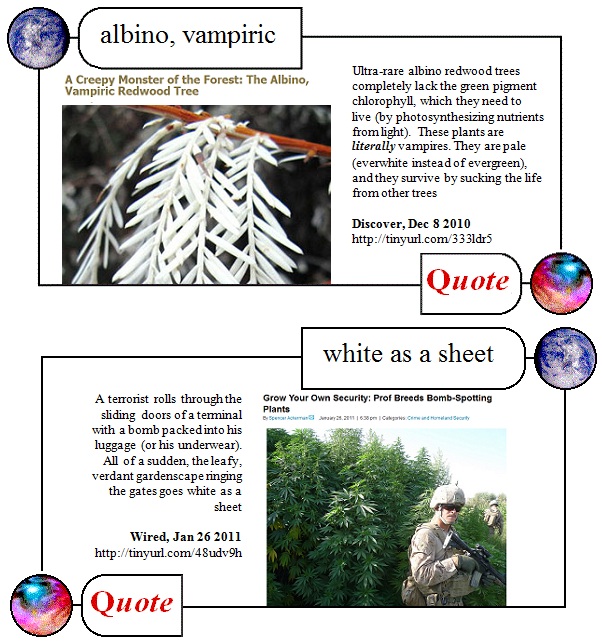
Here are two data-points to drop into the mind-pool as we think about current events in Egypt, the Middle East in general, and the way the world turns.

DoubleQuotes is my name for the format I’m using here, which I came up with a few years back on Brainstorms. The idea is simply to generate fresh insights by juxtaposing two thoughts – be they images, quotes, or even equations (I don’t have the technical chops for music or film clips yet) — in condensed, haiku-like form.

Think of them as pebbles dropped in a pond, watch the ripples…

[ note to Zenpundit readers: I’ll say more about Brainstorms and Brainstormers on the Web in a week or two, once the “on the Web” blog gets under way ]

DoubleQuotes and Questions

Friday, January 28th, 2011

[ by Charles Cameron ]

You know, I really enjoy building my DoubleQuotes. They can be entirely frivolous, as is this one, for instance:

with its touch of gothic — a taste I share with my friend Bryan Alexander.

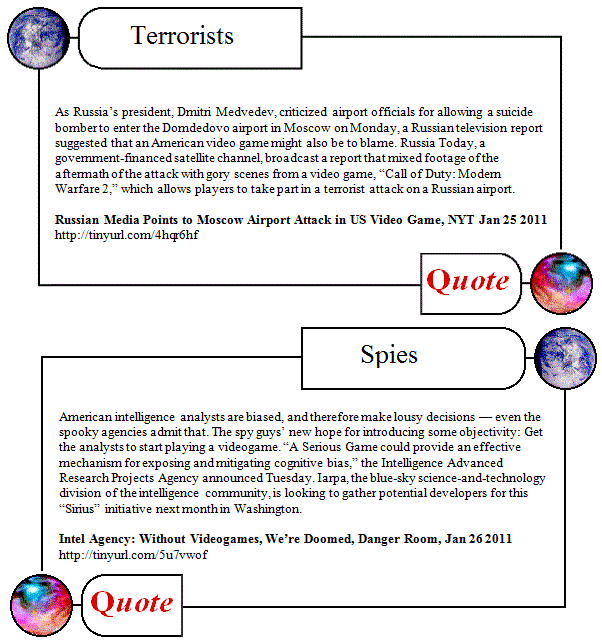
Or they can work like a Necker cube, offering opposite framings with which to view a single topic — in this case, video games.

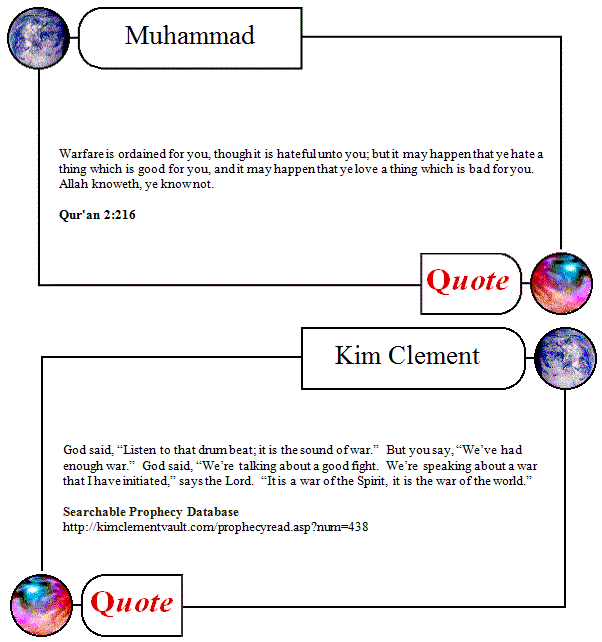
They can also work like Rorschach blots — this one compares two prophecies, one from the Quran and one from a contemporary Christian prophet (if I’m not mistaken, President Obama quoted him recently) —

— but it is left up to the reader to determine the value of each…

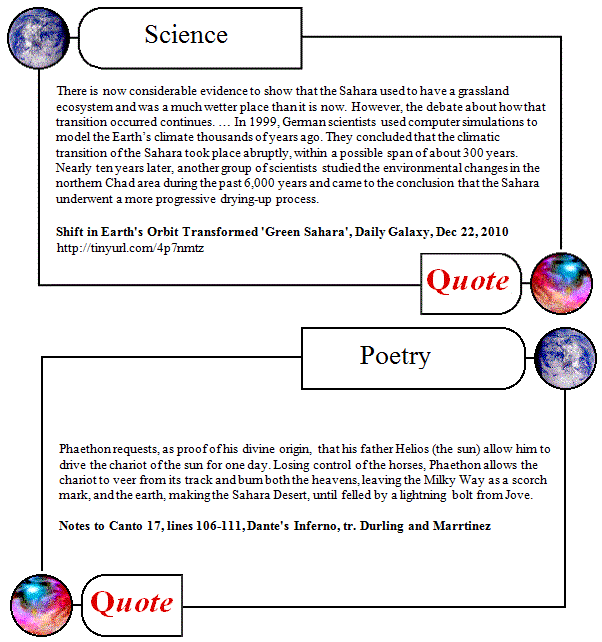
And they can also pose fundamental questions of preference:

Has science simply replaced myth, d’you think? or is science for the facts, perhaps, and the mind — while poetry and myth are for the heart, and truth?

Cameron Guest Posts at Jihadology

Monday, January 24th, 2011

Charles Cameron ventures forth to conquer new blogworlds:

GUEST POST: Hitting the Blind-Spot- A Review of Jean-Pierre Filiu’s “Apocalypse in Islam”

Jean-Pierre Filiu’s book, Apocalypse in Islam (University of California Press, 2011) makes a crucially important contribution to our understanding of current events – it illuminates not just one but a cluster of closely-related blind-spots in our current thinking, and it does so with scholarship and verve.

Al-Qaida’s interest in acquiring nuclear weapons – and Iran’s – and the safety of Pakistan’s nuclear materiel – and the situation in Jerusalem – depending how you count ‘em, there are a half dozen or so glaring world problems where one spark in the Mahdist underbrush might transform a critical situation. And yet as Ali Allawi put it in his talk to the Jamestown Foundation on Mahdism in Iraq a few years back, Mahdists ferments still tend to be “below our radar”.

People are always talking about unintended consequences: might I suggest that blind-spots are where unintended consequences come from – and offer some background on apocalyptic, before proceeding to discuss Filiu’s contribution?

We already have a tendency to dismiss religious drivers in considering current events, having concluded in many cases that religion is passé for the serious-minded types who populate diplomatic, military and governmental bureaucracies world-wide – and we are even more reluctant to focus on anyone who talks about the Last Days and Final Judgment, despite the presence of both in the faith statements and scriptures of both Islam and Christianity. We think vaguely of cartoons of bearded and bedraggled men with sandwich boards declaring The End is Nigh, and move along to something more easily understood, something conveniently quantitative like the number of centrifuges unaffected by Stuxnet in Iran, or purely hypothetical, like the association of Taliban and Al Qaida in Afghanistan.

I think of Cordoba

Friday, January 21st, 2011

[ by Charles Cameron ]

1.

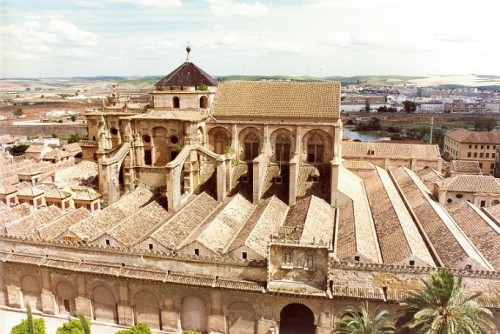
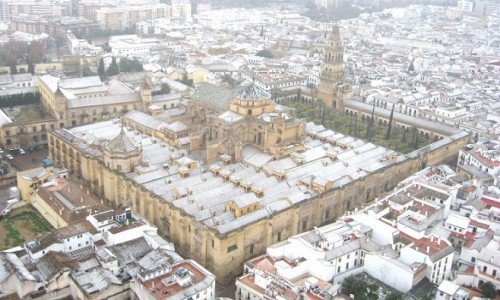
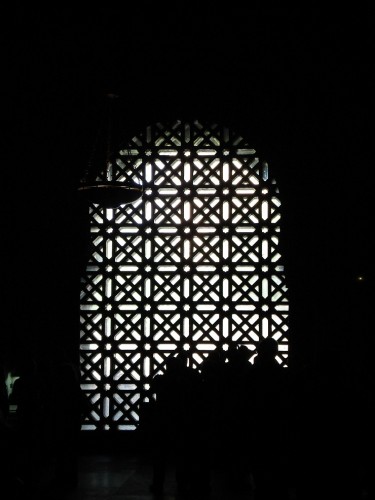
I think of how the Mezquita, once a mosque, must have looked when its whole floor was a single, arched space of prayer:

before Moorish Cordoba was conquered, and the conquerors built a cathedral in the very heart of the place:

like the petals of a flower opening inside the sepals, or a cancer sprouting within the body – for so much depends on your understanding of prayer.

2.

And I think how lovely it still looks, cathedral nestled within mosque under the snow, to this photographer’s eye:

3.

And I think of Seymour Hersh, who has drawn flak for comments in a recent speech about the Bush war in Iraq, and Obama’s continuation of Bush policies – and here’s the part that caught my eye:

“In the Cheney shop, the attitude was, ‘What’s this? What are they all worried about, the politicians and the press, they’re all worried about some looting? … Don’t they get it? We’re gonna change mosques into cathedrals. And when we get all the oil, nobody’s gonna give a damn.'”

“That’s the attitude,” he continued. “We’re gonna change mosques into cathedrals. That’s an attitude that pervades, I’m here to say, a large percentage of the Joint Special Operations Command.”

And I think then of the great cathedral of Hagia Sophia in Constantinople, that was conquered and became a mosque:

and is now a museum. So these things go, in times of war.

4.

As for the Mezquita, its history is more complex than I have suggested: it was first a pagan temple, then a Christian church, then shared between Muslims and Christians, then made into a mosque, then a church again – and the cathedral as we see it today was built during the Renaissance…

And I think at last how much depends on lofty spaces, and on silence, and on prayer:


Switch to our mobile site