zenpundit.com » myth

Archive for the ‘myth’ Category

Grand Blog Tarkin’s Hoth Symposium

Wednesday, February 20th, 2013

Grand Blog Tarkin is hosting a symposium on the Battle of Hoth. Sparked by WIRED magazine’s original debate begun by Spencer Ackerman, Grand blog Tarkin’s Symposium features some of the finest sci-fi war nerd speculation from keen strategic thinkers from the blogosphere and Twitter.  Oh, yeah, I am participating as well, thanks to Kelsey Atherton.

Here are some excerpts and their authors:

Hoth Symposium Comes Home 

Dunkirk-on-Ice by Graham Jenkins

In 1940, French historian Marcel Bloch wrote a slim volume entitled Strange Defeat, on the incomprehensible defeat of the superior French Army at the hands of the Wehrmacht. 60 years later, Ernest May wrote the complementary version in Strange Victory, an account of the improbable German success in defeating France. Many have written on the utter failure of the Imperial Navy to successfully crush the Rebellion once and for all at the Battle of Hoth, but few have bothered to explore the rather unlikely escape the Rebels made from their icy fortress. “How did they not lose?” Contrary to Spencer Ackerman’s view, the Alliance was faced with dire options and chose mostly the best available.

Ackerman critiques the Alliance for keeping virtually all of their key military players in the same location at Echo Base, but ignores the value of face-to-face, instantaneous communication among Rebel leaders. Collaboration is key to any successful insurgency, and while distributed cells might have a better chance of survival, they still require a core group to perform key coordination and planning functions. This is most effectively provided through close, personal cooperation…. 

The Battle of Hoth and Grand Strategy by Mark Safranski

The key to understanding the Battle of Hoth is not in tactical minutia on the icy surface of the planet, nor in confused imperial strategic objectives or even in the quixotic leadership of Lord Vader, but in grand strategy. As a self-contained polity facing no external foes and only a scattered and poorly armed insurgency, the greatest potential threat to the Empire’s two-man Sith regime would likely emerge from the ranks of the imperial military itself. It was not that the Galactic Empire could not have fielded a vast, overwhelmingly powerful and incomparably competent armada against the Rebellion, it was that Darth Sidious did not dare to do so…..

May the Tech Be With You by Shlok Vaidya

The Star Wars world is a bleak one. Aside from the standard strata of humans, the aristocrats like Leia to the paupers like Solo, there exists a more distinct separation. The Force-enabled and the not. Able to summon electricity from thin air, jump great heights, wield weapons of light, it is no surprise that the Empire is run by those able to use the Force. Or that the Rebel Alliance, filled with battle-hardened veterans who fought day in and day out, for days, months, years in some of the most challenging environments the universe has to offer, suddenly promote the Force-empowered Luke Skywalker despite his lack of combat experience.

In a world where a wave of a hand can change minds, it is hard to say technology matters. But as the Battle of Hoth demonstrates, it invariably does. That particular engagement was an exercise in terrible technology decision making. Tanks with weapons that don’t rotate, raised onto legs reminiscent of ostriches, and move with all the finesse of an overweight wampa. Laser blasts that detonate on impact without consistent grouping. A lack of even basic infrared overlays on a ice-covered planet. The Empire’s foot-soldiers, otherwise decent men pulled from their homes and families to wage war in forsaken lands, were abandoned to the tools provided by the lowest bidder. Minor modifications could have addressed a vulnerability to harpoons. Major platform changes could have wiped out the rebel force in minutes…..

Hoth Symposium Comes Home 2: Late Registration

Let’s Cut the Imperial Fleet Some Slack by Brett Friedman

It’s difficult to tell from the original three movies, but the Imperial Fleet is a very new organization. Their operational and strategic missteps make much more sense in this light. A galactic fleet cannot be built in a day. Although we see a Star Destroyer at the end Revenge of the Sith, a fleet is comprised of more than just ships. Doctrine, tradition, staff work, planning processes, and institutional experience are just as important as the ships themselves. Even though decades elapse between Revenge of the Sith and The Empire Strikes Back, it was just not enough time for the Imperial Fleet to become an elite force.

The Battle of Hoth occurs twenty-two years after Palpatine seized power.The first expeditionary operation conducted by the US Navy after their formative battles during the American Revolution occurred between 1801-1805, twenty six years after its formation. Both of these conflicts were waged against non-state actors by very new nations. Although the First Barbary War was successful for the American Fleet(thanks to a few Marines) there was an embarrassing mistake. The USS Philadelphia was run aground and captured, along with its entire crew, without a fight. Additionally the expeditionary force had to depend on third party support from the Kingdom of the Two Sicilies. Presuming that years in the Star Wars galaxy are identical to our own, the two young fleets had a similar amount of time to develop. The Imperial Fleet that we see in Empire, while presumably leavened with clone-veterans from its formative battles, just did not have the know-how to conduct counterinsurgency on a galactic scale. The tactical and strategic situation that the fleet faced at Hoth was, to them, a new one…..

Missed Opportunity: Rieekan’s Failure at Hoth by Mike Forbes

The conventional wisdom regarding the Battle of Hoth is that it was a major Imperial victory, described in terms of the Rebels as the massively overmatched ragtag band scattering before the unstoppable Imperial juggernaut. Thecontrary wisdom of sci-fi strategists focuses both on the tactical blunders made by the Imperial force, and thestrategic factors that influenced the decision-making of key leaders. Both narratives are wrong. The Rebel Alliance was anything but a ragged insurgent mob; they were a well-equipped and well-organized hybrid threat# at the time. The Battle of Hoth should have been a decisive victory for the Rebels, perhaps even as significant as the Battle of Yavin had been. The Imperial forces bungled what should have been a fairly simple HVT capture or kill mission, their staggering incompetence playing right to the Rebels’ strengths. However, the Alliance only managed to scrape by with a strategic draw due to their failure to take advantage of key opportunities during the battle to strike a massive blow to the Imperial fleet and the Empire’s key leadership. Hoth was also not a total tactical failure for the Empire; in fact they managed to pull off a partial victory, since Echo Base was indeed reduced to rubble, and the Rebels lost a large amount of materiel in the process of their hasty withdrawal under fire. The Imperial forces managed to salvage a partial success out of what by all rights should have been a crushing defeat, thanks to the even greater failures of their Rebel opponents, in particular the criminal negligence of General Rieekan….

 

On Socrates and His Legacy, Part I.

Thursday, February 14th, 2013

Recently, I finished two books on the iconic ancient Athenian philosopher Socrates, both of which pointed me to a third. The books were of a very different character and quality, yet together raised an important dichotomy about a man who lived 2400 years ago, whose intellectual legacy contributed to the shaping of Western civilization. The Stoics and Cynics looked back to Socrates as their forerunner; Socrates’ greatest student Plato became the most influential philosopher of the written word of all time, rivaled only by his own protege, Aristotle. So definitive was the influence of Socrates and his inexhaustible store of questions that all the Greek philosophers who came before him are reckoned “the pre-Socratics“. Yet he was put to death by the Democracy that had proudly boasted of being the “the school of Hellas“.

Who then, was the historical Socrates?

Socrates shares, to a lesser degree, the enigmatic quality of Buddha, Jesus and his own near contemporary, Confucius; we know more about Socrates than we do the others, but as with the others, it is all secondhand. Having written nothing himself, we must rely on the apologia of his disciples, the barbs of his critics, some statuary relics and the commentary of philosophers and historians from later in antiquity who had access to sources now lost to tell us of Socrates.

Here are the books:


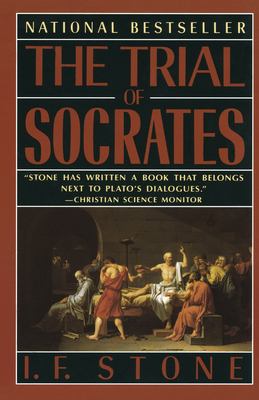
The Trial of Socrates by I.F. Stone

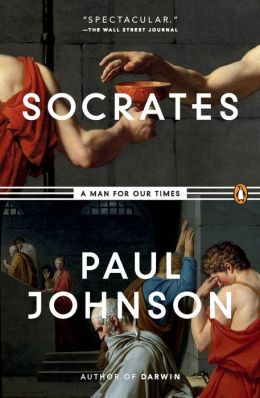
Socrates: A Man for Our Times by Paul Johnson  

Both authors were splendid prose writers, otherwise they are a study in contrasts. The late I.F. Stone was a famous radical, an antifascist, an investigative, “muckraking” journalist of the mid twentieth century and, for a time,  a Soviet agent during the “Red decade” of the Thirties. Stone, who was noted for his diligence with using government documents as a reporter, unearthing scoops everyone else had missed, became, in his retirement, a scholar of antiquity who read deeply in the classics in the original ancient Greek.

Paul Johnson began his career as a prolific writer and popular historian on the British Left with The New Statesman and over time shifted rightward to become a leading Anglo-Catholic conservative public intellectual, an adviser to Margaret Thatcher and an author of 40 books. Johnson is most known for his best-sellers that tackled panoramic and encompassing subjects – The Birth of the Modern, Intellectuals and The History of the Jews, often written from a highly idiosyncratic, as well as a conservative, perspective.

Of the two books, Stone’s  The Trial of Socrates is by far the most substantive. Stone relies heavily, though not exclusively, upon primary sources in the original Greek to build his argument, which is that Socrates was executed because of his militant, arch-reactionary, “antipolitical” opposition to self-government, especially in the form of the Democracy; and further, that Socrates’ actions at his trial were perversely designed to inflame the jury which might easily have acquitted him.  Socrates:A Man for our Times by Johnson is based on English translations of primary sources and secondary sources, is lighter in tone and much closer to being an essay. Johnson is evaluating the importance of Socrates in a broad, civilizational, context while Stone trying to tell what really happened while simultaneously judging Socrates culpability.

One point on which both authors have agreement is the mendacity and artistry with which Plato has made this task more difficult. I.F. Stone generally sees a “sneering” antidemocratic political continuity between Socrates and all of his disciples Plato, Xenophon, Charmides, Critias, Antisthenes and Alcibiades but even Stone cannot stomach Plato’s casual misuse (or abuse) of Socrates in his later dialogues to vent petty gripes and snobbish airs. Writing of an insulting passage in The Republic:

….Plato put this into the mouth of Socrates many years after the latter’s death. There is no evidence that the historical Socrates ever spoke so unkindly or pretentiously. Otherwise Socrates could not have had the lifelong affection of his oldest disciple, the “low-born” Antisthenes; his mother was a Thracian, hence he was twitted for not being of pure Attic blood (Diogenes Laertes, 6.1). Several scholars believe this was Plato’s slur against his fourth century rival – and Socrates’ old friend – Isocrates.[255]

Paul Johnson goes much further; attributing much that scholars regard as negative in Socrates’ reputation to the machinations of Plato using his late master as “a ventriloquist’s dummy”, a caricature Johnson calls “PlatSoc” to add authority to his own views and theories in which Socrates never believed or more likely, never even had heard:

….As an intellectual he [Plato] began to formulate his own ideas. As an academic he quickly merged them into a system. As a teacher he used Socrates to spread and perpetuate it. In his earlier writings Plato presented Socrates as a living breathing, thinking person, a real man. but as Plato’s ideas took shape, demanding propagation, poor Socrates whose actual death Plato had so lamented, was killed a second time, so that he became a mere wooden man, a ventriloquist’s doll, to voice not his own philosophy but Plato’s.

….So the act of transforming a living, historical thinker into a mindless, speaking doll – the murder and quasi-diabolical possession of a famous brain – became in Plato’s eyes a positive virtue. That is the only charitable way of describing one of the most unscrupulous acts in intellectual history. Thus Plato, with no doubt the best of intentions, created like Frankenstein, an artificial monster-philosopher [11]

There are other sources of information regarding Socrates than Plato, of course.  Xenophon, also wrote an apologia; Aristophanes and other comic poets satirized Socrates in their plays, the philosopher being a “public figure” in Athens as much as was Pericles or Cleon (Socrates apparently could take a joke much better than the litigious and bloodthirsty demagogue Cleon); Aristotle had informed speculations regarding Socrates based on his long (and one suspects trying) tutelage under Plato and there are Roman writers such as Cicero who had access to sources now lost, but Plato remains the most prolific.

This is important, because the central thesis in The Trial of Socrates is that Socrates is not merely an “antidemocratic” gadfly in Athens, but an arch-reactionary teacher of “antipolitical” doctrines. That is to say that Stone argued that Socrates and his followers rejected the concept of the self-governing “polis” itself, oligarchy as much as democracy, that men were a “herd” fit only for a shepherd, an absolute Homeric ruler defined by Socrates as “the One who Knows”. Stone argues, with accuracy, that Socrates disciples, despite differences in personality and philosophy, shared a common disdain for democratic politics and furthermore, that Socrates teaching repeatedly led to cohorts of aristocratic, pro-Spartan,”Socratified youth” who twice supported the overthrow of the Democracy. In short that Socrates was tried because his activities, his “examinations”, were ultimately politically subversive to the state in a time of danger and instigated civil strife.

This means, to judge Stone’s argument requires that we discern Socrates from Plato that in turn requires some expertise on Plato. This need to sift Platonic dialogues explains why both Johnson and Stone, despite Stone’s ability to work with the primary texts in the original Greek, turned to the scholarship of Gregory Vlastos for guidance. Vlastos was a seminal figure in the field of Platonist philosophy whose work is described by other scholars as “transformative” and having “a vast influence” who best parsed Socrates from his artfully prolix disciple. Because of Stone and Johnson, I have picked up what is regarded by many as “the best book on Socrates” – Socrates: Ironist and Moral Philosopher by Gregory Vlastos.

Vlastos, in this final book, ultimately came closer to Johnson’s position in the sense that some of what  moderns find disagreeable in Socrates and what Stone criticizes in particular – the harsh antidemocratic edge – is more a product of Plato’s literary handiwork than the philosophy of the historical Socrates. Vlastos writes:

I have been speaking of a “Socrates” in Plato. There are two of them. In different segments of Plato’s corpus two philosophers bear that name. The individual remains the same. But in different sets of dialogues he pursues philosophies so different that they could not have been depicted as cohabitating in the same brain throughout unless it had been the brain of a schizophrenic

The early Socrates of the Elenctic Dialogues is the most genuine in the view of Vlastos.

End Part I.

When myth breaches the news media ocean

Wednesday, January 2nd, 2013

[ by Charles Cameron — Draupadi in the Mahabharata, the anonymous med student recently gang-raped on an Indian bus ]
.

Humpback whale breaching, source: Wikipedia under CC Attribution-Share Alike 2.5 Generic license

.
Some people go out on the oceans and watch and wait for whales to “breach” the surface — you know me, I go out on the interwebs and search for fragments of scripture and myth to breach the surface of the daily news — as when a minor warlord in Aleppo reports seeing angels, or Gregory Johnsen quotes the prophet Hosea in the title of a post on Waq-al-Waq.

**

Today’s main sighting concerns the rape of the young medical student in India, one of many tragedies in the tapestry of griefs and joys we all live with, and perhaps one that will make an incremental shift in global awareness.

It seems to me that India has had her share of violence both during and after Partition — most recently the Babri masjid takedown in Ayodhya, the Gujarat riots, two major sets of bombings in Mumbai, swathes of India under Naxalite influence, and so forth.

I’ve been noticing references to the recent rape, but not really following it in detail until today, when this Al Jazeera report, Rape of Draupadi: Why Indian democracy has failed women, caught my eye.

The author, Dinesh Sharma, quotes blogger Nilanjana Roy — the other person whose writing on the subject had particularly moved me — to list earlier instances of anti-woman violence:

Sometimes, when we talk about the history of women in India, we speak in shorthand. The Mathura rape case. The Vishaka guidelines. The Bhanwari Devi case, the Suryanelli affair, the Soni Sori allegations, the business at Kunan Pushpora. Each of these, the names of women and places, mapping a geography of pain; unspeakable damage inflicted on women’s bodies, on the map of India, where you can, if you want, create a constantly updating map of violence against women.

For some, amnesia becomes a way of self-defence: there is only so much darkness you can swallow.

When I’d first read that on Roy’s blog, I’d been saddened as much by my own ignorance of the named events as by the litany of sorroes Roy put together.

**

But it was Sharma’s invocation of Draupadi that triggered this post:

Draupadi, heroine of the Mahabharata epic, is bold and forthright even in adversity. Her husband Yudhisthira succumbing to his weakness for gambling, stakes and loses all (in a rigged game), including his wife. Draupadi challenges the assembly and demands to know how it is possible for one who has staked and lost his own self to retain the right to wager her.

Duryodhana, the winner of the bet, insists that Draupadi is indeed his to do with as he pleases and orders that she be disrobed. Furious at this insult to her honor, Draupadi loosens her coifed hair and vows that she will not knot it again until she has washed it in Duryodhana’s blood. As she is disrobed, the more her sari is pulled away the longer it becomes. It is this event which turns Draupadi from a contented, but strong willed wife into a vengeful goddess.

Until I saw the title of Sharma’s piece, I hadn’t thought of Draupadi — but she’s the quintessential figure of the woman wrongly treated in the rich mythology of the subcontinent, and thus offers the appropriate background against which to see the terrible event.

Draupadi is celebrated for her devotion to Krishna, the anonymous woman raped in the recent incident on a bus for her devotion to education, medicine, healing…

**

As Sharma says:

The perennial question has to be asked – “Who will protect Draupadi’s honour?”

The Hobbit: Narrative Validation or Vandalism?

Sunday, December 30th, 2012

The Hobbit: An Unexpected Journey a film by Peter Jackson

The Hobbit:Or There and Back Again by J.R.R. Tolkien 

Last night, I took the kids and my nephew to see The Hobbit. In essence, it was less the classic tale woven by J.R.R. Tolkien than a sequel to The Avengers with a cast of Dwarves.

Peter Jackson has made, as he did with The Lord of the Rings movie trilogy, a visually stunning film with The Hobbit. Jackson once again excelled at translating many physical settings of Tolkien’s Middle-Earth into screen reality. Erebor looks the way you would expect an age-old Dwarven kingdom should. Dol Guldor (alluded to ever so briefly in the book) appears to be the place of dread that would attract a great malevolent spirit like Sauron, This extends to some of the characters; the Great Goblin’s semi-comic personage manages to capture some of the original charm of The Hobbit as a children’s story before it later became part of the narrative for Tolkien’s larger and darker romantic epic, The Lord of the Rings.

Unfortunately, the tendency that Jackson demonstrated as the films of The Lord of the Rings progressed,to take ever greater artistic liberties with Tolkien’s story, have, with his swollen ego, run riot in The Hobbit. The primary antagonist in the film, Azog the Orc chieftain is lifted from other Tolkien material, given mutant powers, a scary metal hand and an albino warg by Jackson and is brutally imposed on the story. The wizard Radagast the Brown, whose head for some reason is encrusted with bird crap, gets much screen time as he  zips around Middle-Earth like Mario Andretti on a sleigh pulled by magical bunnies when he is not getting high on ‘shrooms.

What began as a necessary fleshing out of narrative allusions and foreshadowing to effectively translate literature into a movie ended up as Jackson’s sheer invention and gratuitous abuse of the characters, all of whom sword fight more often than Conan the Barbarian and more bloodily than Leonidas. If Thorin had shouted in the midst of battle with the Goblins, “Dwarves! Tonight we dine in Mordor!” no one in the audience would have been the least bit surprised.  Zorro and the Three Musketeers had less skill with a blade in hand-to-hand combat than do these Dwarves, Gandalf or at times, Bilbo Baggins.

The only scenes where Jackson manages genuine fidelity to the story are the ones with Gollum, Bilbo and their Riddle-Game – perhaps out of fear of trivializing his previous movies, Tolkien’s actual dialogue and plot  enters the script before vanishing again into a Jacksonian cinematic homage to every American action movie ever made. No wonder Christopher Tolkien looks on with weary despair.

There’s a name for this kind of genre….

Fan fiction.

New Book: The Violent Image by Neville Bolt

Friday, December 14th, 2012

The Violent Image by Neville Bolt 

Columbia University Press just sent me a review copy of The Violent Image, by Dr. Neville Bolt of King’s College vaunted War Studies Department.  Initially, I was amused by the colorful book jacket, but flipping through, it belies a very weighty, heavily footnoted, academic exploration of the iterative relationship between propagandistic imagery and insurgency. Even a casual perusal indicates that The Violent Image is a book many readers of ZP will  like to  get their hands on.

From the jacket:

….Neville Bolt investigates how today’s revolutionaries have rejuvenated the nineteenth century “ptopaganda of the deed” so that terrorism no longer simply goads states into overreacting, thereby losing legitimacy. Instead the deed has become a tool to highlight the underlying grievances of communities

A small sampling of some of the section titles:

Strategic Communications:the State
Strategic Communications: the Insurgent
Networks in Real and Virtual Worlds
Images as Weapons
POTD as Insurgent Concept of Operations
Anonymity and Leaderless Revolutions
The Arab Uprisings and Liberation Technology
POTD as Metaphor

Endnotes run slightly over 90 pages and the bibliography tips the scales at 50, for those interested in such things.

Looking forward to reading this and seeing how Bolt presents his case.


Switch to our mobile site