zenpundit.com » myth

Archive for the ‘myth’ Category

Guest Post: The United States of Islam

Tuesday, October 26th, 2010

 Charles Cameron is the regular guest-blogger at Zenpundit, and has also posted at Small Wars Journal, All Things Counterterrorism, for the Chicago Boyz Afghanistan 2050 roundtable and elsewhere.  Charles read Theology at Christ Church, Oxford, under AE Harvey, and was at one time a Principal Researcher with Boston University’s Center for Millennial Studies and the Senior Analyst with the Arlington Institute:

The United States of Islam Video

by Charles Cameron

[ the first in a series, cross-posted from Chicago Boyz ]

Let’s take a closer look at the United States of Islam video which I mentioned in my post Of Weaponry and Flags.

 USI Films

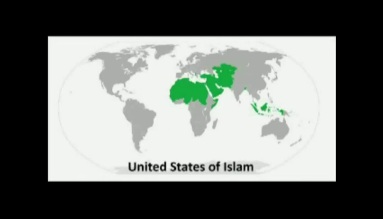
The video announces itself as “an USI Films production”. It then opens with the words “since 911 the world has changed” in white type against black, followed immediately by news clips of the WTC attacks and of President Bush describing them as “evil acts” and declaring “I have directed the full resources of our intelligence and law enforcement communities to find those responsible, and to bring them to justice.” What we shall be seeing, then, is a time-oriented video, presenting a historical context for the present moment with implications for the near future. From here we cut by way of another white on black typed message — “they started this war in afghanistan” – via clips of war footage to another – “but their agenda is much bigger and brutal than that” – and then to another clip of Pres. Bush: “Our war on terror begins with al-Qaida but it does not end there. It will not end until every terrorist group of global reach has been found, stopped, and defeated.” By this point, the background music, which is taken (for reasons both political and musical?) from Vangelis’ 1492 – Conquest of Paradise soundtrack, is swelling. A global map appears, showing much of north Africa, the middle east, Indonesia and Malaysia in green, with Pres. Bush in voice over speaking of the establishment of “a violent political utopia across the middle east which they call a Caliphate where all will be ruled according to their hateful ideology.”

USI world map

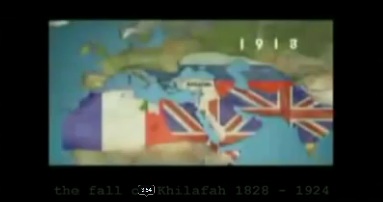
The map is titled United States of Islam. The words “they have done this before” are then followed by a series of film clips showing “the fall of the Khilafa 1828 -1924” and maps showing the slow spread of the British and French flags across north Africa and the middle east, with glimpses of Lawrence of Arabia, the Balfour declaration, and General Allenby, accompanied by the voice-over of someone I’d tentatively identify as Sheikh Imran Nazar Hosein, declaring: The Khilafa was destroyed. Who destroyed it? Why did they destroy it? How did they destroy it? When did they destroy it? What did they replace it with? With what was it replaced? And what is its destiny?

These are awesomely important questions which very few can answer today.

Caliphate divided

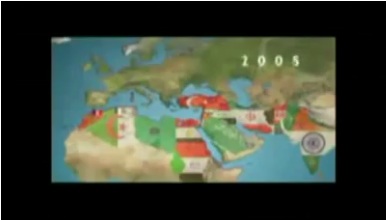
The text then states that (the west) “divided us into 54 states” and the map begins to show the various flags of the Islamic states intowhich the region was more recently divided…

Carved up

ending up in 2006. And what do we want now? You might be forgiven if you haven’t already guessed:

Total Annihilation

Clips then show the toppling of Saddam’s statue in Baghdad, the Israeli army in Gaza with casualties, the October 2009 Pishin attack on the Revolutionary Guard in Iran (which was claimed by Jundullah), and a first mention of the Christmas bomber, Al Qaida and Yemen… a quick mention of Nigeria and Somalia… and “Pakistan from which they fear the most”. A newscaster from, presumably, Pakistan intones “this is called the fourth generation warfare.” That essentially brings us up to the present moment. * We have arrived at the half way point in the 10 minute video and seen the global historical context, laid out in maps and flags. We have focused in on the present from a two-hundred year sweep, and on Pakistan from the distributed ummah. What follows will expound and expand on this present moment, bringing Afghanistan into the picture alongside Pakistan, emphasizing the spiritual significance of Khorasan, and taking the battle variously to India and Jerusalem…

[ to be continued ]

Guest Post: Connecting the Dots: Light on Light

Monday, October 25th, 2010


 Charles Cameron is the regular guest-blogger at Zenpundit, and has also posted at Small Wars Journal, All Things Counterterrorism, for the Chicago Boyz Afghanistan 2050 roundtable and elsewhere.  Charles read Theology at Christ Church, Oxford, under AE Harvey, and was at one time a Principal Researcher with Boston University’s Center for Millennial Studies and the Senior Analyst with the Arlington Institute:

Connecting the Dots: Light on Light

by Charles Cameron 

In a recent blog-post on MahdiWatch, Timothy Furnish draws our attention to an Islamic think tank named Grande Strategy.

1.

Their page of further readings on a future Islamic state includes works by an eclectic bunch – including Sir Muhammad Iqbal, recognized after his death and the foundation of the State as the national poet of Pakistan; Sheikh Taqiuddin An-Nabhani, the founder of the Hizb-ut-tahrir movement; Ali Shariati, the Marx-influenced Shi’ite radical intellectual viewed by some as the ideological force behind the Iranian revolution; Abul A’ala Maududi, Sunni writer and founder of Jamaat-e-Islam; Harun Yahya, also known as Adnan Oktar, a major Islamic creationist writer who holds that “Alawites, Wahabbites, Jafarites, they are all pure Muslims; harboring enmity against them is by no means acceptable”; Sayyid Qutb, Sunni author and Muslim Brotherhood member; and Ayatollah Ruhollah Khomeini, father of the Iranian Revolution.

Let’s just say that if the books of all these worthies were placed on a single bookshelf and given voices, the ensuing hubbub would resemble the House of Commons at Question Time.

2.

One article on the Grande Strategy site – the one that caught Timothy Furnish’s attention – is titled To the Unknown Mujahid, May We Never Forget You. It is interesting, as Furnish notes, because it is yet another sign of Mahdist thinking in the region of Afghanistan / Pakistan. It describes a man seen teaching in a mosque in the Faisal Masjid (presumably in Islamabad):

I have never seen a human spirit glow in this manner. I did not think this was even possible. I checked myself by discretely asking a few other brothers (perhaps it was some deficiency in me), and they too confirmed. Let me intimately describe you this man, he was tall, bearded wore a military camo jacket and in all his manners was as if he had walked out of the 1st century Hijri. He spoke English well enough that you could tell he was well-educated and belonged to a noble family. He was from Kashmir, in fact an elected member of the local government (back then Musharaf was all about devolution of power to press the national parties). Some close relatives of his were also senior officers in the Pakistan Army. He was obviously a mujahid, although in my opinion one that was fighting against India and in Kashmir and had nothing to do with the Afghanistan war.

The writer recounts his experience of this man because, as he puts it…

Because I believe (and Allah knows best) that if he is not the Mahdi himself or one of his men, at the least he is the precursor to the kind of men that would make up the army of the Mahdi. Or for those who do not believe in the Mahdi, he is the category of men that can save us from our present circumstances. A prototype to our success. And Allah knows best. Disclaimer: I don’t want to claim that he is the Mahdi.

3.

There’s also an article on the site about the Black Banners from Khurasan — another marker for Mahdist expectation — that includes quite a mix of sources and resources: commentary, for instance, on the Scofield Reference Bible (a major source of “dispensationalist” end times beliefs) and the “Project for New American Century”, together with some conspiracism about 9/11 specifically and US policy in general:

The US’s War on Terror is a deceptive game and a mind boggling riddle. The term terrorism is itself vague and un-defined and built on repetitive lies upon lies as evident in the case of 9/11. It is almost always blindly used against Muslims. The unilateral, pre-emptive extra-judicial violence by the western powers is always named as wars of democracy and freedom.

— plus for good measure some information about the Jewish origins of the Pashtun / Pathan peoples, and this intriguing statement:

According to Syed Saleem Shehzad of Asia Times Online, Al Qaeda shares this belief with the Taliban that Afghanistan is the promised land of Bilad-e-Khurasan.

— which would mark both as apocalyptic movements (see here and here).

4

On the other hand, one comment from a Shi’ite reader suggests that President Ahmadinejad will be the one who recognizes the Mahdi and brings the victorious army to meet him:

When Shuayb Ibn Saleh (Pres. Ahmedinejad) learns of Al Mehdi (as) emergence he will head towards Syria under three banners each of which has 4,000-5,000 men. It is these banners that are of gaudiance that Allah’s Messenger (saas) spoke of when he mentioned that ‘ when you see this army coming from Khursan, then go and join that army even if you have to crawl over snow, because in that army is the Caliph Al Mehdi[as]’. This holds true because it is Shuayb Ibn Saleh who will consolidate the government of Al Mehdi (as) in Jerusalem within 6yrs (72months).

and:

The Black Flags Coming from Khurasan is not of the Taliban … These Black Flags Belongs To Only Shuayb Ibn Saleh (Pres. Ahmedinejad)

5

But let’s get back to that business about the “Unknown Mujahid”. According to the report Furnish quotes from:

This particular class was being taught by a man, the like of whom I had never seen before, nor since have ever seen again. When you reach a certain level of spiritual enlightenment… sometimes you can “see” or “feel”… the “noor” or “aura” or “spiritual light” of another… This man did not have a glow – it was like a 1000 watt halogen lamp…

I have to say I find that report particularly interesting because, as Dr. Furnish notes, it offers a Sunni parallel to the self-description given by Iran’s Shi’ite President Ahmadinejad — who claimed on video that he’d been told by someone who was there, “When you began with the words ‘in the name of God,’ I saw that you became surrounded by a light until the end [of the speech]”, and commented, “I felt it myself, too. I felt that all of a sudden the atmosphere changed there, and for 27-28 minutes all the leaders did not blink.”

The thing is, this sort of report can also be found on both sides of the Iranian / Israeli aisle.

Gershon Salomon – who as leader of the Temple Mountain Faithful has the twin goals of “the liberation of the Temple Mount from Arab (Islamic) occupation” and “the building of the Third Temple on the Temple Mount in Jerusalem in our lifetime” – wrote a revealing memoir in which he recounted:

I had the privilege to experience the appearance of the G–d of Israel and His angels in one of the critical battles of Israel when I served in the Israeli Army as a young officer and my small unit was attacked by thousands of Syrian Arab soldiers. … It was night but I could see a light covering me from all sides and lighting the dark night. At the same moment, I could see the Syrian soldiers not shooting me but turning and running very fast back to the mountains. I again lost consciousness. I was told later that the Israeli soldiers looking for me in the darkness were only successful in locating me when they saw the light.

6

For what it’s worth, such stories can also be found about the divine or saintly figures of many religions.

Martin Buber tells a legend of the great Hassidic rabbi the Baal Shem Tov, in which a visiting rabbi saw that “the head of the master stood entirely in the white light … The rabbi saw that the master stood entirely in white light.

The Bhagavad Gita describes a moment when Krishna shows his divine form to Arjuna, who describes it thus: “If a thousand suns were to light up the sky all at once, that radiance would equal the radiance of my Lord.”

In the New Testament, Matthew describes how “Jesus taketh Peter, James, and John his brother, and bringeth them up into an high mountain apart, And was transfigured before them: and his face did shine as the sun, and his raiment was white as the light.” (Matt. 17:1-2).

7

If I have points to make, there are several of them:

  • That religious motivations can be powerful drivers at the level of popular morale.
  • That we frequently overlook religious motivations.
  • That reports of apocalyptic signs and miracles are potent amplifiers of religious motives.
  • That when we study religions, we frequently overlook the miraculous and the apocalyptic.
  • That comparative religious studies give context to events that seem extraordinary and affirming within a single religious tradition.
  • That when we study religions, we frequently overlook its comparative aspects.

Oh – and that depth psychology (Freud, Brown, Jung, Hillman) and cultural anthropology (Bateson, Turner, Lansing) also have much to teach us.

8

Connecting dots is not so hard once you can see them — but how do you connect your blind spots?

Guest Post: Of Weaponry and Flags

Sunday, October 24th, 2010

 Charles Cameron is the regular guest-blogger at Zenpundit, and has also posted at Small Wars Journal, All Things Counterterrorism, for the Chicago Boyz Afghanistan 2050 roundtable and elsewhere.  Charles read Theology at Christ Church, Oxford, under AE Harvey, and was at one time a Principal Researcher with Boston University’s Center for Millennial Studies and the Senior Analyst with the Arlington Institute:

Originally posted at Chicago Boyz.com

Of Weaponry and Flags

by Charles Cameron

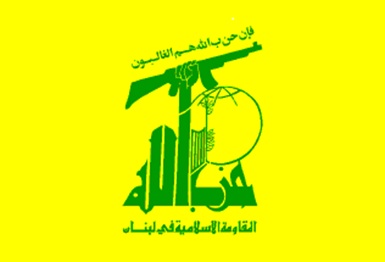
Hezbollah Flag Use

A day or two ago, Abu Muqawama asked whether the Hizballah flag showed an AK-47, and in general what flags carried what weapons as emblems.

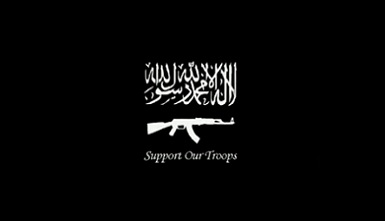
As it happens, I’d just been viewing a pro-jihadist United States of Islam video and made the following screen-capture as an illustration of my continuing concern about the “black flags of Khorasan” and the issue of whether AQ and or its franchises and or portions of the Taliban consider themselves to be fighting the apocalyptic war of the end of time.

Black Flag Support out Troops Sm

Note also that the filmmaker’s ironic borrowing of the phrase “Support Our Troops” to urge support of the troops of the Mahdi will not be lost on some viewers.

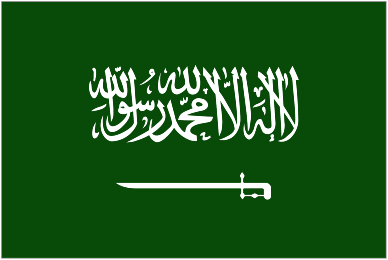
This screen-capture, from the United States of Islam video, in turn reminded reminded me of the Saudi flag, which likewise carries the shahada or Muslim profession of faith and a weapon – a sword.

Saudi flag

According to a note on an earlier version of the World Flag Database:

The script in the centre of the flag is the Islamic creed, “There is no God but Allah, and Mohammed is the Prophet of Allah”. The flag is therefore considered sacred and special protocol rules apply: the flag does not dip in salute, nor is it ever flown at half-mast. Note that the creed always reads properly from right to left, with the sword hilt to the right, so the reverse of the flag is not a mirror image of the obverse. When making the flag, the creed must be reproduced precisely, including the accent marks. The use of the flag on any commercial item (especially clothing) is not recommended as it might be considered inappropriate, or even insulting.

The Shahada is the central testament of faith of Islam, as is the Shema Yisroel of Judaism and the Credo of Christianity, and I respect it as such – and likewise the Saudi flag., on which it is displayed.

*

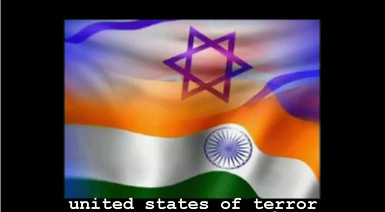
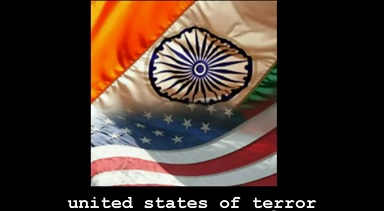
Flags, however, are potent symbols, and the graphical power of the “black flags of Khorasan” motif should not, in my view, be underestimated. The particular video that I took that screen-capture from makes use of “mix” flags of its own devising:

Flag01

– merging the American and Indian flags – or the flags of India and Israel –

Flag02

to create an imagery of the “United States of Terror” to juxtapose against their own black flags as the “United States of Islam” – giving us Huntington’s “Clash of Civilizations” in visceral graphic form.

And that conjunction of India with Israel bears thinking about, too… not only in terms of military aid between the two nations, but also of the symbolic juxtaposition of the Al-Aqsa Mosque and Jerusalem with the Babri Masjid and Ayodhya…

Indeed, the Indian flag itself also deserves consideration in our context.

indian-flag

Originally, Mahatma Gandhi had hoped that it would feature the charka or spinning wheel which he had made famous. As an informative article on the subject from The Hindu puts it:

For Gandhiji, the charka represented not a mere hand-spinning device that could provide employment and income to the poor, but much more. “The message of the spinning-wheel is much wider than its circumference. Its message is one of simplicity, service of mankind, living so as not to hurt others, creating an indissoluble bond between the rich and the poor, capital and labour, the prince and the peasant.” (Young India, September 17, 1925). “Above all, charka is a symbol of non-violence” (Collected Works of Mahatma Gandhi, Vol. 71, first edition, p.234).Gandhiji was, therefore, all the more sad when a correspondent from Hyderabad brought to his notice, on the eve of Independence, K. M. Munshi’s indictment in his broadcast speech that the wheel in the new flag represented the Sudarshana Chakra (discus of Lord Vishnu), a symbol of violence! But Gandhiji consoled himself that “under no circumstances, can the Asoka Chakra become a symbol of violence as Emperor Asoka was a Buddhist and a votary of non-violence” (Harijan Sevak, August 17, 1947).

So there’s another weapon-flag connection – albeit one where non-violence seems to triumph over violence.

*

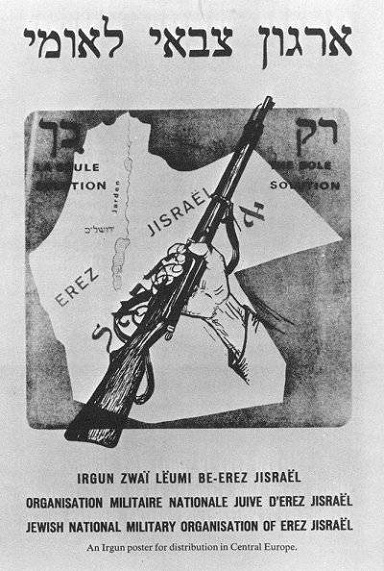
But let me get back to the yellow Hizbollah flag with which we started, and quickly note the resemblance (which I don’t claim to be the first to note, but cannot presently find my source for) between its portrayal of a rifle raised in a victorious fist, and this poster from the Irgun:

Irgun poster

And that’s enough about weaponry and flags for now, I think.

I hope to follow this post up shortly with a more detailed account of the United States of Islam video mentioned above, and its many and curious references and resonances.

Guest Post: Sean Meade Reviews The Illiad

Saturday, September 11th, 2010

The Illiad by Homer

Sean Meade, in addition to being my good friend, is the Web Editor for Aviation Week’s defense and space content and is the former longtime webmaster/editorial assistant/right-hand of Dr. Thomas P.M. Barnett. Sean blogs at ARES for Aviation Week and at his personal blog, Interact:

ON THE ILLIAD

by Sean Meade

What makes ‘The Iliad’ a classic? Why is it classic?

I think the primary answer is simple: it’s the characters. If you can hang tough through all of the idiosyncratic flourishes and ornaments and repetitions, the characters are compelling: Achilleus, his anger and character; the comparative nobility of Hektor and Patroklos (both of whom we know are doomed); the vagaries of the gods and their adolescent machinations; the supporting cast of Agamemnon, Menelaos the wronged, two very different men named Aias (Ajax), Diomedes, Aeneas, Odysseus, Nestor, Paris, Helen and Priam. Take these characters and others and mix them with an interesting story and you have a classic that reaches out to us from about the eighth century BC (when it was likely ‘composed’ (with heavy use of previous, oral sources) by Homer), maybe from as far back as the 12th century BC (maybe the original setting of what has come down to us as The Trojan War). ‘The Iliad’ still resonates with us today.

One reason ‘The Iliad’ can still move us is that Homer has done a masterful job of relating the ‘accidents’ of life. ‘Time and chance happen to all men’, and people who lived 3000 year ago couldn’t deceive themselves about their ability to control life the way we ‘modern’ people do. Human experience and emotions are often inscrutable. ‘Love’ (baldly called ‘lust’ by Homer) can easily destroy. When it occurs in the most influential levels of society, it can draw whole nations into its whirling vortex. Even the love between men in ‘The Iliad’ can seem illogical (no matter where you come down on the homosexuality question): why does noble Patroklos honor Achilleus literally to the death?

‘The Iliad’, of course, focuses a lot on war in ways that have become shockingly remote for most of us. Nothing is so susceptible to ‘luck’ as war. One ‘good’ soldier gets hit by stray friendly fire and dies instantly. Another ‘bad’ soldier comes through the whole war unscathed. Consider the hazards of love, life and war in ‘The Iliad’. Consider them in our own experience. It makes more sense than many theories to conclude that arbitrary and capricious gods can powerfully affect us.

My final guess (for the purposes of this mini-review) at why ‘The Iliad’ is a classic is that the poetry is timeless. This is, of course, nearly impossible to take in from one read-through in translation. My friend, Jason, listened to the abridged version and talked about its power. The commentators discuss it quite a bit, from what I can tell. Most of us (who aren’t going to pay the price to really test it) are going to have to take this on faith and rate it as we will. Poetry is a dying art, and poetry appreciation is probably in an even worse state.

I wonder what role foreknowledge plays in ‘The Iliad’. Many of us know the broad outline of the story going in. If we don’t, Homer spills it in short order. Does knowing Achilleus dies shortly after this episode in The Trojan War change our view of him? Do we cut him more slack? How does  knowing that Hektor and Patroklos die within the bounds of this story affect us? Or that Odysseus lives? Or that Agamemnon will be murdered in his bath by his wife (he had it coming ;-)?

Something else that stands out about ‘The Iliad’ is the graphic war imagery. Homer’s descriptions almost seem gratuitous when he goes into detail about how one soldier killed another, where the spear penetrated and where it came out, what muscles were severed, what happened to the bowels, teeth or brain. It’s probably distasteful to many of us in the 21st century, but I think we can just chalk that up to cultural differences.

My second big question is: what does ‘The Iliad’ mean? I’m very snobbish about exegesis, especially concerning the Bible (my training, as a former pastor), but including any suitably worthy literature (with concomitant training in British Lit and Analytic Philosophy). Exegesis, in principle, is simple: what was the author trying to communicate to the audience? (So why is good exegesis so hard to find? 😉 If we are to make any meaningful connection to the original work, this is where we have to begin. You can deploy your Reader Response Theory on ‘Twilight’ or some such drivel, but keep it off my Homer (I told you I’m a snob ;-).

We come to ‘The Iliad’ at a loss because Homer’s values are very different from ours. His presuppositions are vastly different from ours. I have touched on some of these already. The gods can show up at any time and throw any wrench in the works for almost any imaginable reason. We have to take the role of the gods seriously to take Homer seriously. What did their role say about the responsibility of people? Humans retain some responsibility, almost paradoxically. Helen isn’t completely off the hook for running away with Paris. Achilleus does not get a complete pass for his anger that causes the deaths of so many Achaean comrades. Agamemnon is not excused for his overbearing pride that contributed to the disagreement with Achilleus. And even noble Hektor faces bouts of inaction and cowardice for which he is not wholly exonerated.

Another value we find hard to understand is the ancient Greek concept of nobility. It’s just born there. If you’re a shepherd who’s not the natural-born son of King Priam and Queen Hekabe, that’s all you’ll ever be: a shepherd. The main characters are noble; many are first-generation half-deities and most (all?) have divinity in their bloodline somewhere. From our standpoint, Achilleus behaves like a monster, especially in his repeated attempted-desecration of Hektor’s body (the gods protect Hektor’s body and Achilleus’ ultimate honor by preserving Hektor’s corpse inviolate in almost the perfect proverbial deus ex machina). He’s sacrificed any claim to nobility as far as we’re concerned. Not so for Homer and the ancient Greeks; Achilleus retains his nobility, though it is clouded by sins. He receives partial pardons and rationalizations. From our perspective, we view him as maybe the original anti-hero. Homer’s view is much less ambivalent, and Achilleus gets away with things for which lesser men would go straight to Tartaros without passing ‘Go’. It’s a far cry from our 21st century Western concept of nobility and our love of ‘rags to riches’ fables. It’s only riches to riches here (though maybe no one knew through the rags that you were really rich).

So what is Homer’s message? The conclusion of my barely-better-than-cursory reading is: Given that nobility and greatness are natural, almost literally gifts of fate (the Fates); and that humans are subject to the whims of the gods; it is best to be brave and seek glory (within reason–with a glance forward to Aristotle’s middle-way ethic). How’s that going to help you with your job or family? Not much. It’s fodder for thinking about societal values and a long way from whether or not to stick it out in your mediocre, going-nowhere job. (It might possibly apply to whether or not you should run away with your neighbor’s spouse.)

For most of us, ‘The Iliad’ is probably a test in proper exegesis more than someplace we should or will go to look for meaning. But maybe that’s just my soap box 😉

Grand Strategy and Morality II.

Tuesday, August 24th, 2010


After I wrote the post Grand Strategy and Morality, blogfriend T. Greer had a serious objection:

Grand Strategy, I submit, does not provide us with a moral purpose. Rather, grand strategy is the means we use to satisfy the demands of this purpose. You cannot have grand strategy without the purpose – but they are not one and the same. Purpose transcends individual statesmen. It is the work of peoples, not politicians. As I state later in the piece:

Greer cites his erudite essay on the subject, Dreaming Grand Strategy for the full explanatory argument ( here is Greer’s excerpt but you should read the whole thing):

In  Manifest Destiny and Mission in American History Frederick Merk states that the defining feature of the American polity has been its “sense of mission.” Americans, says he, have always been invested in the idea that their Republic served a great purpose. They could never delegate their destiny to the realpoliticking of the upper echelons of power. In times of crisis it is this sense of of purpose that has sustained the Republic, and in achieving national goals it is this sense of purpose that has acted as the unconscious guide of American statesmen and citizens alike. Strip away America’s mission, and you have stripped away America. And in doing so you have stripped away our grand strategy as well.

You will be hard pressed to find a strategy articulated and pursued by American statesmen that was not embedded in a larger sense of American purpose. The isolationism of the early 1800s was rooted in the conviction that America was creating “an Empire of Liberty”, untouched by the despotism of the old world. 50 years later the nation fulfilled its “Manifest Destiny” to “Extend the Area of Freedom” by expanding to the Pacific coast. Before Roosevelt could put “Germany First”, he needed to declare that his country was “The Arsenal of Democracy”.  Kennan’s policy of containment was reliant on the assurance that America was the true and only “Leader of the Free World.”

Phrases like “Manifest Destiny” and “Arsenal of Democracy” were not merely the rhetorical flourish used by canny politicians to justify the exercise of power. They were the reason power was exercised in the first place. These phrases were, in essence, bit-sized distillations of the mission and purpose Americans claimed for their nation. Containment only worked because the American populace believed that it was America’s mission to act as the Leader of the Free World. Cold War grand strategy was an outgrowth of this mission – a means to maintaining the mission’s end.

Purpose provides America with a vision. It prioritizes our interests, informs us of our enemies, and tells us what position we seek to hold on the international scene. A nation without a purpose is a nation without a grand strategy to achieve it.

I’m very sympathetic to much of what is in this post at Scholar’s Stage because we are grasping toward the same point: the relationship between grand strategy and moral purpose. Having reflected on T.Greer’s argument and my own prior post, here is my response:

  • While moral purpose is a constant variable in grand strategy generally, in specific historical cases it’s importance will vary significantly.
  • At times, Greer is right that grand strategy is embedded in a prexisting moral purpose. I certainly agree that that civilizational values and mores govern the nature of the grand strategies that societies will construct.
  • Greer’s essay, albeit persuasive, is too American-centric. The US among a handful of nations ( France, the former USSR, Imperial Japan, etc.) that requires a more explicit and rhetorically robust moral-ideological justification for a grand strategy than is typical. Some states only need a grand strategy that does not flagrantly contradict national moral principles, while other states require a grand strategy that champions them. Americans want America to be the “Citty on a hill”; others just want their country to survive with honor.
  • At other times, when realpolitik reigns, a successful grand strategy can ignite or act as a catalyst for a resurgence of moral purpose rather than be driven by it. Bismarck’s successful articulation of grand strategy went against prevailing elite opinion in the German states that was weighted heavily against Prussian domination of a united Germany, the military arguments of von Moltke’s grossgeneralstab and the preferences of Bismarck’s own monarch, King Wilhelm of Prussia. Bismarck’s wars of choice against Denmark, Austria-Hungary and France made Wilhem Kaiser and unleashed a ferocious dynamism of German nationalism whose consequences were to shake the world. 

My preference would be for strategic theory to be neat and clean, but history is a messy business.


Switch to our mobile site