Two death tolls, 9/11 and Puerto Rico
Wednesday, September 12th, 2018[ by Charles Cameron ]
.
Simply:
[ by Charles Cameron ]
.
Simply:
[ by Charles Cameron — a light-hearted look at Trump Chess, and an umpire explains millisecond decision-making ]
.
The first of two pieces I’ll explore here is from the New Yorke, Rules for Trump Chess by Andrew Paul. It’s a humor piece, but not without its satirical effect, as you can tell from Rule #1:.
Each turn is referred to as a “news cycle.”
At times, the hunmor gets a bit sour, as with Rule #4:
A handful of new pieces will be introduced during game play, scattered haphazardly across the board. They include: two overcooked macaroni noodles (Kushners), a shrivelled white raisin with lint on it (Sessions), and a washcloth soaked in warm Johnnie Walker (Bannon). Their permitted moves are unclear, but every news cycle, players must select one to put in their mouths until they gag.
Links to an earlier (and more balanced) form of chess are not entirely absent, as exemplified by Rule #11:
Knights still move in that ridiculous two-squares-up, one-square-over path. They think they are being very clever. Their creepy horse faces must always be turned to face the king.
You can read the rest at the New Yorker site
**
Of deeper interest, though with less immediate application to politics, is Jim Evans‘ WaPo piece, Sorry, judges, we umpires do more than call balls and strikes. Here’s the setup:
I don’t remember when I first heard the popular analogy comparing judges to umpires calling balls and strikes, but recently it’s been everywhere. When Brett Kavanaugh was first nominated to the Supreme Court, Tony Perkins of the Family Research Council called him “a constitutionalist — someone who will call balls and strikes.” This past week, as Kavanaugh’s confirmation hearings began, Sen. John Cornyn (R-Tex.) described him as “somebody who calls balls and strikes and doesn’t come up with his own strike zone.” Supposedly a judge is, and should be, as mechanical as an ump.
Mechanical, eh?
It’s true that there are similarities. Umpires have always been considered authority figures, like judges. Both are subject to a lot of scrutiny, and we do what we think is right by rule and tradition. Umpiring is a special calling and a learned skill that requires extraordinary mental toughness. When you put on your uniform, you are supposed to leave all your subjective feelings in that dressing room. Personal integrity and respect for the game are at stake.
I’ve seen similar said about judges when they put on their robes.. But even the simple “calling balls and strikes” level of analogy lacks subtlety:
Seeing the televised rectangle that allegedly represents the strike zone, you might surmise that any 3-year-old should be able to tell whether that little white sphere is in or out of that box. Replay has reinforced the feeling that it’s simple and obvious.
Yet there are many intangibles when it comes to calling balls and strikes. What the umpire’s actually doing is gauging a baseball’s relative position as it travels 95 miles an hour into a three-dimensional area. You’re judging a pitch as it leaves the pitcher’s hand and goes to the catcher’s mitt in less than half a second.
Getting into greater finesse:
For example, the rule book states that a runner must avoid a fielder in the act of fielding a batted ball. If you collided with a shortstop who was bent over in the act of fielding a ground ball, you would be guilty of interference. But if the shortstop had completed the act of fielding and was attempting to tag you when the collision occurred, there would be no penalty. Among elite athletes, this all happens in milliseconds, and to the untrained eye, the plays look the same — both violent collisions with the ball on the ground. This requires an interpretation of when one act ended and another began, and whose rights are in effect. This is a judgment call.
Interesting final sentence, that.
Okay, it would be neat if an appellate or superior court judge could write a similar piece on the niceties of judicial judgment..
**
Umpires and referees..
I’ve always tended to think of umpires as the cricket equivalents of referees, and referees as the soccer equivalents of umpires, but what do I know?
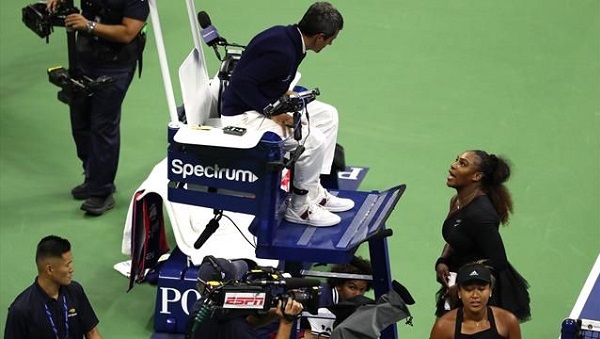
Chair Umpire Carlos Ramos arguably interfered in the match, bringing both repeated champion Serena Williams and first-time winner Naomi Osaka to tears.
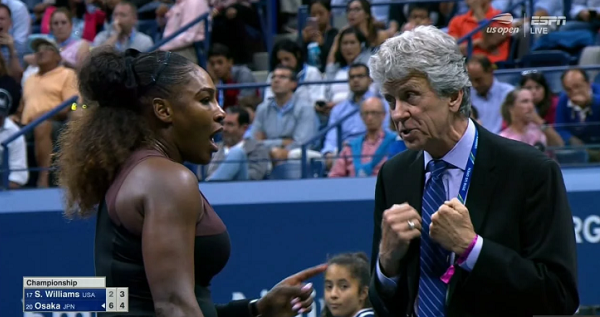
Match Referee Brian Earley holds his fists in, exemplifying both the passion and restraint in play in the US Open final
In the Serena Williams objection to penalties allotted her during the second set of her finals match with Japan’s young winner Naomi Osaka, I’ve learned today that in tennis, the umpire, usually seated in a high chair at center court makes unassailable rulings of fact, while the referee can overrule him in matters of tennis law — effectively making the umpire analogous to the jury, and the referee to the judge, in a trial by jury.
And thus the analogical web widens..
[ by Charles Cameron — a romantic attribute of poets, close to the holy spirit ]
.
Poetic afflatus is the term for a private wind of inspiration which follows a poet around — on fortunate days. That photo of Donald Hall which Sally Benzon so much admired, I believe illustrates the afflatus — Hall has allowed his hair to stray wherever the whim of wind may take it, while the urbane Obama has curated his to stay close to the skull in all weathers — a remarkable juncture of opposites.
Here, then, for Sally B and all, is the only example I know of, presenting that private wind in a motion picture — here surrounding the person of Richard Burton, ruffling his hair and scarf while all else in the room is still — in an unforgettable clip from Christian Marquand‘s 1968 film Candy, itself a loose (not to say libertine) update of Candide:
[ by Charles Cameron — I’d infinitely rather play Bach than chess.. ]
.
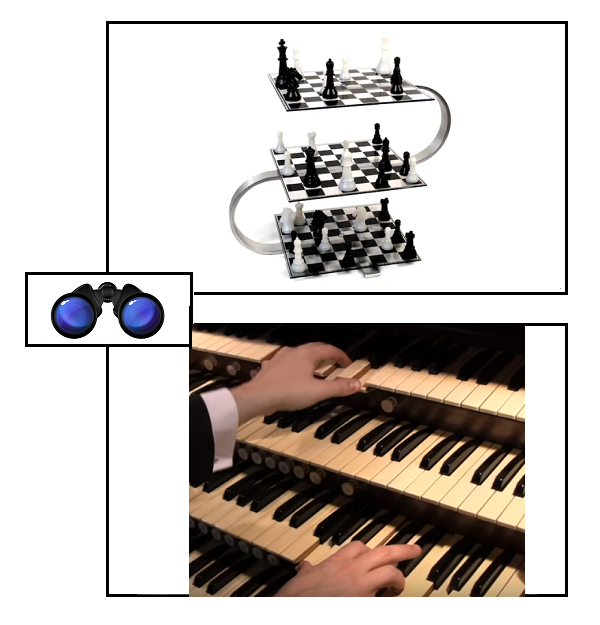
Above, a three-dimensional chess set. When I was up at Oxford, I had a three dimensional tic-tac-toe board, four sheets of plastic stacked vertically, each one drilled four by four, with yellow and red golf pegs to mark moves — it was quite a thrill, especially as an escape from Old Testament studies, but I wouldn’t play it now to save my, well, soul.
Below, Jonathan Scott performs his arrangement of the Finale from Saint-Saens “Organ” Symphony (No. 3) on the 1895 T.C. Lewis organ of Albion Church, Ashton-under-Lyne, UK.
I would, OTOH, give my soul to be able to play the organ — a privilege denied me until I reached Grade 5 in the British system — a grade I gave up on in despair after too mant teachers forcced me to play the detested Alec Rowley‘s exercises — with different fingerings.. Piano, feh, It took me half a lifetimes to realize there is some merit to be found therein.
[ by Charles Cameron — loss and grief, formalized ]
.
Over North Vietnam, Naval pilot John McCain was shot down out of his intended flight path in his youth, to suffer years of captivity and torture before his release, and after a long life of service in the House and Senate, as his body was interred in the Annapolis Naval Academy Cemetery, one jet from a formation of four peeled away up and rose vertically while the three remaining planes regrouped in formation, the purpose of the gesture, the aviation fuel made available for it, and the honor accorded to the four pilots being, in the words of a Naval Air Force Atlantic release
the missing man formation is a salute performed as part of flypast of aircraft at a funeral or memorial event in memory of a deceased aviator. One airplane in a four-plane formation will pull up vertical to signify the passing of the aviator’s soul to the heavens.
You’ll note that the “passing of the aviator’s soul to the heavens” is a theological, rather than a Naval, doctrine, and indeed the gesture is a deeply emotional one, made all the more powerful by the strict discipline required of the pilots involved.
Jets perform ‘missing man’ formation in tribute to John McCain
I just wanted to note, as a religious matter, and as an indication of the power of simplicity, constraint, and tradition in liturgy, the power of this last note in McCain’s funeral passage from Sedona to Annapolis.

Zenpundit is a blog dedicated to exploring the intersections of foreign policy, history, military theory, national security,strategic thinking, futurism, cognition and a number of other esoteric pursuits.
Customized Web Site & Blog Design