Archive for the ‘Afghanistan’ Category
Guest Post: The United States of Islam
Tuesday, October 26th, 2010Charles Cameron is the regular guest-blogger at Zenpundit, and has also posted at Small Wars Journal, All Things Counterterrorism, for the Chicago Boyz Afghanistan 2050 roundtable and elsewhere. Charles read Theology at Christ Church, Oxford, under AE Harvey, and was at one time a Principal Researcher with Boston University’s Center for Millennial Studies and the Senior Analyst with the Arlington Institute:
The United States of Islam Video
by Charles Cameron
[ the first in a series, cross-posted from Chicago Boyz ]
Let’s take a closer look at the United States of Islam video which I mentioned in my post Of Weaponry and Flags.
The video announces itself as “an USI Films production”. It then opens with the words “since 911 the world has changed” in white type against black, followed immediately by news clips of the WTC attacks and of President Bush describing them as “evil acts” and declaring “I have directed the full resources of our intelligence and law enforcement communities to find those responsible, and to bring them to justice.” What we shall be seeing, then, is a time-oriented video, presenting a historical context for the present moment with implications for the near future. From here we cut by way of another white on black typed message — “they started this war in afghanistan” – via clips of war footage to another – “but their agenda is much bigger and brutal than that” – and then to another clip of Pres. Bush: “Our war on terror begins with al-Qaida but it does not end there. It will not end until every terrorist group of global reach has been found, stopped, and defeated.” By this point, the background music, which is taken (for reasons both political and musical?) from Vangelis’ 1492 – Conquest of Paradise soundtrack, is swelling. A global map appears, showing much of north Africa, the middle east, Indonesia and Malaysia in green, with Pres. Bush in voice over speaking of the establishment of “a violent political utopia across the middle east which they call a Caliphate where all will be ruled according to their hateful ideology.”
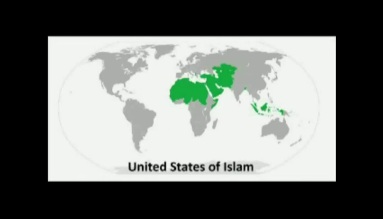
The map is titled United States of Islam. The words “they have done this before” are then followed by a series of film clips showing “the fall of the Khilafa 1828 -1924” and maps showing the slow spread of the British and French flags across north Africa and the middle east, with glimpses of Lawrence of Arabia, the Balfour declaration, and General Allenby, accompanied by the voice-over of someone I’d tentatively identify as Sheikh Imran Nazar Hosein, declaring: The Khilafa was destroyed. Who destroyed it? Why did they destroy it? How did they destroy it? When did they destroy it? What did they replace it with? With what was it replaced? And what is its destiny?
These are awesomely important questions which very few can answer today.
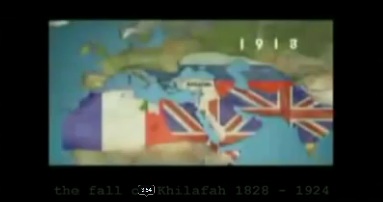
The text then states that (the west) “divided us into 54 states” and the map begins to show the various flags of the Islamic states intowhich the region was more recently divided…
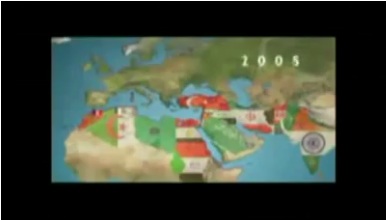
ending up in 2006. And what do we want now? You might be forgiven if you haven’t already guessed:
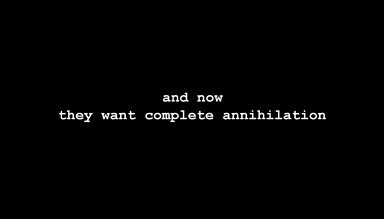
Clips then show the toppling of Saddam’s statue in Baghdad, the Israeli army in Gaza with casualties, the October 2009 Pishin attack on the Revolutionary Guard in Iran (which was claimed by Jundullah), and a first mention of the Christmas bomber, Al Qaida and Yemen… a quick mention of Nigeria and Somalia… and “Pakistan from which they fear the most”. A newscaster from, presumably, Pakistan intones “this is called the fourth generation warfare.” That essentially brings us up to the present moment. * We have arrived at the half way point in the 10 minute video and seen the global historical context, laid out in maps and flags. We have focused in on the present from a two-hundred year sweep, and on Pakistan from the distributed ummah. What follows will expound and expand on this present moment, bringing Afghanistan into the picture alongside Pakistan, emphasizing the spiritual significance of Khorasan, and taking the battle variously to India and Jerusalem…
[ to be continued ]
Guest Post: Of Weaponry and Flags
Sunday, October 24th, 2010Charles Cameron is the regular guest-blogger at Zenpundit, and has also posted at Small Wars Journal, All Things Counterterrorism, for the Chicago Boyz Afghanistan 2050 roundtable and elsewhere. Charles read Theology at Christ Church, Oxford, under AE Harvey, and was at one time a Principal Researcher with Boston University’s Center for Millennial Studies and the Senior Analyst with the Arlington Institute:
Originally posted at Chicago Boyz.com
Of Weaponry and Flags
by Charles Cameron
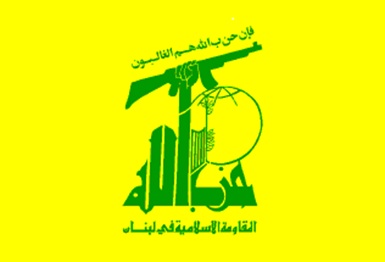
A day or two ago, Abu Muqawama asked whether the Hizballah flag showed an AK-47, and in general what flags carried what weapons as emblems.
As it happens, I’d just been viewing a pro-jihadist United States of Islam video and made the following screen-capture as an illustration of my continuing concern about the “black flags of Khorasan” and the issue of whether AQ and or its franchises and or portions of the Taliban consider themselves to be fighting the apocalyptic war of the end of time.
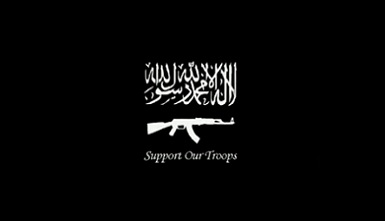
Note also that the filmmaker’s ironic borrowing of the phrase “Support Our Troops” to urge support of the troops of the Mahdi will not be lost on some viewers.
This screen-capture, from the United States of Islam video, in turn reminded reminded me of the Saudi flag, which likewise carries the shahada or Muslim profession of faith and a weapon – a sword.
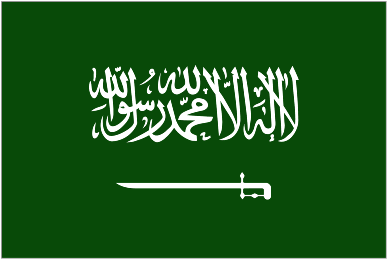
According to a note on an earlier version of the World Flag Database:
The script in the centre of the flag is the Islamic creed, “There is no God but Allah, and Mohammed is the Prophet of Allah”. The flag is therefore considered sacred and special protocol rules apply: the flag does not dip in salute, nor is it ever flown at half-mast. Note that the creed always reads properly from right to left, with the sword hilt to the right, so the reverse of the flag is not a mirror image of the obverse. When making the flag, the creed must be reproduced precisely, including the accent marks. The use of the flag on any commercial item (especially clothing) is not recommended as it might be considered inappropriate, or even insulting.
The Shahada is the central testament of faith of Islam, as is the Shema Yisroel of Judaism and the Credo of Christianity, and I respect it as such – and likewise the Saudi flag., on which it is displayed.
*
Flags, however, are potent symbols, and the graphical power of the “black flags of Khorasan” motif should not, in my view, be underestimated. The particular video that I took that screen-capture from makes use of “mix” flags of its own devising:
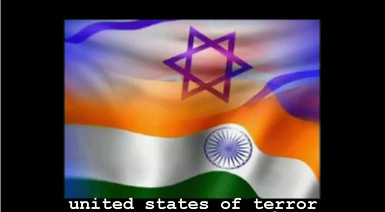
– merging the American and Indian flags – or the flags of India and Israel –
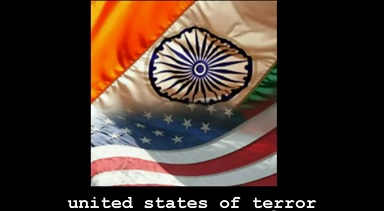
to create an imagery of the “United States of Terror” to juxtapose against their own black flags as the “United States of Islam” – giving us Huntington’s “Clash of Civilizations” in visceral graphic form.
And that conjunction of India with Israel bears thinking about, too… not only in terms of military aid between the two nations, but also of the symbolic juxtaposition of the Al-Aqsa Mosque and Jerusalem with the Babri Masjid and Ayodhya…
Indeed, the Indian flag itself also deserves consideration in our context.
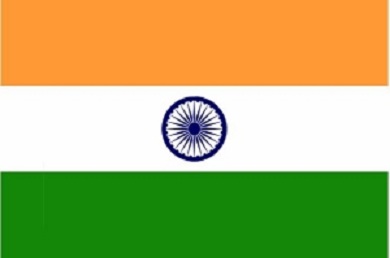
Originally, Mahatma Gandhi had hoped that it would feature the charka or spinning wheel which he had made famous. As an informative article on the subject from The Hindu puts it:
For Gandhiji, the charka represented not a mere hand-spinning device that could provide employment and income to the poor, but much more. “The message of the spinning-wheel is much wider than its circumference. Its message is one of simplicity, service of mankind, living so as not to hurt others, creating an indissoluble bond between the rich and the poor, capital and labour, the prince and the peasant.” (Young India, September 17, 1925). “Above all, charka is a symbol of non-violence” (Collected Works of Mahatma Gandhi, Vol. 71, first edition, p.234).Gandhiji was, therefore, all the more sad when a correspondent from Hyderabad brought to his notice, on the eve of Independence, K. M. Munshi’s indictment in his broadcast speech that the wheel in the new flag represented the Sudarshana Chakra (discus of Lord Vishnu), a symbol of violence! But Gandhiji consoled himself that “under no circumstances, can the Asoka Chakra become a symbol of violence as Emperor Asoka was a Buddhist and a votary of non-violence” (Harijan Sevak, August 17, 1947).
So there’s another weapon-flag connection – albeit one where non-violence seems to triumph over violence.
*
But let me get back to the yellow Hizbollah flag with which we started, and quickly note the resemblance (which I don’t claim to be the first to note, but cannot presently find my source for) between its portrayal of a rifle raised in a victorious fist, and this poster from the Irgun:
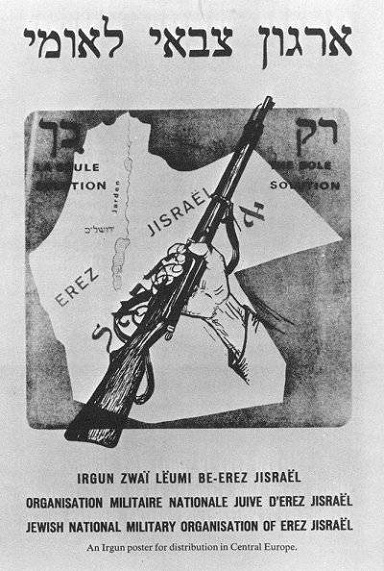
And that’s enough about weaponry and flags for now, I think.
I hope to follow this post up shortly with a more detailed account of the United States of Islam video mentioned above, and its many and curious references and resonances.
Exum in Foreign Policy
Sunday, October 24th, 2010Andrew Exum on negotiation in AfPakland in Foreign Policy:
….But Afghans are perfectly comfortable talking while still fighting. So too, at least in practice, are the United States and its allies: In insurgencies from Vietnam to Northern Ireland, we have negotiated with insurgents while combat operations were ongoing. In the American public’s mind, however, wars take place sequentially: First, you fight;
second, you negotiate a settlement. The word “negotiations” conjures up hopes for an end to the conflict in the minds of Americans and other Westerners — when all that really might be occurring is another round of jockeying for position between Afghanistan’s warring political forces.
….All that, to make matters worse, assumes the insurgent groups are independent actors. The reality, though, is that negotiations between the insurgent groups and the government in Kabul will only go so far as the Pakistani security services allow. Some Western analysts took heart in Pakistan’s decision in February to arrest Taliban leader Mullah Abdul Ghani Baradar. At the time, however, the arrest of Mullah Baradar, who was in negotiations with the government in Kabul, was interpreted by the Taliban rank and file to be a stark warning to those who would negotiate without the permission of the Pakistani government, under whose patronage and protection the Taliban has operated east of the Durand Line since 2005. Today it is widely accepted that this was indeed the case and that Pakistan deliberately thwarted negotiations between the Quetta Shura Taliban and the government in Kabul to serve its own parochial interests. Since that event, there is no sign that Pakistan’s powerful military has taken a softer line on negotiations between the Taliban and the government in Kabul.
Exum wrote a good op-ed. Go read it.
That said, the above paragraph makes me want to ask Andrew why the United States is not negotiating directly with Pakistan/ISI instead of wasting valuable time kabuki-ing around with plausibly deniable and expendable members of proxy groups over which Pakistan holds a demonstrated veto?
What is particularly curious in this situation is that Secretary of Defense Robert Gates, in his memoir From the Shadows, made laudatory remarks about George Schultz (with whom Gates bumped heads) as “the toughest secretary of State I knew” who was willing to negotiate with the Soviets in one part of the world while bleeding them in another ( paraphrasing here). A lesson from history that bears revisiting.
Pakistan is our real adversary in Afghanistan and the party with the power to actually make agreements that stick. Negotiations 101: bargaining should not take place with powerless intermediaries.
Guest Post: Blip 01: Bin Laden the Avatar
Friday, October 15th, 2010Charles Cameron is the regular guest-blogger at Zenpundit, and has also posted at Small Wars Journal, All Things Counterterrorism, for the Chicago Boyz Afghanistan 2050 roundtable and elsewhere. Charles read Theology at Christ Church, Oxford, under AE Harvey, and was at one time a Principal Researcher with Boston University’s Center for Millennial Studies and the Senior Analyst with the Arlington Institute:
Regarding the popular intel phrase “connect the dots”, this is the first, brief ‘blip’ in a series of short posts that Charles will be feeding in here along with more substantial pieces, to capture the sort of stray thoughts, while they are flying by, that may add up to more of a mosaic later.
Bin Laden the Avatar
by Charles Cameron
Just a quick question:

Is bin Laden portrayed as an “Avatar” in the James Cameron sense in this
video in which he also talks about climate change — a significant
ecological theme in his recent discourses?
h/t Ibn Siqilli, frame taken from the video “Help Your Brothers in Pakistan”. People have joked about it – see Here for instance… But is AQ picking up on the meme and exploiting it, as they’ve exploited Tolkien on occasion?


