zenpundit.com » games

Archive for the ‘games’ Category

On the felicities of graph-based game-board design – seven

Tuesday, May 31st, 2016

[ by Charles Cameron — the series continues from six ]
.

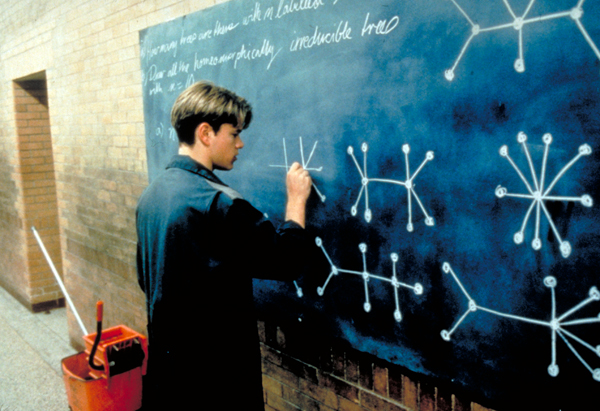
What a pleasure to discover Matt Damon does graph theory in his spare time!

Matt Damon draws graphs

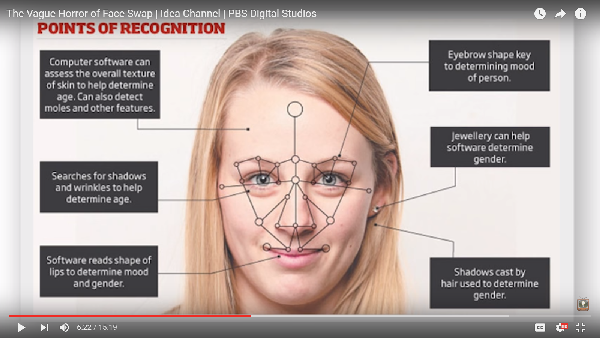
— or that the female face. similarly, is viewed by some as the basis for graphical analysis:

Facial recognition

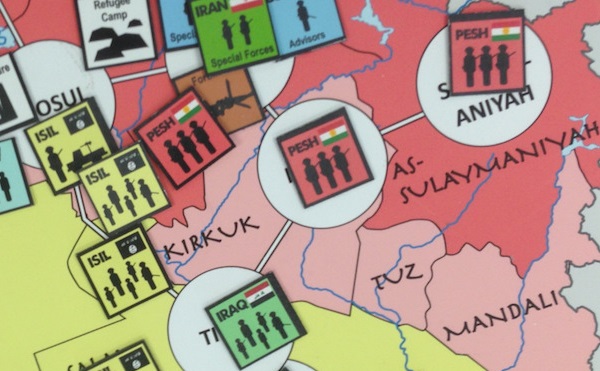
— and that even war-gaming boards, such as this one from PAXsims’ ISIS Crisis game, can feature the node and edge / circle and line format, along with cards, dice, hexagons…

Geek and Sundry

**

Sources:

  • Matt Damon, Good Will Hunting
  • PBS Digital, The vague Horror of Face-Swap
  • Geek & Sundry, Can Gaming Inporove Strategic Military Planning?
  • Incidentally, I have a brief exchange with Rex Brynen in the comments section at PAXsims
  • Previous posts in this series:

  • On the felicities of graph-based game-board design: preliminaries
  • On the felicities of graph-based game-board design: two dazzlers
  • On the felicities of graph-based game-board design: three
  • On the felicities of graph-based game-board design: four
  • On the felicities of graph-based game-board design: five
  • On the felicities of graph-based game-board design: six
  • Take Me Out to the Ball Game, TerraPattern!

    Thursday, May 26th, 2016

    [ by Charles Cameron — “similar-image search for satellite photos” for Sembl / Hipbone players ]
    .

    Tablet DQ 600 baseball at 75

    I began my TerraPattern test-drive at CitiPark [above] and wound up Justin Seitz would know where!

    **

    As you can see [below], TerraPattern gave me plenty of choices:

    Tablet DQ 600 baseball 02 at 75

    **

    The number of museum collections, apps and other sources for Sembl / HipBone use and potential partnership grows by the day!

    A rosary of glass beads for Emily Steiner

    Tuesday, May 24th, 2016

    [ by Charles Cameron — semantic networks as game boards, old and new — see also the series presently linked at and ending with On the felicities of graph-based game-board design: six ]
    .

    Since I’m plaguing Emily Steiner with my thoughts on two of her recent tweets, I’d best explain first the reasons for my interest.
    Game-boards-1
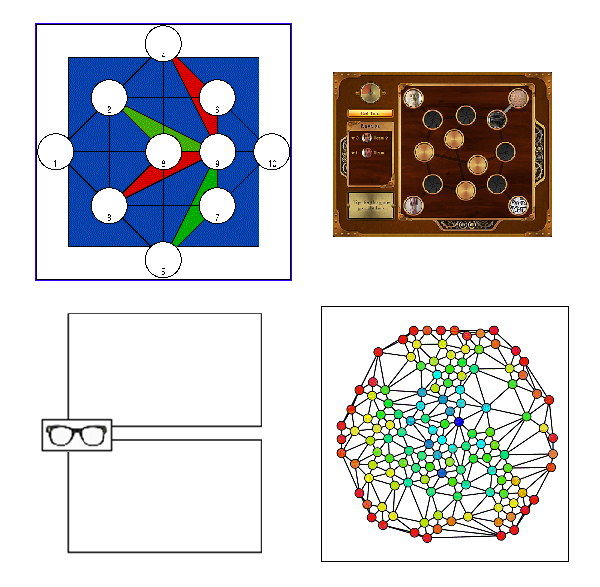
    top left, a HipBione “WaterBird” board; right, Cath Styles‘ “Museum Game” board; lower left, an early HipBone “DoubleQuote” board; right, the “Said Symphony” board

    As long time readers here will already be aware, I’m involved in the design, development and play of a family of games based on Hermann Hesse‘s conceptual Glass Bead Game, using boards that are what mathematicians would term graphs:

    **

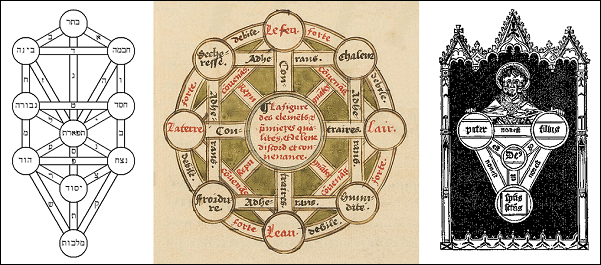
    Technically, our game boards in the course of play are what Margaret Masterman termed semantic networks — and Masterman herself cited one such network from an earlier century imaging the Trinity — here on the right panel — which I have reproduced in the triptych below along with a diagram of the Kabbalah, left, and of the elements by Oronce Fine, center:
    3-ancient-bds2

    **

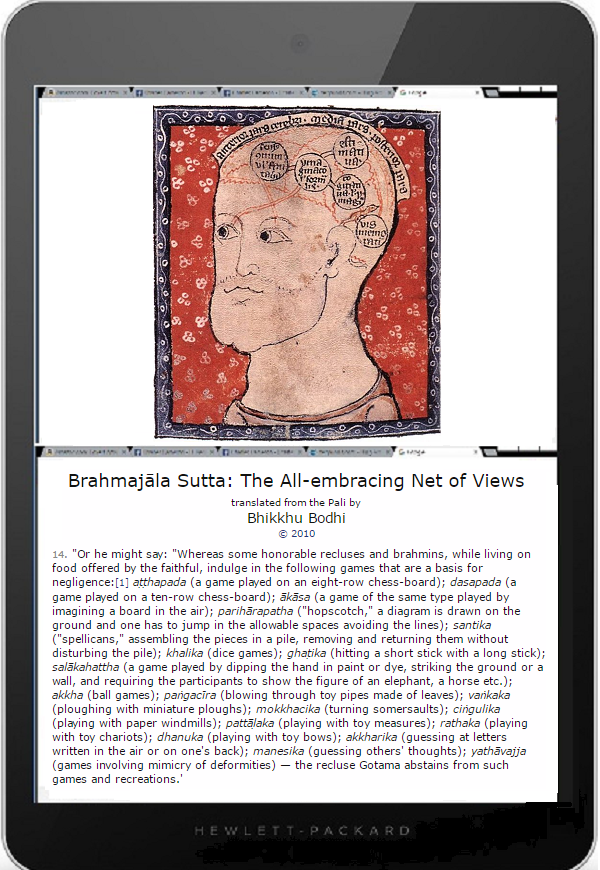
    Which brings me to the first of two tweets Prof. Steiner posted today — the image of a head, with what is clearly a semantic network inside it — thoughts connecting with thoughts, or brain areas with brain areas, or perhaps both:
    Akasha games in the mind

    Viewed from the perspective of the HipBone Games, this semantic network within a brain (mind) is what the Buddha termed, somewhat reprovingly, a game played akasa, “by imagining a board in the air”.

    **

    But the Buddhist tradition wasn’t always as, what shall I say? — puritanical about games:

    Tablet DQ Monastic games

    As you’ll see, the upper panel here is a bit more relaxed on the subject of games in Buddhism — while the lower panel shows another game board, this one for a medieval Christian game on the Gospels, which Dr Steiner featured in the other tweet of hers that caught my eye today.

    There are four canonical Gospels, Matthew, Mark, Luke, and John, but they’re actually asymmetrical, Matthew, Mark, and Luke sharing properties and chunks of text which have conferred on them the group title of the “synoptic gospels” — while John is more symbolic, deeper, indeed mystical, and stands alone.

    There’s a saying about them, Read, Mark, Learn, and Inwardly Digest. I don’t believe it’s intended to name the four pof them, but since Mark is second in order both in the saying and in the sequence of gospels found in the New Testament, I’m happy to consider John’s Gospel to be the equivalent of Inwardly Digest

    **

    But bringing the ancients into the modern day is a laudable activity, so I’ll close by taking that Gospel game board, as I like to think of it, and compariung it with one of the boards from the recent series of games in which AlphaGo — clearly a duende or djinn of some sort — beat out our best-living Go master in a series of 5 games:
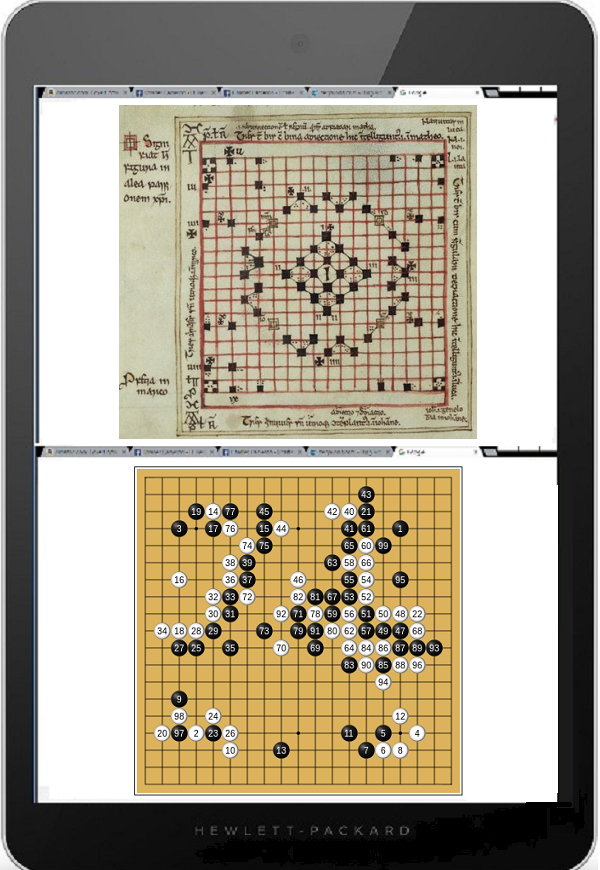
    Tablet DQ Go and Gospel games

    Again, symmetry and asymmetry. Is the symmetry of the Gospels game a symmetry of the Divine Mind? And is the asymmetry of the game of Go an asymmetry of the two minds in play — or simply of a game in which one player gets to make the first move?

    I look forward to learning from Dr Steiner how the Gospel game was played.
    Mancala games in culture & nature

    Tuesday, May 17th, 2016

    [ by Charles Cameron — I would rather play with the woodpeckers than with the humans ]
    .

    Mancala games are games in which “seeds” are places in a series of “holes” in a board, often a carved wooden board, according to mathematical principles of play and capture. Wikipedia:

    Most mancala games share a common general game play. Players begin by placing a certain number of seeds, prescribed for the particular game, in each of the pits on the game board. A player may count their stones to plot the game. A turn consists of removing all seeds from a pit, “sowing” the seeds (placing one in each of the following pits in sequence) and capturing based on the state of board. This leads to the English phrase “count and capture” sometimes used to describe the gameplay. Although the details differ greatly, this general sequence applies to all games.

    ¶¶

    Equipment is typically a board, constructed of various materials, with a series of holes arranged in rows, usually two or four. The materials include clay and other shape-able materials. Some games are more often played with holes dug in the earth, or carved in stone. The holes may be referred to as “depressions”, “pits”, or “houses”. Sometimes, large holes on the ends of the board, called stores, are used for holding the pieces.

    Playing pieces are seeds, beans, stones, cowry shells, half-marbles or other small undifferentiated counters that are placed in and transferred about the holes during play.

    ¶¶

    Among the earliest evidence of the game are fragments of a pottery board and several rock cuts found in Aksumite areas in Matara (in Eritrea) and Yeha (in Ethiopia), which are dated by archaeologists to between the 6th and 7th century AD; the game may have been mentioned by Giyorgis of Segla in his 14th century Ge’ez text Mysteries of Heaven and Earth, where he refers to a game called qarqis, a term used in Ge’ez to refer to both Gebet’a (mancala) and Sant’araz (modern sent’erazh, Ethiopian chess).

    Nota Bene:

    Even when played with glass beads, mancala games are not even close to the Glass Bead Game as Hermann Hesse describes it, since their moves have nothing to do with cultural citation or meanings, let along their contrapuntal connections and correspondences, but are indifferent markers, inherently fungible.

    **

    It was 3 Quarks Daily that introduced me to the avian version of mancala games in a post that read:

    Acorn woodpeckers drill into trees not in order to find acorns, but in order to make holes in which they can store acorns for later use, especially during the winter.

    As the acorn dries out, it decreases in size, and the woodpecker moves it to a smaller hole. The birds spend an awful lot of time tending to their granaries in this way, transferring acorns from hole to hole as if engaged in some complicated game of solitaire.

    Multiple acorn woodpeckers work together to maintain a single granary, which may be located in a man-made structure – a fence or a wooden building – as well as in a tree trunk. And whereas most woodpecker species are monogamous, acorn woodpeckers take a communal approach to family life. In the bird world, this is called cooperative breeding. Acorn woodpeckers live in groups of up to seven breeding males and three breeding females, plus as many as ten non-breeding helpers. Helpers are young birds who stick around to help their parents raise future broods; only about five per cent of bird species operate in this way.

    **

    Conclusion:

    For myself, I would rather play with the woodpeckers than with the humans.

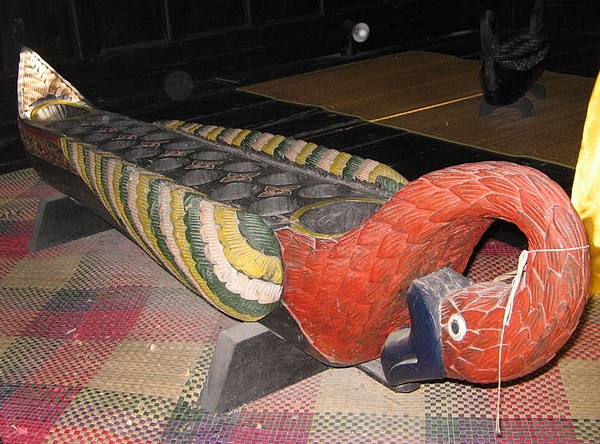
    Even so, a humanly-wrought board can be very lovely:

    swan mancala board

    That a world-mapping should include our assumptions

    Friday, May 13th, 2016

    [ by Charles Cameron — Lorenz’ butterfly : tornado :: Fukushima’s rat : earthquake? + Brussles metro attack ]
    .

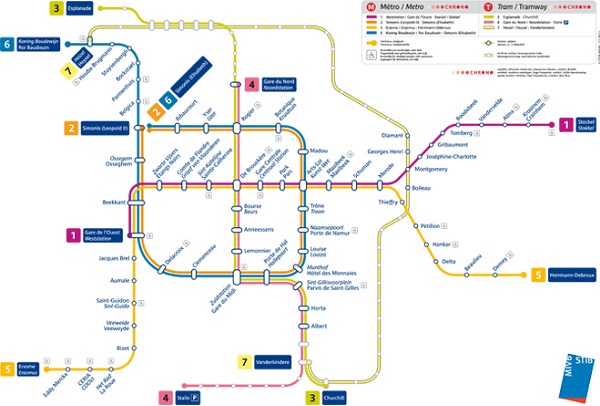
    Brussels map
    Brussels metro & tramway map

    **

    For every unintended consequence, there’s an assumption that was assumed and thus overlooked, forgotten, unfairly assigned to oblivion, amirite? Sometimes we’re fortunate, and a pattern emerges that can then be written into checklists, and repeat unintended consequences subsequently averted, if we heed the checklists, ahem.

    Consider this stunning paragraph, from a Union of concerned Scientists‘ 2013 piece titled Fission Stories #133: Mayflies, and Squirrels, and Rats, …:

    Fukushima Daiichi recently received worldwide media attention when another power outage once again interrupted cooling of the water in the Unit4 spent fuel pool for several hours. The culprits in 2011 were an earthquake that knocked out the normal supply of electricity to the cooling system and a tsunami that disabled the backup power source. This time, a rat was the culprit. It chewed through the insulation on an electrical cable, exposing wires that shorted out and stopped the cooling system. It was also the rat’s final meal as the event also electrocuted the guilty party.

    Part of what’s so conceptually audacious here is the implicit risk equation, okay, perhaps I should call it the implicit risk approximation:

    earthquake = rat

    **

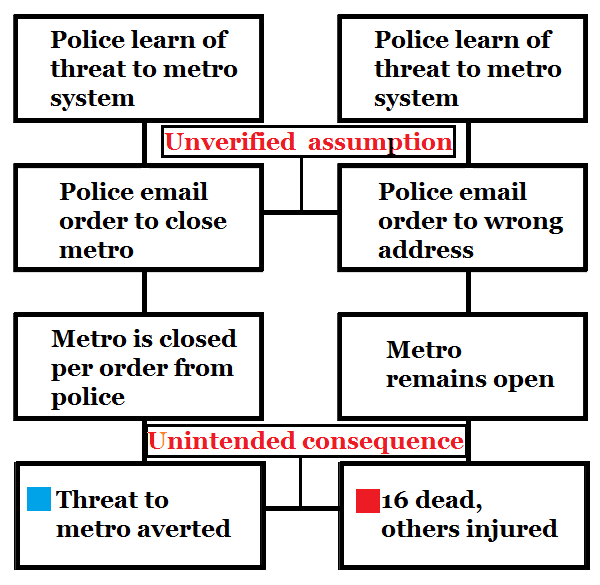
    Take the Brussels metro attack: in my less-than-graphically-ideal mapping below, the left hand column shows what was intanded by the police to be the order of events as they initiated them in response to the airport attack a little earlier:

    01

    while the two centered annotations in red indicate the unverified assumption that interfered with the sequence of events as intended by the police, and the right hand column shows what actually transpired.

    Exceopt that the situation was wildly more complex than that — a point not germane to my argument here, but elaborated upon in today’s WaPo article, The email that was supposed to prevent the Brussels metro attack was sent to the wrong address. Which see.

    **

    Getting back to Fukushima, the earthquake and the rat, perhaps we can now take the title of Edward Lorenz‘ remarable paper that gave us the term “butterfly effect” — Predictability: Does the Flap of a Butterfly’s Wings in Brazil Set Off a Tornado in Texas? — out of the realm of speculation, and into the realm of improbable yet actualized comparables, by rephrasing it thus: Predictability: Does the Bite of a Rat’s Teeth in Fukushima Have Comparable Effect to an Earthquake in Fukushima?

    Oh, and just because something is predictable doesn’t mean it’s predicted — and just because something is predicted doesn’t mean the prediction will be heard or heeded.

    And that’s an anticipable consequence of the way we are.

    **

    In the matter of Quixote:

    I have this quixotic wish to see a map of global dependencies — it’s something I’ve thought about ever since Don Beck told me “Y2K is like a lightning bolt: when it strikes and lights up the sky, we will see the contours of our social systems” — and I’ve talked about it here before, in eg Mapping our interdependencies and vulnerabilities [with a glance at Y2K].

    It’s a windmill, agreed — a glorious windmill! — and indeed, combining all our potential assumptions about even one single Belgian metro station in the course of just one particular morning and adding them to a map — or a checklist — would be another.

    Tilting at windmills, however, is one of the great games of the imagination, frowned upon by all the righteously serious among us, well-suited to poets — and having the potential to help us avoid those damned unintended consequences.


    Switch to our mobile site