At Play in the Fields of the Lord
Monday, October 8th, 2012[ by Charles Cameron — two ways of playing football, two faiths ]
.
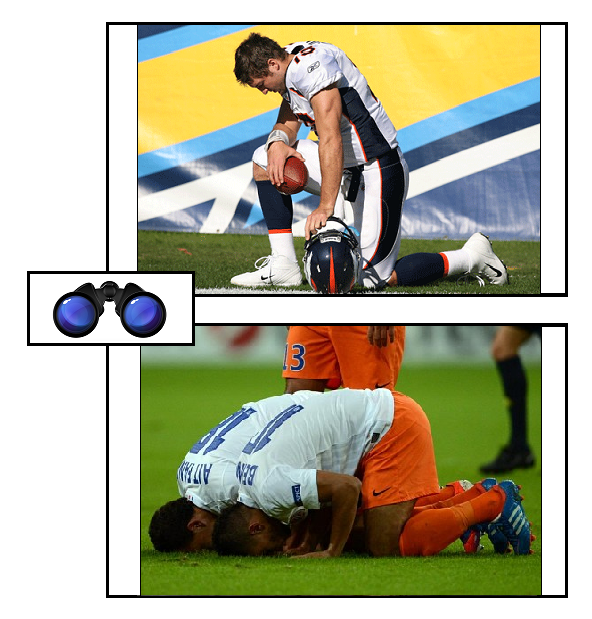
Image sources:
Tim Tebow: Urban Faith
Karim Ait-Fana and Younes Belhanda: Al Arabiya
[ by Charles Cameron — two ways of playing football, two faiths ]
.
Image sources:
Tim Tebow: Urban Faith
Karim Ait-Fana and Younes Belhanda: Al Arabiya
[ by Charles Cameron — a follow up to my previous post — and it’s not religion that’s the alternate reality this time, but games ]
.
.
I just posted a long and potentially contentious post about what I called a person / position paradox: that of the member of the US House Committee on Science, Space and Technology and chairman of the US House Science Subcommittee on Investigations and Oversight, Rep. Paul Broun MD (R-GA), who said recently:
that stuff I was taught about evolution and embryology and the Big Bang Theory, all that is lies straight from the pit of Hell…
And he meant it.
**
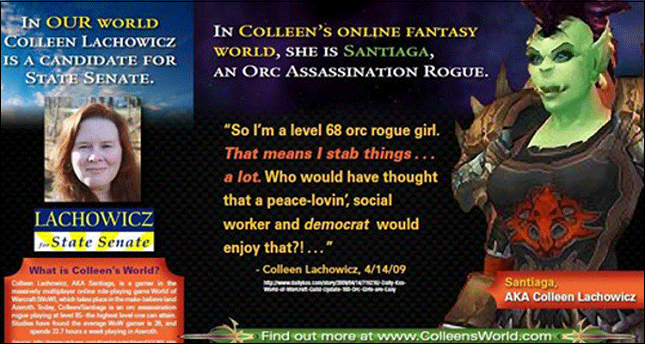
Well, while I was writing that post, this little gem (above) crossed my bows (ht Paxsims) — so perhaps you’ll permit me to poke a little fun at a member of the other US political party.
It seems that Colleen Lachowicz, Democratic candidate for the Maine State Semnate, is also Santiaga, Orc Assassination Rogue in the game-world, World of Warcraft.
Questions arising:
Does that make her more representative or less?
what about the fact that she plays at level 68?
is that a representative level to play at?
and an Orc Assassination Rogue? really?
or is she just a candidate who happens to be a gamer?
The image above comes from the Maine GOP, btw.
**
To look at this minor contretemps from another angle: how far are we from religion, here in the land of Orcs?
The great literary critic Northrop Frye in his Anatomy of Criticism writes of:
great art using popular forms, as Shakespeare does in his last period, or as the Bible does when it ends with a fairy tale about a damsel in distress, a hero killing dragons, a wicked witch, and a wonderful city glittering with jewels.
Frye is not knocking Revelation here, though one might at first think he is: he’s assigning it to a literary genre, as one might assign the Psalms to poetry, Kings and Chronicles to history, or the Gospels and Acts of the Apostles to biography. The Epistles, after all, are already classified as epistolary works. And — give the man a break — he’s also placing it in the same realm of great art as Shakespeare.
How far, then, do you suppose CS Lewis‘ Narnia — or Tolkien‘s Middle Earth, with its Elven folk Firstborn of the Children of Ilúvatar — might be from the World where Colleen is an Orc?
**
How much room can we concede to imagination in our “real world”?
And Dante‘s voyage took him through the three realms of Inferno, Purgatorio and Paradiso, didn’t it, and according to the Apostles Creed, Christ’s Harrowing of Hell took place between his death and resurrection.
So my next question would be:
When will we build and play the games of Paradise?
[ by Charles Cameron — for Madhu ]
.
Our friend Madhu has requested that I post poems here on occasion, and this particular poem made me think of her and her request, so here it is:
A copper and gold koan
.The world happened, the world is drifting away,
the farther away the world floats the deeper into the mists.In Mes Aynak, Afghanistan, the remains
of a buddhist monastery already eroded by time are adrift,
a sitting buddha is floating into the mist,
headless, gold paint still on his knees and robe,
the devotion has drifted, lifted its focus
to the one without a second, the buddha left
whatever he left in memory, lingering, to gather aromas
of other ideas, realms, dust, archaeology, oblivion,
there is change, ceaseless change,and adults must decide: is the wealth implied by the copper
beneath the buddha worth more than a trace of halo,
as the moon moves once again across a brilliant night sky.
.
Koans are those brilliant paradoxes zen buddhism uses to pry the mind open, I think they’re important aids to handling complexity, and I have a post about them coming up shortly. Here, it’s enough to say that the issue of copper mining vs archaeology in Mes Aynak seems to me to be a living, breathing koan.
**
It’s awkward, when you write an “ekphrastic” poem, a poem about a painting or photo, to have the image right there when the poem is read, because it trammels the reader’s mind in much the same way that a film can trammel the mind of a reader into “seeing” only the film-maker’s Gandalf, no longer her or his own.
And I’m going on at some length about this, because next up is the image from which that particular poem was built, but I’d like the image to be, as they’d say in the newsprint world, “below the fold” as you read the poem.
So here it is, #4 in a fine series of photos in a Foreign Policy photo essay which I recommend, although I’ve taken this particular (smaller) version from a CNN page, since the subtitle in the lower right corner explains the basic situation handily:

You can hear the archaeologist Brent Huffman, who took the photo, talk about the situation here — local reactions pro and con, who the Taliban are shooting at, the likelihood that the Chinese operation will in fact benefit the locals and more:
The koan of balancing material with immaterial values remains, but in this circumstance the likelihood of local Afghans receiving litter or nothing from the mining project likely tips the scales.
You can petition Afghan President Hamid Karzai for preservation…
But then he’s another wild-card in the continuing Great Game, isn’t it?
[ by Charles Cameron — cross-posted from Sembl, side-scrollers for the mind, light but deep ]
.

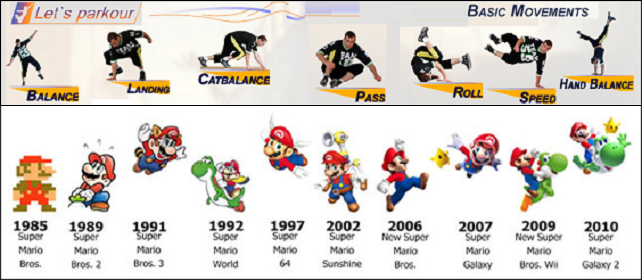
According to 25 Years of Super Mario Bros: A Look Back Through Mushroom Kingdom History, from which I grabbed the Mario Bros portion of the graphic at the foot of this page, “Since 1985’s release of the second-most selling console game of all-time, over 200 Nintendo titles have featured the eponymous Mario Bros” — on which I’ve played perhaps three or four levels of one or two early versions.
The Super Mario Bros side-scrollers (image above, left) are the work of the brilliant Shigeru Miyamoto, and part of what I find so fascinating about them is the way in which they resemble the mind-blowing practice known as Parcours (image, right), which apparently developed from the work of one David Belle, born in 1973 — who would have been 12 when the first Super Mario Bros game came out.
Let’s take a look at Super Mario Bros and Parcours, and then move on to the issue of parcours for the adventuring mind.
**
First, for those of you who don’t remember them, here’s what the early Mario Bros games were like…
I don’t think there’s much doubt that the Super Mario Bros games are essentially digital versions of Parcours, and you can see by comparing the video above with this next one:
Finally, this video from Jesse La Flair confirms the comnnection, at least in the mind of one top flight traceur:
**
My own question is: what would a mental parcours game look like?
I was thinking for a while last week about what a Mario-like side-scrolling game of mental parcours would be like. We already have the “creative leap” side pretty well covered with the various variants of Sembl we’ll be developing, so I thought about other types of mental agility, and what a game might look like if it incorporated a bunch of them — induction? deduction? causality? the sorts of pattern skills that go into IQ tests? — in a side-scroller with playful graphics…
Two things:
One: my friend Derek Robinson pretty quickly informed me that the actual build of such a game would be enormously complex — I resisted him, saying I wasn’t aiming to build the entire game, just to get the idea down on paper to see whether we could get the initial phases funded…
And two: I ran across Lumosity:
Let’s just say Lumosity seems to have a variety of cognitive skills well in hand, which leaves me free once again to concentrate on what Derek calls the mind’s opposable thumb.
**
That’s a brilliant concept, I think, and gets to the heart of what we’re working on with Sembl.
The various other conceptual skills that essentially add up to linear thinking — Zen calls it vertical thinking, see this helpful diagram — are important, and well-studied. They work best where what you are talking about is quantifiable and amenable to logic and cause and effect analysis, and is explored within fields, not across them.
But lo, that approach may help you quantify the trees and evaluate them as board feet of lumber, but consistently misses the forest, the greater context, the big picture –the combined systemic impact of many tiny details, insects, mosses, the tree as ecosystem within an ecosystem, and the ecosystems within that – the time scale, the slow growth, the root system, the transformation of mulch into nourishment, the sudden spurt of tiny leaves in spring, the photosynthesis — and the human wonder — the glory, dappled sunlight on fallen leaves, the shelter afforded to lovers by a weeping willow (I’m thinking of one willow in an Oxford college garden, but I’m time-traveling and I digress) – the poetry, of beech and birch, copper beech and silver birch, the trees, the words, the metals…
Context, quality, complexity, systems, dynamics, process, simplicity, value, passion, poetry – these are the things linear thinking has problems with. Poetry, passion, value, simplicity, process, dynamics, systems, complexity, quality, context – these are the things horizontal thinking does best.
**
That’s it.
Oh, and hey — just because I like the tiny antics they’re getting up to in the graphics:
[ by Charles Cameron — embassy or consulate — a minor detail for an editor, perhaps, but all the difference in the world for Ambassador J Christopher Stevens ]
.
Here’s a screen grab of a piece posted on the Atlantic site today:

.
The article itself is worth your time, and I’ll get back to the screen grab later. Here’s the text para that interests me:
In the famous “Bin Ladin Determined to Strike in US” Presidential Daily Brief of August 6, 2001, one of the major analytic points was that “Al-Qa’ida members — including some who are US citizens — have resided in or traveled to the US for years, and the group apparently maintains a support structure that could aid attacks” (emphasis added). Notice that this analysis uses two hedges in a single sentence. Given the lack of certainty on the issue, such linguistic dodging made sense — as it does in report after report where individuals are discussing information below the level of actionable intelligence.
Leah Farrall has been tweeting about the way this characteristically cautious phrasing used by analysts gets lost as “the higher up the food chain an analytical report goes the greater the tendency for bosses in [the] food chain to add their two cents worth” — so that by the time it reaches the politicians, “there is absolutely WMD.”
The shift from “apparently” to “absolutely” is an interesting one.
**
The 2007 National Intelligence Estimate featured a section on the nomenclature of such distinctions, which I trust and imagine was directed more at its readers than towards the analysts who produced it:
What We Mean When We Say: An Explanation of Estimative Language
When we use words such as “we judge” or “we assess”—terms we use synonymously — as well as “we estimate,” “likely” or “indicate,” we are trying to convey an analytical assessment or judgment. These assessments, which are based on incomplete or at times fragmentary information are not a fact, proof, or knowledge. Some analytical judgments are based directly on collected information; others rest on previous judgments, which serve as building blocks. In either type of judgment, we do not have “evidence” that shows something to be a fact or that definitively links two items or issues.
Intelligence judgments pertaining to likelihood are intended to reflect the Community’s sense of the probability of a development or event. Assigning precise numerical ratings to such judgments would imply more rigor than we intend. The chart below provides a rough idea of the relationship of terms to each other.
We do not intend the term “unlikely” to imply an event will not happen. We use “probably” and “likely” to indicate there is a greater than even chance. We use words such as “we cannot dismiss,” “we cannot rule out,” and “we cannot discount” to reflect an unlikely—or even remote—event whose consequences are such it warrants mentioning. Words such as “may be” and “suggest” are used to reflect situations in which we are unable to assess the likelihood generally because relevant information is nonexistent, sketchy, or fragmented.
In addition to using words within a judgment to convey degrees of likelihood, we also ascribe “high,” “moderate,” or “low” confidence levels based on the scope and quality of information supporting our judgments.
• “High confidence” generally indicates our judgments are based on high-quality information and/or the nature of the issue makes it possible to render a solid judgment.
• “Moderate confidence” generally means the information is interpreted in various ways, we have alternative views, or the information is credible and plausible but not corroborated sufficiently to warrant a higher level of confidence.
• “Low confidence” generally means the information is scant, questionable, or very fragmented and it is difficult to make solid analytic inferences, or we have significant concerns or problems with the sources.
**
You could think of these as counter-telephone measures — attempts to avoid the distortions and corruptions that tend to arise when a message is passed from one person to another, And that’s important a fortiori when an ascending food-chain of transmitters may wish (or be persuaded) to formulate a message that will assure them the favorable attention of their superiors — but also because the higher the report goes, the closer it gets to decision-time..
As the Atlantic article says, this kind of “linguistic dodging” (aka attention to nuance) makes sense “in report after report where individuals are discussing information below the level of actionable intelligence.”
Inevitably there’s a shift in tempo between contemplation and action.
**
Anyway, messages tend to get distorted as they’re passed along.
Consider, for instance, the caption to the photograph that graces the Atlantic piece at the top of this post:
The U.S Embassy in Benghazi burns following an attack in September. (Reuters)
There’s only one problem there. The US didn’t have an Embassy in Benghazi — they had a Consulate — and that’s not a distinction that lacks a consequence. Whatever else may be the case, Ambassador Stevens would certainly have been better guarded had he been back in Tripoli in his embassy.
Whoever wrote that caption wasn’t as deeply immersed in the situation as the former CIA analyst who write the article. And when you’re not deeply immersed, it is perilously easy to get minor but important details wrong.

Zenpundit is a blog dedicated to exploring the intersections of foreign policy, history, military theory, national security,strategic thinking, futurism, cognition and a number of other esoteric pursuits.
Customized Web Site & Blog Design


