zenpundit.com » games

Archive for the ‘games’ Category

Gamification: al Awlaki loses big points

Friday, May 13th, 2011

[ by Charles Cameron ]

.

There’s been talk about “gamification of jihad” recently, the idea being that on the jihadist forums you get points and seniority for posting often, your posts getting thumbs up from others, etc — reputation, in a nutshell.

tweet-quilliam-on-obl-on-awlaki.png

Well, the guys at Quilliam include Senior Analyst Noman Benotman, one time leader of the Libyan Islamic Fighting Group (LIFG) and bin Laden comrade-in-arms, who later disbanded the former and criticized the latter in an open letter — if he’s getting the sense that al-Awlaki didn’t impress bin Laden, hopefully some jihadi wannabes will get rapidly less impressed, too…

Two horrors, one suggestion, and a very great poem

Thursday, May 5th, 2011

[ by Charles Cameron ]
*
.
I like the idea of seven generations as a timeline to work with: it’s mid-range, and it confers a sort of limited immortality on the world around me, without being too bothered about me and my personal survival. On the other hand, it’s an “over the horizon” kind of thinking, and I once heard the suggestion that when in a four-and-a-half tatami room, I should confine myself to four-and-a-half tatami thinking.

So.

An alternative approach is to leave everything else out of a given picture, and concentrate on what happens to children.

I’m not suggesting “seven generation”, “four-and-a-half tatami”, or “children only” thinking should be the only approaches we take, just that they may add valuable insight…

*

In which spirit: Forget, for a moment, enmity: here are two horrors…

quo-child-impact.jpg

*

These two things have struck me as particularly horrible in my browsing over the last few days. The first – assuming the Guardian is quoting the Pakistani intelligence official correctly, and that the official knows what he’s talking about – is the sort of thing we might not, as the saying goes, “wish on our worst enemy” – but it happened to our enemy’s child, a girl, twelve years old:

Osama bin Laden’s 12-year-old daughter watched as her father was shot dead by American special forces, a senior Pakistani intelligence official has told the Guardian.

The girl, who was found at the scene of the raid by Pakistani security services, is being cared for at a military hospital having been wounded in the attack. She has been questioned about the sequence of events during the raid on Sunday night.

No blame, as the saying goes – but for that child, it’s a double tragedy.

And the second?

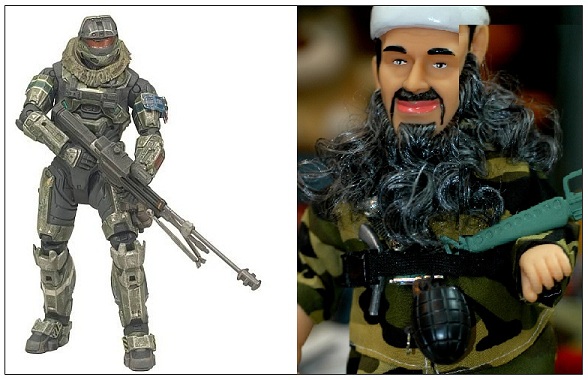
I know how excited my own sons get when a new action-figure toy from the Halo line arrives in the household – so I dread to think how a toy like this might turn younger minds, as yet perhaps innocent of violence and hatred, towards the “heroism” of jihad…

halo-ubl.jpg

[ Jun Noble 3 action figure from Amazon – OBL action figure from Foreign Policy slideshow ]

*

It is childhood I am grieving:

Leaves, like the things of man, you
With your fresh thoughts care for, can you?
Ah! as the heart grows older
It will come to such sights colder
By & by, nor spare a sigh…

Gerard Manley Hopkins SJ, from his poem Spring and Fall, to a young child

Two courtyards, two hundred camels

Sunday, March 6th, 2011

a light-hearted canon in two voices

[ by Charles Cameron ]

*

I’d been doing some research for a follow-up post on story-telling in Afghanistan to go with Scott‘s account of his day at DARPA’s recent STORyNET conference, and one of the interlocutors on the list we’re both on posted a question about the impact of drug use as a consideration in narrative.

Baudelaire and Cocteau both have writings on drug use — hashish and opium respectively — but it was Afghan or more generally Islamic story-telling that I was after, and it occurred to me that the four stories in Paul Bowles‘ collection, A Hundred Camels in the Courtyard, were easily accessible examples of the kind of story-telling that Moroccans are prone to under the influence of hashish.  Bowles describes their mental processes thus:

Moroccan kif-smokers like to speak of the “two worlds,” the one ruled by inexorable natural laws, and the other, the kif world, in which each person perceives “reality” according to the projections of his own essence, the state of consciousness in which the elements of the physical universe are automatically rearranged by cannabis to suit the requirements of the individual. These distorted variations in themselves generally are of scant interest to anyone but the subject at the time he is experiencing them. An intelligent smoker, nevertheless, can aid in directing the process of deformation in such a way that the results will have value to him in his daily life. If he has faith in the accuracy of his interpretations, he will accept them as decisive, and use them to determine a subsequent plan of action. Thus, for a dedicated smoker, the passage to the “other world” is often a pilgrimage undertaken for the express purpose of oracular consultation.

The title of Bowles’ little collection, by the way, comes from the Moroccan proverb which is gives me the first of my two quotes, two courtyards, two intoxicants and two hundred camels below…

I wasn’t entirely satisfied, though, which a Moroccan account of hash-flavored narrative when DARPA was looking for an understanding of narrative that would apply in Afghanistan, so I thought I’d look up some of Idries Shah‘s writings, and Kara Kush in particular, to see if perhaps I could find an Afghan equivalent of Bowles’ stories there…

I already had Bowles’ one courtyard and one hundred camels in mind, so you’ll understand how pleased I was to stumble upon another slightly obscure but interesting writer — Peter Lamborn Wilson, aka Hakim Bey, who gave use the concept of the TAZ or Temporary Autonomous Zone — writing about Afghanistan rather than Morocco, opium rather than hashish, and a second courtyard, with a second hundred camels:

quo-100-camels.jpg

Two terrific writers: Paul Bowles and Peter Lamborn Wilson.

Sources: BowlesWilson

Courtyards with a hundred camels in them are popping up all over.

Call and Response

Thursday, March 3rd, 2011

[ by Charles Cameron ]

Okay, don’t take this one too seriously:

quo-witches.gif

I’m a big fan of Frank Herbert‘s Dune, and the news that there’s now a Goodnight Dune version for kids on the web caught me off guard and carried me away…

Hat tip to Bryan Alexander of Infocult

Elementary, my dear Watson — for humans

Wednesday, March 2nd, 2011

[ by Charles Cameron ]

On the face of it, the two events described here – the super-match in which IBM’s Watson computer beat two human Jeopardy champs, and the crowd-sourced protein-folding experiment in which nearly 60,000 gamers fared better than a supercomputer — would seem to say, respectively, that computers can defeat humans, and that humans can beat computers. So what’s to believe?

quoexperiments.gif

I don’t think the opposition holds up on closer inspection, however.

Watson may have beaten the human contestants in Jeopardy, but as the paragraph I quoted shows, it was nonetheless a human that “had the last word”.

Ben Zimmer in The Atlantic goes on to describe just how clever that “last word” actually was:

If you are a fan of The Simpsons, you’ll be able to identify it as a riff on a line from the 1994 episode, “Deep Space Homer,” wherein clueless news anchor Kent Brockman is briefly under the mistaken impression that a “master race of giant space ants” is about to take over Earth. “I, for one, welcome our new insect overlords,” Brockman says, sucking up to the new bosses. “I’d like to remind them that as a trusted TV personality, I can be helpful in rounding up others to toil in their underground sugar caves.”
.
Even if you’re not intimately familiar with that episode (and you really should be), you might have come across the “Overlord Meme,” which uses Brockman’s line as a template to make a sarcastic statement of submission: “I, for one, welcome our (new) ___ overlord(s).” Over on Language Log, where I’m a contributor, we’d call this kind of phrasal template a “snowclone,” and that one’s been on our radar since 2004. So it’s a repurposed pop-culture reference wrapped in several layers of irony.

Frankly, Watson isn’t up to that level of clever – it would take a Sherlock or a Mycroft to pull that off…
.
So in that first instance, the computer apparently beats the humans, but the humans come across as brighter than the computer all the same.
.
More or less the opposite happens with my second example. Here we have tens of thousands of humans pitted against a single computer, and the humans appear to have the edge – but do they?
.
It’s not the individual human brain that wins here, but what you might term “massively parallel human processing” – which isn’t nearly as impressive.
.
So there are in fact three kinds of ingenuity on display here: the original small-group human ingenuity that constructed the machine, the machine’s own mechanical ingenuity, and the combined ingenuity of sixty thousand humans in distributed collaboration

*

Look, here’s my challenge. The folks at IBM need to read Hermann Hesse’s Magister Ludi, and figure out how to create the sort of computer that could best Joseph Knecht at his own game

Let’s make that a little easier. they need to be able to recognize rich analogies across wide disciplinary distances — well enough to come up with a relationship comparable in its impact on two previously unrelated fields of knowledge to, say, the Taniyama-Shimura conjecture linking elliptic curves and modular forms

Simpler still: they need to be able to play one of my HipBone Games – see Derek Robinson‘s description of the games in The HipBone Games, AI and the rest — well enough to pass a Turing test.

*

Elementary, my dear Watson…


Switch to our mobile site