zenpundit.com » games

Archive for the ‘games’ Category

A Baghdad DoubleTake and other matters

Friday, December 31st, 2010

[ by Charles Cameron ]

Zen recently posted a video of a terrific hour-plus-long speech by Doug Hofstadter – one of the best videos I’ve ever taken the time to watch – in which Hofstadter, the guy who brought us Godel Escher Bach and much more, talked about analogy and suggested that it’s at the very core of human cognition.

I posted a poem and some comments in response — they got a bit mangled in terms of formatting, which may be fixed by the time you read this – and Zen then posed a question:

Charles – there’s a large portion of visual imagery in the passage you cite: do you think the incorporation of imagery (thus activating a powerful region of the brain) enhances or distorts the underlying conceptual connection in an analogical construction?

That’s what set me off this time…

*

I think of a poem as a braiding of three strands: a strand of sound or music, a strand of image, and a strand of meaning. For convenience, I’ll usually include a fourth – wit – but it’s actually more like a pearl that can be threaded on the strand of meaning.

From my POV, the poem is thus essentially a screenplay for the mind’s eye – and if a poem begins with strong music, at the very least I’d like it to end with strong music, if it starts with wit or wordplay, I’d like it to end with that too, and if it has imagery, I’d like the images to unspool in a way not unlike the images in a movie…

When I’m reading poems by others, and particularly if I’m teaching a poetry class, I’ll sometimes notice a sudden disjunction in one of the three strands. If it’s clearly for effect, all’s well and good – but if it’s unconscious, unintended, it will always reveal an aspect of the poem that hasn’t been worked through yet, and applying conscious attention to it will result in the emergence of new material from the unconscious store that enriches the final product. Sometimes, that kind of attention reaches something that was psychologically difficult, a disjunction in soul if you like – and the result of moving through it to the finished poem can be very much like a breakthrough insight in therapy.

But “poetry is not a hospital” – if Apollinaire didn’t say that, and I used to think he did, I shall.

*

From my POV, therefore, there are analogies of sound, analogies of meaning, and analogies of image. There’s an analogy of sound between tomb and womb – we call it rhyme. There’s certainly an analogy of meaning – whence we come at birth, whither we go at death. And if you like, there’s an analogy of image – when I think of the “twinning” of those two words, I see life itself as running across a brief stretch of grass between two caves…

When as here, the analogy runs across all three braids, you have a very powerful “conceit” or poetic device.

The graphic match, together with sonic rhyme, between the visuals of a hotel room fan and the rotors of a helicopter at the beginning of Apocalypse Now parallels the sense of explosive heat and frustrated inaction of Captain Willard trapped in Saigon with the sense of freedom and clarity he feels when sent on mission up-river – again, an analogy in three strands.

*

But analogy can also cut across the senses in a different way. Here’s Hermann Hesse‘s view of the Glass Bead Game:

Throughout its history the Game was closely allied with music, and usually proceeded according to musical or mathematical rules. One theme, two themes, or three themes were stated, elaborated, varied, and underwent a development quite similar to that of the theme in a Bach fugue or a concerto movement . A Game, for example, might start from a given astronomical configuration, or from the actual theme of a Bach fugue, or from a sentence out of Leibniz or the Upanishads, and from this theme, depending on the intentions and talents of the player, it could either further explore and elaborate the initial motif or else enrich its expressiveness by allusions to kindred concepts.

Beginners learned how to establish parallels, by means of the Game’s symbols, between a piece of classical music and the formula for some law of nature. Experts and Masters of the Game freely wove the initial theme into unlimited combination.

That’s analogy cutting across disciplines, and across sensory modalities too.

There was a period of about a dozen years when I almost completely stopped writing poetry, and concentrated on devising a variant on Hesse’s game that would be playable on a napkin in a café – conceiving of it as an art that would combine tight form (think: sonnet, sonata) with the entire spectrum or palette of human thought, visual, verbal, numerical, aural.

Hesse again:

The Glass Bead Game is thus a mode of playing with the total contents and values of our culture; it plays with them as, say, in the great age of the arts a painter might have played with the colors on his palette. All the insights, noble thoughts, and works of art that the human race has produced in its creative eras, all that subsequent periods of scholarly study have reduced to concepts and converted into intellectual values the Glass Bead Game player plays like the organist on an organ. And this organ has attained an almost unimaginable perfection; its manuals and pedals range over the entire intellectual cosmos; its stops are almost beyond number. Theoretically this instrument is capable of reproducing in the Game the entire intellectual content of the universe.

And that was written before the world wide web allowed us to mingle visual, verbal, numerical and aural elements so directly in a single presentation.

You can imagine how delighted I was, therefore, to stumble upon Sven Birkerts‘ writing:

There are tremendous opportunities, and we are probably on the brink of the birth of whole new genres of art which will work through electronic systems. These genres will likely be multi-media in ways we can’t imagine. Digitalization, the idea that the same string of digits can bring image, music, or text, is a huge revolution in and of itself. When artists begin to grasp the creative possibilities of works that are neither literary, visual, or musical, but exist using all three forms in a synthetic collage fashion, an enormous artistic boom will occur.

That’s what the HipBone Games were all about…

*

That’s what I was reaching for, back in the days before I even called my games the HipBone Games — when they were still TenStones Games played on a board whose geometry I borrowed from the Sephirotic Tree – when I played TS Eliot‘s poem, The dove descending, in juxtaposition to Vaughan Williams‘ piece for violin and orchestra, The lark ascending

…matching music with poem, descent with ascent, dove with lark, and the natural world of the English countryside with the “wrought” world of Eliot’s London in the pentecostal Blitz.

I don’t think Stephen or I had web browsers at the time – we played that game using AOL’s early texting function, so the music was entirely in the mind…

And I still think of that game as one of the loveliest expressions of the “hipbone” art.

Hesse’s game really is, for me, the continuation of poetry by other means…

*

But then it turns out that analogy is an incredibly powerful aspect of human thought – and one that, IMO, we haven’t explored very deeply, perhaps precisely because it jumps silos and disciplinary boundaries, and creates fresh insight

…which is pretty much as Doug Hofstadter was suggesting in that video Zen posted.

And so this fundamentally analogical frame of mind — which I had developed in a poetic and aesthetic context and applied to the symbolism so dear to the poets, cultural anthropologists, analytical psychologists, and comparative theologians and the like — turned out to be highly applicable and seen as highly creative when applied to real world issues, when I got a job for a couple of years at a small think-tank just outside DC.

Because if linear causality is the warp of the weave of the world, acausal patterning is its woof (or weft) – and frankly, our current techno-civilization is hopelessly warped in the direction of warp, and has very little understanding of woof, of weft, of pattern — of what can only be learned from analogy.

*

Not that there doesn’t have to be enormous care taken to avoid over-reading parallels. But consider the immediacy of the impact of this DoubleQuote, which I composed in 2003:
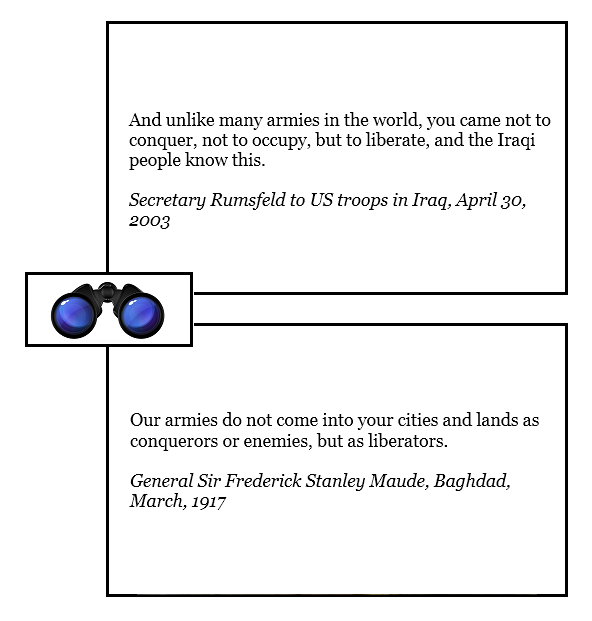
Eh, Zen?

Santayana echoes Marx refracts Hegel:

Hegel remarks somewhere that all great world-historic facts and personages appear, so to speak, twice. He forgot to add: the first time as tragedy, the second time as farce.

Those who cannot remember the past are condemned to repeat it

Seen from another angle: history has rhymes to match its reasons

WikiLeaks in conspiracy space

Sunday, December 12th, 2010

I thought my response to a comment Lex posted at ChicagoBoyz might be of equal interest here.

Lex wrote:

This is starting to remind me a little bit of Robert Anton Wilson. Even the squirrels in the trees are in on the conspiracy. What conspiracy? You know, the conspiracy

My comment follows…

Indeed, it seems there’s plenty of room in conspiracy space for WikiLeaks:

Wikileaks – A Big, Dangerous US Government Con Job
By F. William Engdahl
12-10-10

The story on the surface makes for a script for a new Oliver Stone Hollywood thriller. A 39-year old Australian hacker holds the President of the United States and his State Department hostage to a gigantic cyber “leak,” unless the President leaves Julian Assange and his Wikileaks free to release hundreds of thousands of pages of sensitive US Government memos. A closer look at the details, so far carefully leaked by the most ultra-establishment of international media such as the New York Times, reveals a clear agenda. That agenda coincidentally serves to buttress the agenda of US geopolitics around the world from Iran to Russia to North Korea. The Wikileaks is a big and dangerous US intelligence Con Job which will likely be used to police the Internet.

*

WikiLeaks – More Israeli Game Theory Warfare?
By Jeff Gates
12-1-10

“The United States is the real victim of WikiLeaks. It’s an action aimed at discrediting them.” Franco Frattini, Foreign Minister of Italy

The impact of the WikiLeaks release of diplomatic cables fits the behavior profile of those well versed in game theory warfare. When Israeli mathematician Robert J. Aumann received the 2005 Nobel Prize in economic science for his work on game theory, he conceded, “the entire school of thought that we have developed here in Israel” has turned “Israel into the leading authority in this field.” The candor of this Israeli-American offered a rare insight into an enclave long known for waging war from the shadows. Israel’s most notable success to date was “fixing” the intelligence that induced the U.S. to invade Iraq in pursuit of a geopolitical agenda long sought by Tel Aviv. When waging intelligence wars, timing is often the critical factor for game-theory war planners. The outcome of the WikiLeaks release suggests a psy-ops directed at the U.S.

BTW, both theories come via the same publisher, rense.com.

Update: Wikileaks and Cryptographic Mythology

Saturday, December 4th, 2010

[ by Charles Cameron ]

It seems my intuition of a Lovecraft connection with WikiLeaks was right, as was Jean’s suggestion that the MARUTUKKU quote is “more specific and extensive and ‘mythological'” than the translations of Enuma Elish she’d found on the net. I dropped Anders Sandberg a line letting him know I’d quoted him in my earlier post, and he graciously responded with this clarification of the mystery:

I think the MARUTUKKU name/description is from the Simon Necronomicon, which did its best to shoehorn mythology into the mythos, and might explain the different translation. Of course, one might argue that that book is a real, a hoax posing as real, real posing as a hoax, or both at the same time.

Anders, currently a staff member with the Future of Humanity Institute at Oxford (which name strikingly reminds me of the Bright Futures Institute in Qom, Oxford’s parallel in the Iranian universe), is also known for his writings on Mage: the Ascension and other role-playing games — see for instance this account of the Asatru in M:tA.

*

Bryan Alexander Steve Burnett

The bearded, theremin-wielding mage Steve Burnett [left] also noted the origin of the MARUTUKKU quote in the Simon Necronomicon in his comment on my no-less-bearded mage-friend [right] Bryan Alexander‘s blog Infocult — which features a rich vein of gothic imaginings and runs with the subtitle “We haunt every medium we make”.

Delighted to find an excuse to post that photo, btw. My warm regards to all…

A DoubleQuote for Anders

Friday, December 3rd, 2010

[ by Charles Cameron ]

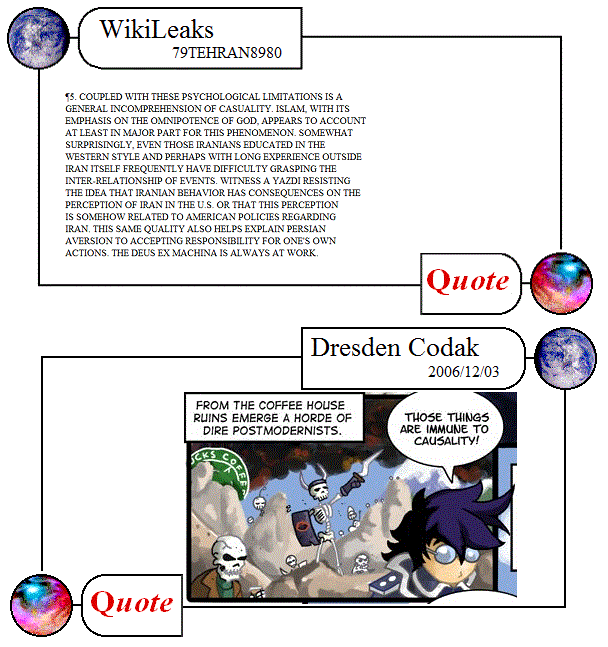
One of my hobbies is finding apposite quotes to juxtapose — I call them DoubleQuotes and think of them as twin pebbles dropped into the mind-pool for the pleasure of watching the ripples…

And I particulartly enjoy it when one of my DoubleQuotes manages to span different sensory streams — aural, visual, verbal, numerical, cinematic — as here, with text and image.

This one’s for Anders Sandberg.

QUOAcausal

I’d been carrying around the quote from WikiLeaks for a few days, but it was running across the Dresden Codak via Anders’ Andart blog today that gave me the second “dot” to connect with the first.

Wikileaks and the Search for a Cryptographic Mythology

Thursday, December 2nd, 2010

[ by Charles Cameron ]

Jean Rosenfeld of the UCLA Center for the Study of Religion just posted a comment on an earlier Zenpundit post of mine, opening up a topic which may interest some readers here: that of Wikileaks founder Julian Assange’s mythological associations.

1

Jean had earlier pointed me to Assange’s use of the name “Marutukku” to describe his encryption program, and a little fishing brought me to these two Assange-related documents:

One Man’s Search for a Cryptographic Mythology
Enuma Elish

2

I’d been idly wondering about cryptographic mythology myself, as it happens, nudged by vague memories of a cache of porno images tweaked by jihadists as encoding devices for steganography.

Steganography is the cryptographic – or is it kabbalistic? — art devised by one Abbot Trithemius, whose 1518 Polygraphia is the first work on cryptography printed in Europe, and whose Steganographia was known in MS to such hermetic philosophers as Cornelius Agrippa, Giordano Bruno and John Dee. Jim Reeds captures the ambiguity of Trithemius’ work nicely in his paper, Solved: The Ciphers in Book III of Trithemius’s Steganographia, when he asks:

Is it [the Steganographia] primarily an exposition of cryptographic techniques disguised as angel magic, or is it primarily a magic work disguised as cryptography?

Readers of Frances Yates and Ioan Couliano will be somewhat familiar with these matters.

And jihadist steganography? The technique itself is described in the al-Fajr Information Center’s Technical Mujahid magazine of Feb. 2007 according to a Jamestown Foundation Terrorism Monitor piece, but the reports of actual jihadist use of the technique may turn out to be fabrications.

3

But it was Julian Assange‘s bliss we were trying to follow, right?

Assange sidekick Suelette Dreyfus wrote The Idiot Savants’ Guide to Rubberhose — which is the manual for Assange’s crypto program… but this business of naming the program gets complicated, eh?

Dreyfus explains:

If you’re wondering about the name of this program, Marutukku is the internal development name (it’s spelled Ru-b-b-e-r-h-o-s-e, but it’s pronounced M-a-r-u-t-u-k-k-u)

In case you didn’t get it, there may be a play on Lewis Carroll there, and the exchange Alice has with the White Knight in Through the Looking-Glass as to what the name of a certain very sad song is called.

Alice aside – and such detours are in fact the very method of discovery in non-linear thinking – Dreyfus offers as an epigraph to her piece the following quote:

The third name is MARUTUKKU, Master of the arts of protection, chained the Mad God at the Battle. Sealed the Ancient Ones in their Caves, behind the Gates.

which she attributes to “The Akkadian Creation Epic”. That would be the Enuma Elish.

Assange, in his One Man’s Search for a Cryptographic Mythology, attributes his choice of the name Marutukku to a conversation he had with a friend concerning the Enuma Elish, telling us (after much other curious and wandering stuff) that his friend recommended the god Marduk’s third name to him, saying

The third name is MARUTUKKU, Master of the arts of protection, chained the Mad God at the Battle. Sealed the Ancient Ones in their Caves, behind the Gates.

Assange liked the idea, observing, “Even the very word MARUTUKKU looked like it had been run through a product cipher”.

A little later in the same document, he quotes from the Enuma Elish, and the phrases given above appear in the quoted excerpts from that text – although they are not present in the version “Based on the translation of E. A. Speiser, with the additions by A. K. Grayson, Ancient Near Eastern Texts Relating to the Old Testament, third edition, edited by James Pritchard (Princeton, 1969), pp. 60-72; 501-503, with minor modifications” that Assange offers us on the sibling-page at Enuma Elish.

As Dr. Rosenberg pointed out to me, “the quote — if it is a translation — differs from other translations I found on the Internet. It is more specific and extensive and ‘mythological.'”

4

Okay, I’ve kept what may be the most practical (ie 21st century) “creative leap” made by my skittish and wandering mind for this, my penultimate paragraph.

Oxford’s Anders Sandberg blogs today about Assange’s application of network theory to conspiracies, quoting Assange as saying:

Conspiracies are cognitive devices. They are able to out think the same group of individuals acting alone Conspiracies take information about the world in which they operate (the conspiratorial environment), pass it around the conspirators and then act on the result. We can see conspiracies as a type of device that has inputs (information about the environment) and outputs (actions intending to change or maintain the environment).

And Anders’ summary of Assange’s position? “In short, conspiracies are a kind of collective intelligence enhancement.”

[ admission: I associate the name Anders Sandberg with some brilliant early net writings on role-playing games and the hermetic tradition – I’m hoping this is the same guy ]

5

Finally, let’s go back to that enhancement of the Enuma Elish text. That phrase, “Sealed the Ancient Ones in their Caves, behind the Gates” struck me, too – it reminded me of the Chthulu Mythos of HP Lovecraft, and its apocalypse:

That cult would never die until the stars came right again and the secret priests would take Cthulhu from His tomb to revive His subjects and resume His rule of earth. The time would be easy to know, for then mankind would have become as the Great Old Ones; free and wild, and beyond good and evil, with laws and morals thrown aside and all men shouting and killing and revelling in joy. Then the liberated Old Ones would teach them new ways to shout and kill and revel and enjoy themselves, and all earth would flame with a holocaust of ecstasy and freedom.

And with that quote from Lovecraft, courtesy of Erik Davis, we have returned by a commodius vicus of recirculation back to the hermetically sealing and revealing world of John Dee.


Switch to our mobile site