zenpundit.com » games

Archive for the ‘games’ Category

.. and including any and all interesting game language & stories ..

Wednesday, September 19th, 2018

[ by Charles Cameron — a 75-year old poker club in DC, more ]
.

It seems I’m moving from collecting only sport and game metaphors for politics, via sport and game metaphors more generally to sport and game language and stories — whatever catches my fancy. The paragraphs from William Finnegan, Off Diamond Head which I quoted in Storm special, surf’s up would have fit here nicely, and were my first signal, or perhaps one of my first, that my search interests might be widening.

Lets start with A club of their own: The story of a secret poker society started by pioneering African Americans. It’s a great story of a poker club that’s been going 76 years now:

In 1942, a group of university professors, doctors, lawyers and other black professionals in Washington wanted to get together on weekends and play poker. But they had a problem. Not only did segregation in the District bar them from joining country clubs or other social organizations where men could gather, but the president of Howard University, where many of them taught, was a religious man who did not approve of card-playing.

So they started a monthly gathering in their homes and came up with a name to mask its true nature — the Brookland Literary and Hunting Club.

The founding members of the club included a College president and consultant on Brown v. Board of Education, and the first black chief judge of DC’s federal court, and one of the the oldest current members at 96 — none of the founders are still with us — was a Tuskegee Airman. Over the last seventy-five years, these men have seen, and shaped, history. Their club is named the Brookland Literary and Hunting Club as code rather than abstract camouflage — “literary” because they’ve always discussed the topics of the day, from WWII via the Civil Rights movement to the present, and “hunting” because players are always hunting for a good hand when playing cards..

Play..

There were two tables — the big table, where hundreds of dollars exchanged hands over five-card stud, and the little table, whose participants played for coins or dollar bills and peppered the games with wild cards. Men would start at the little table and sometimes move up to the big one. As they got older and went on fixed incomes, some would move back to the little table.

And the spirit of play:

We’ve had great games and there’s never anybody who ran out of money, because somebody says: ‘Here, take some more. Just take it. Give it to me when you can,’

**

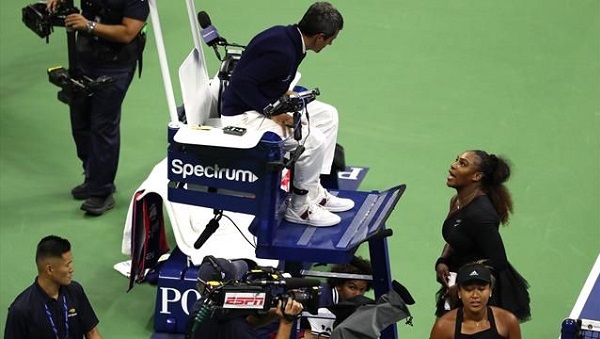
And it looks as though I can’t evade the sports and social parallelism business either. How can I resist What Serena Williams’s defeat tells us about the criminal-justice system? And how better to get at its essential than via another of today’s WaPo pieces, Yes, get consent. But be human, too.?

After describing the two opinion camps around the kerfuffle between Serena Williams and chair umpire Carlos Ramos, the WaPo opinion writer Marc Howard, a professor of government and law at Georgetown, indicates the closeness of the parallel between tennis and social justice:

This disagreement is about more than tennis, or even sports. It connects with a much deeper American divide about policing and criminal justice, with strong undertones connecting to race and racism.

and later:

Just like the criminal-justice system, tennis and many other sports depend on the subjective discretion of neutral arbiters to apply a set of supposedly objective “rules.”

Ramos did indeed follow the code, and each of the three sanctions had some justification, thus satisfying the “rules” camp. But for two of the three violations (the racket smashing was unambiguous), he used his discretion to punish Williams for acts — coaching and heated exchanges with an umpire — that occur routinely in tennis but are seldom punished.

So one “deeper .. divide” is about “policing and criminal justice” — but another deep divide exists between “rules” and what I’ll call “fairness” camps, following this paragraph:

In all of these instances, one can always say, “Well, this person didn’t follow the rules,” and on an individual basis that may seem sufficient to justify the consequences. What gets lost, however, is that rules are rarely applied regularly, consistently or fairly..

You’ll have to read the whole article to get many of the details, but the analogy between a sport and the judicial and penal systems is clear.

How does this relate to the WaPo piece on consent in potential sexual aggression situations?

The question there is whether, in the pithy words of a feminist writer quoted by WaPo:

consent is just a hurdle you have to clear in order to Get The Sex

Consent is the rulebook, and the missing ingredient when consent is the only consideration, is the human context, in the words of the same writer, the need to see our sexual partners:

not simply as instrumental to our own pleasure but as co-equal collaborators, equally human and important, equally harmable, equally free and equally sovereign.

I’m not sure that even that doesn’t smack a bit of the “rules” camp, but it’s certainly a strong step beyond the bare=bones “consent” rule towards an understanding of human circumstances. But the parallelism between that and the Serena Williams piece wouldn’t have struck me so forcefully without this exchange:

“Yeah,” one, a junior, agreed. “The logic is sort of Cartesian.” (Oh, college!) “Do this, not that. Don’t break the rules ..

That really nails it — as Lao Tzu would say:

The rules can be codified in a rulebook aren’t the subtle rules of wisdom.

That’s my Tao Te Ching translation #207 I know, but I think it’s apt for this occasion.

Comments?

Extended chess and baseball metaphors

Sunday, September 9th, 2018

[ by Charles Cameron — a light-hearted look at Trump Chess, and an umpire explains millisecond decision-making ]
.

The first of two pieces I’ll explore here is from the New Yorke, Rules for Trump Chess by Andrew Paul. It’s a humor piece, but not without its satirical effect, as you can tell from Rule #1:.

Each turn is referred to as a “news cycle.”

At times, the hunmor gets a bit sour, as with Rule #4:

A handful of new pieces will be introduced during game play, scattered haphazardly across the board. They include: two overcooked macaroni noodles (Kushners), a shrivelled white raisin with lint on it (Sessions), and a washcloth soaked in warm Johnnie Walker (Bannon). Their permitted moves are unclear, but every news cycle, players must select one to put in their mouths until they gag.

Links to an earlier (and more balanced) form of chess are not entirely absent, as exemplified by Rule #11:

Knights still move in that ridiculous two-squares-up, one-square-over path. They think they are being very clever. Their creepy horse faces must always be turned to face the king.

You can read the rest at the New Yorker site

**

Of deeper interest, though with less immediate application to politics, is Jim Evans‘ WaPo piece, Sorry, judges, we umpires do more than call balls and strikes. Here’s the setup:

I don’t remember when I first heard the popular analogy comparing judges to umpires calling balls and strikes, but recently it’s been everywhere. When Brett Kavanaugh was first nominated to the Supreme Court, Tony Perkins of the Family Research Council called him “a constitutionalist — someone who will call balls and strikes.” This past week, as Kavanaugh’s confirmation hearings began, Sen. John Cornyn (R-Tex.) described him as “somebody who calls balls and strikes and doesn’t come up with his own strike zone.” Supposedly a judge is, and should be, as mechanical as an ump.

Mechanical, eh?

It’s true that there are similarities. Umpires have always been considered authority figures, like judges. Both are subject to a lot of scrutiny, and we do what we think is right by rule and tradition. Umpiring is a special calling and a learned skill that requires extraordinary mental toughness. When you put on your uniform, you are supposed to leave all your subjective feelings in that dressing room. Personal integrity and respect for the game are at stake.

I’ve seen similar said about judges when they put on their robes.. But even the simple “calling balls and strikes” level of analogy lacks subtlety:

Seeing the televised rectangle that allegedly represents the strike zone, you might surmise that any 3-year-old should be able to tell whether that little white sphere is in or out of that box. Replay has reinforced the feeling that it’s simple and obvious.

Yet there are many intangibles when it comes to calling balls and strikes. What the umpire’s actually doing is gauging a baseball’s relative position as it travels 95 miles an hour into a three-dimensional area. You’re judging a pitch as it leaves the pitcher’s hand and goes to the catcher’s mitt in less than half a second.

Getting into greater finesse:

For example, the rule book states that a runner must avoid a fielder in the act of fielding a batted ball. If you collided with a shortstop who was bent over in the act of fielding a ground ball, you would be guilty of interference. But if the shortstop had completed the act of fielding and was attempting to tag you when the collision occurred, there would be no penalty. Among elite athletes, this all happens in milliseconds, and to the untrained eye, the plays look the same — both violent collisions with the ball on the ground. This requires an interpretation of when one act ended and another began, and whose rights are in effect. This is a judgment call.

Interesting final sentence, that.

Okay, it would be neat if an appellate or superior court judge could write a similar piece on the niceties of judicial judgment..

**

Umpires and referees..

I’ve always tended to think of umpires as the cricket equivalents of referees, and referees as the soccer equivalents of umpires, but what do I know?

Chair Umpire Carlos Ramos arguably interfered in the match, bringing both repeated champion Serena Williams and first-time winner Naomi Osaka to tears.

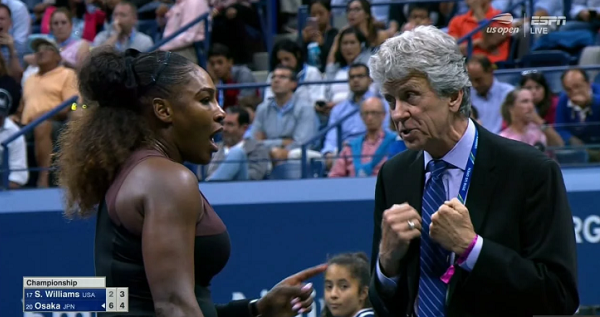
Match Referee Brian Earley holds his fists in, exemplifying both the passion and restraint in play in the US Open final

In the Serena Williams objection to penalties allotted her during the second set of her finals match with Japan’s young winner Naomi Osaka, I’ve learned today that in tennis, the umpire, usually seated in a high chair at center court makes unassailable rulings of fact, while the referee can overrule him in matters of tennis law — effectively making the umpire analogous to the jury, and the referee to the judge, in a trial by jury.

And thus the analogical web widens..

Sunday surprise, two meanings of play in 3 dimensions

Monday, September 3rd, 2018

[ by Charles Cameron — I’d infinitely rather play Bach than chess.. ]
.

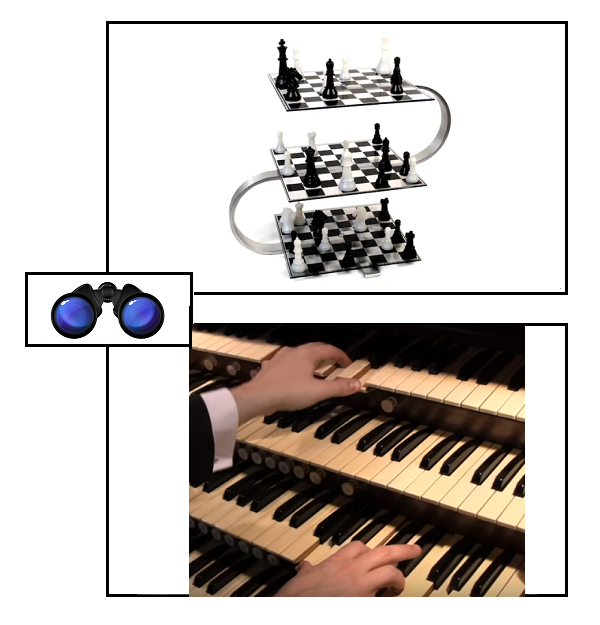
Above, a three-dimensional chess set. When I was up at Oxford, I had a three dimensional tic-tac-toe board, four sheets of plastic stacked vertically, each one drilled four by four, with yellow and red golf pegs to mark moves — it was quite a thrill, especially as an escape from Old Testament studies, but I wouldn’t play it now to save my, well, soul.

Below, Jonathan Scott performs his arrangement of the Finale from Saint-Saens “Organ” Symphony (No. 3) on the 1895 T.C. Lewis organ of Albion Church, Ashton-under-Lyne, UK.

I would, OTOH, give my soul to be able to play the organ — a privilege denied me until I reached Grade 5 in the British system — a grade I gave up on in despair after too mant teachers forcced me to play the detested Alec Rowley‘s exercises — with different fingerings.. Piano, feh, It took me half a lifetimes to realize there is some merit to be found therein.

Reciprocal: a term for form, symmetry, balance — and beyond

Monday, August 13th, 2018

[ by Charles Cameron — weaving a web of mirrors, echos, neurons and mimetics ]
.

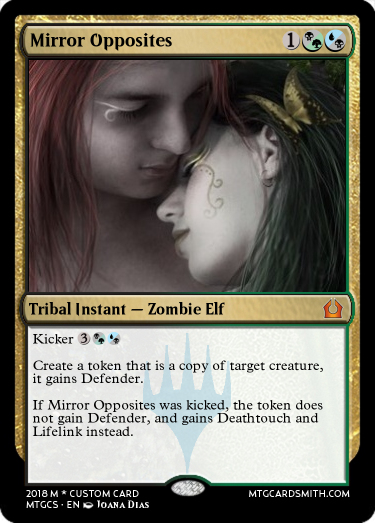
Magic: the Gathering — the game designers know this pattern well!

**

The Far Right And Reciprocal Radicalisation

Could fragmentation within the Far-Right contribute to increasingly extreme responses to Islamist terrorism? There is increasing evidence of instrumental responses from some of the most extreme groups, which seek to encourage the strategic use of violence.

Reciprocal radicalisation, or cumulative extremism, is a concept that suggests extremist groups become more extreme in response to each other’s activity. This means a group may frame violence as justified or necessary because they perceive an opposing group as extreme. Identifying how to respond to such a dynamic has become increasingly important, as terrorist threats from both Far-Right and Islamist groups increase, alongside increased hate crime and group membership.

The nature of siloing would encourage a focus on ISIS violence alone, a terrorism subset of natsec foreign policy, or on alt-right violence alone, a terrorism subset of natsec interior policy, thus remaining blind to the possibility that the two comprise a whole system, with systemic interactions between the two. The UK Centre for Research and Evidence on Security Threats report whose header and intro paragraph I’m quoting here is dealing with a pattern in that system, huzzah.

Such patterns — true reciprocity, which is a form of mirroring, and the kind of escalating reciprocity described here, which is more like an echo chamber with built-in feedback loop, are significant both because they cross-pollinate silos, in a system-friendly way, but also because they offer hints of a pattern language of forms that can be watched for and cataloged.

**

Wilder speculation:

Speaking of mirroring — other readings of mine recently have brought to my attention the intersection of two “hot” fields of study — mirror neurons as a biological substrate for much in human behavior, including our propensity of violence, and Rene Girard’s mimetics as a psychological substrate for much in human nature, including our propensity of violence..

The conjunction of the two, which I intuited, is explored in Vittorio Gallese, The Two Sides of Mimesis: Girards Mimetic Theory, Embodied Simulation and Social Identification.

Again, we have a creative leap, again we have silo-crossing, and again mirroring is the form that lies behind the analogical possibility that creates the possibility of the leap.

Metaphors, more iv, featuring Oliver Roeder & Chris Cillizza

Wednesday, August 1st, 2018

[ by Charles Cameron — others besides david ronfeldt who find game & sports metaphors valuable — or should that be invaluable? ]
.

I’m making this post a “special” because Ron Hale-Evans pointed me to a trove of articles variously about or touching on game metaphors for politics, geo or otherwise.

**

This was the start:

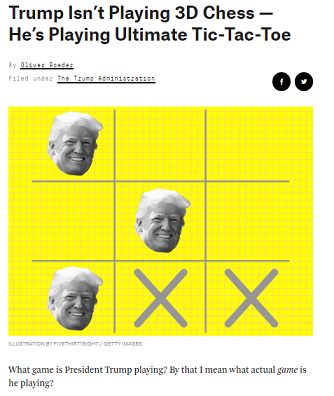
What game is President Trump playing? By that I mean what actual game is he playing?

Trump’s political performance, in seriousness and in jest, has often been likened to chess. Even to three-, four-, eight-, 10- and 12-dimensional chess. His proponents argue he’s a grandmaster,1 and his detractors argue he’s a patzer. CNN’s Chris Cillizza has written two different articles accusing Trump of playing “zero-dimensional chess,” whatever that means. Even Garry Kasparov, probably the greatest actual chess player of all time, has weighed in, inveighing against the use of this gaming cliche via Politico.

In my job here at FiveThirtyEight, I spend a lot of time thinking about games — board games, video games, chess tournaments, math puzzles, the game theory of international affairs. So I understand that “playing chess” is easy shorthand for “doing strategy” or “being smart” or whatever. But I think we can do better. I humbly propose to you that Trump is not playing chess (of any dimension), but rather something called “ultimate tic-tac-toe.” It’s time to update your tropes.

It’s a good day when I find an entire article dedicated to game or sports metaphors for politics, but this one had some great links..

Instances:

**

The second thing this Corker episode makes clear is that, strategically speaking, Trump is playing zero-dimensional chess. As in, the only strategy is that there is no strategy.

In the wake of Trump’s absolutely stunning 2016 victory, the conventional wisdom — in political circles — was that Trump was a strategic genius, always seeing five moves ahead. He was playing three-dimensional chess while the media was still trying to figure out which way pawns could move. The reason no one thought Trump could win was because “we” didn’t see the whole board the way he did. No one else saw it that way. Trump was a genius. An unconventional genius but a genius nonetheless.

There, incidentally, is the definition of zero-dimensional chess:

Trump is playing zero-dimensional chess. As in, the only strategy is that there is no strategy.

And:

**

The key part is when he concludes Flake will be a “no” on the tax reform package in the Senate because, well, his political career is “toast” — or something.

I submit this as yet another piece of evidence that Trump is playing zero-dimensional chess.

What do I mean? Simply this: When Trump won the White House — against all odds — the working assumption was that he had executed a plan so brilliant and so complex that only he (and the few advisers he let in on the plan) could see it. He was playing three-dimensional chess while the media, the Clinton campaign and virtually everyone else was still playing checkers.

But as his first year in the White House has progressed, there’s mounting evidence that Trump may not be playing three-dimensional chess. In fact, he might just be playing zero-dimensional chess. As in, the only strategy Trump is pursuing is no strategy at all.

From a game-policy metaphor angle, this doesn’t take us much further, although you can read the whole post for details of the Trump-Flake business..

And..

**

Chess? That’s not what Garry Kasparov sees Donald Trump or Vladimir Putin playing—three-dimensional or any other kind. But if they did sit down for a game, the former grandmaster believes the Russian president would obviously win.

“Both of them despise playing by the rules, so it’s who will cheat first,” Kasparov told me in an interview for POLITICO’s Off Message podcast. “But in any game of wits, I would bet on Putin, unfortunately.”

Kasparov gets into some interesting details, not entirely uncritical of Obama, and even GW Bush, but flicking Trump off the board with a flick of his cultivated fingernail..

I think I’vetheis referenced the Kasparov article once before, but hey, this is a rich harvest..

Next:

**

Shall we play a game?

Imagine that a crisp $100 bill lies on a table between us. We both want it, of course, but there’s no chance of splitting it — our wallets are empty. So we vie for it according to a few simple rules. We’ll each write down a secret number — between 0 and 100 — and stick that number in an envelope. When we’re both done, we’ll open the envelopes. Whichever of us wrote down the higher number pockets the $100. But here’s the catch: There’s a percentage chance that we’ll each have to burn $10,000 of our own money, and that chance is equal to the lower of the two numbers.

So, for example, if you wrote down 10 and I wrote down 20, I’d win the $100 … but then we’d both run a 10 percent risk of losing $10,000. This is a competition in which, no matter what, we both end up paying a price — the risk of disaster.

What number would you write down?

In the 538 post, the game’s available for interactive play.. And later in the same piece, too..

Now imagine that you’re playing the same game, but for much more than $100. You’re a head of state facing off against another, and the risk you run is a small chance of nuclear war

That was instructive, I think, though my mind is artificially dimmed at present..

And finally:

**

This one revolved around a tweet in which Trump had said

:When a country (USA) is losing many billions of dollars on trade with virtually every country it does business with, trade wars are good, and easy to win. Example, when we are down $100 billion with a certain country and they get cute, don’t trade anymore-we win big. It’s easy!

How easy? was this post’s response:

But how easy? And how exactly do you win them? (Also, what’s a trade war?)

Let’s find out. You (Yes, you!) have just been elected president of your very own country. Congratulations! Now it’s time to get to work. There is another country out there that has goods you can buy, and you have goods it may want to buy. Your job is to choose your foreign economic policy — which you’ll do in the little game we’ve prepared for you below.

The rules go like this: You can cooperate with the other country, allowing the free flow of its goods into your country. Or you can defect, imposing tariffs on the foreign goods. And because you will trade with the same country over and over again, you have to decide whether to stick with a single strategy no matter what or whether to change course in response to your opponent. The other country faces the same choice, but you can’t know in advance what plan they’ve chosen. Free trade helps both countries, generating big windfalls for both sides. But it’s possible for a single country to improve its own situation at the other’s expense — you both have a selfish incentive to defect, taxing the imports from the other country and helping only yourself. However, if you both defect, you both wind up isolated, cutting yourselves off from the market and reducing earnings on both sides.

Again, the game is available for interactive play.

We’ve simplified trade dramatically: You’re engaging in 100 rounds of trade with a randomly chosen FiveThirtyEight reader. In each round, you and your trade partner can either cooperate (allow free trade) or defect (impose a tariff). Your goal is to pick a strategy that earns you as much as possible.

The game mechanics here were interesting (and “gave the game away” where the game is game theory a la Prisoners Dilemma):

Well..

Was there a trade war? Was it good? Did you win it?

Tariffs are the weapons of a trade war

The game you just played took a little game theory — the formal, mathematical study of strategy — and retrofitted it to the world of international relations. (Of course, our simulation is extremely simplified, and it runs in a very controlled little world that ignores alliances, trade deals, political histories, other countries, and hundreds of other factors.)

**

Memory slippage — lest we forget, there was one last game ref today:

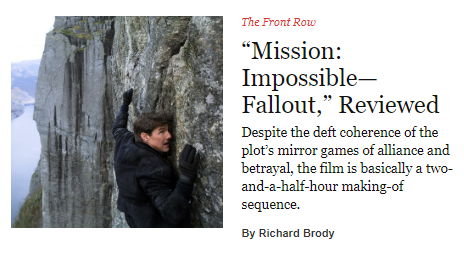
It’s the NYorker‘s film criticism of the latest impossible Mission, and the game sentence in the piece itself reads:

Despite the deft coherence of the plot’s mirror games of alliance and betrayal, which provide the illusion of a developed drama, the movie almost totally deprives its characters of inner life or complex motives.

Mirroring’s one of the patterns I love to collect, and game thinking here might note the Kierkegaardian note:

In his 1846 essay “The Present Age,” Søren Kierkegaard decried the widespread tendency of the time -— which he summed up as an age “without passion” —- to “transform daring and enthusiasm into a feat of skill.”

The continuum from “daring and enthusiasm to “feat of skill” is an interesting one for game designers to place their games on — before and after design, and when player feedback is in.

A rich day indeed.

**

Sources:

  • FiveThirtyEight, Trump Isn’t Playing 3D Chess
  • CNN Politics, Donald Trump is playing zero-dimensional chess
  • CNN POlitics, Donald Trump is playing zero-dimensional chess (again)
  • Politico, Garry Kasparov Would Like You to Stop Saying ‘Trump Is Playing 4-D Chess’
  • FiveThirtyEight, How To Win A Nuclear Standoff
  • FiveThirtyEight, How To Win A Trade War
  • Trump on Twitter, trade wars are good, and easy to win
  • New Yorker, Mission: Impossible -— Fallout
  • **

    Some other posts in this series

    And I emphasize Some, previous posts in the game & sports metaphor series, as somewhat randomly collected, and Likelky not in sequential order:

  • ZP post, http://zenpundit.com/?p=57435
  • ZP post, http://zenpundit.com/?p=59988
  • ZP post, http://zenpundit.com/?p=59082
  • ZP post, http://zenpundit.com/?p=58644
  • ZP post, http://zenpundit.com/?p=57908
  • ZP post, http://zenpundit.com/?p=59678
  • ZP post, http://zenpundit.com/?p=57493
  • ZP post, http://zenpundit.com/?p=59496
  • ZP post, http://zenpundit.com/?p=60193
  • With any luck, some of these will have links to yet others in the series..

    **

    And dammit, pwned by another one before my head hit the pillow..

    Pawn, yes. Pwn?


    Switch to our mobile site