zenpundit.com » barack obama

Archive for the ‘barack obama’ Category

The Twilight War—a review

Monday, July 23rd, 2012

[by J. Scott Shipman]

The Twilight War, The Secret History of America’s Thirty-year Conflict with Iran, by David Crist

When President Obama made a heartfelt opening, a smug Iranian leadership viewed it as a ruse or the gesture of a weak leader. Iran spurned him. Obama fell back on sanctions and CENTCOM; Iran fell back into its comfortable bed of terrorism and warmongering. Soon it may no longer be twilight; the light is dimming, and night may well be approaching at long last. [emphasis added]

Thus concludes senior government historian David Crist’s The Twilight War, and be assured Crist’s language is not hyperbole. Crist masterfully details the tumult of U.S.-Iranian relations from the Carter administration to present day. Using recently released and unclassified archived data from principals directly involved in shaping and making American foreign policy, Crist provides the reader an up-front view of “how the sausage is made;” and, as with sausage, the view often isn’t pretty for either side. Crist’s access wasn’t limited to U.S. policy makers, as he conducted interviews with principles on the other side as well, for instance, he had secret meetings/interviews with pro-Iranian Lebanese officials in south Beirut. In all, Crist estimated he interviewed over “four hundred individuals in the United States and overseas.”

Crist begins his story with the Shah of Iran in the last days of his leadership, as popular sentiment was turning against both his regime, as well as his American enablers. He reveals the Carter administration’s fleeting notion of military intervention following the fall of the Shah, and includes details how the clerics reigned in professional Iranian military members, purging the “unreconstructed royalists.” From the start, the U.S. learned how difficult, if indeed impossible, relations were going to be with the new Iranian leadership. One State Department report summed up the situation:

It is clear that we are dealing with an outlook that differs fundamentally from our own, and a chaotic internal situation. Our character, our society are based on optimism—a long history of strength and success, the possibility of equality, the protection of institutions, enshrined in a constitution, the belief in our ability to control our own destiny. Iran, on the other hand has a long and painful history of foreign invasions, occupations, and domination. Their outlook is a function of this history and the solace most Iranians have found in Shi’a Islam. They place a premium on survival. They are manipulative, fatalistic, suspicious, and xenophobic.

While I am certain the writer of this report was not intending to be prophetic, as it turns out this paragraph captures the essence of our conflict. Each American president has thought himself equal to the challenge and each has thus far failed.

The Twilight War includes the birth of Hezbollah, accounts of the Marine barracks bombing in 1983 (from the men who were there), and the details of the Kuwaiti request for American protection of their tanker fleet from the Iranians. From this decision, the U.S. committed military force to protect Middle East oil—a difficult and at times, contentious decision. This decision resulted in continued sporadic confrontations between the U.S. and Iranian forces in the Persian Gulf.

Crist’s book is an illustration writ-large of a book previously reviewed here at Zenpundit.com; Derek Leebaert’s Magic and Mayhem, The Delusions of American Foreign Policy—as both “magic” and “mayhem” figure large in our on-going relationship with Iran. Most U.S. administrations when dealing with Iran came to rely on the “magic, ” and often divorced, or worse, ignored the realities.

At 572 pages, the fast paced narrative is a must read for anyone wanting insight into the origins and issues that remain in the ongoing U.S.-Iran conflict. The Twilight War is exhaustively sourced.  Crist says in the Notes his book was twenty-years in the making and it shows. Further, this book comes with excellent maps, so keeping up with the geography is made easier.

Tom Ricks said, “this is the foreign policy book of the year, perhaps many years,” and Ricks may be right. The Twilight War is an important and timely book on a vital topic, and comes with my strongest recommendation.

Postscript:

A copy of The Twilight War was provided to this reviewer by the publisher.

New Article: The Coming National Defense Crack-Up

Wednesday, June 27th, 2012


I have been asked to contribute foreign policy and defense pieces to IVN – The Independent Voter Network. The emphasis at IVN  is on well-supported brevity to inform a general audience of prospective voters for 2012 and not to entertain the legions of doctorate-seeking war nerdom with iterations of mutant 4GW, hybrid neo-Clausewitzian, counter-counter-insurgency theoretical castles in the sky 🙂 Different readership there.

Here is my first article:

The Coming National Defense Crack-Up

….Despite a major speech on defense issues given at the Citadel in 2011, Governor Romney’s strengths as a candidate are not associated with national security, while President Obama’s staff prefer to emphasize to the administration’s many successes in counterterrorism operations instead of the accumulation of serious issues faced by the Department of Defense, the armed services and America’s returning veterans.

This lack of debate is problematic because the next president will require a mandate for his solutions to the Pentagon’s laundry list of problems if they are to have a hope of passing the Congress in tight budgetary times. Some of the national defense problems are structural while others constitute a legacy of ten years of war in Afghanistan, Iraq and in remote lawless regions, but the political capital needed to fix them will be substantial:

  • Never has the Pentagon’s system for acquiring weapons and supplies been so dysfunctional or so ruinously expensive. Most of the major weapons systems of the past decade have been cancelled or halted in scandal at a cost of billions, including the Future Combat System, theF-22 Raptor , the next generation Destroyer, the Crusader, the Comanche helicopter, theExpeditionary Fighting Vehicle and the Littoral Combat Ship. The desk-bound military bureaucracy bitterly fought against the deployment of the life-saving MRAP while outfitting troops in uniforms that made it easier for the enemy to shoot them.
  • The Obama administration is attempting a “strategic pivot” toward Asia by focusing shrinking military resources in the Pacific, but the United States Navy will be extremely hard-pressed to carry out offshore balancing of a rising China with a reduced fleet of only 285 aging ships, the lowest number in a century. Nor do we have any regional allies with operational aircraft carriers – Japan has only a helicopter carrier, Britain is losing it’s last carrier in 2014, Australia and South Korea have no carriers and New Zealand barely has enough ships to constitute a functioning navy. Naval expansion would require a significant investment and several decades to complete…..

Read the rest here.

We do our job, He does His.

Wednesday, May 30th, 2012

[ by Charles Cameron — today’s NYT, just war, Brennan, Obama ]
.

1.

Today’s New York Times piece by Jo Becker and Scott Shane, Secret ‘Kill List’ Proves a Test of Obama’s Principles and Will, refers to just war theory while comparing John Brennan, counterterrorism advisor to the President, not once but twice to a priest:

Beside the president at every step is his counterterrorism adviser, John O. Brennan, who is variously compared by colleagues to a dogged police detective, tracking terrorists from his cavelike office in the White House basement, or a priest whose blessing has become indispensable to Mr. Obama, echoing the president’s attempt to apply the “just war” theories of Christian philosophers to a brutal modern conflict.

As regular readers here know, I can’t resist a hint of theology…

2.

The President does in fact speak of “just war” in his Nobel Prize acceptance speech:

War, in one form or another, appeared with the first man. At the dawn of history, its morality was not questioned; it was simply a fact, like drought or disease — the manner in which tribes and then civilizations sought power and settled their differences.

And over time, as codes of law sought to control violence within groups, so did philosophers and clerics and statesmen seek to regulate the destructive power of war. The concept of a “just war” emerged, suggesting that war is justified only when certain conditions were met: if it is waged as a last resort or in self-defense; if the force used is proportional; and if, whenever possible, civilians are spared from violence.

Of course, we know that for most of history, this concept of “just war” was rarely observed. The capacity of human beings to think up new ways to kill one another proved inexhaustible, as did our capacity to exempt from mercy those who look different or pray to a different God. Wars between armies gave way to wars between nations — total wars in which the distinction between combatant and civilian became blurred.

That quote about “our capacity to exempt from mercy those who look different or pray to a different God” seems particularly poignant.

3.

But let’s return to the priestcraft of John Brennan, as Harold Koh offers it to the NYT:

“If John Brennan is the last guy in the room with the president, I’m comfortable, because Brennan is a person of genuine moral rectitude,” Mr. Koh said. “It’s as though you had a priest with extremely strong moral values who was suddenly charged with leading a war.”

That’s (arguably) good.

4.

But then consider this observation from the same article:

… Mr. Obama embraced a disputed method for counting civilian casualties that did little to box him in. It in effect counts all military-age males in a strike zone as combatants, according to several administration officials, unless there is explicit intelligence posthumously proving them innocent.

On the face of it, John Brennan doesn’t seem to be guiding his pupil into the ways of “genuine moral rectitude” with great success, particularly regarding that bit about the just war requiring that “whenever possible, civilians are spared from violence”.

5.

Perhaps, though, that’s okay. After all, Arnaud-Amaury, the Abbot of Cîteaux who led the siege of Béziers in which 20,000 heretics — heretics, mind you — were slaughtered, is reported to have said:

Caedite eos! Novit enim Dominus qui sunt eius

In plain English, that’s “Kill them! The Lord knows his own”.

6.

A similar sentiment may be found in other theologies:

According to an old, old, so old it’s Archived piece in the Wall Street Journal written by Amir Taheri — whose reputation for accuracy in quotation has been questioned — the late Ayatollah Sadeq Khalkhali wrote a fatwa in which he said:

Among those we seize hostage or kill, some may be innocent. In that case, Allah will take them to his paradise. We do our job, He does His.

Which in turn gives me the title for this post.

7.

But this isn’t only a Shi’ite opinion: in the same article, Taheri quotes the distinctly Sunni Abu Anas al-Shami, “the self-styled ‘mufti’ of al Qaeda”:

“There are times when Mujahedeen cannot waste time finding out who is who in the battlefield,” he wrote. “There are times when we have to assume that whoever is not on our side is the enemy.”

… which reminds me of another remark made by a recent US President …

8.

… which in turn reminds me of the apparent paradox presented by Luke 11:23, “He that is not with me is against me: and he that gathereth not with me scattereth” — when set beside Luke 9:50, “And Jesus said unto him, Forbid him not: for he that is not against us is for us”.

Of Solomon and the Ant

Thursday, April 5th, 2012

[ by Charles Cameron — King Solomon’s battle order in the Qur’an, the speech of ants, science confirms scripture, two possible directions of scriptural interpretation ]
.


.

If I might connect two recent strands of my thinking here on Zenpundit:

1.

One thing I have been puzzling over is the relationship between highly charged metaphysical realities in battle, and the physical personnel and materiel of war, in posts such as Quantity and Quality: angelic hosts at Badr and / or Armageddon and More “night watch” than “guardian angels” perhaps.

This Qur’anic passage, 27.16-19 which I shall quote in the Marmaduke Pickthall version, presents an interesting “battle order” in this regard:

And Solomon was David’s heir. And he said: O mankind! Lo! we have been taught the language of birds, and have been given (abundance) of all things. This surely is evident favour. And there were gathered together unto Solomon his armies of the jinn and humankind, and of the birds, and they were set in battle order; Till, when they reached the Valley of the Ants, an ant exclaimed: O ants! Enter your dwellings lest Solomon and his armies crush you, unperceiving. And (Solomon) smiled, laughing at her speech, and said: My Lord, arouse me to be thankful for Thy favour wherewith Thou hast favoured me and my parents, and to do good that shall be pleasing unto Thee, and include me in (the number of) Thy righteous slaves.

How’s that? “Armies of the jinn and humankind, and of the birds, and they were set in battle order…”

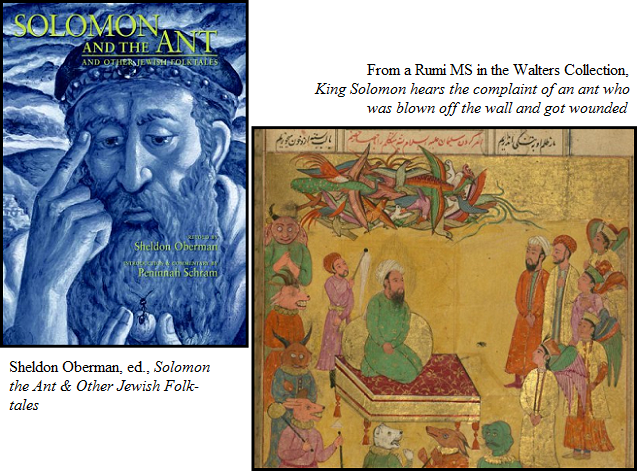
Note also the Jewish folk-tale concerning King Solomon and the ant… and Rumi’s telling, illustrated above from Walters manuscript W.626

2.

I have also been talking about mapping the conceptual way-stations that are found in conversations leading to radicalization – but that’s really just a target of opportunity for me, I am interested in mapping concepts in general. Here again, that Qur’anic passage is of interest.

That’s because it “maps” – in a very double-quote-ish way – to recent findings in science, as exemplified by:

Francesca Barbero, Jeremy A Thomas, Simona Bonelli, Emilio Balletto, Karsten Schönrogge, Queen Ants Make Distinctive Sounds That Are Mimicked by a Butterfly Social Parasite, in Science, Vol. 323 no. 5915 pp. 782-785 (2009).

Ants, it appears, talk among themselves, but the voices of their queens are distinctive: and the Maculinea rebeli butterfly larvae can mimic the speech of a Myrmica schencki queen. As reporter Jeremy Hance discussing this study puts it:

While ant vocalizations had not been as widely studied as their chemical communications, the researchers believed this might hold the key to the butterfly’s success. They recorded the vocalizations of both the ant workers and the queens, and discovered significant differences in the queens’ “dominant frequency and overall acoustics”. When the queen’s vocalizations were replayed, worker ants would gather around the caller and guard it. The researchers found that this was “consistent with the exalted status and protection afforded to queens in the hierarchy of a colony”.

Researchers then turned to the parasitical butterfly larvae, whose vocalizations were mimics of their hosts’. However, the scientists discovered that the sounds were 23 to 27 percent closer to the queens’ over the workers’, thus providing them with first-class treatment. While the butterfly larvae may use chemical resemblance to infiltrate the colony, once inside the colony it is the mimicked vocalizations that allow it to rise to the top, often at the expense of its hosts’ offspring.

3.

So ants talk, and butterfly larvae can communicate with them – successfully enough, in fact, that “living M. rebeli larvae are rescued in preference to ant larvae when a colony is disturbed,” and “nurse workers kill and feed their own brood to the social parasite if food is scarce”.

And so ants talk, and Solomon can understand them – enough so that their concerns about his army bring a laugh to his lips.

And the overlap between those two ideas – one scripturally based and dating back fourteen hundred years, the other a product of recent science – is of the kind that provides confirmation for believers of their belief along these lines:

the Qur’an says that ants speak, now science has shown this to be literally true… and this provides additional evidence that the Qur’an is Truth.

4.

Here, then, is yet another use of the “overlapping concepts” notion that I’ve explored in posts on Ada Lovelace, and more recently Nancy Fouts, Walter Benjamin, and the confluence of Hamlet and the Heart Sutra in a poem of mine…

Arthur Koestler affirms in The Act of Creation that such intersections are to be found at the heart of tragedy and catharsis, humor and laughter, and discovery and eureka: here we find them providing confirmation for religious belief.

5.

Such intersections can in practice be read in two directions, as Bernard McGinn notes in the article on Revelation he wrote for Robert Alter and Frank Kermode‘s Literary Guide to the Bible – here’s his comment on Martin Luther‘s interpretive process:

Earlier interpreters, such as Joachim (but not Augustine), had also claimed to find a consonance between Revelation’s prophecies and the events of Church history, but they had begun with Scripture and used it as a key to unlock history. Paradoxically, Luther, the great champion of the biblical word, claimed that history enabled him to make sense of Revelation…

When the overlaps are between scientific knowledge and scriptural statements, believers tend to read science as an empirical support for scripture – they don’t read scripture as supporting the findings of science.

When it comes to prophecy and fulfillment, however, the danger exists that current events will be forced into the Procrustean bed of scripture – as when JF Kennedy, Jimmy Carter, Ronald Reagan, and Barack Obama have each in turn been accused of being the Antichrist…

6.
.

.
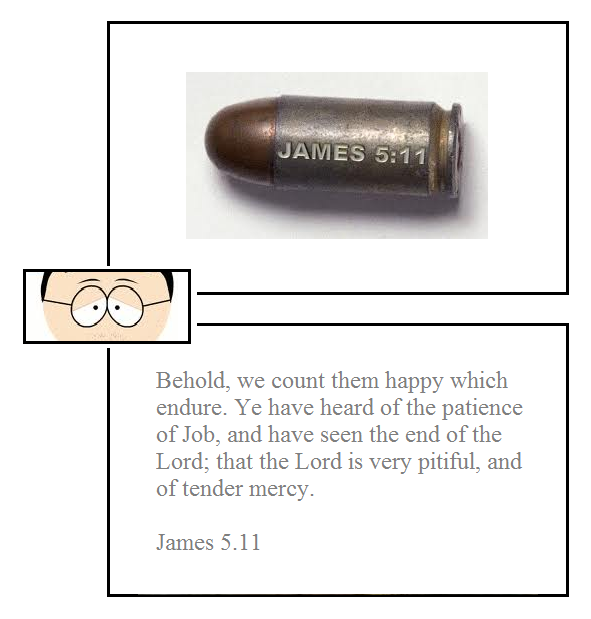
The bullet image above is available from Way 2 Worship as wallpaper for your computer screen. The verse below it, James 5.11, is the verse the bullet “cites”.

Comedy, tragedy — or inspiration?

Which world is more vivid? This, or the next?

Monday, March 19th, 2012

[ by Charles Cameron — bin Laden, Abu Bakr, Bernard of Clairvaux, Qur’an burning, Tora Bora, David Ignatius, Emptywheel, and impassioned belief ]
.


image: Paulo Uccello (1443) depicts the Resurrection
life after the grave, seen through a glass, darkly

We keep on stumbling over this one.

To the western mind, mostly, this world is axiomatically more vivid than the next. But there are those for whom the next life is axiomatically the more vivid – even if their day to day practices are geared to success and continuity in this life.

And this has consequences for our own lives, in the world around us — and for security.

1.

Some who are of this mind – bin Laden in this video among them — may quote or paraphrase Abu Bakr‘s message to Khosru:

I have come to you with an army of men that love death, as you love life.

That particular quote is from the rich tapestry of Islam – but Jewish history speaks also of Kiddush ha-Shem, martyrdom for the glory of God, which became in the time of the crusades “the exemplary answer of Jews threatened in their life and faith” when offered the options of conversion to Christianity or death.

And in Christendom, there is St Bernard of Clairvaux, who is quoted as writing in his letter to the Templars at the time of the Second Crusade:

The Christian who slays the unbeliever in the Holy War is sure of his reward, the more sure if he himself is slain.

and for good measure in his sermon promoting the Crusade:

Christian warriors, He who gave His life for you, to-day demands yours in return. These are combats worthy of you, combats in which it is glorious to conquer and advantageous to die.

2.

It is with this difference in axiomatic understanding in mind, that we should approach such issues as the relative importance – in our own minds, and in those of many Afghans – of the loss of human life in a night raid, as compared with the burning of copies of the Qur’an [In Reactions to Two Incidents, a U.S.-Afghan Disconnect]:

The mullah was astounded and a little angered to be asked why the accidental burning of Korans last month could provoke violence nationwide, while an intentional mass murder that included nine children last Sunday did not.

“How can you compare the dishonoring of the Holy Koran with the martyrdom of innocent civilians?” said an incredulous Mullah Khaliq Dad, a member of the council of religious leaders who investigated the Koran burnings. “The whole goal of our life is religion.”

And a quick note here — this is an issue I’ve raised before, eg in Burning scriptures and human lives, in Of Quantity and Quality I: weighing man against book, and more recently in On fire: issues in theology and politics – ii.

3.

The same understanding also explains bin Laden’s retreat to the Tora Bora caves. As I said in an early guest post here on ZP, with a hat-tip to Lawrence Wright and his book The Looming Tower:

When bin Laden, at the lowest point of his jihadist efforts, leaves the Yemen for Afghanistan and betakes himself to the Tora Bora caves, he will inevitably remind some Muslims of the Prophet himself, who at the lowest point of his prophetic vocation left Mecca for Medina and sought sanctuary in a cave — where by the grace of his God, a spider’s web covered the entrance in such a way that his enemies could not see him.

Our natural tendency in the west is to see Tora Bora in terms of military topography, as a highly defensible, almost impregnable warren of caves deep within some of the world’s most difficult mountain territory. What we miss may be precisely what Muslim piety will in some cases see — that bin Laden’s retreat there is symbolically aligned with the “sunna” or life of the Prophet, and thus with the life of Islam itself — in much the same way that Christians, in the words of Thomas a Kempis, may practice “the Imitation of Christ”.

4.

It was in fact Emptywheel‘s piece about bin Laden’s comment re killing President Obama (and thus promoting Joe Biden) that caught my attention today and prompted this post.

Emptywheel quoted the same passage from David Ignatius that had triggered my own post On the “head of infidelity” and the tale of Abdul-Rahman ibn Awf late yesterday —

“The reason for concentrating on them,” the al-Qaeda leader explained to his top lieutenant, “is that Obama is the head of infidelity and killing him automatically will make [Vice President] Biden take over the presidency… “

— and commented:

OBL was going to kill Obama not for the sake of killing the US President, but because Biden, who served in the Senate for 36 years, almost 12 of which he served as one or another powerful committee Chair, “is totally unprepared for that post, which will lead the U.S. into a crisis.”

I just don’t think that’s right. I think it’s wrong, in fact, but [and here’s the important part] subtly wrong.

I believe that OBL lived at the confluence of worlds — one that we might call mythic or spiritual, and one that’s the one we call the “real” world. I believe that it was his myth, archetype, spirit based reality that was the more vivid to him, the one to which he was entrained, and that he found means in the practical world of strategies and tactics to adhere to the demands of that other world.

A world that was both invisible to us, and to him axiomatically victorious – at least as much so in death as in life.


Switch to our mobile site