zenpundit.com » Religion

Archive for the ‘Religion’ Category

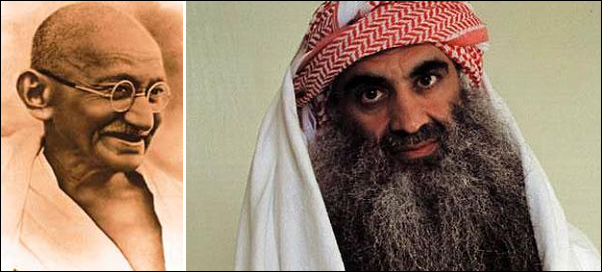
Jottings 12: KSM’s “non-violence” refers to preaching, not fighting

Tuesday, February 18th, 2014

[ by Charles Cameron — not an aha! but a d’oh! moment ]
.

.

This, from the Huffington Post last month:

The mastermind of the Sept. 11, 2001, terrorist attacks now says that the use of violence to spread Islam is forbidden by the Quran, a major shift away from the more militaristic view he had put forward previously.

Khalid Sheikh Mohammed’s thinking is detailed in a first-of-its-kind 36-page manifesto obtained by The Huffington Post. In a departure from his previous stance, which led the Guantanamo Bay prisoner to tell a military commission, “it would have been the greatest religious duty to fight you over your infidelity,” KSM, as he’s known in intelligence circles, instead seeks to convert the court to Islam through persuasion and theological reflection, going so far as to argue that “The Holy Quran forbids us to use force as a means ofconverting” and that reaching “truth and reality never comes by muscles and force but by using the mind and wisdom.”

I saw various versions of this tale — from the LA TimesKhalid Shaikh Mohammed issues ‘nonviolence’ manifesto:

The Koran, Mohammed wrote, “forbids us to use force as a means of converting” others, and “truth and reality never comes by muscles and force but by using the mind and wisdom.” Those statements clash with his earlier braggadocio in saying he plotted the Sept. 11 attacks and personally beheaded Wall Street Journal reporter Daniel Pearl, and in calling for young Muslims around the world to embrace violence.

— and from Andrew Cohen, explaining in The Atlantic why the manifesto may have been made available in the first place:

Perhaps the feds welcome Mohammed’s shifting interpretation of the Quran, which he now says prohibits violence as a means of spreading Islam.

However, I very much doubt that’s what’s going on.

**

The true meaning of KSM’s writing may be a little different from the reading given to it by the press. Here’s an actual quotation from the manifesto:

It is my religious duty in dealing with any non-Muslims to invite them to embrace Islam.

The Counter Jihad gets this bit right, I think, in a post titled KSM’s Prison Communiqués Part II: Wartime Religion of Peace Propaganda:

In point of fact, Islamic law teaches that, before waging offensive jihad, Muslims must first invite nonbelievers to accept the truth of Islam. Doctrinally, this summons to Islam is a necessary precondition to waging violent jihad. There are numerous examples of bin Laden and Zawahiri (bin Laden’s deputy and now the leader of al Qaeda) issuing public statements calling on infidels to accept Islam.

It’s a one-two sequence. Before engaging in acts of war, the jihadist must first make a peaceful and indeed graciously phrased invitation to convert to Islam… in the words of the Qur’an, 16.125:

Invite (all) to the Way of thy Lord with wisdom and beautiful preaching; and argue with them in ways that are best and most gracious: for thy Lord knoweth best, who have strayed from His Path, and who receive guidance. Q 16.125

**

The result, in the case of KSM’s manifesto, is an appeal that blends Murray Gell-Mann‘s quarks…

Everything that turns in the universe, from the smallest quarks to the largest supernovas are worshipping God, just as Muslims in Mecca circulate around the Kaba, counterclockwise. If you have Mecca TV channel just look for one hour how people from all around the world travel in circles like any electron or moon or earth or sun or any star or galaxy does. Try to record the picture for 15 minutes and then fast forward the picture then repeat it again, then ask yourself who told Abraham (PBUH) and these people a thousand years ago to imitate the laws of the Universe and nature. The answer will be He Who created these trillions of galaxies and human beings and made ?xed laws for all, but granted humans free will in order to test them.

— with the fifth century AD Neoplatonism of Proclus Lycaeus:

Just as in the dialectic of love we start from sensuous beauties to rise until we encounter the unique principle of all beauty and all ideas, so the adepts of hieratic science take as their starting point the things of appearance and the sympathies they manifest among themselves and with the invisible powers. Observing that all things form a whole, they laid the foundations of hieratic science, wondering at the first realities and admiring in them the latest comers as well as the very first among beings; in heaven, terrestrial things according both to a causal and to a celestial mode and on earth heavenly things in a terrestrial state….

What other reason can we give for the fact that the heliotrope follows in its movement the movement of the sun and the selenotrope the movement of the moon, forming a procession within the limits of their power, behind the torches of the universe? For, in truth, each thing prays according to the rank it occupies in nature, and sings the praises of the leader of the divine series to which it belongs, a spiritual or rational or physical or sensuous praise; for the heliotrope moves to the extent that it is free to move, and in its rotation, if we could hear the sound of the air buffeted by its movement, we should be aware that it is a hymn to its king, such as it is within the power of a plant to sing…

**

Interestingly enough, KSM also quotes Matthew 5.44-45a:

But I say unto you, Love your enemies, bless them that curse you, do good to them that hate you, and pray for them which despitefully use you, and persecute you; That ye may be the children of your Father which is in heaven…

— and in a letter to Rory Green, a British Christian who had written inviting him to repentance and faith in Jesus Christ, he responds:

I appreciate your deep concern regarding my worldly and hereafter life … You asked me to repent from my sins. For your own information, I never stop.

**

Let’s just say, it pays to peer beneath the surface.

Jottings 11: self-immolators and suicide bombers?

Tuesday, February 18th, 2014

[ by Charles Cameron — on some aspects of religiously motivated suicide, and I’m not clear why I called this one a jotting, since it’s quite long and detailed ]
.


.

I have been taking a couple of online courses on terrorism in recent months, and in one of them I ran across a Foreign Policy article titled Ultimate Sacrifice: What’s the difference between self-immolators and suicide bombers?

… there is another form of deadly protest that has made a resurgence in recent years. Not only did Tunisian street vendor Mohamed Bouazizi’s fiery suicide ignite the region and inspire subsequent self-immolations in Algeria, Egypt, and Morocco, but a growing number of Tibetans have also set themselves alight to protest Chinese rule in Tibetan region

It’s an intriguing question, phrased by one of my fellow students as the question, “Can Tibetan Self-immolators be considered “terrorists”?

**

I did my “due diligence” research, and came up with some articles worth reading:

  • Tenzin Tharchen, 125 Self-Immonlations: why suicide by fire protests continue in Tibet
  • Tsering Shakya, Self-Immolation, the Changing Language of Protest in Tibet
  • Martin Kovan, Buddhist Self-immolation and Mahayanist Absolute Altruism
  • while my interlocutor offered this one:

  • Jose Cabezon, On The Ethics Of The Tibetan Self-Immolations
  • But you know, the mind has indirect back-channels as well as direct information freeways, and the question seems to have been percolating while I’ve been asleep.

    **

    Sonam Wangyal, Lama Sobha, was the first Tibetan lama to self-immolate, and left a cassette tape in which he explained his motives:

    I am giving away my body as an offering of light to chase away the darkness, to free all beings from suffering, and to lead them — each of whom has been our mother in the past and yet has been led by ignorance to commit immoral acts — to the Amitabha, the Buddha of infinite light. My offering of light is for all living beings, even as insignificant as lice and nits, to dispel their pain and to guide them to the state of enlightenment. I offer this sacrifice as a token of long-life offering to our root guru His Holiness the Dalai Lama and all other spiritual teachers and lamas.

    The full text of Lama Sobha’s message can be found at the bottom of an International Campaign for Tibet page titled Harrowing images and last message from Tibet of first lama to self-immolate — the “harrowing images” themselves are linked to, but not shown.

    **

    The Chinese come close to targeting Tibetan self-immolators as terrorists, using the terms “Splittist”– so often also used of the Dalai Lama — and calling their actions “intentional homicide”. This from the “>Scottish Parliament’s Cross-Party Group on Tibet:

    Nonetheless, the response by the Chinese authorities to self-immolations by Tibetans has been extremely draconian, largely because of an assumption that all protest by Tibetans must be intrinsically “splittist” (that is, secessionist). In particular, it has involved the formulation of new laws that seem to target Tibetans specifically, and the imposition of collective punishments, and the application of the crime of “intentional homicide” to all those aiding, abetting, encouraging or even photographing self-immolations.

    **

    It occurs to me that sacrificing oneself for the benefit of other beings is symbolically enacted in the Tibetan Chöd ritual, in which one symbolically feeds the parts of one’s body to the pretas or hungry demons to satiate them and put them to sleep — and also in some of the Jataka Tales of the previous rebirths of the Shakyamuni Buddha.

    I’m thinking particularly of The Bodhisattva and the Hungry Tigress, and will quote here from Edward Conze‘s telling in Buddhist Scriptures, pp 24-26. On being told that self-sacrifice is difficult, Mahasattva (the future Buddha) replies:

    It is difficult for people like us, who are so fond of our lives and bodies, and who have so little intelligence. It is not difficult at all, however, for others, who are true men, intent on benefitting their fellow-creatures, and who long to sacrifice themselves. Holy men are born of pity and compassion. Whatever the bodies they may get, in heaven or on earth, a hundred times will they undo them, joyful in their hearts, so that the lives of others may be saved.

    His prayer before offering his own body and blood to feed an ailing tigress and her cubs is:

    For the weal of the world I wish to win enlightenment, incomparably wonderful. From deep compassion I now give away my body, so hard to quit, unshaken in my mind. That enlightenment I shall now gain, in which nothing hurts and nothing harms.

    Assuming the Jataka tales made it to Tibet, this one might be a potent influence on potential self-immolators.

    **

    A possible Tamil “comparable” — presumably Hindu rather than Buddhist, culturally if not religiously:

    When young Murugathasan Varnakulasingham (aged 26) committed self-immolation in front of the UN headquarters in Geneva on 19 February 2009 he was protesting against international failures of intervention in the unfolding humanitarian tragedy in northern Sri Lanka, where he believed that large bodies of Tamil people faced extinction by the Sri Lankan government. “The flames over my body will be a torch to guide you through the liberation path,” he wrote in his parting letter.

    There have been a few other protest suicides by Tamils in Tamilnadu and Malaysia, but Varnakulasingham’s altruistic act probably garnered the most attention.

    **

    Further thoughts:

    There’s always Samson, pulling down the pillars that upheld the roof of their temple on the Philistines, once he’d regrown his hair and strength…

    Then the lords of the Philistines gathered them together for to offer a great sacrifice unto Dagon their god, and to rejoice: for they said, Our god hath delivered Samson our enemy into our hand. And when the people saw him, they praised their god: for they said, Our god hath delivered into our hands our enemy, and the destroyer of our country, which slew many of us. And it came to pass, when their hearts were merry, that they said, Call for Samson, that he may make us sport. And they called for Samson out of the prison house; and he made them sport: and they set him between the pillars. And Samson said unto the lad that held him by the hand, Suffer me that I may feel the pillars whereupon the house standeth, that I may lean upon them. Now the house was full of men and women; and all the lords of the Philistines were there; and there were upon the roof about three thousand men and women, that beheld while Samson made sport. And Samson called unto the Lord, and said, O Lord God, remember me, I pray thee, and strengthen me, I pray thee, only this once, O God, that I may be at once avenged of the Philistines for my two eyes. And Samson took hold of the two middle pillars upon which the house stood, and on which it was borne up, of the one with his right hand, and of the other with his left. And Samson said, Let me die with the Philistines. And he bowed himself with all his might; and the house fell upon the lords, and upon all the people that were therein. So the dead which he slew at his death were more than they which he slew in his life.

    — Judges 16.23-30 — not quite self-immolation, not quite suicide bombing, but certainly suicidal warfare with a religious motive.

    Okay, When Christians quote John 15.13:

    Greater love hath no man than this, that a man lay down his life for his friends.

    surely they include in their understanding of that verse, those who throw their bodies on top of grenades to protect their comrades — which would seem in its own way to parallel the teaching of the Jataka Tale.

    **

    Likewise, when Muslims quote the hadith from Sahih Bukhari, Volume 4, Book 52, Number 53, in which the Prophet says:

    Narrated Anas bin Malik:

    The Prophet said, “Nobody who dies and finds good from Allah (in the Hereafter) would wish to come back to this world even if he were given the whole world and whatever is in it, except the martyr who, on seeing the superiority of martyrdom, would like to come back to the world and get killed again (in Allah’s Cause).”

    and from Sahih Muslim, Chapter 28, Book 020, Number 4626:

    It has been narrated on the authority of Abu Huraira that the Messenger of Allah (may peace upon him) said:

    [ … ] By the Being in Whose Hand is Muhammad’s life, if it were not to be too hard upon the Muslims. I would not lag behind any expedition which is going to fight in the cause of Allah. But I do not have abundant means to provide them (the Mujahids) with riding beasts, nor have they (i.e. all of them) abundant means (to provide themselves with all the means of Jihad) so that they could he left behind. By the Being in Whose Hand is Muhammad’s life, I love to fight in the way of Allah and be killed, to fight and again be killed and to fight again and be killed.

    — how close are we to Nathan Hale:

    I only regret that I have but one life to lose for my country

    — and behind that, to Joseph Addison:

    What a pity it is
    That we can die but once to serve our country.

    — that’s from Addison’s now obscure play, Cato, a Tragedy, Act IV, Scene 4

    **

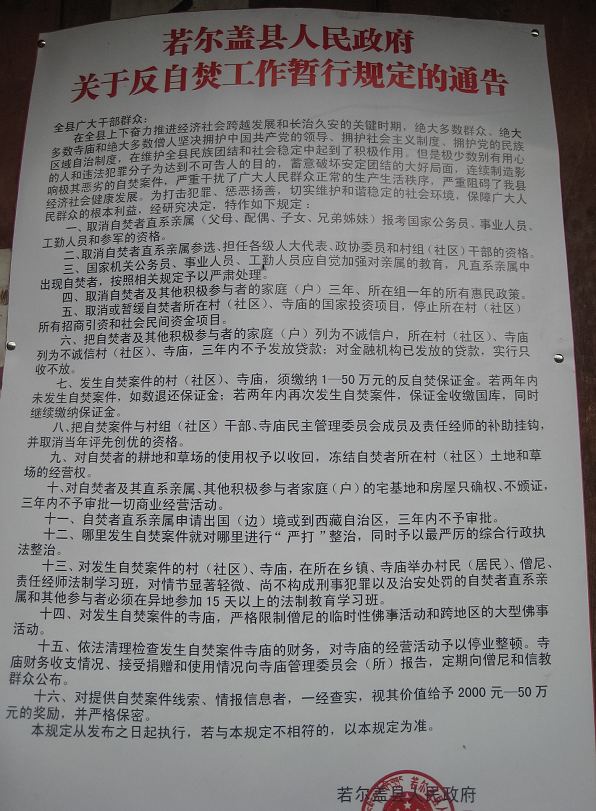
    Of course, the way to stop self-immolations in Tibet is simple — put up a notice:

    See also New document sheds light on China’s campaign against self-immolations in Tibet

    On the history of the selfie

    Monday, February 3rd, 2014

    [ by Charles Cameron — on self representation, avatars, and what we may be missing ]
    .

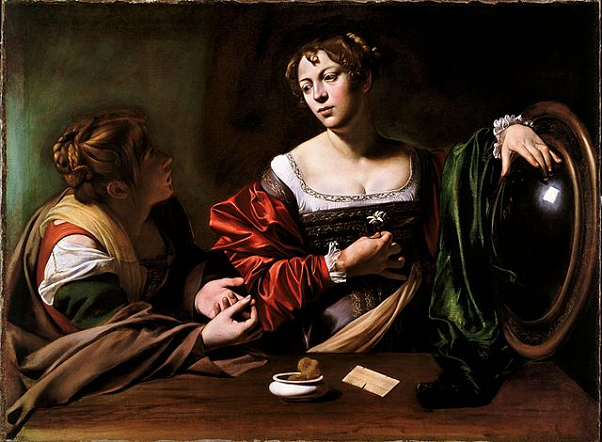
    Caravaggio, Martha and Mary Magdalen, aka The Conversion of the Magdalen

    **

    Where to begin?

    The Washington Post doesn’t like selfies much, according to Galen Guengerich in the Religion, yes, the Religion section — in a post titled ‘Selfie’ culture promotes a degraded worldview he writes:

    The 2013 word of the year, according to the Oxford Dictionaries, was “selfie,” which Oxford defines as “a photograph that one has taken of oneself, typically one taken with a smartphone or webcam and uploaded to a social media website.” The first use of the term, according to Oxford, occurred when a young Australian got drunk at a friend’s 21st birthday party and fell down the stairs. He hit lip-first and his front teeth punched a hole in his bottom lip. His response was to take a photo of himself and post it online for his friends to see. “Sorry about the focus,” he wrote, “It was a selfie.”

    Okayyyyy…

    As usual, the Kierkegaard / Kardashian combo that tweets as @KimKierkegaard manages to straddle the worlds material (in the Madonna sense) and spiritual (in the sense of the Madonna):

    **

    I wanted to dig deeper — the WashPost Religion section, Kierkegaard, how could I not? I often want to dig deeper, and today I was driven to do so because today — not or the first time — I ran across a terrorism analyst and blogger named Cristina Caravaggio Giancchini, who uses a detail from her namesake Michelangelo Merisi da Caravaggio‘s Martha and Mary Magdalen (above) as her avatar…

    Avatars are a kind of selfie, aren’t they?

    In any case, I found myself looking for the particular Caravaggio that contains that detail, discovering it was the Martha and Mary Magdalen, which you see that the top of this post — then kept on digging via Google to learn a little more.

    **

    Here’s what I found in a blog post titled Fingers and Mirrors: Caravaggio and the Conversion of Mary Magdalene in Renaissance Rome:

    The inclusion of the mirror asks viewers to enter into a dynamic conversation about their own delight in the rich textures of the picture; alongside a powder puff and comb, it points us to Mary’s vanity, and her concern with the things of this world. Rather than showing Mary to herself, however, the mirror captures a diamond of light — a visual representation of the divine grace that inspires Mary to look beyond her earthly passions. The flower that Mary clutches to her chest is an orange blossom: symbol of purity.

    As Debora Shuger realises, in a stimulating essay on early modern mirrors, for Renaissance viewers ‘the object viewed in the mirror is almost never the self’ (22). Such mirrors are, Shuger suggests, if not totally Platonic (reflected an absolute ideal), at least ‘platonically angled, titled upwards in order to reflect paradigms rather than the perceiving eye’ (26). Renaissance mirrors, she concludes, ask us to think differently about the mental worlds and self-awareness of people living in this period: ‘they reflect a selfhood that … is beheld, and beholds itself, in relation to God’ (38).

    Pilgrims who travelled to Aachen in the fifteenth-century appear to have purchased small convex mirrors as souvenirs: as relics were carried through the thronging crowds, travellers held up the mirrors to catch a glimpse of them, and then preserved the mirrors as objects which, according to Rayna Kalas, ‘betokened that moment when the pilgrim had a vision of and was visible before the sacred relic. … Every subsequent glance at this mirror memento might serve to remind the believer of that glimpse of sacred divinity’. In Caravaggio’s painting, though, Mary looks away from the mirror which might capture her reflection (the ‘dark glass’ of Corinthians?), and towards her shadowed but persuasive sister.

    **

    We began this post with the idea that our 21st century ‘Selfie’ culture “promotes a degraded worldview” — and here by way of contrast, in the use of hand-held mirrors in 15th century Aachen, we see what we are missing…

    … a glimpse of the sacred, in which the sacred glimpses us in transcendent return.

    Christian cannibal: first the horror, then the meditation

    Friday, January 17th, 2014

    [ by Charles Cameron — you may not want to watch the video – read the text first, okay? ]
    .

    Here’s what the BBC-wallah said:

    The Christians were victims; now they’re on top. It’s a dangerous time to be Muslim. A charred and dismembered body is dragged through the streets. Christians have just killed a Muslim passerby. Ouandja “Mad Dog” Magloire was at the head of the mob. He was in a blind fury that day. Muslims killed his pregnant wife, his sister in law, her baby, he tells me. They broke down the door and cut the baby in half. I promised I’d get my revenge. Revenge was an act of cannibalism. First, he stabbed j\his victim. You are Muslim, Muslim, Muslim, he said. I poured petrol over him, I burned him, I ate his leg, right down to the white bone. The victim was just passing through on a bus. Most Christians are horrified, but resigned. No-one tried to help him, say these eyewitnesses. Everyone is so angry with these Muslims. No way anyone was going to intervene.

    This happened at two o’clock in the afternoon, when the streets were crowded with people, just like you see today. Everyone we’ve spoken to is still at a loss to know what to make of it. Was it the act of a madman, was it somebody who’d been pushed by sectarian hatred, was it explained perhaps, by traditional beliefs in magic and sorcery. These fighters are Christians but they also believe in magic. their amulets contain soil from their ancestors’ graves. Some carry the flesh of enemies they’ve killed. These charms are a delicate subject, not often discussed with outsiders. We are bullet-proof, says the commander. Mad Dog Magloire went further. perhaps his crime resulted from his own demons, but to some Christians he’s a hero. That doesn’t bode well for this country’s future.

    If you want to watch him say it, it’s powerful. Here you go:

    Okay, now for the meditation: I want to rescue something out of all this horror.

    **

    The very first thing I want to note is this:

    We are bullet-proof, says the commander.

    I’ve run across this before, it’s a common motif. Remember the Lakota Ghost Dance shirts? Johnny and Luther Htoo, the cigar-smoking twins who led God’s Army in Myanmar…? Televangelist Wilde Almeda of the Jesus Miracle Crusade in the Philippines?

    This is just to say that in my view, religion with spiritual bullet-proofing is different from religion without it, no matter what name you tag the religion with.

    **

    Next up:

    Most Christians are horrified, but resigned. … perhaps his crime resulted from his own demons, but to some Christians he’s a hero.

    It could be tribal. It could be magical, maybe. It could be religious, specifically Christian. It could be Mad Dog Magloire‘s “own demons”. It could be, and surely was, that he saw his pregnant wife slaughtered before his own eyes.

    But he projected his thirst for vengeance not on the man — a Muslim — who had butchered them, but on a guy in a passing bus who looked like he was Muslim.

    **

    Some weeks back, Commander Abu Sakkar of the Farouq Brigades in Syria ate what he took to be the heart of one of his enemies. It turned out to be his enemy’s lung.

  • If you think Mad Dog Magloire doesn’t represent Christianity, maybe Abu Sakkar doesn’t represent Islam.
  • If you think Abu Sakkar is representative of Islam, maybe Magloire is representative of Christianity.
  • I think it is fair to say that any religions with in excess of a billion adherents will find the odd cannibal among them in time of war.

    **

    But then consider this, in peacetime:

    In Ireland this week, a man confessed he’d murdered his landlord over a chess game, and eaten his heart. Forensics showed it was a lung that was missing

    **

    We are, after all, human.

    Oklahoma and the various believers

    Thursday, January 9th, 2014

    [ by Charles Cameron — puzzled, amused, and a little pained by these goings on ]
    .

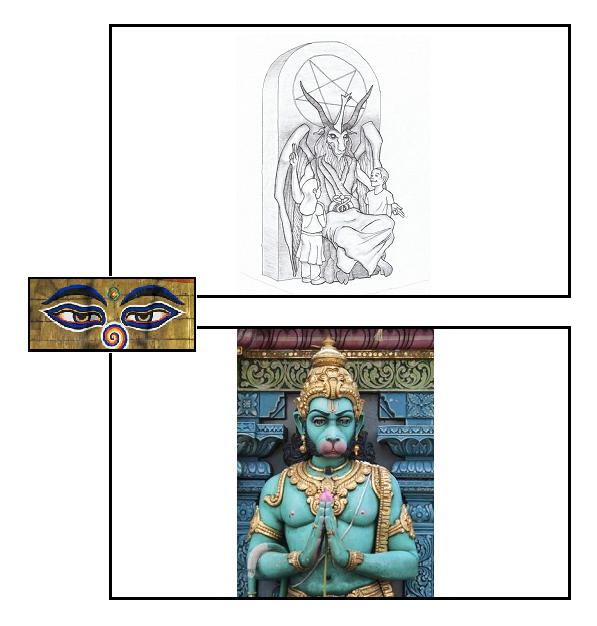
    There’s a new-ish monument of the Ten Commandments at the Oklahoma state capitol, and now some Satanists want to erect a statue of their deity, and Oklahoman Hindus are chiming in with their own proposal…

    Okay, as far as I’m personally concerned, Satan (above, upper panel) can get behind me — far behind, not right behind, preferably — while I’m happy to have a small statue of a Hindu deity above my desk — although in my case it’s Ganesh rather than Hanuman (above, lower panel), since Ganesh is the patron of writers. But that’s my personal take.

    Oklahoma, however…

    Let me put it this way. I suspect the Satanists are mostly drawn by the thrill of doing something the French have a handy phrase for: épater le bourgeois — literally shock the bourgeois, or more colloquially, blow their tiny minds

    To be honest with you, I think that’s not a bad motto for poets and artists in their teens and twenties, Rimbaud, even Baudelaire… but being shocking at my age, even if you’re a poet, gets frankly tedious, and trying to build or conserve a civiliation on that basis — more than a little ridiculous.

    Those who have a devotion to Hanuman, on the other hand, are simply members of one world culture among many in this grand American experiment.

    So let me put it this way: putting up a monument that proclaims “Thou shalt have no other Gods before me” — in a nation proudly founded on the principle of freedom of religion — really does offer the épateurs a hyper-juicy opportunity to do some blowing of minds — though just whose minds are “tiny” here is not a discussion I choose to enter.

    And Hanuman, Lord Rama‘s friend? Well, if there’s a freedom of religion issue, all parties have a right to their beliefs…

    **

    One of the reasons some religions ban religious imagery is because so many of us mistake the image for the deity it’s supposed to represent. And contrariwise, one of the reasons some religions treasure their religious imagery is because so many of us are reminded of the deity it represents. So you’ll often find both iconoclasts and iconodules, puritans and poets, the via negativa and the via positiva — the great cathedrals and the dissolution of the monasteries, the Bamiyan Buddhas and the Taliban.

    Laws have a difficult time coming to terms with paradoxes of this nature.

    What’s needed is greater human understanding and consideration. As in the Two Commandment (abridged) version found in Matthew 22. 27-29.

    But please don’t make a monument out of that…


    Switch to our mobile site