zenpundit.com » Religion

Archive for the ‘Religion’ Category

At a distance of three caliphs

Friday, August 31st, 2012

[ by Charles Cameron — caliphal succession as a marker in Egyptian-Iranian diplomacy at NAM ]
.


.

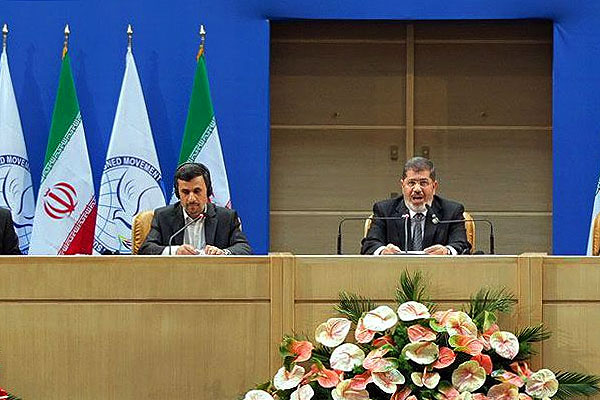
Describing Egyptian President Morsi‘s speech in Iran at the Non-Aligned Movement conference, Rodger Shanahan of Australia’s Lowy Institute wrote, tellingly:

Invoking the names of the first four caliphs (which never goes down well in uber-Shi’a Iran), his condemnation of the Syrian regime (an Iranian ally) caused the walkout of the Damascene delegation and stole much of the positive messaging that Iran would have been hoping for from this meeting.

Sunni Islam recognizes four “rightly guided” Caliphs as the successors to the Prophet: first among them was Muhammad‘s friend Abu Bakr, who was succeeded by Umar — who when he conquered Jerusalem, is said to have entered it on foot, and guaranteed the protection of the Christians and their churches – third, Uthman, remembered for establishing the definitive text of the Quran, and finally the Prophet’s cousin and son-in-law, Ali ibn Abi Talib.

Of these, Ali alone is recognized by the Shia, who consider him the Prophet’s rightful heir and their own first Imam.

As the photo above suggests, Morsi, a Sunni, and Ahmadinejad, a Shia, are precisely three caliphs apart.

Every Day is the Day of Something

Wednesday, August 29th, 2012

[ by Charles Cameron — days, months, years, Saints, Josaphat, Buddha, problems, issues, solutions — I think that about captures it all ]
.

Josaphat, the Bodhisattva Saint

.

Today is the International Day against Nuclear Tests — and since I don’t much like tearing open the fabric of the world I’m living in to witness and geiger-count the radiance it usually hides, I favor the idea. But the Day was already a Festival as far as I’m concerned: I woke up.

**

Look, there are International and National Days, Weeks, Months and Years — this month, for instance, in addition to Spinal Muscular Atrophy Awareness Month was also National Catfish Month. It was Don’t be a Bully Month and National Dirty Harry Month, quite a pair! It was also Never Leave a Child Unattended in a Car Purple Ribbon Month, National Water Quality Month – which needs to be Internationalized – and Win with Civility Month. And there are many more

See — we have enough issues to go around twenty-four slash seven slash three-sixty-five plus one on leap years…

That remarkable fellow Anthony Judge is largely responsible for the Union of international Association’s Encyclopedia of World Problems and Human Potential, which includes:

a World Problems database with 56,000+ entries and 276,000+ links
a Global Strategies and Solutions database with 32,000+ entries and 284,000 links
a Human Values database with 3,200+ entries and 119,000+ links
a Human Development database with 4,800+ entries and 19,000+ links, and
a Patterns and Metaphors database with 1,200+ entries and 4,500+ links.

**

So that’s how many problems we have, and how many solutions, and naturally we can offer prayers about the problems, and perhaps the prayers will be answered by the solutions, or with new ideas…

So it’s also not surprising that there are a vast number of saints who can intercede for us…

And since my birthday happens to fall on November 27, I have a special affection for St Josaphat, whose Feast Day that is.

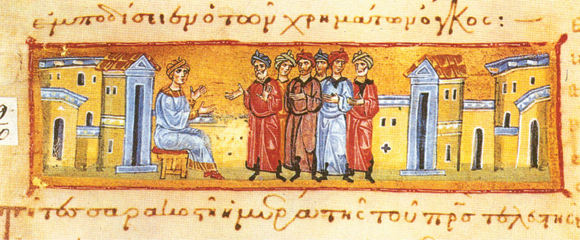
He’s the fellow preaching in the panel at the top of this post, from a 12th Century Greek manuscript…

**

Josaphat’s story is recounted in Wikipedia:

According to the legend, King Abenner or Avenier in India persecuted the Christian Church in his realm, founded by the Apostle Thomas. When astrologers predicted that his own son would some day become a Christian, Abenner had the young prince Josaphat isolated from external contact. Despite the imprisonment, Josaphat met the hermit Saint Barlaam and converted to Christianity. Josaphat kept his faith even in the face of his father’s anger and persuasion. Eventually Abenner converted, turned over his throne to Josaphat, and retired to the desert to become a hermit. Josaphat himself later abdicated and went into seclusion with his old teacher Barlaam.

A fine tale it is, and curiously reminiscent of that of the young bodhisattva Siddhartha, who was to become known as the Buddha:

Siddhartha Gautama was also a prince whose birth was accompanied with a prophecy that he would become a great holy man but not a king. He was also protected from the outside world by his father but on leaving the palace he also recognised that the world was full of suffering. He sought to pursue an ascetic life and to reach enlightenment but during this process he was subjected to many attempts to deflect him from this path. He was tempted by the demon Mara who sent his three beautiful daughters, Tanha (desire), Raga (lust), and Arati (aversion) to try to seduce him while he sat meditating under a banyan tree. After resisting these temptations, the prince attained Buddhahood at the age of thirty five.

And yes, that would make an excellent DoubleQuote!

**

In fact, stories travel — and the Buddha we know became Josaphat as his story traveled from India via St John Damascene to the farthest west:

Bodhisattva in Sanskrit became rendered as Bodhisav in Persian, then as Budhasaf in Arabic, Iodasaph in Georgian, Ioasaph in Greek and then finally Josaphat in Western Europe

I used to collect books about the kindly teacher Barlaam and his student Saint Josaphat the Boddhisattva: most of them are now in storage, alas.

And you can now see how the Catholic in me feels warmly-disposed towards the Buddhist, while the Buddhist in me is on amicable terms with the Catholic.

**

And i haven’t even begun to talk about the Sufis yet…

Rhetoric, intent — logistics — and who went first?

Monday, August 27th, 2012

[ by Charles Cameron — when religious leaders talk of wiping nations off the map ]
.

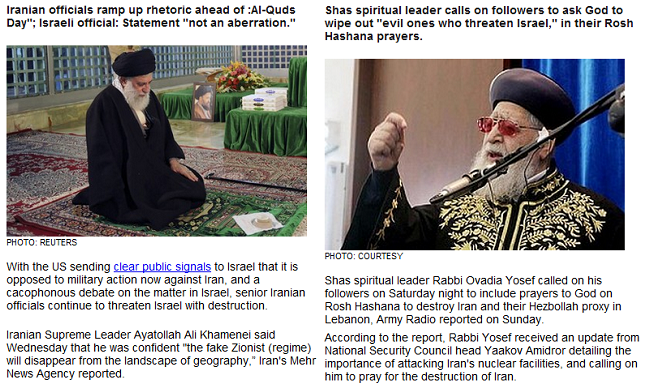
-Two bearded religious figures face of with what seems like parallel but opposite rhetoric:

______________________________________________________________________________________________

______________________________________________________________________________________________

The Ayatollah Khamenei, left, is the Supreme Jurisprudent of Iran — not merely a senior cleric but Iran’s final authority. Rabbi Ovaida Yosef, right, is the leader of the Shas movement in Israel and a cleric who swings enough power that Prime Ninister Netanyahu consults him and Foreign Minister Avigdor Lieberman, briefs him — an influence, then, something akin to an eminence grise perhaps, but by no means the final authority.

You may, loathe one of them you may loathe both of them: I doubt there are many people who admire both. But I’m not here to stir your animosities, I’m here to see what we can learn from comparing and contrasting them by catching them in similar circumstances. Perhaps it will make their differences stand out in high relief — perhaps it will reinforce their similarities.

The two men are both religious clerics, both political players, both getting on in years, both grey-bearded — and both seem to be comfortable using the same rhetoric at this point.

My aim here is to learn from this juxtaposition.

*

So I have two sorts of questions that I’d like to explore here, calmly and with appropriate documentation if you please…

One sort of question probes the differences in position and pouvoir of the two men:

Who has the higher position? Whose side has the most potent weapons? Whose side started this — or is that a moot question?

The second sort is subtler, since it has to do with motives hidden in the hearts and minds of men — and with the differences that sometimes exist between between rhetoric and intent.

Is is an entire people, or simply a regime that they would like to see an end to?

Is either one of them bluffing?

And of course my own favorite: is either one of them, the rabbi or the ayatollah, saying what he’s saying because of an “end times” (Messianic or Mahdist) expectation?

**

Hitler‘s rhetoric in Mein Kampf was pretty clear, and the actions of his Dritte Reich did not belie his rhetoric. Considerable planning was involved, there was documentation.

What, beyond rhetoric, do we know about Israeli planning to take down the Iranian nuclear program? What, beyond rhetoric, do we know about Iranian planing to respond to an Israeli strike — or to defeat and destroy Israel more generally?

Do the logistics back the rhetoric up?

What happens when the word “fire” is itself a match? What happens in an echo chamber, in a hall of mirrors?

Pussy Riot VI: counterpoint and counterfactuals

Wednesday, August 22nd, 2012

[ by Charles Cameron — compare and contrast as a means of contextualizing, suggesting a tool that might be of use to the IC in any number of circumstances ]
.

In this particular case, Pussy Riot is the topic, comparison with is the method, and some form of graphic the appropriate medium around which to build a presentation.


.

Both these statements have been made recently by Catholic priests, and they portray opposite positions on the matter. Again, it is my sense that the graphical representation of these remarks calls forth in the reader both similarities and differences, as Cath Styles nicely put it:

A general principle can be distilled from this. Perhaps: In the very moment we identify a similarity between two objects, we recognise their difference. In other words, the process of drawing two things together creates an equal opposite force that draws attention to their natural distance. So the act of seeking resemblance – consistency, or patterns – simultaneously renders visible the inconsistencies, the structures and textures of our social world. And the greater the conceptual distance between the two likened objects, the more interesting the likening – and the greater the understanding to be found.

From my point of view, the direct juxtaposition in a DoubleQuote or equivalent format does the job nicely when two fairly simple quotes are considered together.

Things can get more complex than that when a variety of discourses come together, but the same general principles can still be applied, and a graphical representation sought.

Bearing Cath’s point in mind, then, I’d like to examine some of the ways in which people have contextualized the Pussy Riot event in the Cathedral with counterfactual instances (ie by contrasting it with instances that in some ways parallel the factual instance, but in “what if” style alternate universes.

**

Here, then, are the documents I’ll be drawing on. First, from Khanya, a blog I’ve praised in an earlier post:

An Amnesty International petition site (Take Action Now – Amnesty International USA) urges people to send an email with the following text to the Russian prosecuting authorities:

I respectfully urge you to drop the charges of hooliganism and immediately and unconditionally release Maria Alekhina, Ekaterina Samutsevich and Nadezhda Tolokonnikova. Furthermore, I call on you to immediately and impartially investigate threats received by the family members and lawyers of the three women and, if necessary, ensure their protection. Whether or not the women were involved in the performance in the cathedral, freedom of expression is a human right under Article 19 of the Universal Declaration of Human Rights, and no one should be jailed for the peaceful exercise of this right. Thank you for your attention to this serious matter.

Now imagine, for a moment, that the boot was on the other foot.

Imagine that it was a Western European country, and that the act of “hooliganism” concerned was daubing swastikas on a synagogue. If that were the case, would Amnesty International be urging its members and the general public to send messages saying:

Whether or not the women were involved in writing the graffiti on the synagogue, freedom of expression is a human right under Article 19 of the Universal Declaration of Human Rights, and no one should be jailed for the peaceful exercise of this right. Thank you for your attention to this serious matter.

I think that in Western Europe such a petition would be widely regarded as “hate speech”, and “anti-Semitic”, as would the graffiti. So why does Amnesty International think that it is OK to encourage people to send such things to Russia?

And then, of course, one can put the boot back on the first foot again. If these same three young women had daubed graffiti on a synagogue in Moscow, would they have been prosecuted for the same offence and in the same way as they have been in this case?

So there are differences between Russian culture and Western culture, and differences within Russian and Western culture.

That’s a pretty impressive example of the counterfactual genre — and doubly so, it seems to me, because of the final reversal, the twist in its tail.

**

Next, here’s another quote from the same Fr. Hogan we quoted above. In this case, the mosque is used as the primary contrast to the cathedral, but the synagogue also makes an appearance — and Fr. Hogan throws at least one other interesting contrast into the mix — comparing Putin and western leaders:

Protest is fine, the day will come, I’m sure, and not too far away either I think, when we Christians may be protesting against our governments and engaging in civil disobedience, but protest must always respect others and the faith of others. As some have asked, would these ladies do the same in a mosque? They would not for two reasons – it would not be politically incorrect and they might end up being stoned to death before they had a chance to get out of the building. Is it legitimate to mock faith and descecrate places held sacred by people in order to protest against a political regime?

Some will say these ladies did so because the Orthodox Church is too close to the Russian government. Okay, well Judaism is considered by many to be too close to Zionism and the State of Israel – well, where are the lewd feminists dancing in the synagogues mocking Abraham and Moses? They are not there because they know it is inappropriate and wrong – just as it is inappropriate and wrong to desecrate a place of Christian worship.

What interests me here is that he uses multiple counterfactual contrasts, which perhaps makes his paragraphs a little less elegant than Khanya’s — but interesting in the complexity it adds to his analysis.

I’ll return to that remark about “we Christians may be protesting against our government” later.

**

My last text — and I’ve quoted it here on ZP before — is Josh Shahryar‘s tweet:

I wonder if #PussyRiot would get so much attention if they were a band of men called #DickMob.

That comes at the Pussy Riot issue from a completely different angle, and is very elegantly done.

**

Our next task is to see what oppositions we can find in these three statements.

  • Kanya uses Amnesty’s concerns regarding freedom of expression vs appropriateness of expression by comparing the cathedral incident with women “in a Western European country” daubing swastikas on a synagogue, thus also proposing a comparison between eastern and western European mores.
  • Then, in a reversal, Kanya uses the same cathedral incident vs daubing graffiti on a synagogue specifically in Moscow this time, to explore the degree to which Moscow might be more tolerant of anti-Semitism than of anti-Orthodoxy, both in terms of public opinion and via political and legal systems.
  • Fr Hogan’s question poses a contrast between the cathedral (and Orthodoxy and Putin) and a hypothetical mosque (and Islam and, say, a militant faction in Pakistan).
  • His second comparison is between two church-and-state collaborations, Orthodoxy with the Russian state and Judaism with the Zionist, and again the question he raises is whether similar behavior in a parallel situation would be tolerable.
  • Then there’s his intriguing third comparison, which I said I’d return to, in which he suggests that the “not too far” future may hold the need for civil disobedience and anti-government protests by Christians – in the west presumably. Fr Hogan hails from Ireland, which has had its own share of Church troubles and no longer wields the power it once did over Irish people and politics. Present day Russia, then, contrasted with a hypothetical future Ireland.
  • But the malaise is more widespread, and to add a comparison of my own into the pot, Fr Hogan’s remark reminds me of something Cardinal George of Chicago said not so long ago, looking at the looming battle between an increasingly secular state and his own moral stances on such issues as abortion and same sex marriage:

    I expect to die in bed, my successor will die in prison and his successor will die a martyr in the public square.

  • But that’s oblique to our narrative here…

  • Finally, there’s Josh Shahryar’s contrast between a factual girl band named Pussy Riot and a counterfactual boy band called DickMob.

**

What sort of a graphic would allow us to rotate all these polarities in our minds?

One answer is a Sembl-type game board — see design below — but with concepts rather thyan objects in the “positions” on the board:

But I’m also after other possibilities here. What would our fine artists, engineers, architects, dancers, cartographers, logicians, musicians, data visualizers and computer scientists suggest?

**

It would of course be nice if we could wrap this whole business of counterfactuals with a nice British cuppa tea, eh? Perhaps we can…

From a comment in the Guardian:

With the best will in the world I can’t see that if a bunch of noisy youngsters stood up in Westminster Abbey and screamed obscenities about the Queen to the accompaniment of electric guitars turned up to eleven, that the rest of the world would throw up its hands in horror if they were first stopped and then charged with an offence.

What’s that? We endured the Blitz, for goodness sake!

An Unquiet Riot

Monday, August 20th, 2012

The Master and the Minion

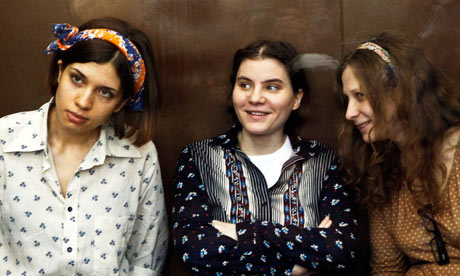
The Russian girl-punk rock band Pussy Riot has done something with their protest at  Christ the Savior Cathedral that prior cases of oppression, election-fraud, corruption and murder of Putin’s critics by agents of the siloviki regime failed to do – put a defiant human face on political persecution in Russia. Something we have not seen since the days of Sakharov and Solzhenitsyn.


Photo credit: The Guardian 

A reminder that when men are not free, mocking insolence is a form of bravery.

In a thoughtful post, Charles Cameron suggests that their performance was not a “political protest”. I disagree, though I think Charles’ examination of the tradition of “Holy Fools” in Russia is useful and culturally relevant as to how this event was intended to register with a Russian audience. Pussy Riot was being audaciously offensive in their selection of performance sites, as TM Lutas explains:

Orthodoxy is not a religion that is widely understood in the West. So it’s actually the rare pundit that catches how offensive what this punk riot group was doing actually was. There’s a subtitled version of the video that helps. The video misses the positional problems. The picture screen, called an iconostasis is something like the old altar rails of Catholicism but with fairly elaborate rituals surrounding the structure. There are three doors, the center one is called the holy doors. As a lay person you’re not even supposed to walk in front of that door. It’s viewed as disrespectful, even sacrilegious. So the people in charge of order and discipline were a bit stuck because these girls were dancing in the sanctuary, in front of the iconostasis and extracting them actually meant that they had to break the rules too. Several times a Pussy Riot girl bowed and did a full prostration. One does these things towards the altar in Orthodoxy. Reversing this as the protesters did is viewed as idolatry. Who, exactly, are they bowing to? That’s the genesis of the “devil dancing” talk in their trial.

Putin may have been a target but he certainly wasn’t the target. Their attack had a much wider range of victims. This was an attack on Orthodoxy, an attack on symphonia, the concept of church and state in complementary roles and mutual respect, and also an attack on Putin. 

In 4GW thinking, the strong lose when they are forced to fight the weak on terms that favor the weak. Pussy Riot – a group of young women – engineered a protest at a location whose significance meant that the authorities could not easily ignore or suppress it quietly with brutal thuggery in the shadows. By making Vladimir Putin the lyrical center of gravity, local officials were  made to look sycophantic and toadying, national officials petty and foolish. The Russian authorities, burly and oafish like their Soviet counterparts, have been reduced to fighting young girls while the rigged legal system that passes for justice in Russia is showcased in the unsparing glare of the global media.

By daring the authorities to make them political prisoners, Maria Vladimirovna Alyokhina, Yekaterina Stanislavovna Samutsevich and Nadezhda Andreyevna Tolokonnikova have made the regime look weak.

Moreover, their actions are a not so subtle reminder to Russians that the Orthodox Church is a corrupt vessel, a propaganda arm of the regime with a long tradition of KGB agents as Patriarchs and squalid informers as clergymen. The Church in Russia has not been free of the tentacles of state security since the day Lenin ordered the arrest of St. Tikhon. President Putin and Patriarch Kyrill are not peers temporal and spiritual, but fellow alumni of the same organs as the Big Lubyanka’s gaolers and policemen.

I would like to close this post by letting Yekaterina Samutsevich speak for herself:

In the closing statement, the defendant is expected to repent, express regret for her deeds, or enumerate attenuating circumstances. In my case, as in the case of my colleagues in the group, this is completely unnecessary. Instead, I want to voice some thoughts about what has happened to us.
That Christ the Savior Cathedral had become a significant symbol in the political strategy of the authorities was clear to many thinking people when Vladimir Putin’s former [KGB] colleague Kirill Gundyayev took over as leader of the Russian Orthodox Church. After this happened, Christ the Savior Cathedral began to be openly used as a flashy backdrop for the politics of the security forces, which are the main source of political power in Russia.
Why did Putin feel the need to exploit the Orthodox religion and its aesthetic? After all, he could have employed his own, far more secular tools of power—for example, the state-controlled corporations, or his menacing police system, or his obedient judicial system. It may be that the harsh, failed policies of Putin’s government, the incident with the submarine Kursk, the bombings of civilians in broad daylight, and other unpleasant moments in his political career forced him to ponder the fact that it was high time to resign; that otherwise, the citizens of Russia would help him do this. Apparently, it was then that he felt the need for more persuasive, transcendent guarantees of his long tenure at the pinnacle of power. It was then that it became necessary to make use of the aesthetic of the Orthodox religion, which is historically associated with the heyday of Imperial Russia, where power came not from earthly manifestations such as democratic elections and civil society, but from God Himself.
How did Putin succeed in this? After all, we still have a secular state, and any intersection of the religious and political spheres should be dealt with severely by our vigilant and critically minded society. Right? Here, apparently, the authorities took advantage of a certain deficit of the Orthodox aesthetic in Soviet times, when the Orthodox religion had an aura of lost history, of something that had been crushed and damaged by the Soviet totalitarian regime, and was thus an opposition culture. The authorities decided to appropriate this historical effect of loss and present a new political project to restore Russia’s lost spiritual values, a project that has little to do with a genuine concern for the preservation of Russian Orthodoxy’s history and culture.
It was also fairly logical that the Russian Orthodox Church, given its long mystical ties to power, emerged as the project’s principal exponent in the media. It was decided that, unlike in the Soviet era, when the church opposed, above all, the brutality of the authorities toward history itself, the Russian Orthodox Church should now confront all pernicious manifestations of contemporary mass culture with its concept of diversity and tolerance.
Implementing this thoroughly interesting political project has required considerable quantities of professional lighting and video equipment, air time on national television for hours-long live broadcasts, and numerous background shoots for morally and ethically edifying news stories, where the Patriarch’s well-constructed speeches would in fact be presented, thus helping the faithful make the correct political choice during a difficult time for Putin preceding the election. Moreover, the filming must be continuous; the necessary images must be burned into the memory and constantly updated; they must create the impression of something natural, constant, and compulsory.
Our sudden musical appearance in the Cathedral of Christ the Savior with the song “Mother of God, Drive Putin Out” violated the integrity of the media image that the authorities had spent such a long time generating and maintaining, and revealed its falsity. In our performance we dared, without the Patriarch’s blessing, to unite the visual imagery of Orthodox culture with that of protest culture, thus suggesting that Orthodox culture belongs not only to the Russian Orthodox Church, the Patriarch, and Putin, but that it could also ally itself with civic rebellion and the spirit of protest in Russia.
Perhaps the unpleasant, far-reaching effect of our media intrusion into the cathedral was a surprise to the authorities themselves. At first, they tried to present our performance as a prank pulled by heartless, militant atheists. This was a serious blunder on their part, because by then we were already known as an anti-Putin feminist punk band that carried out its media assaults on the country’s major political symbols.
In the end, considering all the irreversible political and symbolic losses caused by our innocent creativity, the authorities decided to protect the public from us and our nonconformist thinking. Thus ended our complicated punk adventure in the Cathedral of Christ the Savior.
I now have mixed feelings about this trial. On the one hand, we expect a guilty verdict. Compared to the judicial machine, we are nobodies, and we have lost. On the other hand, we have won. The whole world now sees that the criminal case against us has been fabricated. The system cannot conceal the repressive nature of this trial. Once again, the world sees Russia differently than the way Putin tries to present it at his daily international meetings. Clearly, none of the steps Putin promised to take toward instituting the rule of law has been taken. And his statement that this court will be objective and hand down a fair verdict is yet another deception of the entire country and the international community. That is all. Thank you.

Switch to our mobile site