zenpundit.com » Religion

Archive for the ‘Religion’ Category

Battlefield magic

Tuesday, August 9th, 2011

[ by Charles Cameron — Africa, military, witchcraft, need for analysis ]
.

From a transcript of yesterday’s CNN News Stream: [h/t @Intelwire]

Rebel fighter Mohammed shows me something else he found on the battlefield, what he says are pages of African witchcraft or black magic designed to protect fighters from enemy bullets. Saturday, he says, he got chills when it appeared to work on an armed Gadhafi soldier casually walking in the open.

Mohammed says he and 10 fellow fighters opened fire on the man from 200 meters.

MOHAMMED, REBEL FIGHTER: We tried to shoot him with different guns — Kalashnikov, 14.5 gun, but no one can hit him. And…

HOLMES: He’s out in the open. You’re putting all kinds of weapons at him, including anti-aircraft guns, and you’re not hitting him.

MOHAMMED: We didn’t hit him and he reached the car. He go in the car and go away.

HOLMES: An obviously unnerved Mohammed says he found these writings in another car next to the one the man escaped in.

This isn’t an area that I’ve been tracking in any detail, so I’d welcome further bibliographic suggestions – but two books I ran across recently might be of background interest, Peter Geschiere‘s The Modernity of Witchcraft: Politics and the Occult in Postcolonial Africa and Christopher Taylor‘s Sacrifice as Terror: the Rwandan Genocide of 1994

I’ve mentioned these before, but so might James R Price and Paul Jureidini‘s 1964 Witchcraft, Sorcery, Magic, and Other Psychological Phenomena and their Implications on Military and Paramilitary Operations in the Congo, and Roger D Hughes‘s 1984 Emergency in Kenya: Kikuyu and the Mau Mau Insurrection.

twins.jpg

Magical bullet-proofing as a spiritual theme turns up all over the place. The Ghost Dance shirts of the Lakota were supposed to make their wearers impervious to attack, and similar mythic powers were attributed to Johnny and Luther Htoo [picture credit: BBC], the twins who led God’s Army in Myanmar…

It would be useful to have a cross-cultural study of magical weaponry and protection, no?

UBL and Fisk: a quick note on something that caught me eye

Sunday, August 7th, 2011

[ by Charles Cameron — taqiyya, diplomacy, or theology? ]

.

I understand that Robert Fisk is viewed differently by different segments of the public, and hope we won’t get entangled in that discussion here – because I want to quote a story he tells, with an eye for two or three significant details.

The first detail, which you’ll find right at the end of the story, has to do with a leader’s standing when he must “withdraw” in front of his men – in other words, it’s a matter of honor and shame, and Fisk clearly feels that’s a motif of significance in his tale, though we might miss it if we weren’t specifically looking for it…

Here then is the story as Fisk tells it:

19 March 1997. There was a sudden scratching of voices outside the tent, thin and urgent like the soundtrack of an old movie. Then the flap snapped up and Bin Laden walked in, dressed in a turban and green robes. I stood up, half bent under the canvas, and we shook hands, both of us forced by the tarpaulin that touched our heads to greet each other like Ottoman pashas, bowed and looking up into the other’s face. Again, he looked tired, and I had noticed a slight limp when he walked into the tent. His beard was greyer, his face thinner than I remembered it. Yet he was all smiles, almost jovial, placing the rifle which he had carried into the tent on the mattress to his left, insisting on more tea for his guest. For several seconds he looked at the ground. Then he looked at me with an even bigger smile, beneficent and, I thought at once, very disturbing.

“Mr Robert,” he began, and he looked around at the other men in combat jackets and soft brown hats who had crowded into the tent. “Mr Robert, one of our brothers had a dream. He dreamed that you came to us one day on a horse, that you had a beard and that you were a spiritual person. You wore a robe like us. This means you are a true Muslim.” This was terrifying. It was one of the most fearful moments of my life. I understood Bin Laden’s meaning a split second in front of each of his words. Dream. Horse. Beard. Spiritual. Robe. Muslim. The other men in the tent were all nodding and looking at me, some smiling, others silently at the Englishman who had appeared in the dream of the “brother”. I was appalled. It was both a trap and an invitation, and the most dangerous moment to be among the most dangerous men in the world. I could not reject the “dream” lest I suggest Bin Laden was lying. Yet I could not accept its meaning without myself lying, without suggesting that what was clearly intended of me – that I should accept this “dream” as a prophecy and a divine instruction – might be fulfilled. For this man to trust me, a foreigner, to come to them without prejudice, that was one thing. But to imagine that I would join them in their struggle, that I would become one with them, was beyond any possibility. The coven was waiting for a reply.

Was I imagining this? Could this not be just an elaborate, rhetorical way of expressing traditional respect towards a visitor? Was this not merely the attempt of a Muslim to gain an adherent to the faith? Was Bin Laden really trying – let us be frank – to recruit me? I feared he was. And I immediately understood what this might mean. A Westerner, a white man from England, a journalist on a respectable newspaper – not a British convert to Islam of Arab or Asian origin – would be a catch indeed. He would go unsuspected, he could become a government official, join an army, even – as I would contemplate just over four years later – learn to fly an airliner. I had to get out of this, quickly, and I was trying to find an intellectual escape tunnel, working so hard in digging it that my brain was on fire.

“Sheikh Osama,” I began, even before I had decided on my next words. “Sheikh Osama, I am not a Muslim.” There was silence in the tent. “I am a journalist.” No one could dispute that. “And the job of a journalist is to tell the truth.” No one would want to dispute that. “And that is what I intend to do in my life – to tell the truth.” Bin Laden was watching me like a hawk. And he understood. I was declining the offer. In front of his men, it was now Bin Laden’s turn to withdraw, to cover his retreat gracefully. “If you tell the truth, that means you are a good Muslim,” he said. The men in the tent in their combat jackets and beards all nodded at this sagacity. Bin Laden smiled. I was saved.

I’m interested in the honor / shame angle because I have just been reading my friend Richard Landes‘ paper Edward Said and the Culture of Honour and Shame: Orientalism and Our Misperceptions of the Arab-Israeli Conflict and his blog post Game Theory and Social Emotions… I may not always agree with Richard, but he certainly sets me thinking…

The second point of interest here — which I’ve noted before — is the emphasis in the minds of bin Laden and his followers on the prophetic nature of dreams.

It is the third that is, if Fisk is accurate in his recall here, the most interesting – that bin Laden would utter the words “If you tell the truth, that means you are a good Muslim.” Fisk is not threatening him, so this is not an occasion for taqiyya as I understand it – perhaps it is an occasion, as Fisk himself suggests, for diplomacy.

But how does that remark sound as theology in the mode of Ibn Abd al-Wahhab?

Guest Post: John R Hall: “Norway’s cultural Christian apocalyptic crusader?”

Monday, July 25th, 2011

Blog-friend John R. Hall is a Professor of Sociology at the University of California – Davis, and the author of such books as Gone from the Promised Land: Jonestown in American Cultural History; Apocalypse Observed: Religious Movements and Violence in North America, Europe, and Japan with Philip D. Schuyler and Sylvaine Trinh; and Apocalypse: From Antiquity to the Empire of Modernity. His current research involves deploying a social phenomenology to retheorize modernity in relation to contemporary society.

David Ronfeldt suggested that John’s long and detailed remarks taking off from my own post, 2083 Graphics – a first look, deserved to be a post in its own right and not be lost in the comments section, and with Zen’s approval, I am delighted to present it here as Dr Hall’s first Zenpundit guest-post. — Charles Cameron

___________________________________________________________________________________________

I have just completed a very preliminary examination of the Norwegian manifesto posted just before the Oslo bombings. It is an astonishing and significant document, far from the incoherent ravings of a mad person, as I would wish it to be. And it is incredibly chilling in its ruthless rationality and relative coherence. Here, I offer some initial reflections. I have concentrated on the portions from page 717 forward, where the author details ideology, revolutionary strategy, and utopian vision of a future, federated Europe. Beginning on p. 1388, the author offers an autobiography and c.v. of Breivik, which presumably will be checked out by investigators and the media, plus a quite detailed account of his actions over the past several years. A number of important comparisons already have been made – to al Qaida and the Oklahoma City bombing, for example. But in many ways, if the perpetrator indeed acted alone, he is something of a piece with the Unabomber, who similarly combined ruthless action with a carefully elaborated manifesto. There are important difference, to be sure. In particular, the Unabomber worked to conceal his identity so that he could carry out multiple actions, and he operated out of an environmental left ideology rather than a Christian nationalism.

The latter part of the document depicts its account of pre-emptive war as a new mode of writing, exploring scenarios rather than writing fiction or history, thereby claiming to eliminate its usefulness to authorities seeking to use it as evidence when bringing charges against the author or a perpetrator of the acts it describes.

As others already have commented, the label of ‘Christian fundamentalist’ seems wrong, at least in conventional use of the term today. Certainly the author represents himself as a nationalist/European federalist conservative opposed to ‘cultural genocide’ of the Enlightenment West, and seemingly he proposes reinstitution of monarchy as more representative of a nation than democracy can be. Only very late in the missive, p. 1134, does he embrace Europe’s return to the traditional Catholic Church, for its apostolic succession of authority and its capacity to guide believers in matters of scripture. This development is to be coupled with a re-initation of patriarchy, developed in substantial detail (p. 1141ff.), and concern about ‘the ongoing genocide of the Nordic tribes’ and a discussion of its genetic basis and the dangers of miscegenation and sexual promiscuity (including a discussion of ‘erotic capital,’ leading to a frank discussion of the possibility that the state could ‘play an essential role in national reproduction’ (p. 1157ff.; quote, p. 1185). The treatise goes on to mention future education, economic, pollution-control, population-control, crime, cultural/anti-multicultural, deportation, and youth policies, as well as discussing financing an organization, categories of traitors (A, B, and C). In short, it is a comprehensive (in Mannheim’s terms) ‘utopian’ vision, i.e., one that could never be realized in the world as it is presently institutionalized.

Yet there is certainly a basis for recognizing the claims of a ‘Christian’ basis for the ideology, and a religious fundamentalism as well. This latter claim, I make in relation to Martin Riesebrodt’s important comparative study of U.S. Protestantism at the dawn of the twentieth century and Iranian fundamentalism 70 years later or so – both of them strongly based in an ideology of patriarchy, as is the Oslo killer’s manifesto (A Pious Passion, U. California Press, 1993).

Yet this is not simply ideological quasi-religious fundamentalism/nationalism. Rather, the utopian program has all the markings of an apocalyptic crusader, and more generally, the apocalyptic warring sect that I described in Apocalypse (Polity, 2009). The lever by which the author makes contact with Christianity (beyond its status as the cultural basis of European civilization, is a modern-day ‘PCCTS, Knights Templar’ struggle to initiate a European ‘civil war’ against ‘enablers’ – cultural marxists and multiculturalists who are ‘aiding and abetting’ cultural genocide, most significantly in efforts to accommodate Islam within Europe. The challenge, as the author sees it, seems to be to eliminate Islamic migration to Europe, assimilate or force emigration of Muslims, and to excise all Islamist or Arab influenced culture, art, and architecture from European countries. The Knights Templar, described as an ‘ancient Christian European military order,’ is being re-founded not by Christians alone, but by 12 individuals, including a ‘Christian atheist’ and a ‘Christian agnostic.’ Eventually, p. 1309, the manifesto is clear that its appeal is to ‘cultural Christians,’ although it invokes the Bible and Church crusading history, especially the work of Bernard de Clairvaux, to justify the contemporary initiative. One of many elements is the crucial proposal to engage in asymmetric warfare – a vein that is classically that of the apocalyptic warring sect, using a ‘clandestine cell organization,’ combining the rhetoric of ultimate belief in a cause with the cold, rational logic of how to operate. In considerable detail, the manifesto outlines a mode of operations that foreshadows the actions in and near Oslo, including the chilling note, page 886, that it will take ‘the SWAT team 10 – 40 minutes to reach you,’ and therefore, it is worthwhile to divide up the components of a planned action accordingly.Similarly, the author mentions, p. 995, ‘announcing your operation’ ‘only seconds before you initiate’ it, and suggests, p. 927, ‘hide a knife behind a smile,’ a recommendation, along with subsequent ones, that foreshadows the killer’s use of a police uniform and a story about helping to ensure the safety of the island camp participants before beginning to slay them – a technique that he used twice, in different places on the island.

In a variety of passages, the document offers a detailed handbook of asymmetric operations of war, including attacks and sabotage, and evaluation of a variety of targets, accompanied by a detailed catalogue of equipment, weapons (including bombs made from fertilizer – see esp. p. 1015), and armor, where to buy materials, and how to create weapons, detailed discussions of chemical, biological assaults, and attacks on nuclear reactors, as well as dietary recommendations, and an outline of a training regimen, recommendations concerning alliances with certain criminal networks [a theme that reprises the analysis of Eric Hobsbawm that I cited several weeks ago].

The author also announces that the apprehension of a Knights Templar is not the end of the operation: it ‘will mark the initiation of the propaganda phase’ (p. 948), and afterward, the task will be one of ‘countering the misinformation campaign’ (p. 1073), and comments on the use of trial opening and concluding statements for propaganda purposes (p. 1108-14). Alternatively, if you die, you will live on as a martyr in the memory of those carrying on the cause.

The scope of the publication is almost encyclopedic. It also includes historical analysis of how the past millennium of European history lead to the present crisis and need for re-formation of the Knights Templar, as well as a sketch of the umbrella organization, membership, military uniforms for dress occasions, medals, appropriate tombstones, a proposal for subsequent compensation (upon victory) for people who contribute to the resistance movement (a sort of rational-choice approach to mobilizing supporters), and on and on.

In short, the document envisions apocalyptic war as the means to reach a new European conservative/nationalist/Christian utopia. Yet unlike many other visions of apocalyptic war, this manifesto goes far toward detailing what that utopian world would look like. Even if, as it seems, this action is that of a lone individual, it is a dangerous development that we ignore at our peril.

John Hall

Oslo and Utoya — short version

Saturday, July 23rd, 2011

[ by Charles Cameron — leads related to Anders Breivik, suspected in Oslo bombings / Utoya shootings ]

.
I may follow this post up with a longer and more detailed version, time permitting – but for now, this presents the lines of inquiry I am following.

The alleged Oslo bomber and Utoya Island shooter, with 90+ deaths to his credit, was not a Muslim jihadist, as many at first suspected, and as at least one Islamist-identified group claimed. Anders Behring Breivik was a Norwegian with strong anti-Islamic views.

Large gobbits of his posts on the Norwegian blog site “document.no” are now available for serious study: there’s an English translation (possibly mechanical) on ScribD and a better one appearing in sections on Leo’s Passagen blog.

Juan Cole titled his blog comment, White Christian Fundamentalist Terrorism in Norway, referencing a Norwegian police spokesman who called Breivik a “Christian fundamentalist”. Breivik was not a Fundamentalist. He was a Protestant – but one who hoped individual Protestants would gradually join the Catholic Church, and one who was himself (paradoxically) active in Freemasonry. But his religious views, as expressed in his document.no postings, were peripheral to his main concerns.

He was an entrepreneur, a millionaire, and a political “conservative” who claimed to be anti-racist. His major political emphasis seems to have been on resisting the “Islamization” of Europe, which he regarded as a form of “demographic warfare” waged by Islamists with passive facilitation by the “multikulti” or multiculturalists. In one of his posts, he suggested the formation of a “cultural Euro-version of a Tea Party movement”.

He was also the owner of a successful farming enterprise, with a reported 700 employees — hence his ability to obtain large quantities (6 tons) of fertilizer of a kind useful in making bombs.

According to the Swedish “Expo” site, he was affiliated with a Nazi web forum.

Two other possible sources for information:

This is not standard evangelical behavior, this is not standard white, male, or white male behavior, this is not standard blogger behavior, this is not standard Norwegian behavior, this is not standard gamer behavior, this is not standard right wing behavior — but it is all too tragically human, this behavior…

There’s a lot to untangle here; this is one complex individual, and we’d do well to get a detailed and nuanced understanding of the various drivers in play…

Sacred space and the imagination

Sunday, June 19th, 2011

[ by Charles Cameron — no mil/intel stuff — the sacred, architecture, nature, books, imagination ]

.

This post began with a photo my friend William Benzon took of an abandoned passenger terminal in Liberty State Park:

abandoned_passenger_terminal_libery_state_park.jpg

*

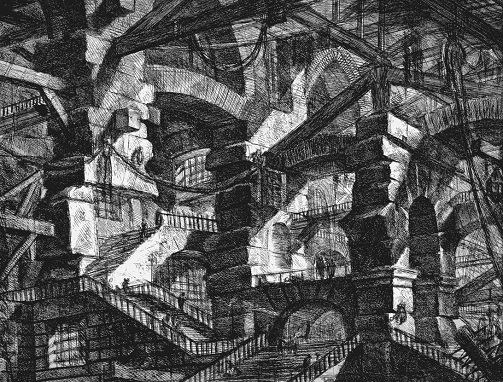
Without the greenery, I don’t think I’d feel this was “special” in quite the same way.  I might see it as prison-like, akin to those magnificent Piranesi prints in his Carceri series:

piranesi_carcere_xiv.jpg

… vast, haunted — the anti-cathedral.

Yet the grasses and small trees are there in Benzon’s photo, green and vibrant — and in their presence, the prison becomes a cathedral… not unlike the great ruined abbeys of England, Tintern, Calder, Whitby, Walsingham, Fountains.

Here’s Tintern Abbey by JMW Turner, for a sense of how ruins were viewed in his day:

423px-turner_tintern1.jpg

Somehow, in the workings of the human mind and heart, nature’s grasses can keep a ruined space sacred…

*

But what of books?

bookstore-interior-design-in-the-former-dominican-church-by-merkxgirod-1.jpg

The effect is austere by comparison, but the hush of the library slips into the high-vaulted silence of the cloister, and when I saw Bill Benzon’s photo above, this photo of a bookstore in Holland was the first analogy to cross my mind…

The Selexyz Dominicanen bookshop is housed in an old church in the centre of Maastricht. A beautiful listed building, this former Dominican church was transformed into a bookstore by architects Merkx+Girod, resulting in an extraordinary combination of bookselling complex and church interior, preserving the unique landmark setting. It was praised by British newspaper The Guardian as ‘possibly the world’s finest bookshop’. Earlier, Selexyz Dominicanen had already received the prestigious Lensvelt Architecture Interior Award 2007 for the décor of the store.

Of course, not everyone thinks a bookstore is sacred, and a lot might depend on what books you browsed, or caught your neighbor browsing. Here’s one negative report:

When your church community gets bored of reaching out with the love of Christ and doesn’t like to meet together anymore, don’t cry over it! Build a bookstore and coffee shop out of your unwanted worship space. The chancel is great for a cappuccino… And the worship space would house a nice collection of bargain-priced books, and kitten calendars:

So next time you despair that the church has lost its way, relax and sooth your aching conscience with a steaming latte – you can even sit at the crucifix table and plug into the WiFi. There are so many uses for old churches, why bother with renewal in the Church at all?

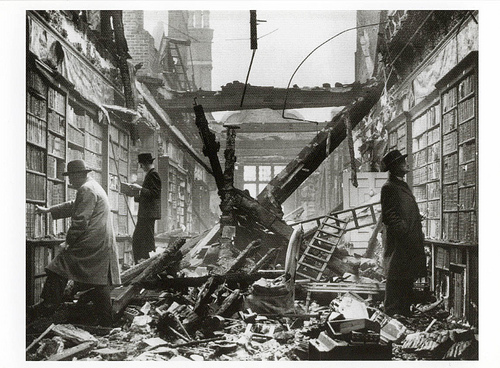
Even a ruined bookstore can have something of a sacred quality, though, as this London library photo clearly shows:

london-library-bomb-damage.jpg

Surely, that’s the last word in books — what more could one ask for?

*

Still — look.  There’s some sort of disaster, atrophy, ruin or sea-change in each of these images.  What happens when an architect — as skilled as the folks from who designed that bookstore — builds a chapel in the forest?

With all the contemporary emphasis on modern sustainable architecture, sometimes we seem to forget that environmentally friendly architecture has existed for a long time. Built in 1980, Thorncrown Chapel was created with the idea of highlighting the natural setting, which was, and still is, an attractive natural setting for tourists in the area. The owner of the site, Jim Reed, hired well known architect, Frank Lloyd Wright alumni E. Fay Jones to design and build the site which used native timber to match the setting around it, and the result was a fantastic expression of architecture that was awarded the “Twenty-Five year award” by the American Institute of Architects.

It is as lovely by winter light:

snow_fs1.jpg

as it is by light of spring and summer:

thorncrown-chapel.jpg

and yet I’d say there is something not ascetic but arid there: it has tried a great deal, but not died a little.

*

Nothing there is any which way ruined.  And it is out of ruins that our hopes grow these days, as grass at times breaks through tarmac.

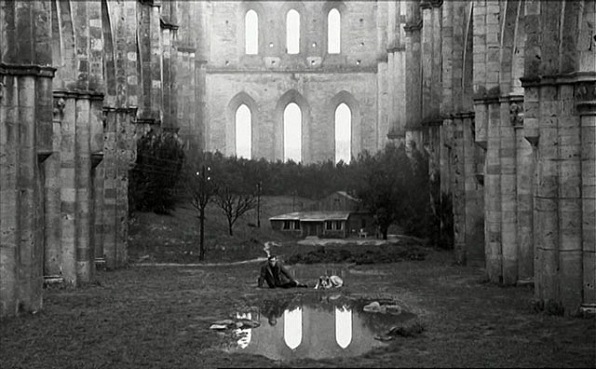
Tarkovsky’s great film Nostalghia closes with a breathtaking shot…

nostalghia11.jpg

a sacred space in pure, delivered, imagination — a single shot which to my mind, having seen the film and left the movie theater speechless, must be accounted the greatest single work of surrealism yet…

in which the protagonist, a Russian exiled in Italy, sees finally the lonely Italian abbey that has come to symbolize his loss of hearth and home, all loss, all absence — with his home nestled inside it, the little pond, himself, his dog…


Switch to our mobile site