zenpundit.com » Air Force

Archive for the ‘Air Force’ Category

The integration of religion and popular culture

Friday, March 25th, 2011

[ by Charles Cameron ]

*

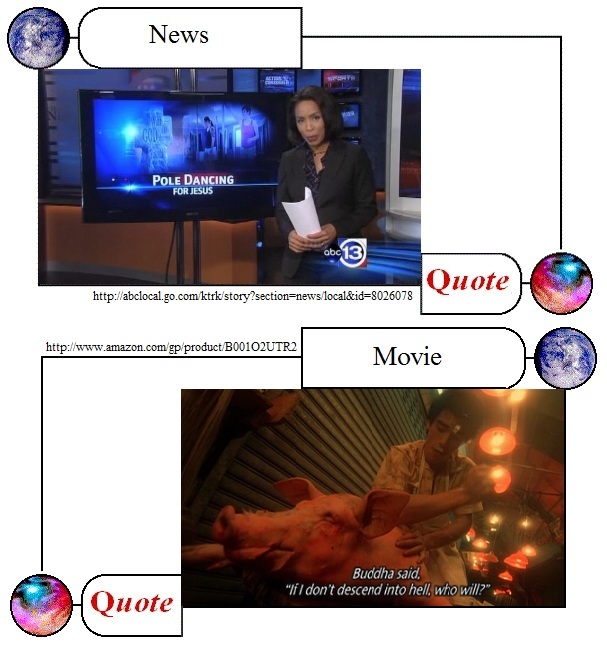
Yesterday, I stumbled on the account of pole dancing for Jesus with the accompanying graphic. I was a little taken aback, I’ll admit, but Jesus didn’t confine his ministry to the pious and scholarly, he befriended women of questionable morals and enforcers from the Roman mob as I recall, or “publicans and sinners” to give them slightly more pleasant names – so I sat up, took notice, downloaded the image, and re-sized it to fit in the top position of one of my DoubleQuotes – while wondering if I’d have to wait till Doomsday to find a suitable companion piece.
quopole-dancing.jpg

All in a day’s screen-gazing, I wound up watching the Wong Kar-Wai film, Fallen Angels, last night, and lo: the screen-shot in the lower part of the DoubleQuote revealed itself.

There are interesting paradoxes embedded in each image, of course, pitting what you might call “deep” theology against pious expectation – but they also illustrate another matter of some interest to me, the degree to which religion is now richly integrated into popular culture.

*

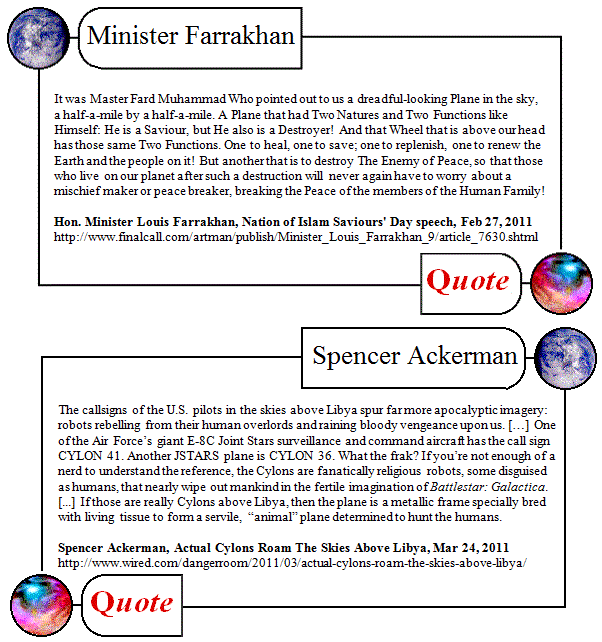
My second DoubleQuote, which contains today’s haul, deals with the same theme, I suppose — this time showing how what used to be the separate realms of science fiction and religion are now intermingled, with Minister Farrakhan speaking of an “end times” space craft that is an integral part of NoI eschatology in his annual Saviours’ Day speech, while alien aircraft flown by religious robots feature in a tongue-in-cheek news report about the war over Libya from Spencer Ackerman at the Wired War Room.

It is perhaps not surprising that Minister Farrakhan also cites Scientology with approval in the same speech, nor that that religion was itself the offspring of science fiction writer L Ron Hubbard. We are in a fertile period for the religious imagination, I believe, grappling to find new ways to answer the age-old questions — and science fiction and “signs in the skies” are among the vehicles, along with new religious movements and old religions renewed, by which we are coming to terms with life in this post-nuclear age…
quosigns-in-the-sky.gif

I’m not much of a prophet, but I predict that the confluence of science fiction with religion will prove to be one of the keys to an understanding of our times…

Happy Veteran’s Day!

Thursday, November 11th, 2010

Thank you to all who have served and who are serving now.

Distracted by Drones

Thursday, September 16th, 2010

Should have posted tonight. Have an interesting idea too – but I was distracted by having to comment on this article at SWJ BLog.

Arquilla on the New Rules of War

Thursday, February 25th, 2010

John Arqilla, along with David Ronfeldt, was the pioneering military and security theorist who forseaw the rise of networked non-state adversaries, which they detailed in their now classic book, Networks and Netwars. Below, in a Foreign Policy mag article, Arquilla expounds on the failure of the Pentagon to adapt sufficiently to leverage the power of networks or counter those opponents who have done so.

The New Rules of War

When militaries don’t keep up with the pace of change, countries suffer. In World War I, the failure to grasp the implications of mass production led not only to senseless slaughter, but also to the end of great empires and the bankruptcy of others. The inability to comprehend the meaning of mechanization at the outset of World War II handed vast tracts of territory to the Axis powers and very nearly gave them victory. The failure to grasp the true meaning of nuclear weapons led to a suicidal arms race and a barely averted apocalypse during the Cuban missile crisis.
 
Today, the signs of misunderstanding still abound. For example, in an age of supersonic anti-ship missiles, the U.S. Navy has spent countless billions of dollars on “surface warfare ships” whose aluminum superstructures will likely burn to the waterline if hit by a single missile. Yet Navy doctrine calls for them to engage missile-armed enemies at eyeball range in coastal waters.
 
The U.S. Army, meanwhile, has spent tens of billions of dollars on its “Future Combat Systems,” a grab bag of new weapons, vehicles, and communications gadgets now seen by its own proponents as almost completely unworkable for the kind of military operations that land forces will be undertaking in the years ahead. The oceans of information the systems would generate each day would clog the command circuits so that carrying out even the simplest operation would be a terrible slog.
 
And the U.S. Air Force, beyond its well-known devotion to massive bombing, remains in love with extremely advanced and extremely expensive fighter aircraft — despite losing only one fighter plane to an enemy fighter in nearly 40 years. Although the hugely costly F-22 turned out to function poorly and is being canceled after enormous investment in its production, the Air Force has by no means given up. Instead, the more advanced F-35 will be produced, at a cost running in the hundreds of billions of dollars. All this in an era in which what the United States already has is far better than anything else in the world and will remain so for many decades.
 
These developments suggest that the United States is spending huge amounts of money in ways that are actually making Americans less secure, not only against irregular insurgents, but also against smart countries building different sorts of militaries. And the problem goes well beyond weapons and other high-tech items. What’s missing most of all from the U.S. military’s arsenal is a deep understanding of networking, the loose but lively interconnection between people that creates and brings a new kind of collective intelligence, power, and purpose to bear — for good and ill…..”

Read the rest here.

It was nice to see Arquilla give some props to VADM Art Cebrowski, who is underappreciated these days as a strategic thinker and is much critricized by people who seldom bothered to read anything he actually wrote. Or who like to pretend that he had said a highly networked Naval task force is a good way to tackle an insurgency in an arid, mostly landlocked, semi-urban, middle-eastern nation.

It also occurs to me that one of the reasons that the USAF resisted drones tooth and nail is that robotics combined with swarming points to en end ( or serious diminishment) of piloted warplanes. Eliminating the design requirements implicit in human pilots makes for a smaller, faster, more maneuverable, more lethal aircraft that will probably be infinitely cheaper to make, more easily risked in combat and usable for “swarming”. Ditto attack helicopters.

Of course, nuclear bombers will probably stay in human hands. Probably.

ADDENDUM:

Contentious Small Wars Council thread on Arquilla begun by “student of war” and defense consultant Wilf Owen. I have weighed in as has Shlok Vaidya.

Book Review: The Mind of War

Sunday, April 5th, 2009

The Mind of War: John Boyd and American Security by Dr. Grant T. Hammond

The Mind of War went on to my “must read” list after attending the Boyd 07 Conference at Quantico, where I heard Dr. Frans Osinga deliver a keynote presentation on the theories of Colonel John Boyd, based on Osinga’s exhaustive study of Boyd’s personal papers, which culminated first in a PhD dissertation and then later was published as Science, Strategy and War: The Strategic Theory of John Boyd. Col. Osinga credits Boyd associate Dr. Grant Hammond and The Mind of War with introducing him to the ideas of John Boyd and inspiring him in his own intellectual journey as a student to try to understand and explain Boyd’s strategic theories.

Unlike Osinga or Robert Coram, author of the celebrated biography, Boyd: The Fighter Pilot Who Changed the Art of War, Hammond enjoyed the advantage of having had a personal and intellectual relationship with Col. Boyd, one that Hammond called “Transforming”. This gives Hammond’s shorter biography insights into how Boyd’s mind worked that Coram and Osinga miss (or more properly, could not have known), including  the “perverse glee” Boyd felt in discovering and exploring the Darwinian mismatch between perception and unfolding reality. While Robert Coram wrote about the demanding aspect that collaborators sometimes felt when dealing with the relentlessly autodidactic John Boyd, who could call at any time of the day or night and talk for hours, Hammond was actually on the receiving end of this treatment for six years:

“Let me illustrate by going through my notes of three telephone calls in the space of a single week in november 1995….He went through differences in his work,the portion that dealt with static or fixed data (energy manuverability) and that dealt with potential….He prefers potentialities. He then proceeded to review his latest reading. In rather short order, I was instructed to read Konrad Lorenz’s Behind The Mirror, Ernst Mayer’s The Growth of Biological Thought, Gerard Radnitsky and W.W Bartley’s edited collection entitled Evolutionary Epistemology (focus on particularly on Karl Popper’s essay and that of Donald T. Campbell) and Stuart A. Kauffman’s The Origins of Order.

….From biology to chaos, future defense scenarios to information war, Sun Tzu and Musashi to the Ames Spy Case, genetic algorithms to how one thinks and learns, airbase security and police to the Japanese art of war, evolutionary epistemology and the growth of biological thought – to Boyd, they are all clearly interrelated.” [ 184-186]

Note that Hammond’s description of just three phone calls with John Boyd ran over three pages of text and the above excerpt reveals only a fraction of the concepts and source material discussed. From Hammond’s The Mind of War the reader gains a good appreciation of how Boyd’s analogically oriented, synthesizing, pattern recognizing, fluidly connective mind worked in practice with a personality or character that could make Boyd competitive, confrontational, admirable, brusque, antagonizing or heroic at different turns.

The Mind of War also puts Boyd’s role in the “military reform movement” into greater clarity and sheds more light on Boyd’s retirement years of declining personal health, intellectual epiphanies, and partial rehabilitation with the Air Force brass that continued to nevertheless inflict slights and insults on the rebel who had repeatedly “bucked the system. While The Mind of War is primarily an intellectual biography of John Boyd, the human dimension is far from absent in Hammond’s writing.

For the serious student of modern strategy or aficianados of Col. John Boyd, Grant Hammond’s The Mind of War is a must read book. It forms a necessary bridge between Robert Coram’s classic style, popular, biography and Osinga’s strictly military-academic treatise on Boydian strategic theory. The Mind of War helps the reader better comprehend either book while remaining a great and highly informative work in it’s own right. Strongly recommended.


Switch to our mobile site