zenpundit.com » Perception

Archive for the ‘Perception’ Category

Walter Russell Mead on our Oligarchical and Technocratic Elite

Saturday, May 14th, 2011

I am still busy with several posts and a couple of book reviews, none of which are finished and some offline activities. In the interim, Lexington Green sent me this post by Walter Russell Mead. It is long but brilliant, spot on and thoroughly devastating:

Establishment Blues

….By contrast, we have never had an Establishment that was so ill-equipped to lead.  It is the Establishment, not the people, that is falling down on the job.Here in the early years of the twenty-first century, the American elite is a walking disaster and is in every way less capable than its predecessors.  It is less in touch with American history and culture, less personally honest, less productive, less forward looking, less effective at and less committed to child rearing, less freedom loving, less sacrificially patriotic and less entrepreneurial than predecessor generations. 

 Its sense of entitlement and snobbery is greater than at any time since the American Revolution; its addiction to privilege is greater than during the Gilded Age and its ability to raise its young to be productive and courageous leaders of society has largely collapsed.

…We have had financial scandals before and we have had waves of corporate crime.  We have had pirates and robber barons.  But we have never seen a collapse of ordinary morality in the corporate suites on the scale of the last twenty years.  We have never seen naked money grubbing among our politicians akin to the way some recent figures in both parties have cashed in.  Human nature hasn’t changed, but a kind of moral grade inflation has set in and key segments of the American Establishment are increasingly accepting the unacceptable as OK.  Investment banks betray their clients; robo-signers essentially forge mortgage documents day after day and month after month; insider traders are lionized.   Free markets actually require a certain basic level of honesty to work; if we can’t be more honest than this neither our markets nor we ourselves will remain free for very long.

Many problems troubling America today are rooted in the poor performance of our elite educational institutions, the moral and social collapse of our ‘best’ families and the culture of narcissism and entitlement that has transformed the American elite into a flabby minded, strategically inept and morally confused parody of itself….

[ Emphasis mine]

….A leadership class is responsible for, among other things, giving a voice to the feelings of the nation and doing so in a way that enables the nation to advance and to change.  Most of the American establishment today is too ignorant of and too squeamish about the history and language of American patriotism to do that job.  In the worst case, significant chunks of the elite have convinced themselves that patriotism is in itself a bad and a dangerous thing, and have set about to smother it under blankets of politically correct disdain.

This will not end well.

Read the rest here.

I have written about the deficiencies of the elite before, mostly in their inability to think strategically and create a coherent foreign and national security policies but their increasingly oligarchical attitudes of favoring self-dealing fiscal, regulatory and social policies, at the expense of their fellow citizens or the national interest is cause for great alarm.For example a legion of recent national security officials from the current and previous administration, a few barely out of office, have just accepted large wads of lightly laundered Saudi cash to lobby on behalf of the Mujahedeen-e Khalq, a nutty, cultish, Marxist terrorist group that formerly worked for Saddam Hussein. This with no sense of embarrassment or shame that they are putting a dingy cast on their prior public service or awareness that doing so conflicts with solemn oaths some of them have made to the Constitution of the United States. 

How many are also taking Chinese money, I wonder?

We need a new elite

Gamification: al Awlaki loses big points

Friday, May 13th, 2011

[ by Charles Cameron ]

.

There’s been talk about “gamification of jihad” recently, the idea being that on the jihadist forums you get points and seniority for posting often, your posts getting thumbs up from others, etc — reputation, in a nutshell.

tweet-quilliam-on-obl-on-awlaki.png

Well, the guys at Quilliam include Senior Analyst Noman Benotman, one time leader of the Libyan Islamic Fighting Group (LIFG) and bin Laden comrade-in-arms, who later disbanded the former and criticized the latter in an open letter — if he’s getting the sense that al-Awlaki didn’t impress bin Laden, hopefully some jihadi wannabes will get rapidly less impressed, too…

“Trust, but verify” and Pakistan: II

Sunday, May 8th, 2011

[ by Charles Cameron — second of three ]
*
.

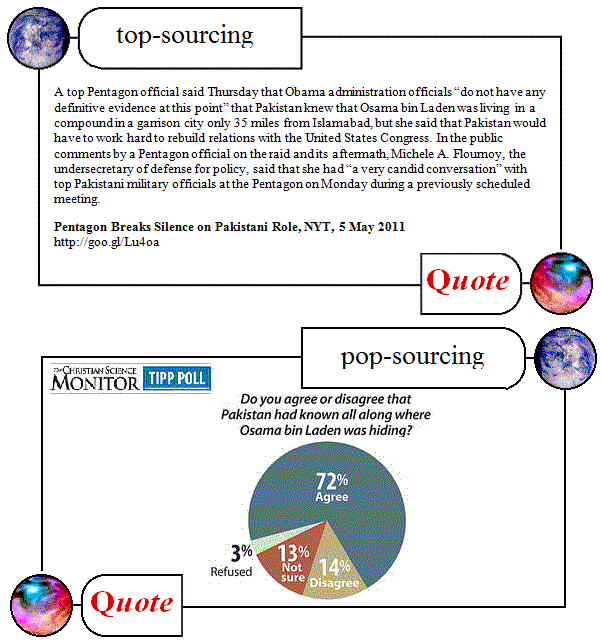
Trust — or mistrust — but verify.

So: can you trust crowd-sourcing, can you trust officialdom?

quo-csm-poll-vs-flournoy.gif

Can you trust Pakistan?

The Abbottabad raid: tellings and retellings

Thursday, May 5th, 2011

[ by Charles Cameron ]
*

.
bryanalex.jpg

My friend Bryan Alexander‘s book, The New Digital Storytelling: Creating Narratives with New Media, hit the shelves a short while ago (recommended) — and this month Bryan is exploring the various forms of digital story-telling on his new digital storytelling blog.

I’m interested in narrative, too – even when it isn’t digital – because it’s the prime way in which we humans figure out what’s going on around us…

Here, then, are two “tellings and retellings” of the Abbottabad raid and the death of Osama bin Laden.

.
1. The fog of war

In his first briefing on bin Laden’s death from the White House, John Brennan, Assistant to the President for Homeland Security and Counter-Terrorism, dismissed bin Laden with the words, “I think it really just speaks to just how false his narrative has been over the years.”

Narrative is important, and the narrative John Brennan was proposing as a corrective to bin Laden’s version went as follows:

here is bin Laden, who has been calling for these attacks, living in this million dollar-plus compound, living in an area that is far removed from the front, hiding behind women who were put in front of him as a shield. I think it really just speaks to just how false his narrative has been over the years. And so, again, looking at what bin Laden was doing hiding there while he’s putting other people out there to carry out attacks again just speaks to I think the nature of the individual he was.

A writer in the Atlantic commented today:

And that’s the message our counterterrorism officials would, I expect, like the world — and especially any potential followers of al-Qaeda’s anti-American ideology — to get about our newly vanquished enemy, responsible to the single deadliest attack on American soil. The leader of the terrorist group was soft, a coward in the end who hid behind a woman’s skirts like a little girl, having grown accustomed to living in luxury in a mansion. Almost everything about this narrative seemed calculated to diminish any possible perception of strength or masculinity in bin Laden’s reaction to the raid by an elite team of U.S. Navy Seals — men who are in contrast among the most mythic and valorized in our armed forces, known for slogans like “pain is just weakness leaving the body.”

But just a day after Brennan’s briefing, the President’s Press Secretary, Jay Carney, gave a second briefing, in which he revised the official narrative, saying:

Well, what is true is that we provided a great deal of information with great haste in order to inform you and, through you, the American public about the operation and how it transpired and the events that took place there in Pakistan. And obviously some of the information was — came in piece by piece and is being reviewed and updated and elaborated on.
.
So what I can tell you, I have a narrative that I can provide to you on the raid itself, on the bin Laden compound in Pakistan.

I have a narrative…

The revised narrative featured an unarmed bin Laden in a far from palatial house with no visible air-conditioning, who didn’t in fact use a woman as a human shield… all of which “really just speaks to just how false” Brennan’s own original narrative was.

But then – you don’t believe everything you read in the press, do you? And besides, the first news reports of almost any big story are almost invariably inaccurate, it takes time for clarity to emerge… which adds up to the idea that it’s not so easy to distinguish between how the world actually spins — and how the world is spun.

So that’s a telling and retelling of the Abbottabad raid in “real life” as transmitted to us by various media and recorded on the web…
.

2: The twitter-stream and the analyst

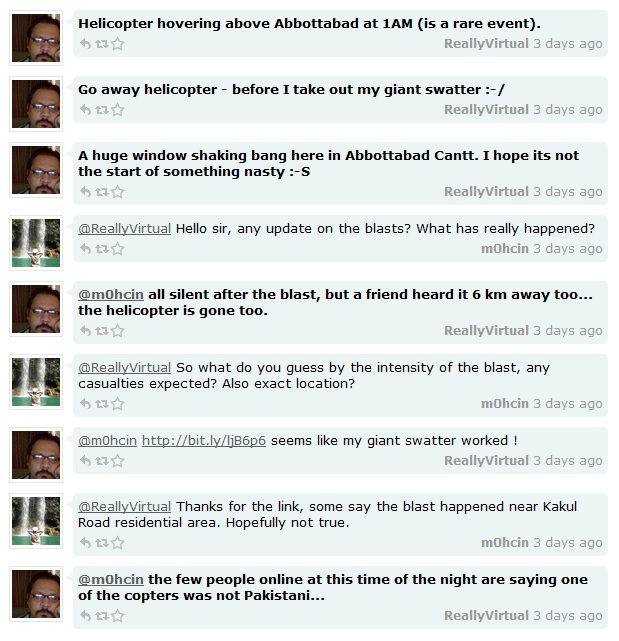
A little earlier a more “purely” digital version of the story – no less confused by the “fog” that inevitably surrounds the reporting of highly volatile situations – had emerged quite spontaneously via Twitter, when the delightfully-named ReallyVirtual (an IT specialist who had moved to Abbottabad for some peace and quiet) was kept awake by the noise of helicopters overhead and sounds of explosions, and tweeted a couple of late-night friends… and a stream of tweets began which quickly led to an almost thousandfold spike in Yahoo searches on bin Laden, and bin Laden related searches occupying all top twenty spots on Google trends

You might call that spontaneous, distributed story-telling – but it’s also the raw material for a collated and curated twitter narrative, using Chirpstory, a tool for curating and presenting stories from the twitter-stream:

chirpstory.jpg

We’re not done yet…

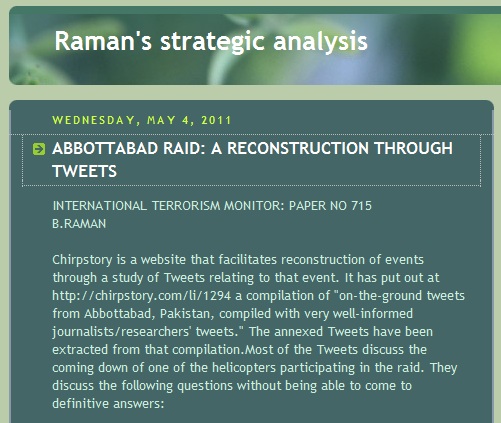
That in turn provides grist for the analytic mill of B Raman, a highly-regarded Indian analyst, blogger, and former chief of counter-terrorism with India’s R&AW intelligence agency – who winnowed out the chaff and added in his own commentary to create a denser, tighter analytic narrative of his own:

raman.jpg

To my way of thinking, the spontaneous twitter-stream version, the Chirpstory adaptation and B. Raman’s midrash on it are at least as interesting as the successive White House narratives…

.

3. Further reading:

Also relevant to our narrative here, and your own readings on the topic of our tale:

How the Bin Laden Announcement Leaked Out
Bin Laden Reading Guide: How to Cut Through the Coverage

New Book: Spinning the Law by Kendall Coffey

Monday, May 2nd, 2011

Spinning the Law: Trying Cases in the Court of Public Opinion by Kendall Coffey

Just received a courtesy review copy of Spinning the Law from Ruby at FSB Associates. This is not the genre of books that I typically review and I was initially hesitant that it would just be a pop culture title, but in skimming, I am pleased to report that the author, former US. Attorney Kendall Coffey, is engaged in an analysis of how public opinion, shaped by the media, impacts the justice system.

Coffey explains the strategies and tactics that prosecutors, defense lawyers and their clients employ as well as the hazards and mistakes made in playing to the media. Coffee’s reach includes the trials of  Joan of Arc, Socrates and Aaron Burr as well as more recently infamous characters as the American Taliban, John Walker Lind, Jose Padilla and Governor Rod Blagojevic. Spinning the Law would seem to have a great deal of applicability to those readers interested in IO and public diplomacy, as well as those with conventional interest in the legal system and American politics.

I look forward to reading this and eventually posting a full review.


Switch to our mobile site