zenpundit.com » Perception

Archive for the ‘Perception’ Category

The Sounds of Silence and Your Own Mind

Tuesday, November 27th, 2012

Scott Shipman had an excellent book review post An Unknown Future and a Doubtful Present: Writing the Victory Plan of 1941 — a review-lite and a few questions in which he discussed the intellectual seriousness and evolution of war planner   Major Albert C. Wedemeyer as a military officer and strategist:

….Wedemeyer was an honor graduate of the Command and General Staff College, and his performance earned him the opportunity to attended the Kriegsakademie, the German staff college. However, coupled with impressive academic preparations, Kirkpatrick writes that Wedemeyer’s curiosity exposed him to a “kaleidoscope” of ideas and methods. Kirkpatrick summed-up Wedemeyer: “Competence as a planner thus emerged as much from conscientious professional study as from formal military education…” Going on to say:

In common with many of his peers, much of Wedemeyer’s professional and intellectual education was less the product of military schooling than of personal initiative and experience in the interwar Army.

Wedemeyer’s intellectual development was purposeful and paid off. In Wedemeyer’s deep study of his profession he used the prescribed paths, but also explored on his own. How common is that today? 

As often happens, the discussion can take an unexpected turn in the comments section. Lexington Green weighed in with this:

Think about George Marshall in China, traveling around on horseback.  No cell phone, no email.  The man could actually think.  Or Eisenhower meeting with Fox Connor to talk about the books Connor had him read. Telephone calls were not even common.  The military might do well to have two days once a quarter of silent retreats, only emergency communication permitted, with literally no unnecessary conversation, for groups of officers and non-coms, with some assigned reading and some self-selected on the same theme, then an open discussion after dinner. It would cost virtually nothing and would be an intellectual and mental oasis, and some good ideas might come out of it.  Religious silent retreats which last a couple of days and are truly life-restoring. This would probably be useful as well.

That in turn provoked this response from Marshall:

My sense is that many of us live, work, and fraternize in a culture of crisis. Everything is urgent. One response is to just shut off the moment we get some downtime. TV, drinking, schlock fiction, immersion in pop culture, video games, blog reading are some of the ways I’ve coped. I grew out of those as timewasters as I realized that I no longer had time to shut off if I wanted to do something.

But I still live in a culture of crisis. Almost everybody around me “has no time”. It doesn’t really matter what is being proposed, the sense of urgency kills all ambition toward progress. Defending myself and my space form this is a daily challenge – and some days I lose.

I’m visiting family this week on a long-scheduled “vacation” that has been interrupted by my office several times already, but always with the promise, “just this thing, Marshall, we don’t want to take you away from your family”. And these are the people I choose as my allies!

The culture of crisis doesn’t believe in people’s choices. It says that time will only be wasted, so we have to keep our people busy. After all, see how they spend their “free” time? Dissolute wastrels the lot of them. And then the culture of crisis tells us that we need to recharge by shutting off our minds. You need to vege out, man, you’re stressed; turn on the TV and have a beer, mate. Or else fire up your e-mail and write six more. And, hey, sorry about your insomnia, but it lets you get a jump on the day, amirite? [….]

The discussion moved on, but I have been mulling upon this exchange ever since.

The first thing that came to mind is that what we mean by “silence” really isn’t silent, what is really meant is that there is an absence of human voice pulling at our limited capacity for attention. Cognitive load is probably a real, if variable, limit on human cognition and the nature of hyperconnected information society is that all too frequently we are -and feel – “overloaded”.

When human voices are absent the “background” environmental noise comes “forward” , natural (wind through trees, animals etc) or mechanical (various humms and clicks) that we unconsciously tune out as a matter of routine focusing on conversation or distracting hearsay, broadcasts and so on. The processing in the brain is significantly different depending on what kinds of sounds you are listening to, for example:

1. Listening to Music

2. Listening to Language
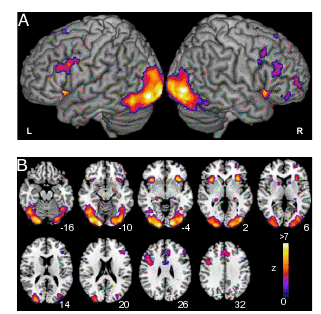
3. Listening to unpleasant sounds (nails on chalkboard etc.)
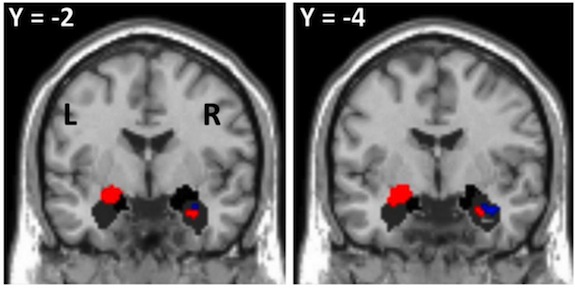
So eliminating human speech from your environment but not hearing (earplugs) itself allows other regions of your brain to become more active than usual, depending on whatever else you may be doing at the time (walking, chopping wood, smelling a flower, scanning the horizon and so on).  Your brain’s performance and how it varies when thinking under conditions of different combinations and levels of sensory stimuli – “crossmodal processing” – is not yet well understood as research is in early stages of investigation.

I will speculate here that what is important for enriching your thinking is that taking your brain out a linguistic-saturated environment (let’s include the “soundless noise” of intruding textual symbols as well from smartphones, iPads, laptops)  gives it an opportunity to operate differently for a time and establish new neuronal network patterns of activity. Various forms of meditation – which involves both silence and an intentional modulation of attention – also  alters normal  brain activity.

I will now go further out on a data-free analytical limb and hypothesize that making a practice of “silence” and/or meditation might improve your thinking by making moments of creative insight more likely. Studies on insight tend to show that as a cognitive event, insight  comes about as a kind of a “pulse” of activity and relaxation in the brain:

….Mark Jung-Beeman, a cognitive neuroscientist at Northwestern University, has spent the past fifteen years trying to figure out what happens inside the brain when people have an insight. Jung-Beeman became interested in the nature of insight in the early nineteen-nineties, while researching the right hemisphere of the brain. Mentions Jonathan Schooler. Jung-Beeman decided to compare word puzzles—or Compound Remote Associate Problems (C.R.A. Problems)—solved. He teamed up with John Kounios, a psychologist at Drexler University, and they combined fMRI and EEG (electroencephalography) testing to scan people’s brains while they solved the puzzles. The resulting studies, published in 2004 and 2006, found that people who solved puzzles with insight activated a specific subset of cortical areas. Although the answer seemed to appear out of nowhere, the mind was carefully preparing itself for the breakthrough. The suddenness of the insight is preceded by a burst of brain activity. A small fold of tissue on the surface of the right hemisphere, the anterior superior temporal gyrus (aSTG), becomes unusually active in the second before the insight. Once the brain is sufficiently focused on the problem, the cortex needs to relax, to seek out the more remote association in the right hemisphere that will provide the insight. As Kounios sees it, the insight process is an act of cognitive deliberation transformed by accidental, serendipitous connections. Mentions Joy Bhattacharya and Henri Poincaré. The brain area responsible for recognizing insight is the prefrontal cortex. Earl Miller, a neuroscientist at M.I.T., spent years studying the prefrontal cortex. He was eventually able to show that it wasn’t simply an aggregator of information, but rather it was more like a conductor, waving its baton and directing the players. In 2001, Miller and Princeton neuroscientist Jonathan Cohen published an influential paper laying out their theory of how the prefrontal cortex controls the rest of the brain. It remains unclear how simple cells recognize what the conscious mind cannot. An insight is just a fleeting glimpse of the brain’s huge store of unknown knowledge.

Another interesting data point to consider re: “silence” and insight is that the mental illness of schizophrenia, where delusions and other mental “noise” exists is significantly negatively correlated with insight.  Researchers are currently investigating if meditation can ease the symptoms of schizophrenia and other mental illnesses.

For myself, I find my best ideas come via insight when I am doing something primarily physical requiring steady but not all of my concentration and I am alone – working out, walking the dog, a household chore and so on. Relatively useful ideas can happen when I am reading or writing or debating (i.e. interacting with a text or a person), but they tend to be analytic and derivative, sort of an intellectual “tweaking” or “tinkering” but not ones that are fundamentally creative or synthesizing.

Lexington Green may be right – Silence is golden.
 

The Battle of Algiers / Black Friday koan

Saturday, November 17th, 2012

[ by Charles Cameron — a tale of two films, two conflicts, two cities ]
.

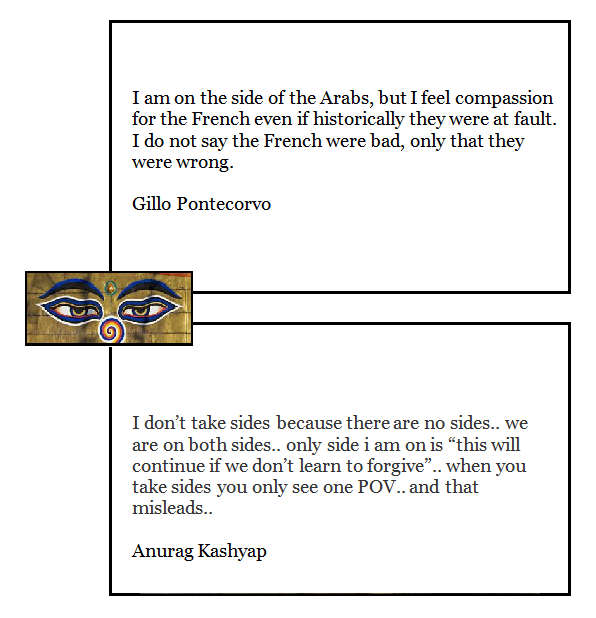
Are these two positions — take one side, take both sides — reconcilable?

That’s the koan, the paradox that’s facing me, after seeing two terrific films by these two directors again, this time back-to-back. The two films their respective directors are discussing are Gillo Pontecorvo‘s Battle of Algiers and Anurag Kashyap‘s Black Friday.

Elie Weisel triggered this set of reflections for me when I saw his stark statement of the “one side” position:

We must always take sides. Neutrality helps the oppressor, never the victim. Silence encourages the tormentor, never the tormented.

Let’s turn to the films.

**

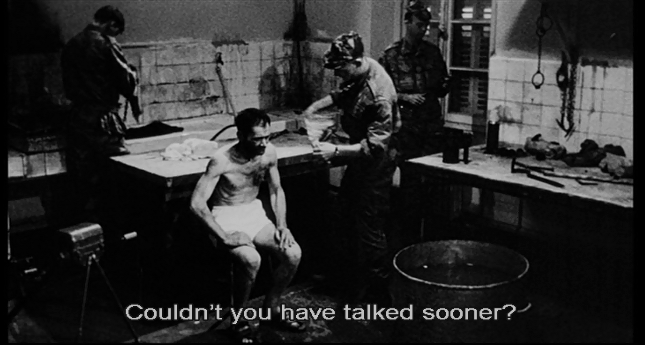
Pontecorvo’s Battle for Algiers is a rightly-celebrated classic, and it’s opening shot confirms the director’s claim to show compassion for both sides:

That’s an unexpected question from torturer to the victim he has just “broken”, and speaks volumes about the director’s intent — as does this quote from the french paratroop commander, Col. Mathieu, speaking of Larbi Ben M’Hidi, a leader of the National Liberation Front (FLN) whom he has captured and questioned — and who in “RL” was in fact murdered, though his death was reported at the time as a suicide:

Pour ma part, je peux seulement vous dire que j’ai eu la possibilité d’apprécier la force morale, le courage et la fidélité de Ben M’Hidi en ses propres idéaux. Pour cela, sans oublier l’immense danger qu’il représentait, je me sens le devoir de rendre hommage à sa mémoire.

For my own part, I can only tell you that I had the opportunity to appreciate Ben M’Hidi’s moral strength, his courage and his loyalty to his own ideas. On that account, and without overlooking the immense danger he represented, I feel obliged to salute his memory.

That reads to me as the respect of courage for courage.

The Pentagon, FWIW, held a screening of Battle for Algiers in September 2003, issuing a flyer indicating their reason to be interested in the film:

How to win a battle against terrorism and lose the war of ideas. Children shoot soldiers at point-blank range. Women plant bombs in cafes. Soon the entire Arab population builds to a mad fervor. Sound familiar? The French have a plan. It succeeds tactically, but fails strategically. To understand why, come to a rare showing of this film.

Yes indeed, it does sound a tad familiar.

**

I’ll represent Kashyap’s Black Friday visually with a pair of images, the top one showing the Babri Mosque in Ayodhya / Oudh, which was leveled in December 1992 by an angry Hindu mob who claimed it had been built on the birthplace of Lord Rama, the avatar of Vishnu whose story is told in the Mahabharata

while the lower one represents Muslim rage at that event, making use of voice-over and that remarkable phrase, “martyred our sacred mosque”, to good effect.

Kashyap, then, can understand the feelings behind the horrific series of terrorist bombings that shook Bombay — as well as those of the bombed and terrorized population of that city. As Oorvazi Irani explains in her commentary on the film, Kashyap’s own views are expressed in the voice of DCP Rakesh Maria in the “chapter” on the interrogation of Badshah Khan:

Badshah Khan very proudly takes credit for the bombings and says Muslims have taken the revenge for the atrocities done to their Muslim brothers. That’s when Kay Kay Menon who plays the cop says and speaks in the voice of the director “…Allah was not on your side, on your side was Tiger Memon. He saw your rage and manipulated you. He was gone before the first bomb was even planted. ..he fucked you over. you know why? Because you were begging for it. All in the name of religion. You are a fucking idiot. You are an idiot and so is every Hindu, who murders one of you. Everyone who has nothing better to do … but to fight in the name of religion is a fucking idiot.”

**

Can there be a right side and a wrong side in a game? There can certainly be a winning side and a losing side — but a right side and a wrong side?

I ask, because the connection between wars and games is an ancient one. Can there be a right side and a wrong side in war? Looking at World War II, which was almost certainly the war that Elie Weisel was thinking of, the answer is pretty obviously yes. But what about the reasons given for “our side” being the right side?

Is our cause just because God is on our side? Because might makes right, and the big battalions are on our side? Or simply because it is our side — my country, right or wrong?

And then there is civil war to consider — for all wars are civil wars, when seen within the context of that greater “nationality”, the human race.

Abraham Lincoln, from his Second Inaugural:

Both parties deprecated war, but one of them would make war rather than let the nation survive, and the other would accept war rather than let it perish, and the war came. … Neither party expected for the war the magnitude or the duration which it has already attained. Neither anticipated that the cause of the conflict might cease with or even before the conflict itself should cease. Each looked for an easier triumph, and a result less fundamental and astounding. Both read the same Bible and pray to the same God, and each invokes His aid against the other. … The prayers of both could not be answered. That of neither has been answered fully. The Almighty has His own purposes…

The whole issue of the just war — or of jihad, its Islamic approximate equivalent — revolves around the question of whether there can be a wrong side in war.

**

If there can be a wrong side, it may be shredded. As Mark Twain once prayed:

O Lord our Father, our young patriots, idols of our hearts, go forth to battle — be Thou near them! With them — in spirit — we also go forth from the sweet peace of our beloved firesides to smite the foe. O Lord our God, help us to tear their soldiers to bloody shreds with our shells; help us to cover their smiling fields with the pale forms of their patriot dead; help us to drown the thunder of the guns with the shrieks of their wounded, writhing in pain; help us to lay waste their humble homes with a hurricane of fire; help us to wring the hearts of their unoffending widows with unavailing grief; help us to turn them out roofless with little children to wander unfriended the wastes of their desolated land in rags and hunger and thirst, sports of the sun flames of summer and the icy winds of winter, broken in spirit, worn with travail, imploring Thee for the refuge of the grave and denied it — for our sakes who adore Thee, Lord, blast their hopes, blight their lives, protract their bitter pilgrimage, make heavy their steps, water their way with their tears, stain the white snow with the blood of their wounded feet! We ask it, in the spirit of love, of Him Who is the Source of Love, and Who is the ever-faithful refuge and friend of all that are sore beset and seek His aid with humble and contrite hearts. Amen.

**

There are things to be said for being on the winning side of a conflict: you get to write history. There may be things to be said for being on the losing side: you gain the sympathy that accrues to the underdog. There are things to be said for supporting neither side, for being on the sidelines to pick up the pieces.

Then again, as Buddha observed in the Dhammapada, there are disadvantages to being on either side —

Victory breeds hatred. The defeated live in pain. Happily the peaceful live giving up victory and defeat.

while Christ muddies the simplicity of the whole business with a further contrarian note:

love your enemies.

Peace is not a bad side to be on, but perhaps love is more nuanced.

**

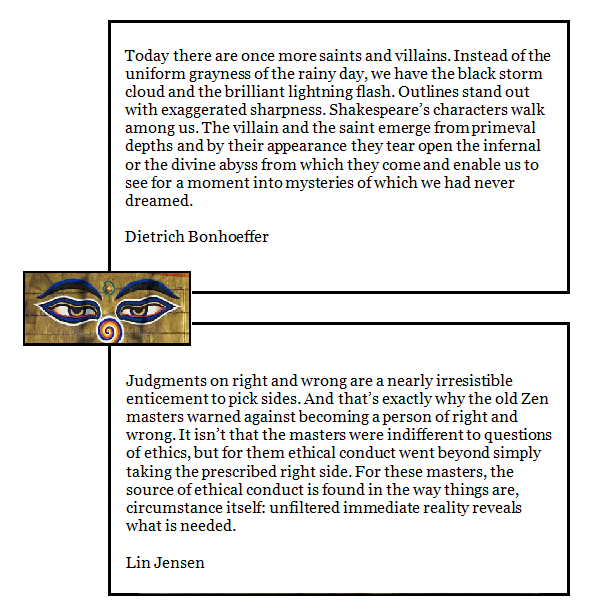
To bring us full circle, here’s another statement of the Elie Weisel position, this time in the words of Dietrich Bonhoeffer, the Lutheran pastor and theologian involved in the plot to assassinate Hitler and executed in one of the concentration camps — together with a response to the question I’ve been posing for myself here which may perhaps providinge some measure of reconciliation, this one from a contemporary Zen Buddhist, someone for whom the appreciation of koans is a way of life:

Does Culture Trump Strategy?

Thursday, November 1st, 2012

The always interesting John Hagel tweeted a link recently to an old post at  Mill’s-Scofield Innovanomics, a blog run by a business strategist and consultant with a science background, Deb Mills-Scofield.

Summer’s Trump Cards 

….Culture Trumps Strategy: The best made plans are worthless if they’re not aligned with the culture. Sometimes the strategy can help transform the culture (for good or bad), but if the culture doesn’t support it, it won’t happen.  Perhaps that’s why I think CEOs need to be CCS’s – Chief Culture Stewards.

Challenge:  Start to check the health of your culture – really, be brutally honest -before the end of August.

This was interesting to me.

Obviously, Mills-Scofield was concerned here with “business strategy” and organizational theory and not strategy in the classical sense of war and statecraft. As Dr. Chet Richards has pointed out, unlike a military leader in war, businessmen are not trying to destroy their customers, their employees or even their competition, but while not the same kind of “strategy”, the underlying cognitive action, the “strategic thinking”,  is similar. Perhaps the same.

So, shifting the question back to the original context of war and statecraft, does culture trump strategy?

On twitter, I had a brief twitter discussion on this with Marc Danziger who was sympathetic to the proposition of cultural supremacy. I am not so sure, though I think the relationship between culture and strategy is an iterative one, the degree to which culture matters in strategy is highly contextual and is determined by how broadly you define cultural values as being directly operative in driving the scenario. Some disjointed comments:

  • Your own cultural-societal worldview shapes politics, policy and politik. So indirectly, culture will be a determining factor in conceiving “Ends” worth spilling blood and dying for – particularly in wars of choice. When war, especially existential conflict is forced upon a state by an enemy attack, some of the initiative and room for constructing artful or limited “Ends” has been lost and becomes secondary to survival. Even Stalin’s normally overweening and murderous ideological preferences mattered somewhat less in Soviet policy and strategy the day after Operation Barbarossa began than the day before.
  • If the Ends in view imply forcing a political settlement upon the enemy – “compelling him to do our will” – than the enemy’s culture matters a great deal. All the moreso, if the war entails COIN, military governance of an enemy population and reconstructing an enemy state to our liking. The enemy culture is part of the operational environment because our use of military force (destruction) is going hand in glove with substantial political activity (construction) – mere physical control of the population is not enough, though it is a precondition for success. MacArthur’s role as SCAP in post-war Japan demonstrated an exceptionally shrewd blend of coercion and concession to traditional Japanese cultural touchstones.
  • If our Ends are much more limited – degrading enemy operational capacity and/or simple, spasmodic, punitive expeditions to impose costs on an enemy state or entity in retaliation for aggression; or, if we intend to stand off-shore and strike with air and naval superiority – than the enemy culture matters far less. Force is being used to “bargain” at a very primitive level that does not require much cultural nuance to understand and the message of “we will hit back” . Likewise, if the war is an unlimited one of extermination and Carthaginian peace, enemy culture matters far less than your military capacity to execute your strategy.
  • Your cultural worldview shapes your grand strategy or statecraft because great and lesser powers are not coldly playing chess for material interests alone when they engage in geopolitical conflict and warfare but are establishing, evolving and protecting a national identity on the world stage. What Thucydides called “Honor”, the British “Paramountcy”, Richard Nixon “Credibility” and Joseph Nye “Soft Power” may all have been intangible expressions, difficult to quantify, but are very much part of the strategic calculus of war and peace.
  • Finally, it is important to note that strategic employment of brute force has a large role in setting the parameters of where and when cultural nuance and interpretation matter and exercise political leverage during war. Extreme violence disrupts and warps the cultural norms of belligerents, usually for the worse. It was the wars of the French Revolution and Napoleon that awoke the romantic pan-German nationalism of the 19th century that eventually united Germany and transformed it into the terror of the world in the 20th. The First World War ushered in a century of ideological monstrosities and revolutionary state terrorism on an epochal scale of murder unequaled even by the butchery of the Romans or Mongols. War is often the Abyss that looks into you.

Thoughts?

Graphic matches?

Thursday, September 27th, 2012

[ by Charles Cameron — Netanyahu’s UN speech, Jyllands-Posten cartoon, a nifty film technique, and is there an echo there? ]
.

**

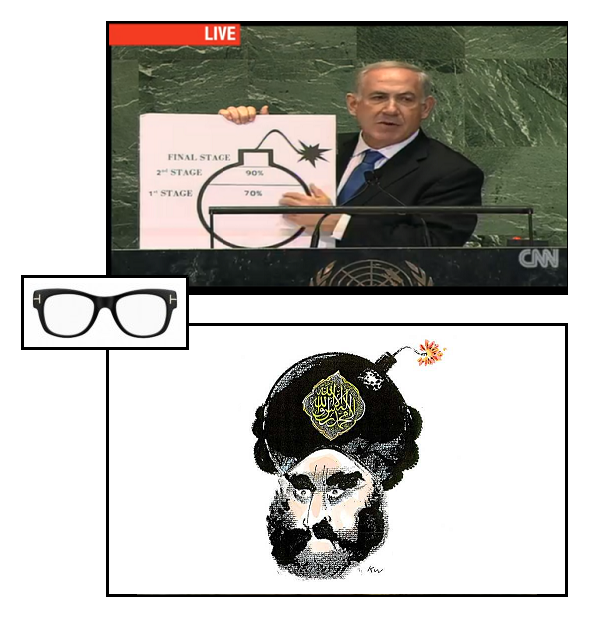
A fair number of people have commented on Israeli PM Netanyahu‘s displaying a cartoonish bomb graphic in the course of his UN address today, and some have complained, fairly IMO, at the choice of photo used to depict Netanyahu during his speech by eg Fox News:

I think it’s important to read graphic messages closely for the cues they contain.

**

Sometimes, as with images of the Virgin Mary seen in grilled cheese sandwiches or oil slicks, the correspondences don’t really mean much more than that the brain is designed for pattern recognition, and a little “imagination” without critical appraisal can get things wrong: the terms commonly used for this are apophenia, patternicity and pareidola.

My own favorite example of this phenomenon is of the wall-stain in a school in the East Bay that was recognized as the Virgin Mary by Catholics and the bodhisattva Kuan-Yin by Buddhists

Nonetheless, I’m reluctant to ridicule such modes of perception without also recognizing the utility of Rorschach blots in psychology and the even more creative uses to which Leonardo put them.

**

Perceived visual similarities, in short, can be the result of creative or merely overheated imagination, but in the visually sophisticated they become much more.

Film-makers, in particular, have several names for the kind of skillful editing by which one scene segues into another via a well-chosen visual similarity: match cut and graphic match.

My personal favorite example is that of Apocalypse Now, where the rotors of the fan in that claustrophobic hotel room in Saigon morph into the rotors of the helicopter coming to take Captain Willard out and away on his mission up river…

Perhaps even more celebrated, though, is Kubrick’s match between the bone tumbling through the air and the space station tumbling through space, in 2001: A Space Odyssey:

**

To get back to Netanyahu, then — is his hand held out a little above vertical, palm down, really a Hitler salute? I think not.

And does his image of a bomb carry any resonance from the Jyllands-Posten cartoon? I have to admit I’m almost undecided on that one.

And if there’s just a hint of a correspondence, would it be conscious or unconscious?

**

The thing is, politicians have to be extremely careful about tossing graphic matches onto dry kindling.

To my own way of thinking, both Netanyahu’s “cartoonish bomb” graphic and his “mid-heil” salute are potential fodder for incautious speculation — but neither one is even remotely as far-fetched as Jerome Corsi‘s claim in a recent WND that a recent Obama campaign use of the Stars and Stripes (above, upper panel) — in admittedly terrible taste — suggests that Obama in any way favored the decease of Ambassador Christopher Stevens in Benghazi (lower panel).

**

My point here, as so often, lies not in any political content or conclusion, so much as in a general purpose invitation to persons of intelligence (and a fortiori, intel) to watch out for possible graphic matches, to make close and cautious readings of visual as well as textual data — in short, to take a closer look

Twenty-Nine Articles

Tuesday, September 18th, 2012

SWJ Blog has a new post up with an important and all too timely article on transition operations whose authors include an amigo of mine, Pete Turner, a veteran of Iraq and Afghanistan. Turner will also be one of the featured speakers at the Boyd & Beyond Conference in October at Quantico:

Transition Operations: A Discussion with 29 Articles by Richard LedetJeff Stewart and Pete Turner 

….What is Transition?

Currently, there is no accepted definition for Transition in US Doctrine.  For the purpose of this discussion, we will define Transition simply as the transfer of responsibility from Supporting Nations (SN) to the Host Nation (HN). 

How do we go from full-speed-ahead COIN operations where we call all of the shots to a fully functioning sovereign nation that provides security and services for its population?  Although we have concluded one Transition (Iraq) and are in the midst of another (Afghanistan), we are still literally feeling our way forward, one unit at a time, without a coherent strategy, doctrine, or national policy.  Battalion and Company Commanders want to know, “What comes after build?”

As previously stated, our doctrine is remarkably silent on Transition.  FM 3-24 Counterinsurgency acknowledges the requirement for Transition in the late stage of counterinsurgency:  

“The main goal for this stage is to transition responsibility for COIN operations to HN leadership.  In this stage, the multinational force works with the host nation in an increasingly supporting role, turning over responsibility wherever and whenever appropriate.  Quick reaction forces and fire support capabilities may still be needed in some areas, but more functions along all Logical Lines of Operations are performed by HN forces with the low-key assistance of multinational advisors.  As the security, governing, and economic capacity of the host nation increases, the need for foreign assistance is reduced.  At this stage, the host nation has established or reestablished the systems needed to provide effective and stable government that sustains the rule of law” (paragraph 5-6).

That is the sum total of the guidance given in our counterinsurgency manual.

Transition thus appears to be rather nebulous; it is something we desire and anticipate, but do not necessarily know how to achieve, or even understand.  It may occur quickly, or be drawn out over an extended period of time.  Like other operations in COIN, Transition will also occur differently in different locations, with various requirements and assorted timelines.  Our own relief in place/transfer of authority (RIP/TOA) process even affects Transition.  How do we maximize effects at this point, especially considering that the level of international effort is simultaneously in decline?  What are the requirements for Transition, and what is the glide path to a smooth successful hand-off to the host nation?  Is it a phase that comes after “Hold,” or is it part of the “Build” phase, both of which occur sequentially after “Clear?”  One might also argue that once “Transition” has begun, the COIN fight is over for SN forces and the responsibility shifts to the State Department or the UN.  Or does it?  

There is no simple way of answering these questions, or the others which are raised throughout this paper.  The answers may change with each particular case.  However, without a dialogue on the subject these questions will continue to go unanswered and operations are likely to proceed with uncertain or frustrating results. ….

Read the rest here.   I am a particular fan of points 3,4,5,6 and 9.

And now, we interrupt this post for a…….

Public Service Message:

If you enjoy discussions like this one and think that SWJ and SWJ Blog are an important forum for debate on key defense and strategic issues, they could really use your financial support:

Small Wars Foundation Annual Fundraising Campaign

The Small Wars Foundation / Journal / Council’s annual fundraising campaign is now underway and this is easily the most critical funding effort we have conducted since going hot in 2005. We originally envisioned quarterly campaigns but quickly realized that we were likely over-tapping the hard-core few who have kept our head above water all these years. Well, we are currently on life support in many aspects of our operations to include day to day operating costs, upgrades to the site, and providing at least a meager compensation to those who work 24/7 to keep our humble contribution to our Nation’s security and foreign policy alive and well.

There are many ways to support SWF/SWJ and they can be found here. But what we are most in need of right now is hard cash, the more the better. We have over 200 of our popular Small Wars Journal challenge coins remaining and will get one off to those who donate $50 or more or commit to a $25 a month recurring contribution. Donation options are available at the same link.

And for US contributors – your donation is tax deductible. Last year our goal was to raise approximately $20k but we fell far short of that. Our goal this year, and a very optimistic one at that, is $30k and we will keep you posted on our progress. Thanks in advance in helping keep this effort alive and well.


Switch to our mobile site