Tuesday, July 19th, 2011
Doing some heavy duty research…..Amazon will be doing well this year on my dime:


Architect of Global Jihad by Brynjar Lia
A Terrorist’s Call to Global Jihad by Jim Lacey
Modern Strategy by Colin Gray
Posted in 20th century, 21st century, 4GW, academia, arab world, authors, book, Clausewitzian, COIN, counterinsurgency, DIME, ideas, insurgency, intellectuals, islam.insurgency, islamic world, islamist, strategist, strategy, Strategy and War, Tactics, terrorism, The Project, theory, war | 18 Comments »
Tuesday, July 5th, 2011
Wilf Owen, noted Clausewitzian and Editor of Infinity Journal has a provocative new piece up at SWJ Blog:
Killing Your Way to Control
The population is not the prize. The population are the spectators to armed conflict. The prize is the control the government gains when the enemy is dead and gone. Control only exists when it is being applied, and it exists via the rule of law. The population will obey whoever exercises the power of law over them. Power creates support. Support does not create power. This is the source
of great confusion.
….In general terms killing the wrong people (civilians) may undermine the political objective being sought. Whether it does or does not will be the policy context. How proportionately, precisely or discriminately lethal force is applied will be dependant on the tactics employed. Thus Rules of Engagement (ROE) are those limitations on lethal force and military activity that armed forces use to ensure that force does not undermine policy.
….All the new counter-insurgency theorists concede, some killing is required but to quote FM3-24 while necessary, especially with respect to extremists [killing] by itself cannot defeat an insurgency. Again this makes no sense, unless as part of a defence mounted to preserve the idea that you cannot kill and capture your way to success. Those who are extremists do not become apparent or may not even exist until the ranks of the enemy have been thinned by death, desertion and surrender. Until lethal force is focused on the enemy, the extremists may not be apparent, and who is and is not an extremist is irrelevant if they are clearly armed and thus a legitimate target within the ROE.
Killing and capturing are important, because lesser forms of operation aimed at disrupting or dislocating while useful, may allow the enemy to survive. Dead and captured cannot return at some later date to re-contest any issue they see fit. Warfare against irregular forces is won in a similar way to warfare against regular forces. The only major differences is that force usually has to be employed far more precisely, discriminately and proportionately. This is because lethal force will be applied close to or within a population that you are politically/legally required to protect. The other difference is that lethal force will be focussed at the individual level. This is a general distinction from that of fighting regular forces where operations would seek to defeat units and formations in part or as a whole.
The case of Algeria, during the 1990’s with the battle between Islamist rebel-terrorists and a radical Arab-socialist dictatorship provides some support for Owen’s ideas regarding killing and the separation of opponents into extremists and moderates. The government, which applied force with minimal constraints, did succeed in killing off the leadership cadres of the FIS, GIA and MIA faster than they could be properly developed, leaving leadership in the hands of either younger, more radical but less experienced men or causing the groups to accept government amnesty.
Algeria of course enjoyed several advantages that the West lacks in places like Afghanistan – the Algerian rebels were isolated from the outside world and enjoyed minimal foreign support and the Algerian dictatorship conducted operations without regard to the laws of war in a media blackout, getting a pass from the international community because the behavior of the rebels was even worse. In Afghanistan, the center of gravity of the Taliban movement is the support of Pakistan’s ISI whch is using them as proxies to drive ISAF out of Afghanistan and the kind of punitive raiding into Pakistan to decimate Taliban manpower is forbidden by policy.
ADDENDUM:
Spencer Ackerman offers a spirited rebuttal to Wilf Owen:
Please, God, No More Stupid Anti-Counterinsurgency Arguments
…. Where to begin. Sometimes, as in nearly all counterinsurgency fights, the counterinsurgent cannot easily distinguish the insurgent from the civilian. That’s not always because of poor tactical intelligence or ignorance of a foreign culture. It’s because the guy who gives his old cellphone to his cousin so his old neighborhood friend can use it to construct IEDs for the guy paying a good going rate — quick, is he an insurgent or not? If you can’t immediately answer, Owen’s argument falls apart.
Even if you unflinchingly decide the guy’s an insurgent, killing the guy can easily inspire the whole neighborhood to rally to the insurgents’ cause. Quick: do you kill the guy so you can approach the Magic Number of dead insurgents that assures you victory? Or does not killing the guy take you further away from the Magic Number?
I know, I know. Counterinsurgency is OVER. Whatever context, wisdom or experience led people to consider it a least-bad option ought to be ignored. Its unsuitability for Afghanistan has rendered the entire enterprise inert. What, you didn’t read that National Journal piece?
My only comment here is that Pop-centric COIN is only one brand of COIN that fits some situations better than others. I suspect much of the time in the near future, US military forces will be limiting themselves to FID, largely for budgetary reasons, and the host nation may see COIN differently than our current doctrine prescribes.
Posted in Clausewitzian, COIN, counterinsurgency, ideas, Infinity Journal, insurgency, intellectuals, military, small wars journal, strategy, Strategy and War, strategy swj, swj blog, Tactics, terrorism, theory, tribes, war | 52 Comments »
Wednesday, June 22nd, 2011
The real value was in the comment thread. Original post here.
That caused Joseph Fouche to post Overgrown Comment, Short Post from which I will excerpt relevant comments from JF, Dave Schuler and Seydlitz89:
Dave Schuler comments:
I think that the Obama Administration’s actions are less an instance of only an indirect relationship between means and ends than a disagreement with you on ends, Mark. Just as one example, the primary objective of the Obama Administration (as in all administrations) is a second term. Consider the actions through that lens.
Also, isn’t it possible that the Administration is really sincere about the “international support” trope that marked the Libyan intervention? International support will never be forthcoming for intervention against the Syrian regime. I don’t think that either the Russians or Chinese would stand for it. The Russian relationship with Syria at least is much cozier than that between Russia and Libya.
Noted Clausewitzian seydlitz89 comments:
Zen-
Good thought-provoking post, you actually got me out of my hiatus from blogs/blogging, just don’t tell anyone over at milpub ;-)>
While I agree with Joseph’s comment, I would add a few other points to consider:
First, “strategy”, is a specific concept in terms of strategic theory which can be linked to “strategic effect”, but not necessarily so. Force and personality alone (which are not “strategy” the way I define it -see http://milpubblog.blogspot.com/2010/11/when-strategy-is-not-strategy.html) can achieve strategic effect. So we need to be clear how we are using this particular adjective, which need not be linked to a specific strategy at all. Also the strategy in question might be bad, even self-defeating, as Joseph points out and still be a strategy.
Second, when has our Middle Eastern policy ever been consistent, in terms of treating all countries the same? Perhaps under Bush I during 1990-91, but we have always treated the different Arab countries differently in line with our different interests involved. Bahrain gets a pass, whereas Libya gets NATO intervention, and Syria gets referred to the ICC . . . In each case the US interest is seen as different so the response is different.
Third, the real root cause of the problem is imo our dysfunctional political system which is unable to implement policies which are in the best interests of the country as a political community. The Iraq war was essentially a collapse of US strategic thought and rather was based on narrow and corrupt interests, deceptive politics and notions of unlimited US power (force) and exceptionalism (personality) which triggered a still ongoing strategic disaster for US interests in the region, but not limited to it.
We have a long way to go and I don’t see us getting there any time soon, unfortunately.
The Committee comments posts:
Scottish historian Niall Ferguson, just before transmogrifying into Scottish celebrity historian Niall Ferguson, proposed an approach that serious credentialed historians could use if venturing to write the generally silly and uncredentialed genre of counter-factual history:
To produce serious counter-factual history that is not utter bollocks, your point of departure from our factual timeline has to be a documented and real credible alternative raised by a documented and real credible person at a documented and real point in time prior to the moment when factual and the proposed counterfactual timelines diverge.
As Dave Schuler alludes, how Zen, I, or seydlitz interpret what is strategic, what is astrategic, and what is antistrategic is often determined by what we individually interpret as political, apolitical, or antipolitical. We put events in boxes and eventually there is a box beyond which we do not stray because we don’t know this outer box is there. We can perhaps use Ferguson’s approach to separate which of the Administration’s factual alignment of ends to means are impossible and which are merely improbable and which of our various counterfactual alternative alignments of ends to means are impossible or merely improbable.
….I’ll close my observations on this post and its comment thread with two points:
- Whatever framework you use to analyze human actions, especially those actions your framework categorizes as war or conflict, it should be equally capable of shedding light (and defining) “good” or “successful” actions and “bad” or “failed” actions. Categorizing one lump of actions as Actions while excluding another lump of actions as less than actions does not a good framework make. For those frameworks that aspire to pass as “strategic theory”, this means that they should be just as capable of analyzing Hitler’s strategy of dividing Germany into bloodied, burned out, and thoroughly wrecked fragments occupied by foreigners as they are of analyzing Bismarck’s strategy of creating a unified and independent Germany. A proposed strategic analytic framework that accepts some strategic phenomena into the garden of strategy while consigning others to the outer darkness of non-strategy does serve a useful purpose. Strategic effect rains on both righteous and wicked alike. Neither can be barred from opening an umbrella to shield themselves from strategic fallout because an observer runs up and commands them to stop because theory forbids it. One of the fundamental principles of strategic theory is that theory cannot absolutely forbid umbrella opening: the umbrella opener will inevitably seek to subvert any theory that seeks to unnaturally restrict their freedom to open umbrellas.
That was very interesting and thought provoking. I have, in fact, thought about these comments for several days and I do not have a neat, plausible rejoinder so much as some thoughts in regard to epistemology, which is the level where this discussion really is taking place.
Dave, I think, is correct that are a jumble of motivations in play within the Obama administration, not least of which is the overriding focus of domestic politics in an administration where the national security and foreign policy apparat is heavy with politicos. There is an internationalist faction in the administration too, though they are hardly dominant. They win some and lose some. Incidentally, most administrations, from transcripts and memoirs I have read operate in a state of crisis management much of the time – tightly focused sessions like ExComm during the Cuban Missile Crisis are exceptions. Oval Office convos and meetings as a rule, ramble like meetings do everywhere except when the POTUS (like Eisenhower) demands otherwise.
So, is it proper to categorize this behavior as something other than strategy? Yes – at least when you want to discern conscious strategic thinking about geopolitics and military operations, or absence thereof, you’d refer to what the administration is doing currently as “politics” insofar as their eye seemed to be primarily concerned with domestic political effects rather than strategic effects in the international arena. Strategy requires conscious effort because it is pro-active and often, what passes for strategy is brilliantly intuitive tactical reactions coupled with a fair piece of luck that generated fortunate outcomes that were strategic in their effect, if not intent.
I am pretty much in agreement with Seydlitz89 that the root of our inability to think and act in a strategic fashion is our dysfunction as a political community and his caution regarding strategic effects. There’s a number of reasons for this dysfunction but even if that was instantly remedied by the Good Civics Fairy, we would have to make a conscious effort to build a rational strategic culture.
Regarding Joseph Fouche’s comment on frameworks, he has a logical point regarding strategic theory that works….in theory. By that I mean that I don’t disagree, he’s right in the abstract sense that such a comprehensive and consistent structure would be preferable. My impression though – and I think this is in line with what he is arguing above – is that strategic theory as a field itself may not be quite up to the high standard to which Fouche aspires. Strategic theory in practice, rarely demonstrates the concise elegance of Newtonian physics. In terms of explanatory power, strategic theory used by practitioners or created by modern day theorists rarely rises beyond being situationally “good enough” for the problem at hand. An intellectual tool, like a sharp rock or a pointy stick in the fist of a paleolithic hunter-gatherer. For that matter, if strategic theory proves to be situationally accurate and useful, that is often a cause for celebration!
Going beyond “good enough” to “universally” or “generally” applicable strategic theory is an intellectual feat of the first order. That kind of system -building is usually the result of a life’s work and cannot be called into being on a moment’s notice. Aside from the fact that most people are not capable of rising to becoming a Clausewitz or Sun Tzu, the time constraints make it impossible for state decision makers to think and act within such a framework unless they have arrived into office with one already inculcated as part of their worldview (and even then, it is of great help if they spent years out of office thinking through real and hypothetical problems using that framework, internalizing the principles without losing the ability to observe and think critically). This is why in matters of strategy, our decision makers are usually wielding the intellectual equivalent of stone tools – the statesman with the cognitive flintlock musket or strategic steam engine is few and far between.
So, we are often left with a fractured mess, analytically speaking. Entrails to root through, looking for signs from the gods.
Posted in Clausewitzian, cognition, counterintuitive, democracy, Epistemology, geopolitics, ideas, intellectuals, metacognition, national security, politics, psychology, scenario, social science, society, strategist, strategy, Strategy and War, synthesis, Tactics, theory, Uncategorized, war | 5 Comments »
Sunday, June 12th, 2011
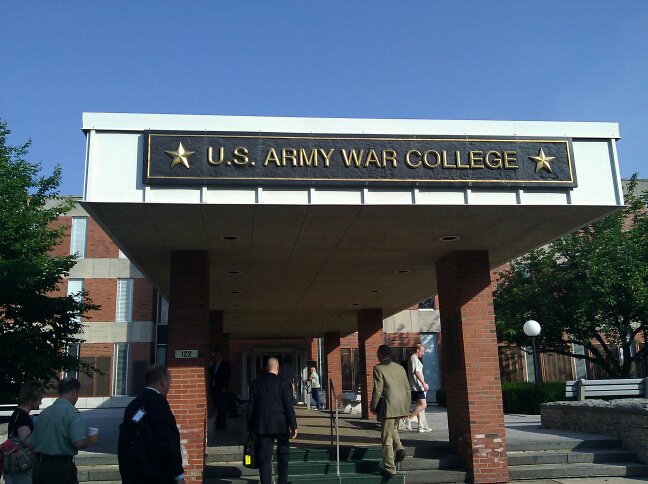
As noted previously, I was fortunate to attend the National Security Seminar at the the US Army War College this year and wanted to relay my impressions while they were still fresh.
First, in terms of reception and cordiality, I have rarely experienced such an extensive and personal outreach as was demonstrated by the War College staff, faculty, administration and students. Every new member had a “sponsor” – a student, usually a colonel or Navy captain, who acted as a liason and personal guide from the time their plane touched down until the moment they returned to the airport. My sponsor, the former commander of the Wolfhounds, Colonel Richard “Flip” Wilson, whom I consider a friend, really extended himself on my behalf, making me feel welcome and a full member of Seminar Group 20. Most of the students have multiple tours of duty in Iraq and Afghanistan under their belt and many can report the same for the first Gulf War, Panama, Bosnia or Kosovo.
The War College, the Commandant and the Seminar Group all hosted receptions and dinners designed to get students and civilian new members to mix and further discuss issues raised in the seminar sessions or lectures. At these events I had the opportunity to meet and talk to the leadership of the Army War College including the Commandant Major General Gregg Martin, the Deputy Commandant for International Affairs, Ambassador Carol Van Voorst, the Executive Director of the Army Heritage Foundation, Mike Perry, the Director of SSI, Dr. Douglas Lovelace, the Chief of Staff and numerous faculty and seminar members. The New Members such as myself were exceedingly well fed at these events as I suspect the Army was attempting to prove that it really does march on it’s stomach.
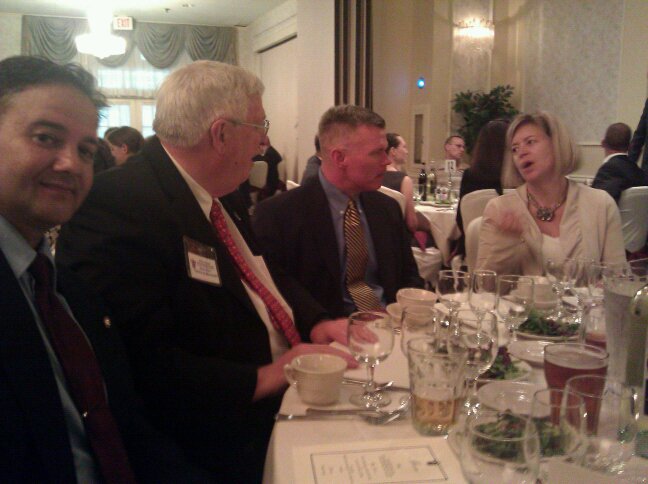

The serious business of the National Security Seminar was divided into two segments, the talks given by distinguished speakers to the entire class of 2011 and the New Members and the Seminar Group sessions of approximately twenty students, New Members, academics and foreign visitors. We received a brief on the war in Afghanistan from the ISAF Chief of Staff, who was standing in last minute for General Petraeus who was called to meet with senior adminstration officials; and a very interesting concluding talk by Foreign Affairs Editor Gideon Rose, author of How Wars End, which covered issues of strategy, grand strategy and the disconnect with policy.
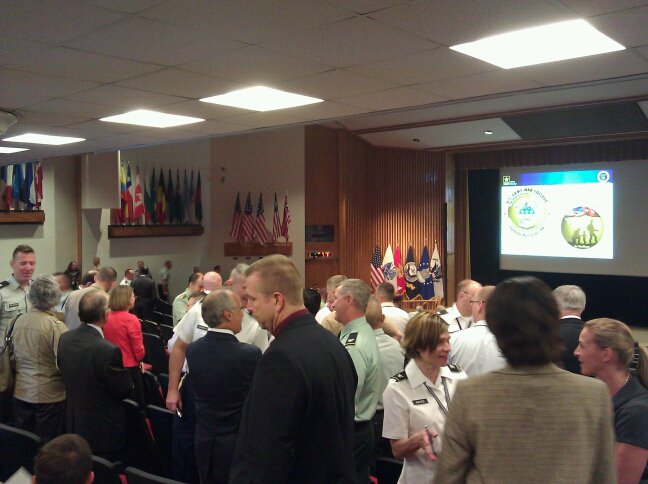
The National Security Seminar is run strictly on a non-attribution basis, in order to encourage candor and frank exchange of views, which handicaps my ability to discuss specifics here. I can say that my views on Pakistan ( which I compared to “North Vietnam” ) riled more than a few people – Pakistan is the only country in the world given 2 exchange student slots at the Army War College at the request of the most senior leadership of the US Army – and several students and faculty members took the time, outside of seminar sessions, to make certain I heard countervailing POV regarding Pakistan’s value as an ally. Other topics included, but were not limited to:
Defense budget cuts and force structure
Narco-cartels in Mexico: Insurgency or No?
Civil-Military Relations
Repeal of DADT
AfPak War
al Qaida and GWOT/US Strategy
COIN
Critical thinking and Leadership
Logistics
Libya and NATO
AWC Strategy Curriculum/Program
What the US public expects from their military
China as a peer competitor
Effects of ten years of war on officer corps/military
Illegal combatants and international law
PTSD
Battle of Gettysburg and Grand Strategy
Cyberwar
Differences in Armed Services strategy, command climate, discipline, leadership
The Arab Spring
US Global leadership and Economics
Interagency Operational jointness
Most of the discussion took place in the seminar groups, with Q&A periods in the mass sessions with featured speakers. I came away deeply impressed with the seriousness and insights as practitioners that AWC students brought to the table. The AWC strategic studies program seeks to broaden students who are assumed to arrive with tactical expertise and prepare them for higher command that carries operational, strategic and even policy responsibilities (at least in terms of interpreting and executing within policy guidelines). Many students were articulating ideas associated with Thomas P.M. Barnett, the “mission order” and “commander’s intent” style of leadership or Clausewitzian strategic premises during debates and discussion.
The National Security Seminar Week was for me, an enlightening and exceptionally enjoyable experience, one I would highly recommend to readers who may have such opportunities in future years.
Posted in 19th century, 2011, 20th century, 21st century, 3 gen gangs, 4GW, academia, Afghanistan, Air Force, al qaida, America, army, barnett, Clausewitzian, cognition, COIN, counterinsurgency, Cyberwar, defense, DIME, diplomacy, diplomatic history, education, Epistemology, foreign policy, government, historians, history, ideas, insurgency, intellectuals, intelligence, leadership, metacognition, military, military contractor, military history, military intelligence, military reform, national security, Network-centric Warfare, organizations, security, social science, strategist, strategy, Strategy and War, Tactics, theory, war, warriors | 12 Comments »
Saturday, June 4th, 2011

In a few days, I will be headed to the US Army War College to become a new member of their National Security Seminar, an honor I owe entirely to the kind offices of Dr. Steven Metz, as Big Steve saw fit to nominate me. Once at Carlisle, I will have the opportunity to participate with AWC students in a variety of sessions and discussions related to national security and strategy and hear speakers who are top experts in their field. The keynote, if I understand correctly, will be given by General David Petraeus. The liason assigned to me, Col. Richard “Flip” Wilson, has been gracious and friendly and I am very much looking forward to visiting the War College, meeting new friends and learning a thing or two.
My blogging here at ZP may be erratic next week, though Charles and Scott will carry on in my absence, but I will try to put up a few items or pictures as time and internet connectivity permits. Twitter may be a much better bet for frequent updates and I can be followed @zenpundit for readers who are interested.
Posted in 4GW, army, blogging, Clausewitzian, COIN, counterinsurgency, government, military, national security, steven metz, strategy, Strategy and War, Tactics, war, warriors | 8 Comments »


