zenpundit.com » visualization

Archive for the ‘visualization’ Category

Robert Scoble on “Revolutionary” Apps that Fuse TV, Streaming and the iPad

Thursday, April 14th, 2011

Scoble claims AirPlay will be on par with the advent of RSS.

Oddly enough, when I first got an iPad my first thought was to find a way to stream it through an LCD projection system at work through our network ( giving the IT department much cause for amusement). Now I am wondering if the AppleTV device and/or AirPlay will get this idea off the ground….

Comments from the technophile-geek portion of the readership are cordially invited.

Martyrologies and the Undead

Saturday, April 9th, 2011

[ by Charles Cameron ]

*

How things stay the same, and change!

quo-martyrologies.jpg

The first book cover is that of Abdullah Azzam‘s account of miraculous events associated with shahids / martyrs among the mujahideen in Afghanistan during the fight against the Soviets, while the second is a Dar al-Murabiteen Publications compilation of stories of jihadist martyrdom. In effect, they are both devotional propaganda items, using the deaths of the fallen to inspire the actions of the living:

And call not those who are slain in the way of Allah “dead.” Nay, they are living, only ye perceive not.

Qur’an, 2. 154.

Two shifts are worth noting between the two of them:

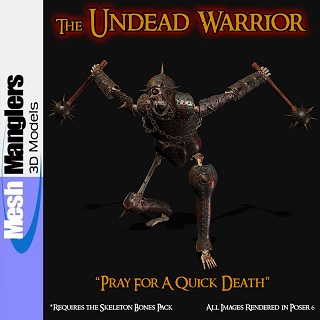
First, the Dar al-Murabiteen cover design betrays an awareness of the pop-cultural ubiquity of the undead meme – whether it’s applied in books, games or films, to vampires or zombies… as exemplified here:

undead-warrior-model.jpg

Second, the shift from a classic Islamic to a pop cultural title is accompanied by a shift from a local to a lunar graphic background and from a contemporary armored vehicle silhouette to a silhouette of a mythic horseman-warrior…

The Dar al-Murabiteen effort is thus both more contemporary and more archaic — hip and contemporary to catch the attention of western youth, archaic and mythic to give resonance to the idea that the glorious past, the past of Saladdin, the past of Ali, is lived again in present reality.

That’s master narrative in the form of imagery.

Of the Mahdi and the Matrix

Saturday, April 2nd, 2011

[ by Charles Cameron ]

*

There’s a book by Douglas Harding that I very much doubt Samir Khan has read, which may still be relevant to the ad in Inspire #4 that Jarret Brachman pointed to in this piece on Cronus Global — in which he notes the parallel between Inspire‘s ad featuring the choice between paradise and hell, and the choice featured in The Matrix between the blue and red pills…

jarret.jpg

That image, with its headless figure, put me in mind of another image that greatly interests me — a portrayal of the Imam Mahdi by Mahmud Farshchian — so I rescued it from my files to see if it was a good enough match with the ad for me to suggest a possible second graphic influence to Jarret:

16_imam-zaman2.jpg

Not surprisingly perhaps — considering that Samir Khan’s work is, putting it crudely, an advertising graphic, whereas Farshchian’s is a work of devotional art, and that furthermore Inspire is a Salafi-jihadist journal while Farshchian is a pious Shi’ite — the match isn’t close enough for me to argue influence…

But it did set me thinking.

*

The title of the Harding book to which I referred above is On Having no Head, and although it now carries the subtitle Zen and the Rediscovery of the Obvious it actually draws on Islamic traditions quite a bit, quoting Rumi:

Behead yourself! … Dissolve your whole body into Vision: become seeing, seeing, seeing!

and Attar:

Cover your breast with nothingness, and draw over your head the robe of non-existence.

and proposing — I’m putting this into my own words, now — the notion that the physical form of a human face is in some sense no more than a mask, veil or hijab over that light “which lighteth every man that cometh into the world” (John 1.9) — a light too profound for the conventional gaze.

And it is this profundity, attributed in Islam to the prophets in general and superlatively to Muhammad, which makes their literal portrayal a matter of some controversy…

*

Farshchian’s Imam Mahdi, like Khan’s Islamist Morpheus, is headless, I’m suggesting, because, to speak figuratively, radiance has taken the place of the face.

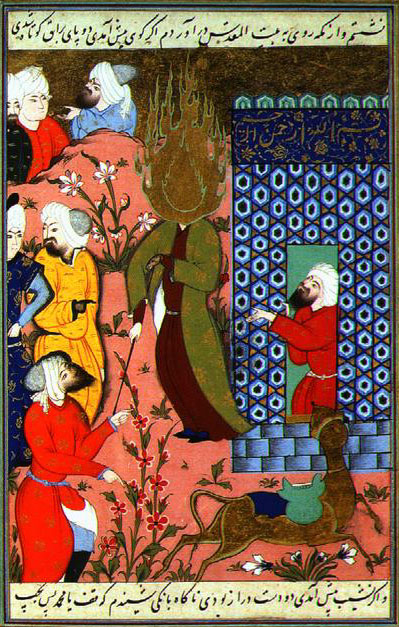
Which is also why, in this image of what must be for Muslims one of the holiest nights in the history of the world, the Night of the Mi’raj, the Prophet is portrayed without a face — or veiled — in this Persian miniature:
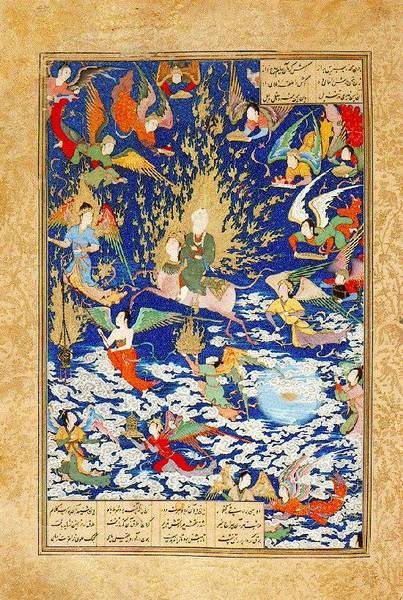
miraj_by_sultan_muhammad.jpg

and transfigured by his own fiery “halo” of illumination in this one:
muhammad_miraj1.jpeg

Of the tsunami and Mt. Fuji

Friday, April 1st, 2011

[ by Charles Cameron — cross-posted from ChicagoBoyz ]

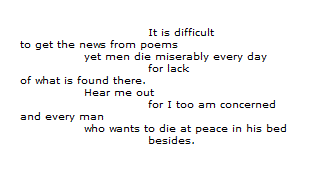
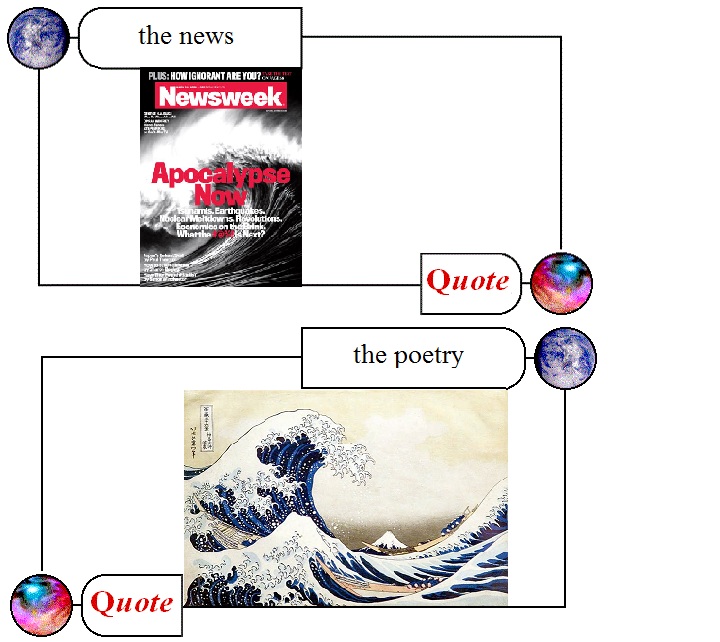
I’ve been thinking quite a bit about William Carlos Williams and his observation in Asphodel, That Greeny Flower:

Our news media blare with (apocalyptic but not revelatory) trumpets…

while Hokusai, painting circa 1831, conveys the vulnerability of the (Japanese and human) situation with his image of boats in a storm.

*

Here’s Dr. Barnett, in my own transcript of his video this week:

The surprise factor here really shouldn’t exist in our minds. I mean the mega-disaster of a tsunami plus and earthquake plus a nuclear meltdown in Japan – well, those three are already highly linked. Japan highly depends on nuclear power, it’s one of the most seismically active island chains in the world, and tsunami is a Japanese word. So if you are going to put a forty year old very aging early technology nuclear power plant right on the coast in Japan, the only mega-disaster you’re going to get there is an earthquake-triggered, tsunami-delivered nuclear meltdown. So these are not surprising connections, we’re just bumping into the connectivity that’s natural and only becoming more expansive as globalization advances.

That’s exactly right – and Hokusai should have been an early warning.

The only thing missing from Barnett’s analysis, and present in Hokusai, is Mt. Fuji – or what TS Eliot (to circle back again to “verbal” poetry) would call “the still point of the turning world”.

Rationality: Saw this on Facebook

Thursday, March 17th, 2011

Hat Tip to Dan F.

flowchart-to-determine-if-youre-having-a-rational-discussion-e1300206446831-634x882.jpg

If only…..


Switch to our mobile site