zenpundit.com » Apocalyptic

Archive for the ‘Apocalyptic’ Category

The Profession

Saturday, June 18th, 2011

The Profession by Steven Pressfield 

My friend Steven Pressfield has a new novel out, one that touches on many themes and issues discussed here at ZP, SWJ Blog, Global Guerrillas, Feral Jundi and the rest of this corner of the blogosphere. Sometimes fiction can be a lot more fun 🙂

You can read the first chapter here.

Will have commentary and review at a later date.

Pundita on Mexican Insurgency and Hollowing Out America

Wednesday, June 15th, 2011

Blogfriend Pundita turns an eye to Mexico, which is currently entering free fall despite official US policy that the cartels are not an insurgency, and has extensive comments on how the transnationally oriented, strategically inept, elite mismanaging US foreign policy no longer think in terms of a “US foreign policy”. Or perhaps, a “US”:

“Hollowed out” Mexico and hollowed-out USA

….I hate to be the one to break this news to Mark but there can no longer be an American policy on Mexico because there is no longer a United States of America. He doesn’t know this because he doesn’t watch much television news, but a few weeks of watching CNN will clue him that the USA is no more. In its place is a country called The Whole World (aka RIC – Republic of International Community), which for reasons known only to the rascals who run CNN excludes every world region where CNN is not in hot competition with al Jazeera.I myself speak of the “country” of the USA, which I think is what seems to be a box of cookies or a milk carton in the foreground of the above satellite photo of the RIC, only as a matter of convention.

As for FNC (Fox News Channel): currently too busy taking pot-shots at other TV news outlets for initially covering up the Weiner story and otherwise too busy trying to find a Republican who can win the White House to notice that a U.S. government is a memory.

(Memo to FNC: The other TV media were initially quiet about Weiner’s texting problem not because he’s a Leftist but because his wife is Hillary Clinton’s closest aide and they didn’t want to have to tell the American public that the person closest to the U.S. Secretary of State is an American Muslim of Indian-Pakistani heritage who was raised in Saudi Arabia, you nitwits.)So before we try to upgrade U.S. policy on the hollowed-out state of Mexico, as the Narcos book terms it, I say let’s examine how the U.S. got hollowed out.

One more point before I cede the floor to Mark: His summary doesn’t indicate whether the book addresses racism and apartheid in Mexico. I know that Mark is aware of the subject so I think he would have mentioned it, if any of the monographs dealt specifically with racism; frankly I’d be surprised if any did because the topics of Mexican racism and apartheid are taboo in both the USA and Mexico.

Later this week or the next I’ll try to rip myself away from the Afghan War long enough to return to those issues, which I touched on in an earlier post. For now, I’ll just say that I think Mexico’s type of racism is the true “virus” that Dr Bunker talks about….

Good question regarding the effects of racism in Mexico on the evolution of the cartel wars. An important point. I know why employees of USG entities do not raise it; for the same reason they will not use the “i” word – Mexican officials would go ape.

Dr. Bunker reads ZP from time to time and he’s best placed to explain why none of the authors delved into that aspect of narcocultas folk religion or Mexican elite behavior. My recollection is that most of the contributors to Narcos Over the Border were security specialists rather than social historians or sociologists.  Maybe David Ronfeldt, who also has a specialty in Mexican affairs, can also weigh in on this important point.

Hollowing out of the US requires a post of it’s own to consider.

Apocalypse Not Yet?

Sunday, June 12th, 2011

[ by Charles Cameron – comparative eschatologies ]

.

FYI or A:

quo-apocalypse-not-yet.gif

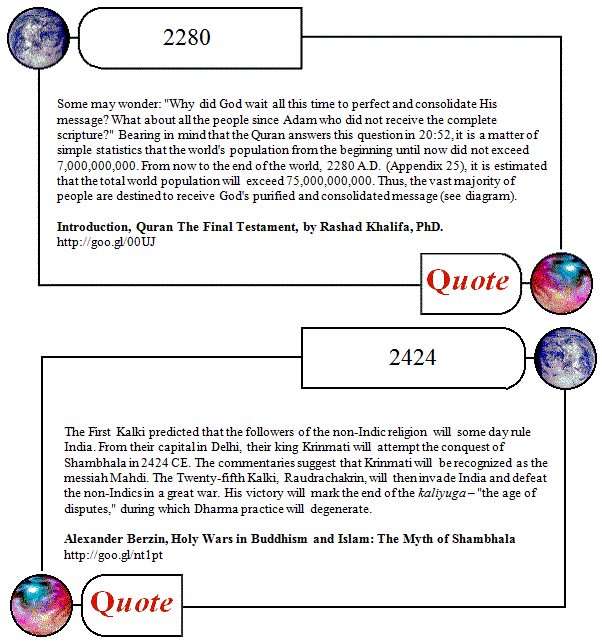
Sources: KhalifaBerzin

*

Seriously, though…

Alexander Berzin has been tutored by HH the Dalai Lama and HHDLs own tutors on the interpretation of the Kalachakra Tantra, and served for some years as HHDL’s translator when HHDL was giving the Kalachakra initiation: indeed his book on the Kalachakra initiation carries a Foreword by HHDL.  His writings are thus among the most scholarly and trustworthy available in the western world on the topic of the initiation which the Dalai Lama will impart for world peace again this July.

Berzin’s words introducing the topic of Holy Wars in relation to the Kalachakra, Buddhism and Islam, are therefore important:

Often, when people think of the Muslim concept of jihad or holy war, they associate with it the negative connotation of a self-righteous campaign of vengeful destruction in the name of God to convert others by force. They may acknowledge that Christianity had an equivalent with the Crusades, but do not usually view Buddhism as having anything similar. After all, they say, Buddhism is a religion of peace and does not have the technical term holy war.

A careful examination of the Buddhist texts, however, particularly The Kalachakra Tantra literature, reveals both external and internal levels of battle that could easily be called “holy wars.” An unbiased study of Islam reveals the same. In both religions, leaders may exploit the external dimensions of holy war for political, economic, or personal gain, by using it to rouse their troops to battle. Historical examples regarding Islam are well known; but one must not be rosy-eyed about Buddhism and think that it has been immune to this phenomenon. Nevertheless, in both religions, the main emphasis is on the internal spiritual battle against one’s own ignorance and destructive ways.

Specifically, he writes:

In The Abridged Kalachakra Tantra, Manjushri Yashas explains that the fight with the non-Indic people of Mecca is not an actual war, since the real battle is within the body. The fifteenth-century CE Gelug commentator Kaydrubjey elaborates that Manjushri Yashas’s words do not suggest an actual campaign to kill the followers of the non-Indic religion. The First Kalki’s intention in describing the details of the war was to provide a metaphor for the inner battle…

To provide a metaphor…

With Greco: two views of Toledo

Monday, June 6th, 2011

[ by Charles Cameron — perception, painting, pre-modern, modern, post-modern, heaven, sky, simulation, John Donne, El Greco ]

.

It is Sunday.

I find it powerfully interesting that the sky as perceived by painters (our “seers” par excellence) used to be filled with supernatural beings and is currently filled with natural ones — a clear sign that our culture has effectively moved from what one might call a theological vision of the world to a meteorological one (with astronomical trimmings under a clear sky)…

And I see that transition captured very precisely in four words, when John Donne writes:

At the round earths imagin’d corners, blow
Your trumpets, Angells, and arise, arise
From death, you numberlesse infinities
Of soules, and to your scattred bodies goe…

The “round earth” is that of modern science, the “imagin’d corners” those of pre-modern maps – and angelology.

*

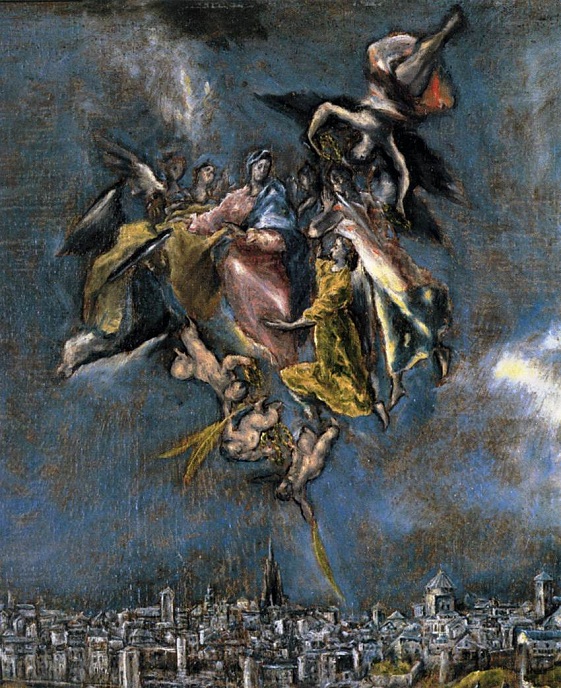
I have to admit, therefore, that I was surprised yesterday evening to come across an El Greco painting of Toledo that featured the blessed Virgin Mary over the city.

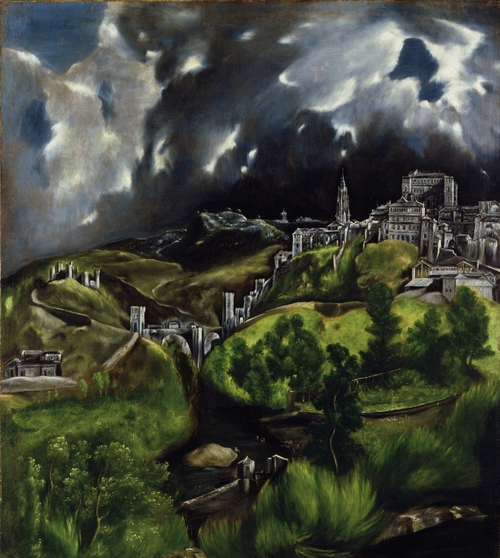
I have long been familiar with his better known View of Toledo, which is entirely naturalistic unless you want to consider storm-clouds as portents of a divine presence —
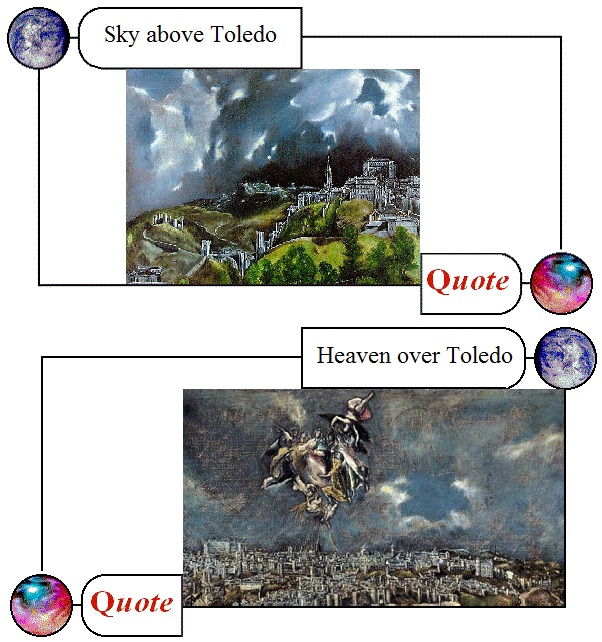
quo-sky-over-toledo.jpg

but the second of these images, from the View and Plan of Toledo, came as quite a surprise…

Here is a detail of the Virgin taken from it, to illustrate the point:
el-greco_view-and-plan-of-toledo_detalhe2_c1610.jpg

*

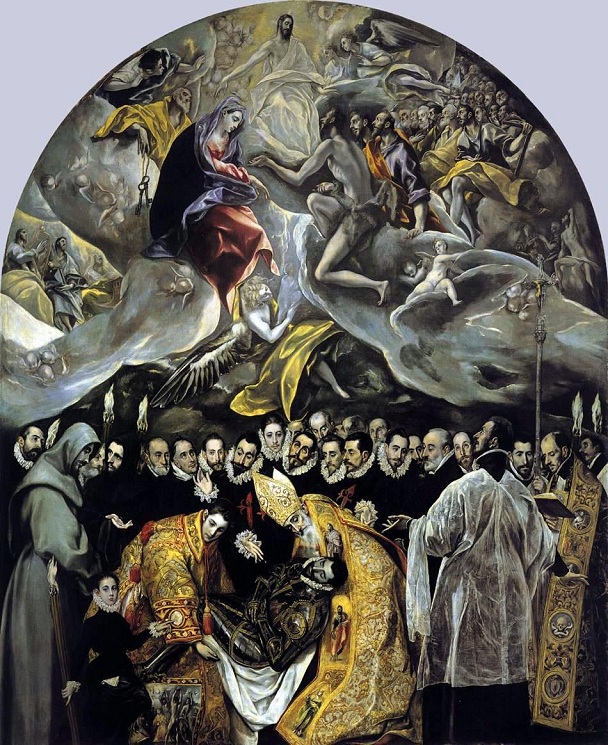
El Greco is famous for painting heaven-and-earth as a continuum – his great masterpiece, the Burial of Count Orgaz, catches the release of the soul from its bodily sheath as directly as Donne’s “to your scattred bodies goe” does to the return of those souls to corporeality at the General Resurrection:
entierro-del-conde-de-orgaz-sm.jpg

*

And yet El Greco, like Donne, sees both – Toledo under storm-clouds, Toledo under the shelter of the blessed Virgin…

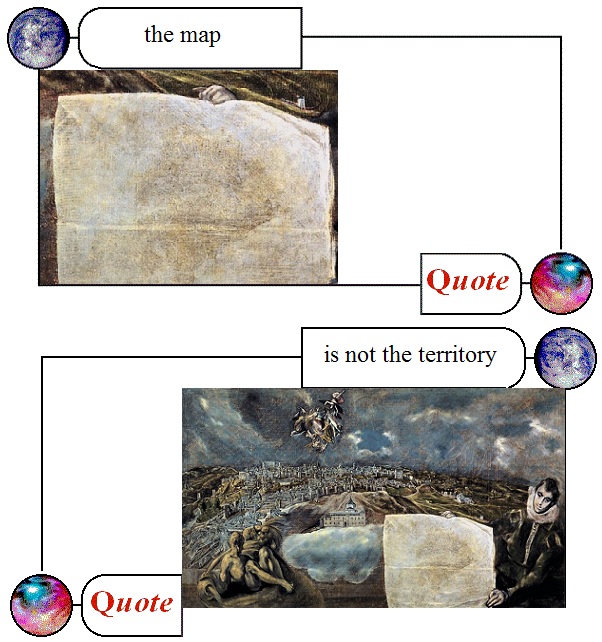
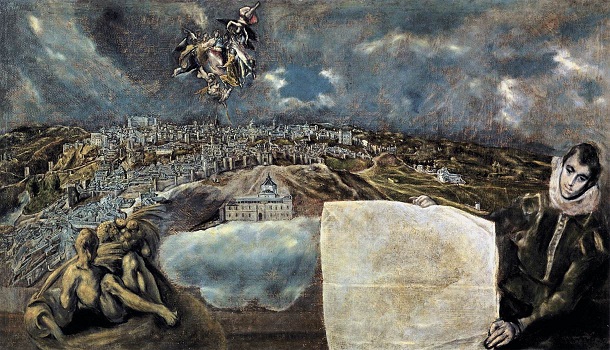
But there is more here, in this extraordinary painting. There is a map of the territory

quo-greco-toledo.jpg

*

If I could say in a nutshell what post-modern is, I would say it is recursive. It recognizes our perceived reality to be a simulation, and is thus always playing with maps and models, as Shakespeare was when he penned the words “All the world’s a stage” to be spoken in a theater whose sign and motto was “Totus mundus agit histrionem” – the whole world enacts a play.

Think of Hofstadter‘s Godel Escher Bach. Of Escher himself, and his image of himself holding his own small world in a glass sphere in his hand…

Think of Korzybski, and his dictum: the map is not the territory.

Think of Gregory Bateson, who wrote:

We say the map is different from the territory. But what is the territory? Operationally, somebody went out with a retina or a measuring stick and made representations which were then put on paper. What is on the paper map is a representation of what was in the retinal representation of the man who made the map; and as you push the question back, what you find is an infinite regress, an infinite series of maps. The territory never gets in at all. […] Always, the process of representation will filter it out so that the mental world is only maps of maps, ad infinitum.

Astoundingly, presciently – prophetically? – El Greco is already alluding to this, around 1610, in his View and Plan of Toledo.
11777-view-and-plan-of-toledo-el-greco-sm.jpg

*

El Greco’s Burial of Count Orgaz is in the Church of Santo Tomé in Toledo.

El Greco’s View and Plan of Toledo is in the Museo de El Greco, Toledo.

Here is the complete text of Donne’s sonnet:

At the round earths imagin’d corners, blow
Your trumpets, Angells, and arise, arise
From death, you numberlesse infinities
Of soules, and to your scattred bodies goe,
All whom the flood did, and fire shall o’erthrow,
All whom warre, dearth, age, agues, tyrannies,
Despaire, law, chance, hath slaine, and you whose eyes,
Shall behold God, and never tast deaths woe.
But let them sleepe, Lord, and mee mourne a space,
For, if above all these, my sinnes abound,
‘Tis late to aske abundance of thy grace,
When wee are there; here on this lowly ground,
Teach mee how to repent; for that’s as good
As if thou’hadst seal’d my pardon, with thy blood.

El Greco’s View of Toledo is in the Metropolitan Museum of Art in New York:
29_1006.jpg

Here we find no blessed Virgin, no angels with their final trumpets — and yet this painting can be viewed as analogous to his Vision of Saint John and the opening of the Fifth Seal — which owes its power to its “otherworldly stormy light” — and thus seen as yet another apocalyptic scene, one which “recalls St. John’s vision of the New Jerusalem in the Book of Revelations … a landscape of unearthly power and drama: a dialogue between heaven and earth conducted appropriately by the cathedral spire…”

Jung in Tehran, aka “enantiodromia”

Wednesday, June 1st, 2011

[ by Charles Cameron — Ahmadinejad vs Khamenei, Jungian enantiodromia ]

.

quo-enantiodromia-in-tehran.gif

*

The western press, on the whole, has covered the recent tussle between Iranian President Ahmadinejad and his superior, the Ayatollah Khamenei, in political terms — as a power struggle between a President who wants increased authority for the Presidency and a Supreme Authority who isn’t about to relinquish his Supremacy.

It is also a theological struggle, and the LA Times nicely weaves the two strands together in commenting:

At its heart is a possible future struggle for power between the firebrand president and Khamenei’s conservative clergy, who are wary of Ahmadinejad’s messianic strain of Islam and his incendiary populism. They worry his tendency for explosive talk could threaten their long-term interests, if not render them obsolete.

Putting it bluntly, the arrival of the Mahdi – or a strong populist current holding the opinion that Ahmadinejad is the Mahdi’s trusted lieutenant, chosen to prepare the way for his coming – would disenfranchise the clerics of Qom, who ultimately derive their authority from the Imam Mahdi’s absence.

The fairly recent discovery of a video, apparently prepared by Ahmadinejad’s supporters and proclaiming the Mahdi’s “soon coming”, seems to have heightened the tension…

Having said that, it’s my impression that Ahmadinejad is losing this tug-of-war, that he doesn’t have the popular groundswell of support he would need to go up against the Supreme Authority and win, and that consequently, his Mahdist “messianic strain” is losing power and credibility.

Which in turn should mean that the West has less to fear from Iranian Mahdism…

Glenn Beck, take note.

*

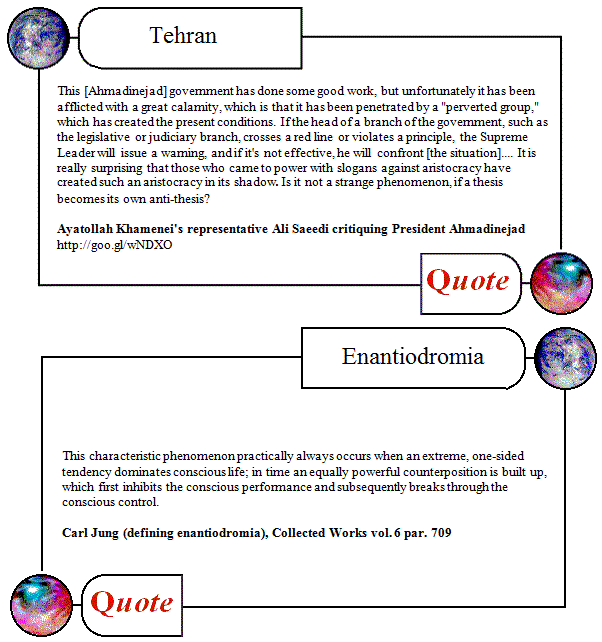
Putting that another way, it seems that the extreme Mahdism of Ahmadinejad is resulting – ironically enough, by enantiodromia – in a backlash from Khamenei that appears likely to depotentiate and dissipate it.


Switch to our mobile site