zenpundit.com » Patterns

Archive for the ‘Patterns’ Category

Blessed are the conflict resolvers II: in dance and song

Tuesday, July 16th, 2013

[ by Charles Cameron — what can these two stunning performances tell us about conflict and / or peace? ]
.

I’m not sure if I’ve said it here before, but conflict resolution is pretty much the same as peace making, hence my title for both parts of this post, Blessed are the conflict resolvers (Matthew 5.9). In the second part of this post, I’d like to shared with you two stunning and highly stylized situations in which peace and conflict are brought together by sheer art.

Battle as dance, from Carlos Saura‘s Carmen — in the aftermath of a gambling disagreement, the jealous rivalry of two men over the young female lead bursts into violent dance:

And …

The battle of songs, from Breuer and Telson‘s Gospel at Colonus. Oedipus, played here by Clarence Fountain and the Blind Boys of Alabama, at the end of his days, wishes to enter the city of Colonus and find rest and the peace prophesied for him at last — the people of Colonus, knowing him accursed, try to resist him:

**

What can we learn from these two examples of conflict circumscribed within the parameters of art?

For comparison, here are two reports of the stylized Beating Retreat ceremony at the Wagah Border crossing, jointly performed each evening by the Indian Border Security Force and Pakistan Rangers and aptly described as a “synchronized display of stomps and shouts” — with some suggestive comments about the rivalry between the two nations in each.

From Michael Palin:

and from Voice of America:

Where’s Ms. Waldo?

Sunday, July 7th, 2013

[ by Charles Cameron — on two technologies for human dot-connection ]
.

How long would it take you to find this particular woman:

in this crowd, if you already had another photo of her?

Click here and give it a try.

Next question: how long would it take the best pattern recognition software in the world?

For bonus points: how many cameras like this are there in the world, who has access to that kind of software, what countries are cameras and software in, what kinds of agencies use them, under whose supervision, how easily hacked — and how many such photos will have been taken, grand total, by the end of 2013?

I don’t have even a hazy idea of the answers. I don’t even know where in the photo the woman in the headband can be found. I imagine there are export controls on both cameras and software, I suspect they can be circumvented…

**

As I noted in a comment here three weeks ago:

Green party politician Malte Spitz sued to have German telecoms giant Deutsche Telekom hand over six months of his phone data that he then made available to ZEIT ONLINE. We combined this geolocation data with information relating to his life as a politician, such as Twitter feeds, blog entries and websites, all of which is all freely available on the internet.
.
By pushing the play button, you will set off on a trip through Malte Spitz’s life. The speed controller allows you to adjust how fast you travel, the pause button will let you stop at interesting points. In addition, a calendar at the bottom shows when he was in a particular location and can be used to jump to a specific time period. Each column corresponds to one day.

You can give that one a whirl, too: feel free to zoom in and out.

**

Happy trails!

Geometry aka logic as an analytic tool

Friday, June 28th, 2013

[ by Charles Cameron — reflections on cognitive empowerment by selective noticing ]
.


.

I just realized that I take notice of details at the level of “geometry aka logic” which I would miss if I were more focused on content. In effect, I treat idiosyncracies and hiccups of expression — such as paradoxes — as indicative of condensed or distilled meaning.

What triggered this realization was the way my interest was aroused by this phrase:

The parallel universes may soon become perpendicular.

I found that today in an FP piece, Will June 30 be midnight for Morsi’s Cinderella story?

**

Paradox? Geometry? Contradiction? Figure of speech?

It’s the irregularity in the pattern used to describe the events in question that catches my eye here, however you care to name it. And something very similar is going on when I flag the weird juxtapositions of imagery and music in Taylor Swift, Sara Mingardo, JS Bach and a quiet WTF, or the koan-like tensions and reconciliations inherent in such inseparable pairs as war-and-peace in Of dualities, contradictions and the nonduality.

Here’s the full paragraph, discussing the increasing polarization of the Egyptian public, and some ways in which “the current situation differs more in degree than in kind from the recent past”:

Second, violence is on the table. The parallel universes may soon become perpendicular. Of course, Egyptian politics has had its victims over the past two and a half years, but violence has seemed episodic and almost self-limiting since those who have deployed it have paid a heavy political price. Nobody advocates violence now, but many expect it and it is not uncommon to hear from both sides that they will not shrink from self-defense. And the line between self-defense and offensive action can become thin for each camp for opposite reasons. The opposition is hardly centrally controlled and rogue elements have already been involved in attacks on Brotherhood offices as well as those of its political party. For the Brotherhood, its discipline has led it to prepare for what it sees as defensive action in a manner that understandably appears threatening to outsiders (especially after the events of December 2012 when Brotherhood cadres constituted themselves as a vigilante force to confront those demonstrating at the presidential palace).

Okay, so I’m already reading the article, ergo I must already have been interested enough in what’s going on in Egypt to click through to it. So why the fuss about paradox and geometry in what is, after all, only one turn of phrase in a piece whpose subject already interests me?

**

I’m still feeling my way towards and understanding of how my mind works, how I pick up on things, how I populate my mind with rich and interesting memories, how I make my small and large creative “leaps” — my means of collecting and connecting dots, if you will. Because there’s a cognitive skill there that I haven’t seen taught, and I believe it offers an “outside the box” alternative mode of monitoring topics of interest.

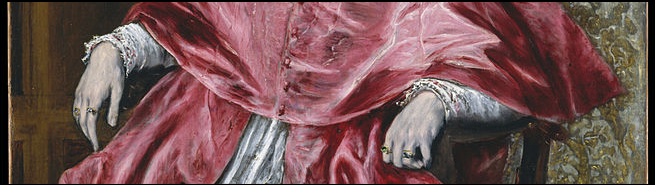
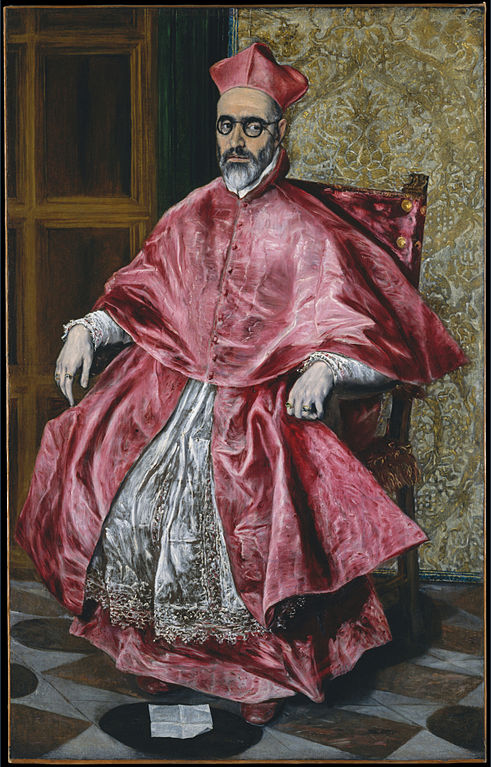
You know, of course, that most every time you read the words you know, of course, that it’s a dead giveaway that the speaker or writer is skimming quickly past a cherished assumption that he or she wouldn’t want you to examine too carefully? Of course you do. It’s one of those psychological “tells” that should alert you, like a facial tick, a hesitation, or that curious (and paradoxical) tight grip on one arm of the chair with one hand while the other rests almost disdainfully relaxed and gracious on the other, in El Greco’s masterful portrait of a Cardinal, now in the Metropolitan in New York:

How very telling that sort of detail can be!

**

And intersections.

I talk quite a bit about juxtapositions and parallelisms, because they’re the elements of “creative leaps” (and Sembl / Hipbone moves) and I “practice” noting them for my DoubleQuotes. But one way to clear the xlutter from mind is to concentrate on places where two fields intersect. I’m interested in apocalyptic, for instance, so I take particular note when someone from a Christian apocalyptic POV (Joel Richardson, Joel Rosenberg, eg) writes about Islamic eschatology, or when someone from an Islamic apocalyptic POV (Sh. Safar al-Hawali, eg) writes about Christian eschatology. Reading wherever I notice this kind of overlap means that I learn in two contexts — effectively doubling my knowledge value — where most reading that’s not “targeted” this way only allows me to learn in one…

Again: parallelisms, overlaps, paradoxes, perpendiculars, contradictions — these are all “formal properties” of a given text rather than “contents” — that’s the level of abstraction at which you can make the details sing.

**

Hey, I’m not alone. As I was cleaning this post up, Adam Elkus tweeted a link to a post about the CTO of Intel, Intel Labs: Assuring Corporate Immortality by Rob Enderle, which contains this phrase:

This is very orthogonal thinking

There we go! The word orthogonal is so important to me, and is so often on the tip of my tongue but out of reach of immediate memory, that I have a file on my computer consisting solely of the words “opposite oblique orthogonal congruent incongruous antithetical obtuse parallel asymptotic perpendicular right angles” — so if I can remember any one of them, I can easily find “orthogonal”.

Very orthogonal thinking — terrific!

Manhunt: religion and the director’s eye

Saturday, June 8th, 2013

[ by Charles Cameron — with an assist from Wm Benzon, under-appreciated and brilliant film and literary critic, musician, author of Beethoven’s Anvil ]
.

Screen-time is valuable: movie directors don’t just throw it away.

Here are screen-grabs of two moments in Greg Barker‘s HBO bin Laden documentary, Manhunt, offered for your consideration:

and:

**

As you know from my review of Battle of Algiers (Pontecorvo) and Black Friday (Kashyap), I’m a film buff.

Screen time is the life-time of story: every second counts. And thus it is that if a director uses the same shot with variations at two or more points in a movie, they don’t just follow along, the way the elements in the narrative through-line follow along, one after another — they stack up. They “mean” cumulatively, synchronically…

Putting that in musical terms, they take on the function of rhythm rather than melody — and it is rhythm that can make the body dance, just as it is melody that can make the heart soar.

So, this repetition, this striking parallelism — why?

**

Here’s my friend Bill Benzon, writing about the use of parallelism in Apocalypse Now:

The Assassin and the Surfer

Now for the less obvious parallel: Willard and Lance, the only member of the boat crew to survive. One can’t miss the parallel killings nor Willard’s statement of kinship with Kurtz. This parallelism, on the other hand, is easy to miss. That is to say, it may well elude conscious notice. Unconscious notice, on the other hand … Well, what is that?

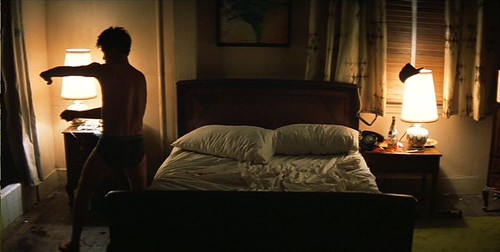
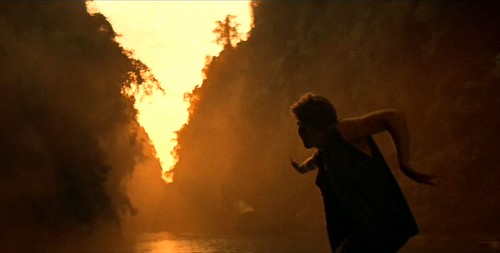
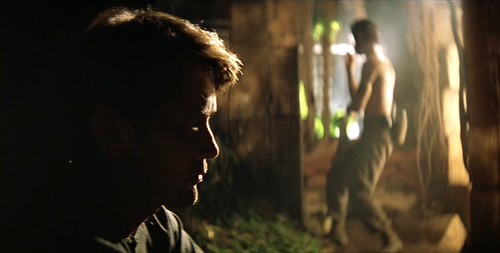
Here’s three frame-grabs that point up the parallel. The first is from the opening montage of Willard in Saigon just before he gets his orders:


Montage AN 19 martial arts

The second shot comes much later in the film. Clean has been killed (bullet), then the Chief (spear). Lance is the one who floated the Chief’s body down the river. Now they’re heading upriver toward Kurtz again, with Lance in the bow of the boat:


AN Lance dance1

He’s doing a martial arts dance. Not the same one as Willard did in the opening montage, but a martial arts dance. No one else in the film does such a thing. Clean does some dance moves while listening to the Rolling Stones, but they’re in an entirely different style; faster, jerkier, more angular.

Finally, we have this scene in Kurtz’s compound. Willard’s in the foreground, and Lance is in the background:


AN Lance dance2

One might suggest that this parallel is a mere accident, one might. And perhaps it is. In cases like this, however, my default assumption is that it is not an accident. It may not be there by conscious intent and deliberate plan; but it is not there by accident. The people who made this movie are too skilled to do such things inadvertently.

That final remark of Benzon’s makes exactly the point I was hoping to make here, before commenting on those two screen-grabs from Manhunt:

The people who made this movie are too skilled to do such things inadvertently.

**

There’s actually a third shot in Manhunt with a view of a dangling rear-view-mirror ornament — let’s take a look:

This one’s from the van Peter Bergen and his cameraman, Peter Jouvenal, took in the docu’s re-enactment / flashback to their CNN interview with bin Laden, back in 1997. I don’t think this one is a rosary-like thing though it might be — I think it’s just the sort of tassel decoration you’ll find on saddle-bags, or decorating a camel or a car in Afghanistan.

The other two, however, seem clearly religious, both of them are shots of the cars in which American counter-terrorist folks would have gone to work during their efforts to track down bin Laden — and I find it significant that one features a (Christian) cross while the other very likely shows (Muslim) prayer-beads.

I say “very likely” because the beads could be (secular, Greek) worry-beads — but they look more like a tasbih to me. And why would that be interesting — why would a film-maker be interested in such a parallelism?

Besides the fact that these shots allow voice over and show us the various folk involved going to work, they specifically point up the fact that those working to defeat bin Laden were not all kuffar but included Ali Soufan of the FBI and “Roger” — the fellow described by Greg Miller in this March 2012 piece in WaPo, At CIA, a convert to Islam leads the terrorism hunt.

Am In right? I don’t know. But the subliminal message, if I am, is that the manhunt for bin Laden was indeed not a “Crusaders against Islam” affair.

**

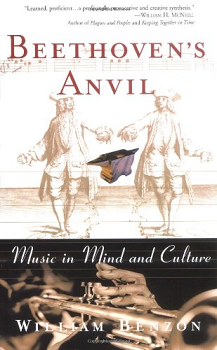
May I recommend Wm. Benzon’s Beethoven’s Anvil to all who read here who have an interest in cognition and / or music?

For more on parallelism in cinema, see David Bordwell, Julie, Julia, & the house that talked, to which Benson also pointed me.

A feast of form in my twitter-stream today

Sunday, June 2nd, 2013

[ by Charles Cameron — forms & patterns, pattern recognition & creative leaps, creative leaps & connecting dots, connecting dots & node-and-edge mapping — node-and-edge mapping, link charts and Sembl-HipBone games ]
.
.

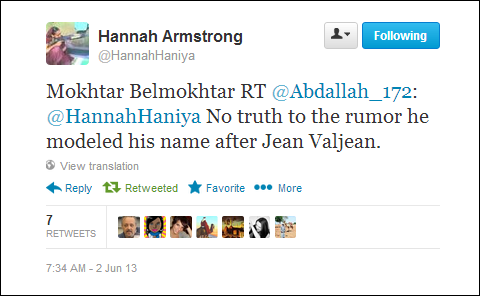
There’s no “actionable intelligence” in that tweet, but it recognizes a pattern, it makes a fine creative leap. And given the chance, that’s something bright minds do naturally, and enjoy doing, and is away more important than we think.

Yestedrday I was watching Manhunt pretty closely for an upcoming Zenpundit review, and noticed that some of the most significant quotes in the film were absent from CNN’s transcript. One gap I noticed had to do with the descriptions of the analytic process, and in particular some of the things Cindy Storer said. I’ll quote this one, which goes to the heart of the matter, but there’s plenty more left for me to chew over with you later. Here she goes:

Even in the analytical community there’s a relatively smaller percentage of people who are really good at making sense of information that doesn’t appear to be connected. So that’s what we call pattern analysis, trying to figure out what things look like. And those people, you really need those people to work on an issue like terrorism, counternarcotic, international arms trafficking, because you’ve got bits and pieces of scattered information from all over the place, and you have to try to make some sense of it. … That takes this talent, which is also a skill, and people would refer to it as magic — not the analysts doing it, but other people who didn’t have that talent referred to it as magic.

That’s a pretty exact description of what the Sembl game will eventually teach people, once it comes out of the museum prototype and onto the web — but let’s back it up with a quick quote from Wittgenstein:

A surveyable representation produces precisely that kind of understanding which consists in ‘seeing connections’ [Zusammenhänge sehen]. Hence the importance of finding and inventing connecting links. Hence the importance of finding and inventing intermediate links.

That’s from Philosophical Investigations, 122, and it’s a higher altitude / more abstract view — but it’s also the very heart of network thinking, seeing processes not just in terms of isolated nodes but of the connections between them.

**

Seeing connections — connecting the dots — happens in lines and leaps. That is to say, it can happen according to the usual linear way of thinking, the dogged 99% of perspiration that people talk about — or according to the far less common lateral move or creative leap, which moves by analogy, which is to say by pattern recognition, by the perception of similarities of form.

That’s the 1% we call inspiration. That’s the magic.

**

So a whole lot of patterning was going on in my twitter-stream today, and I thought I’d show you.

First, there was the parallel between the names Mokhtar Belmokhtar and Jean Valjean (above). If you’re hunting either fellow, the parallelism isn’t going to yield a useful clue — but the mode of recognition is what matters, and the reason its such a rare mode is precisely because it’s playful. It plays with forms — in this case, the forms of the two names — without regard for practicality.

And yet this playful spirit is what brought us Weil‘s conjecture and Pierre Deligne‘s Abel Prize, and the Taniyama-Shimura conjecture and Wiles‘ proof of Fermat’s Last Theorem.

Serious playfulness is key… to serious, magical breakthroughs. In any and all domains.

*

With that in mind, here are the rest of the patterns I recognized in todays feed.

Let’s start with self-reference, which can hardly get more succinct than the hackers hacked:

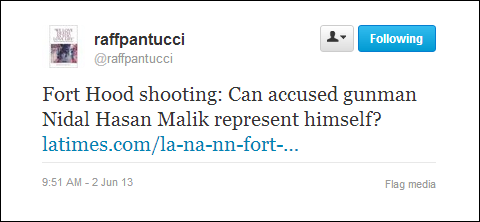
There’s also a self-referential paradox at work in the question of a defendant appearing in his own defense — something that gives judges pause, because they see how tightly the serpent is chasing its own tail. Defendant defends self, From Raff Pantucci:
The saddest self-reference of the morning’s tweets was this one, which could be encapsulated as storm-chaser chased by storm:
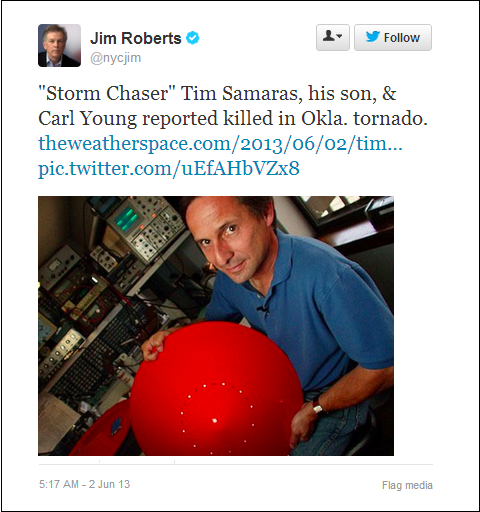
Even tragedy can take self-referential form.

**

But lets move on to Turkey, which provided a rich dividend:

There was this problem:
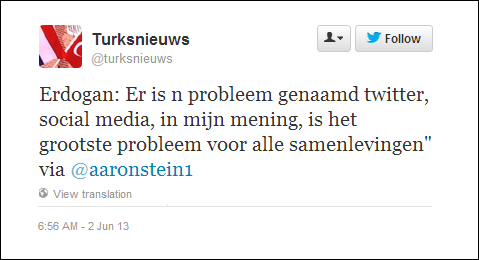
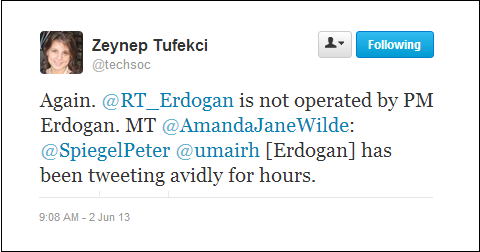
Turkish I couldn’t read, Dutch I can more or less make out — but for an English tweet making the same point let’s go to Zeynep Tufekci, who has expertise in both matters Turkish and matters Internet, and tweets about Erdogan disapproving of tweeting:

Tufekci again, this time catching an even neater self-reference which doesn’t quite pan out — because, as she says, PM Erdogan is not the same as @RT_Erdogan:
**

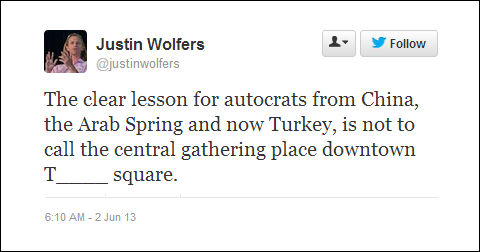
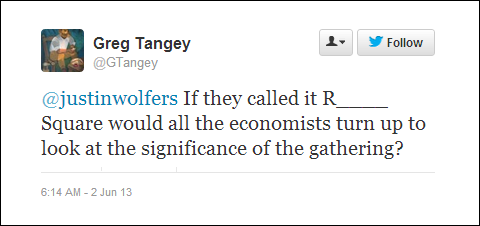
While we’re on Turkey, this tweet about Tienanmen, Tahrir and Taksim Squares gave us another example of a bright mind catching a hint of pattern…
And what a neat rejoinder!
All of the above is quite useless, entirely playful — and of deep interest if creativity and insight matter

**

Finally, I’d like to go someplace quiet and bathe in peace. This tweet, featuring a poem by a Korean zen master, does the trick nicely:
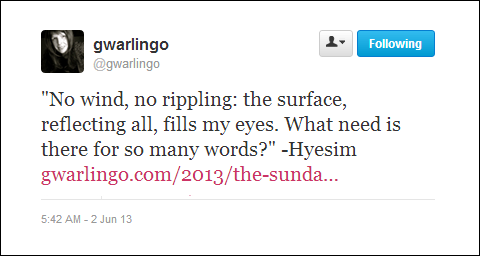
AN appreciative bow to Gwarlingo for that one…

Switch to our mobile site