zenpundit.com » Patterns

Archive for the ‘Patterns’ Category

Theory and Practice:

Friday, November 29th, 2013

[ by Charles Cameron — how theory works out in practice, and vice versa ]
.

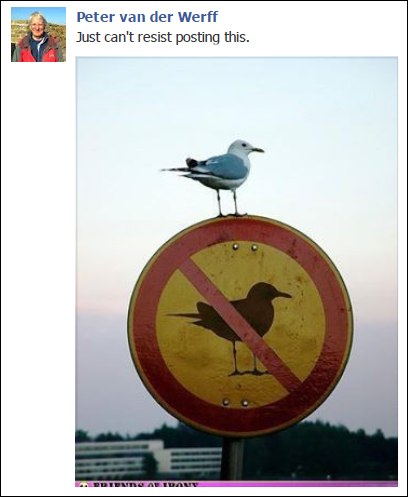
Here’s the first of a pair of “patterns” of interest…

Theory contradicts practice:

— with thanks to my friend Peter van der Werff!

**

And here’s the second, a delicious serpent-bites-tail tweet re Egypt:

Practice contradicts theory:

**

Okay, there are two more items for the “pattern recognition” / “pattern language” archives…

And here’s wishing you all a Happy Black Friday — if that’s even concedivable!

Serpent logics: a ramble

Sunday, November 24th, 2013

[ by Charles Cameron — continuing my exploration of a pattern language of thoughts, both verbal and imagistic ]
.

One of my favorite patterns derives from the nesting of Russian dolls inside Russian dolls, so it’s only appropriate to start with an example of what I can only call.. Matrioshka shipping!

**

It’s my habit, as you may have seen, to collect certain “ways of thinking” in the miniature format provided by my Twitterstream. Whether you think of them as logical forms, patterns in a pattern language, or amuse-bouches for the mind, they are here to delight and instruct — and when you pile a whole lot of them up together, they can make you just a touch dizzy.

Today I’ll be bringing my collection up to date with two posts, Serpent logics: a ramble, and Serpent logics: the marathon. If you want a quick look at some of the neat patterns I’ve seen since I last posted on these topics, this post — Serpent logics: a ramble — is the one for you. If, after reading it, you want a gruelling, hilarious, insightful, insane, devious, extended course in this kind of pattern recognition — try Serpent logics: the marathon.

**

Here’s one from today, tweeted as I was prepping this post — in a category I’ll simply call…

Counter-intuitive?

Admit it, that’s just a trifle mind-blowing, no? C’mon!

**

Serpent Bites Tail:

Here’s a light-and-dark-hearted example of the ourobouros or serpent-bites-tail recursive patterm, with a hat tip to Allan Stairs:

Follow Kim Kierkegaardashian (@KimKierkegaard) on Twitter if you like mashups between the deepest of theologians and the shallowest of celebrities…

**

I have no idea what category this one belongs in, so I’ll slip it in here. It’s from the Electronic Frontier Foundation, protecting our digital private parts:

Oh my! A Clash of Classifications!

The EFF even has it’s own playful-serious version of the NSA logo —

— as the DoubleQuote above — juxtaposing how the Agency views itself with how the EFF sees it — illustrates…

**

DoubleQuotes in the Wild

DoubleQuotes in the Wild is my on-going collection of paired juxtapositions that say more together than they do apart. It’s a beginning training in what F Scott Fitzgerald claimed was the “test of a first-rate intelligence” — “the ability to hold two opposed ideas in mind at the same time and still retain the ability to function”.

The example above comes from Parecidos Razonables, a blog that takes off from the Separated at Birth concept and specializes in double-takes of this sort, often satirical. One of their more celebrated examples:

I’d have juxtaposed Vladimir Putin with Daniel Craig as James Bond myself, but that idea has already been taken — a Bond fan apparently photoshopped Putin’s face onto a poster of Bond in Casino Royale, and then “plastered” Moscow with his handiwork.

Apparently the Apparat, like Queen Victoria, was not amused. I’d have been flattered…

**

While we’re on the subject of President Putin, here’s another category to consider…

Mixed games:

The op eds by Presidents Putin and Rouhani to which Soufan refers are Putin’s A Plea for Caution From Russia and Rouhani’s Why Iran seeks constructive engagement.

Ali Soufan, the author of Black Banners, is always worth paying attention to — and his tweet, above, clearly belongs with that Alasdair MacIntyre quote I’m so fond of [1, 2]:

Not one game is being played, but several, and, if the game metaphor may be stretched further, the problem about real life is that moving one’s knight to QB3 may always be replied to by a lob over the net

**

Let’s close with some examples from the arts, the first with just a touch of Tibetan Buddhist flavor…

One of mine:


For further details, see Death and hallucination color new work by Chinese artist Zhang Huan after life-altering Tibet trip.

And the second, a pair of images — each in itself a sort of DoubleQuote in the Wild comparing the forms of birds and mechanical objects in a single photo — posted together today by Wm. Benzon under the title Conjunctions:

Birds and cranes, New Jersey and Lower Manhattan.

IMGP3517rd - Five ducks and freedom tower

Birds and cranes, Brooklyn and Governors Island.

birds of a feather.jpg

Magnificent — what a generous eye he has — many thanks, good Sir!

**

Patterns? You might think of them as Jungian archetypes, Platonic ideas, Hofstadterian analogies — or Ayat, the same word used to describe the verses of the Qur’an, signs in the calligraphy of God:

Qur’an 41 (Fussilat), 53

We shall show them Our signs in the horizons and in themselves

**

And now, consider your options. Have you had enough of these damn patterns of mine — or would you like to try out for the marathon version?
Spirals, a quick revisit

Thursday, November 14th, 2013

[ by Charles Cameron — spiraling costs — same pattern, different mechanism, closer to home ]
.

Back in Serpent logic and related, I featured this spiral from Louisa Lombard:

Ha, funny.

How’s this, in today’s opening salvo from Rosa Brooks at POLITICO Magazine?

“If you believe the mission truly requires 50,000 troops and $50 billion, but you know that the White House is going to automatically cut every number in half, you’ll come in asking for 100,000 troops and $100 billion,” says the aforementioned former White House official. “The military eventually starts playing the very game the White House has always suspected them of playing.”

Not for nothing does the phrase “spiraling out of control” garner 7,840,000 hits on Google.

Pattern recognition: backlash

Sunday, October 20th, 2013

[ by Charles Cameron — on human obstinacy, a change of heart, and what seems to me a major piece from Res Militaris ]
.

There’s a pattern of backlash that occurs when you present people with facts that don’t fit their preconceptions — they don’t switch, they double up. Here’s the opening of io9‘s report, The Backfire Effect shows why you can’t use facts to win an argument:

“Never let the facts get in the way of a good story” isn’t just a maxim for shady politicians and journalists. It’s also the way people often live their lives. One study indicates that there may even be a “backfire effect,” which happens when you show people facts that contradict their opinions.

Then there’s a study — Brendan and Jason Reifler, When Corrections Fail: The persistence of political misperceptions. I won’t go into the details, it’s the pattern it finds that’s of interest to me, but I will note that the title is a tip of the hat to Leon Festinger‘s When Prophecy Fails, a classic study in the same pattern of denial as it applied to a group whose belief in an end time prophecy was not shattered when the day arrived and the world went on as usual…

Here’s how the pattern works:

Participants in the experiments were more likely to experience the Backfire Effect when they sensed that the contradictory information had come from a source that was hostile to their political views. But under a lot of conditions, the mere existence of contradictory facts made people more sure of themselves — or made them claim to be more sure.

Everyone has experienced the frustration of bringing up pertinent facts, in the middle of an argument, and having those facts disregarded. Perhaps the big mistake was not arguing, but bringing up facts in the first place.

Okay? That’s a veeery interesting pattern to think about any time you’re considering ways to persuade people to change their minds during, for instance, a CVE campaign.

I’d like to dig into it a great deal more, of course.

**

Maajid Nawaz, a former recruiter for Hizb ut-Tahrir who renounced his membership and is now Chairman of the counter-extremist Quilliam Foundation, seems to have persuaded Tommy Robinson, until recently a leader of the English Defence League, to renounce the EDL and join Qulliam — a move whose results and second-order effects have yet to be seen. Both men, however, offer us examples of people who have in fact changed their minds on matters of profound belief, religious and political, and the odd uncomfortable fact may have played some role in those changes.

The role of anomalies (cf. “outliers”) in Kuhn‘s The Structure of Scientific Revolutions comes to mind.

And if showing people the error of their ways (a very loose equivalent of telling them unwelcome facts, I’ll admit) doesn’t work, here’s another anomaly that I ran across only yesterday, that “proves the rule” by, well, partially disproving it.

Dutch ex-politician Arnoud van Doorn, previously a senior member of Geert Wilders‘ fiercely anti-Islamic party, has changed his mind — or his heart was changed for him, within him, depending on your perspective. He has made the Shahada and is henceforth Muslim himself. In this photo, van Doorn is performing the Hajj, the pilgrimage to circumambulate the Kaaba in Mecca:

Do I detect a hint of enantiodromia here?

**

In closing, I would like to offer this link to an article in Res Militaris by Jean Baechler, titled Outlines of a psychology of war. It’s a weighty piece, as befits its grand sweep, and I believe it throws some light on the obstinacies of the mind to which this post is addressed.

I tried excerpting it, but it appeared to me that each sentence in every paragraph in turn begged to be highlighted, approved, tweaked, questioned, or disagreed with, and I wound up feeling you should read it for yourselves. I’ll be very interested to see if it captures the attention of the ZP readership, and leads to a more extended discussion…

Dawn and Decadence, Innovation, & The Face of Battle — top 3

Friday, October 4th, 2013

[by J. Scott Shipman]

From Dawn to Decadence, 500 Years of Western Cultural Life, by Jacques Barzun

In a year where I’ve not been able to read as much as normal and with 89 days remaining in 2013, these three titles are the best so far. I’m not finished with Dawn, but it seems like the late Professor Barzun is an old friend (here is a video from 2010). Barzun’s opus was published when he was 93 and was almost ten years in the making. Dawn has been sitting on my shelves for four or five years and I’d started it two or three times only to get bogged down and lose interest. Well over half way finished and I’m pretty sure I’ll be rereading this title for years to come (co-blogger Lynn Rees reports he’s read it four times). Barzun’s scope covers the gamut: religion, literature, poetry, theater, painting, sculpture, philosophy, and the aristocracy/life at court. Since many of these topics are interconnected he uses an ingenious method to assist the reader in keeping up. He uses this: (<page number)(page number>) to direct the reader to something previously discussed or something he will cover later. In the text, he will recommend “the book to read is” “the book to browse is” in brackets. I’ve found this method distracting as I’ve read three books he referenced since I started… Barzun also provides generous lift quotes in the margins to give the reader a flavor for a particular writer or idea/example. If the book had a traditional bibliography, I dare say it would cover a couple hundred pages–at least. Dawn has been a pleasure I’ve been taking in small doses and am in no hurry to finish. This is the best book of the genre that I’ve read.

Men, Machines and Modern Times, by Elting Morison

Elting Morison’s Men, Machines is reviewed at Amazon by former House Speaker Newt Gingrich as “purely and simply one of the best books ever written on the process of innovation and the interaction of technology, culture, systems, and individual personalities.” I could not agree more. Morison’s book is a collection of essays dealing with change and man’s inherit but paradoxical reaction to it:

Yet, if human beings are attached to the known, to the realm of things as they are, they also, regrettably for their peace of mind, are incessantly attracted to the unknown and things as they might be. As Ecclesiastes glumly pointed out, men persist in disordering their settled ways and beliefs by seeing out many inventions…Change has always been a constant in human affairs…

From gunnery at sea to 19th Century railroads, Morison provides illustration after illustration of man, his institutions, and the almost universal resistance of both to change. Morison observes of inventors (real “disruptive thinkers’) [this was written in the early 1950’s]:

I once collected evidence on the lives of about thirty of these men who flourished in the nineteenth century. A surprising number turned out to be people with little formal education, who drank a good deal, who were careless with money, and who had trouble with wives or other women.

Morison devotes one essay to the characteristics and ills of a “bureau.” He describes the difficulty of getting anything accomplished within an average bureaucracy—largely because bureaucrats live for process and harmony. He says:

Taken together, a set of regulations provides a pattern of behavior for the energies bureaus are set up to regulate….Regulations are a way of keeping a system of energies working in harmony and balance…First it is easier to make a regulation than to abolish it.

Morison’s eighth and concluding essay provide Some Proposals for dealing with change and newness—in a word, solutions to many of the problems identified earlier. That said, only the most dedicated reader will complete the seventh (and longest) chapter, according the Morison, originally intended to be a book about the history of 19th Century American railroad innovation. Overall, I concur with Speaker Gingrich and highly recommend this title.

The Face of Battle, by John Keegan

A title needing no introduction at Zenpundit, I’ll only offer this title as one of the best books of the genre I’ve read. Keegan covers three battles across 500 years of history, Agincourt, Waterloo, and The Somme. In each, he brings alive the battlefield and provides the conditions faced by combatants—often up close and personal. Keegan’s scholarship, insight, and importantly, his humility in addressing a topic he admittedly had no first hand experience make this a must read for anyone in the profession of arms, and recommended for anyone seeking more insight into how we fight.

That’s a wrap, be back soon! 


Switch to our mobile site

