zenpundit.com » counterpoint

Archive for the ‘counterpoint’ Category

The zen of Cage II: from the A Train to Liverpool Street Station

Wednesday, August 15th, 2012

[ by Charles Cameron — two performances of Cage’s 4’33” in the New York and London Times: an interlude in my review of Where the Heart Beats, with a brief meditation on contrapuntal listening ]
.

I began to review Kay Larson‘s Where the Heart Beats in a post here last week, and am not done yet.

**

London:

photo credit: Chris Harris for the London Times

In John Cage’s sound of silence… at Liverpool Street station [London Times, subscription required], Igor Toronyi-Lalic describes performing John Cage‘s silent work 4’33” in what Cage himself — but few others — would have recognized as a concert venue, London’s Liverpool Street Station:

My rendition isn’t going down well. “This is doing my head in!” groans a drunken West Ham supporter as he watches me at the piano outside Liverpool Street station. I hear shuffling. “I can’t dance to this,” someone shouts. The restlessness is in danger of turning to anger. And I probably should have guessed it would. Presenting a performance of one of the most controversial works of music yet written in a rowdy Central London station forecourt on a Friday night on a public piano (one of several that made up the City of London Festival’s Play Me, I’m Yours artwork) was always going to be ambitious.

The work itself is hardly over before it begins — again, a paradox Cage would have enjoyed:

At my Liverpool Street Station performance, there was a symphony of rush-hour noise: commuter patter, train announcements, drunken heckling and the screeching of taxis stopping to pick up fares. Not everyone appreciated the music in this.

“When’s he going to start?” asked one lady as I finished the final movement. Others felt like they’d been had. “I thought you were going to play,” they shouted.

There’s more, and if you can get past the pay-wall you should read it all. I’ll just quote one more snippet here, though, because it leads directly into one strand of the book that I’ll be discussing in Part III of my review of Larson’s book:

“Classical musicians don’t know about Cage. They don’t perform it. We aren’t taught it in schools,” Volkov says.

But, for visual artists, Cage is a revered figure, a key part of the 1950s and 60s New York arts scene and godfather to conceptual and sound art, a connection cemented by Cage’s 40-year creative relationship with his lifelong partner, the late choreographer Merce Cunningham. “Cage worked with Rauschenberg and Cunningham and, at Black Mountain College, he mainly taught music to artists,” observes Volkov, “So, today, in art schools, they teach Cage properly. They teach his ideas.”

**

New York:

photo credit: Christian Hansen for the New York Times

From London’s Liverpool Street Station we pass to New York City’s subway system. I don’t know what it is about trains, but there you are and there you go. Or perhaps the transit is from Times to Times?

Allan Kozinn‘s John Cage Recital? Take the A Train [New York Times] starts by defining “Cage moments”:

You know about Cage moments, don’t you? We all have them, whether we think of them that way or not. They occur when happenstance kicks in, and surprising musical experiences take form, seemingly out of nowhere. They can happen anywhere at any time.

Listening. Listening as though all life is music.

Kozinn is a listener, a listener to music — but he doesn’t always listen for the music in his daily life. This time, as it happens, he did:

On the A train I wasn’t thinking about Cage at all. I had just heard an exquisitely turned, energetic performance of Schubert’s String Quintet in C at a church in Greenwich Village, and Cage could not have been further from my thoughts. Nor did the crowded subway car bring him to mind at first. But I noticed that it was unusually noisy.

**

Then something shifted:

Typically, most of the noise you hear comes from the subway itself: its din drowns out conversations, and people tend to stare at their feet, or at whatever they are reading, and listen to their portable music players. But this Tuesday evening just about all the people were talking, and working hard to drown out both the subway and the chats taking place around them.

I would normally have tuned all this out, but instead I sat back, closed my eyes and did what Cage so often recommended: I listened. I made no effort to separate the strands of conversation or to focus on what people were saying. I was simply grabbed by the sheer mass of sound, human and mechanical. It sounded intensely musical to me, noisy as it was, and once I began hearing it that way, I couldn’t stop.

Okay, this is where it get’s interesting. You remember that I pointed to the pianist Glenn Gould in my Said Symphony posts, and quoted this passage from David Rothenberg‘s Sudden Music:

Gould set himself up to hear the world in a new way. In diners he ate his lunch alone, eaves dropping closely on the voices around him. He learned to hear conversation as music, the lilting lines, the rhythms everywhere up, down, and around, what Bach does to our sense of talk. There are two part inventions in words, themes and variations in the quarrels of couples and the tales told by friends. Gould met the world on his own terms, and he was fascinated by this way of listening to human voices as if they were a musical interplay, not participating in a conversation but taking it all in, as an audience.

What Gould sets out to do — and records for Canadian Broadcasting — Kozinn finds himself doing:

Strand upon strand of the chatter was animated and midrange: there were neither basso profundos nor soaring sopranos in this choir, but after a moment the pitch levels began to sort themselves out as a kind of orchestration. Argumentative voices created driving, punchy rhythms that sailed over more smoothly floating narrative tones.

At least three languages were being spoken, each with its own melodic lilt and rhythmic character. To my left, a woman’s laughter momentarily changed the coloration of this vast choral tapestry and offset the argument to my right.

Within it all, squeaking metal yielded a high-pitched ostinato, and the ever-so-slightly-clattery rumble of the train was the high-tech equivalent of a Baroque basso continuo. As the train pulled into each station, the muted squeal of the brakes, the opening and closing of the doors and the slight shift in the balance of voices as some people left and others entered, already talking, suggested shifts between connected movements.

Again, I recommend reading the entire piece, but will close with just one more short clip:

I have heard “4’33” ” performed by pianists, percussion ensembles, oboists, cellists and orchestras, but none of those versions were as exciting as what I now think of as “4’33”: The Extended Subway Remix” by the A Train Yakkers, an ensemble so conceptual that its members had no idea they were in it.

Cage would have understood.

**

And wherever:

Listening — and listening to the world around us as music — can happen anywhere and everywhere. But as usual, I’d like to take this a step further.

As I never tire of repeating, Edward Said — pianist and music critic as much as writer on Israeli-Palestinian issues — carries the idea of listening to multiple voices a step further, when he suggests:

When you think about it, when you think about Jew and Palestinian not separately, but as part of a symphony, there is something magnificently imposing about it. A very rich, also very tragic, also in many ways desperate history of extremes — opposites in the Hegelian sense — that is yet to receive its due. So what you are faced with is a kind of sublime grandeur of a series of tragedies, of losses, of sacrifices, of pain that would take the brain of a Bach to figure out.

Said’s proposed manner of listening to the many voices of life in counterpoint involves listening to the words, their meanings, their stories, their histories, and thus to a simultaneous listening across time itself — not just to a harmonious blur, “Strand upon strand of the chatter .. a kind of orchestration .. driving, punchy rhythms that sailed over more smoothly floating narrative tones.”

It goes way deeper: my life and concerns, and yours, and yours, heard together — separate and interwoven — in polyphony, in a many-voiced music — in counterpoint.

In conflict, and in hope of resolution.
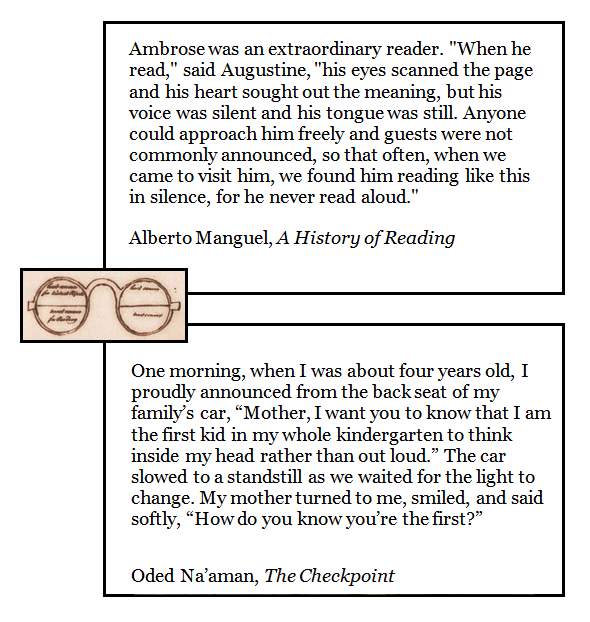
Silent reading, silent thinking, bifocal glasses

Thursday, July 26th, 2012

[ by Charles Cameron — two forms of creativity: far out and close in ]
.


.
Some of the most obvious things aren’t obvious at all, until you think of them. The things my friend Derek Robinson talks about as being in the beforeground. Too close to notice / right under our noses all along.
.
And I think that’s one of the principles of creative thinking — a lot of creative detailing takes place out on the bleeding edge, where someone pushes the limits of existing knowledge that little bit farther, and sometimes those insights can be revolutionary. But profound revelations also come from questioning the most basic assumptions — as Cambridge University Press blogged last year, celebrating the centenary of the Russell-Whitehead Principia Mathematica, vol II:

Principia attempted to ground mathematics in logic and the authors left no stone unturned in their attempt to create the ultimate definition of mathematics. For example, they were well into volume two before they had proved that one plus one equals two! They concluded their proofs with the laconic statement: “The above proposition is occasionally useful.”

BTW, that’s a point I also addressed in the context of my work on social entrepreneurship for the Skoll Foundation:

IMO, we need some funding sources that understand that the next significant breakthrough, too, will be all but invisible — and who therefore look specifically for projects that are categorized by their radical rethinking of the seemingly known and obvious.

**

For anyone who’s curious, the bifocals pictured in the tiny “specs” section of my graphic above come from Ben Franklin‘s original letter proposing the idea of bifocal glasses, courtesy of the Library of Congress (link is to complete image).

The Odel Na’aman story, The Checkpoint: Terror, Power, and Cruelty is up at the Boston Review site. I haven’t read it yet, just tasted the first paragraph.

There are times when it helps to have bifocal (contrapuntal) vision…

At the round earths imagin’d corners

Friday, July 20th, 2012

[ by Charles Cameron — mapping, holding two worldviews in mind at one time, a conductor’s score, complexity thinking ]
.


.

About a year ago, the Atlantic reported that the Library of Congress had been given a map of the flat earth, designed according to Biblical principles — yet showing knowledge of the border between the United States and Canada…

Thanks to a post from Jason Wells, I saw it today.

The view that the earth is flat is one worldview, of course, and no longer the prevailing one. As Nicholas Jackson noted at the Atlantic:

The interesting thing about the map is that it was created about 120 years ago by Orlando Ferguson, then a practicing physician in Hot Springs [South Dakota]. This is more than 500 years after most educated people gave up on the idea of the Earth as flat and accepted the spherical viewpoint first expressed by the Ancient Greeks.

**

It is, however, possible to hold two worldviews in mind at the same time. John Donne manages it in the first line of his extraordinary poem, written at a time when the two views were clashing:

At the round earths imagin’d corners, blow

AT the round earths imagin’d corners, blow
Your trumpets, Angells, and arise, arise
From death, you numberlesse infinities
Of soules, and to your scattred bodies goe,
All whom the flood did, and fire shall o’erthrow,
All whom warre, dearth, age, agues, tyrannies,
Despaire, law, chance, hath slaine, and you whose eyes,
Shall behold God, and never tast deaths woe.
But let them sleepe, Lord, and mee mourne a space,
For, if above all these, my sinnes abound,
‘Tis late to aske abundance of thy grace,
When wee are there; here on this lowly ground,
Teach mee how to repent; for that’s as good
As if thou’hadst seal’d my pardon, with thy blood.

Donne accomplishes the task of holding two worldviews in mind at one time with four simple words: “round earths imagin’d corners”.

**

I don’t know how many melodic “lines of thought” the mind can hold in counterpoint at once. I do know it’s an important cognitive skill for us to cultivate. A classical conductor must surely be able to hold as many lines as there are in this page of Olivier Messaien‘s Oiseaux:

As I pointed out in a recent comment here, “somewhere above three and before eleven there’s a point — Miller’s ‘magical number seven, plus or minus two‘ where the human mind can’t hold any more detail, so that’s a cut-off of sorts.”

Well, Messaien clearly imagines the conductor’s mind can follow more than eleven paths…

**

And then there’s Bob Milne.

I’ll let the Philosophy Compass take it from here:

Bob is predominantly known for his piano concerts of Ragtime and Bogie-Woogie music – and was given the moniker of ‘National Treasure’ by the United States Library of Congress. It was at one of these concerts that drew the attention of Penn State neuroscientist Kerstin Bettermann. At his concerts, Bob often carries on conversations, telling stories and jokes, while simultaneously modulating key signatures over the polyrhythmic Ragtime music. In their broadcast, Radiolab discusses with Dr. Bettermann why this is so surprising.

Language use and musical competency often use the same neural resources: the prototypical language areas in the left hemisphere of the brain, and the working memory circuit that keeps information available and rapidly accessible for a short-period of time. Our ability to use language and engage with music should, on most models of the brain, be competing for these neural resources and interfere with one another. Not so with Bob – he appears to be able to tackle both tasks with ease. Further, while most people can approach this kind of competency in multi-tasking, it usually involves many learning trials, a process of sedimenting the learning into what psychologists call procedural memory, which may have its roots in a different brain region, the cerebellum. But Bob can hear a tune just once, and play it back with commentary.

But that’s not all Bob can do.

In their interview, Dr. Bettermann heard Bob claim something extraordinary. He claims not only to be able to hear a symphony in his head, but that he normally does this with two symphonies simultaneously. Where most individuals would only hear a cacophonous mess – Bob claimed he could dial the relative volume of either symphony up or down, and could zoom in or out of individual instrumentations. To return to the considerations above, Bob further states on the Radiolab website that he does this while driving – another procedural memory task and presumable source of interference. But when Dr. Bettermann challenged him, Bob reluctantly claimed that he could probably do the same (not while driving, mind you) with four simultaneous symphonies.

The claim is something like this: Bob states that he can hold and listen to four symphonies with different keys, instrumentation, tempo and style in his working memory at the same time. And what is stunning is that when they put Bob into an fMRI machine, they verified his claim. Bob could be stopped at any time during his imaginative trip through the four simultaneous symphonies, and hum out the exact phrase that the original recording would be on. Remarkable.

**

This in turn takes us back to that point Edward Said made, which gave me the basic concept for my Said Sympohony (must get back to that soon):

When you think about it, when you think about Jew and Palestinian not separately, but as part of a symphony, there is something magnificently imposing about it. A very rich, also very tragic, also in many ways desperate history of extremes — opposites in the Hegelian sense — that is yet to receive its due. So what you are faced with is a kind of sublime grandeur of a series of tragedies, of losses, of sacrifices, of pain that would take the brain of a Bach to figure out. It would require the imagination of someone like Edmund Burke to fathom.

Edward W. Said, Power, Politics, and Culture, p. 447 — from the section titled “My Right of Return,” consisting of an interview with Ari Shavit from Ha’aretz Magazine, August 18, 2000.

I asked in a post yesterday how good we now are at modeling or simulating ideas in the “war of ideas” — just for a moment, suppose we could think through all complex geopolitical issues in this polyphonic, contrapuntal way…

**

Okay, you deserve a reward for faithful reading if you’ve come this far with me. Here’s the incomparable Richard Burton reading Donne’s poem — the text is up above, if you want to follow along:

A host of lessons on the web, with room for admiration

Thursday, June 14th, 2012

[ by Charles Cameron — Farrall and McCants, debate and discourse]
.


.

There’s a whole lot to be learned about jihad, counter-terrorism, scholarship, civil discourse, online discourse, and social media, and I mean each and every one of those, in a debate that took place recently, primarily between Leah Farrall and Will McCants.

Indeed, Leah still has a final comment to make — and when she makes it, that may be just the end of round one, if I may borrow a metaphor from a tweet I’ll quote later.
.

1.

Briefly, the biographies of the two main agonists (they can’t both be protagonists, now, can they? I believe agonist is the right word):

Dr. Leah Farrall (left, above) is a Research Associate at the University of Sydney’s United States Studies Centre (USSC). She was formerly a senior Counter Terrorism Intelligence Analyst with the Australian Federal Police (AFP), and the AFP’s al Qaeda subject matter specialist. She was also senior Intelligence Analyst in the AFP’s Jakarta Regional Cooperation Team (JRCT) in Indonesia and at the AFP’s Forward Operating Post in response to the second Bali bombings. Leah has provided national & international counter terrorism training & curriculum development. She recently changed the name of her respected blog. Her work has been published in Foreign Affairs, Foreign Policy, The Atlantic, and elsewhere.

Dr. William McCants, (right) is a research analyst at the Center for Strategic Studies at CNA, and adjunct faculty at Johns Hopkins University. He has served as Senior Adviser for Countering Violent Extremism at the U.S. Department of State, program manager of the Minerva Initiative at the Department of Defense, and fellow at West Point’s Combating Terrorism Center. He edited the Militant Ideology Atlas, co-authored Stealing Al Qa’ida’s Playbook, and translated Abu Bakr Naji‘s Management of Savagery. Will has designed curricula on jihadi-inspired terrorism for the FBI. He is the founder and co-editor of the noted blog, Jihadica. He too has been published in Foreign Affairs, Foreign Policy, The Atlantic and elsewhere.
.

2.

Gregory Johnsen, the Yemen expert whose tweets I follow, noted:

Watching @will_mccants and @allthingsct go at it, is like watching heavyweights spar for the title about 17 hours

Daveed Gartenstein-Ross commented on the civility of the exchanges:

it was an excellent model of argument within this sphere. Competitive analysis is important, and it is generally best when conducted in the open, as this has been. Further, the exchange has been respectful and collegial, something that is atypical for today’s debates.

Between those two comments, you have the gist of why this debate is significant — both in terms of topic and of online conduct.
.

3.

The debate started with a blog post by Leah, went to Twitter where the back and forth continued for several days, was collated on Storify, received further exploration on several blogs, turned sour at the edges when an article on Long War Journal discussing Leah’s original blog post draw some less than civil and less than informed drive-by remarks in its comments section, and continues…

And to repeat myself: all in all, the debate is informative not only about its topics — issues to do with terrorism and targeting — but also in terms of what is and isn’t possible in online dialog and civil discourse on the web.
.

4.

Leah Farrall’s Some quick thoughts on reports Abu Yahya al-Libi has been killed was the counter-intuitive (but perhaps highly intuitive) blog post which began the debate, and perhaps her key paras were these:

And if he has in fact been killed, I wonder if those who think this is a victory (and those supporting the strategy of extrajudicial killings more generally) have given ample thought to the fact that he along with others who have been assassinated were actually a moderating force within a far more virulent current that has taken hold in the milieu. And yes, given his teachings I do note a certain irony in this, but sadly, it’s true.

What is coming next is a generation whose ideological positions are more virulent and who owing to the removal of older figures with clout, are less likely to be amenable to restraining their actions. And contrary to popular belief, actions have been restrained. Attacks have thus far been used strategically rather than indiscriminately. Just take a look at AQ’s history and its documents and this is blatantly clear.

I say, “counter-intuitive” because, as Leah herself notes, this is not the received opinion — “Right now you’re probably scoffing at this” she writes. And I say intuitive because Leah may be the one here who whose insight comes from herself not the crowd, who sees things from a fresh angle because she has a more wide angle of vision, who is in fact intuiting a fresh and revealing narrative…

Not that she’s necessarily right in this, and not that it would be the whole picture if she was — but that she’s challenging our orthodoxies, giving us food for thought — and then, having read her, we need to see how clearly thought out the response is, how strongly her challenge withstands its own challenges… how the debate unfolds.
.

5.

I am not going to summarize the debate here, I am going to give you the pointers that will allow you to follow it for yourselves.

It is very helpful indeed for those who are interested in this unfolding debate, that Khanserai has twice Storified the initial bout of tweets between Farrall and McCants.

Khanserai’s second Storify is the one to read first, as it offers the whole sweep of several days of tweeting. That’s the full braid. Khanserai’s earlier Storify is worth reading next. It concerned itself solely with Leah’s significant definitional distinctions regarding discriminate vs indiscriminate targeting and targets vs victims.

There’s a lot to read and even more to mull right there, but the persevering dissertation writer for whom this is the ideal topic will then want to read a number of significant posts triggered by the debate:

Jarret Brachman was among the first to comment on al-Libi’s reported demise, in a post titled In a Nutshell: Abu Yahya’s Death. I don’t know if his post appeared before or after Leah’s, but his comment is congruent with hers:

The cats that Abu Yahya and Atiyah had been herding for so long will begin to wander. They will make mistakes. They will see what they can get away with. Al-Qaida’s global movement cannot endure without an iron-fisted traffic cop.

I look forward to Brachman’s comments on al-Libi’s “other important role: that of Theological-Defender-in-Chief for al-Qaida”. Another day…

McCants’ On Elephants and Al-Qaeda’s Moderation posted on Jihadica first paraphrases Farall:

Leah argues that the US policy of killing senior al-Qaeda Central leaders is wrongheaded because those leaders are “a moderating force within a far more virulent current that has taken hold in the milieu.” Leah compares these strikes to the practice of killing older elephants to thin a herd, which leaves younger elephants without any respectable elder to turn to for guidance as to how to behave. By analogy, killing senior al-Qaeda Central leaders means there will be no one with enough clout to rein in the younger generation of jihadis when they go astray.

He then argues that while there “might be good reasons not to kill al-Qaeda Central’s senior leaders with drones but their potential moderating influence is not one of them” — and proceeds to enumerate and detail them. His conclusion:

It is hard to imagine a more virulent current in the jihadi movement than that of al-Qaeda Central’s senior leaders. Anyone with a desire or capability of moderating that organization was pushed out long ago. AQ Central may have moderated in how it conducts itself in Muslim-majority countries, but it certainly hasn’t moderated toward the United States, which is what has to be uppermost in the minds of US government counter-terrorism policymakers.

Other responses worth your attention — and I know we’re all busy, but maybe this is an opportunity to dig deeper something that shouldn’t only concern those in search of a dissertation topic — would include:

Daveed Gartenstein-Ross’s The Strategy of Targeting al Qaeda’s Senior Leadership posted at Gunpowder and Lead contains the most thoughtful counterpoint to Leah’s point that I have found:

contrary to Farrall’s argument, a strategic opponent actually seems far more dangerous than an indiscriminate opponent

Clint Watts should be read and pondered, too. His post, It’s OK to Kill Senior al Qaeda Members in Pakistan, tackles Leah’s position from several angles, one of which focuses on her “law enforcement” perspective on terror:

I am with Leah that in an ideal world, it would be great to capture, convict and imprison terrorists. This approach only works when there are effective criminal justice methods for implementing it.

I wonder how he views military vs law enforcement attempts to corner Joseph Kony, but that’s off topic. To return..

Bernard Finel, too, posted a thoughtful piece on The Unsatisfying Nature of Terrorism Analysis, and wrapped up his post with the words:

In short, I’ll keep reading Farrall, McCants, and GR because they are smart, talented folks. They know a lot more than I do. But I can’t help by feel that there just isn’t enough there to make their arguments convincing on a lot of scores.

Those are the heavyweights weighing in, as far as I can see — feel free to add others in the comments section. But then…
.

6.

But then there’s Andrew Sullivan in The Daily Beast, asking Are Drones Defensible? in what I found to be a lightweight contribution. As I read it, Sullivan’s key question is:

if you’d asked me – or anyone – in 2001 whether it would be better to invade and occupy Afghanistan and Iraq to defeat al Qaeda, or to use the most advanced technology to take out the worst Jihadists with zero US casualties, would anyone have dissented?

as if such a hypothetical — asking about popular opinion rather than ground realities, which are a whole lot more complicated either way — was the right question to be asking. And his conclusion, interesting but unsubtle: “drones kill fewer innocents”.
.

7.

Oh, lightweight is more or less okay in my book, as is the strong affirmation of a strong position.

The editors at Long War Journal clearly feel strongly about Leah’s suggestion, and make no bones about it in a post titled US killing moderate al Qaeda leaders, like Abu Yahya, says CT analyst — which I don’t think is quite what Leah was saying — and opens with the sentence “This is one of the more bizarre theories we’ve heard in a while.”

That, you’ll notice, is a pretty bluntly phrased attack on Leah’s ideas, not her person. But what follows is interesting.

In the comments section at LWJ we see comments like “I assume this young lady is paid for her thoughts. If so by whom? Is she the ACLU lawyer? If so when was her last interview with Abu Yahya al Libi” and “Leah Farrall is one of these many Peter Panners who form a loosely knit confederation of self identified intellectuals with little or no understanding of violence & of those presently arrayed against ‘us'”…

You don’t see comments like those on the other sites I’ve mentioned, and to my mind they show surface ignorance of the deep knowledge that informs the main participants on both sides — and perhaps as a corrollary, the absence of the civility that characterizes the debate as a whole.
.

8.

My own interest in terrorism / counterterrorism is explicitly limited to the ways in which theological drivers manifest, and while I read a fair amount about the broader issues into which theology enters, I’m no expert, humble and (inside joke) for the moment at least, more or less clean-shaven.

I am waiting for Leah Farrall’s response to the debate thus far, but have no expectation of being the best proponent of any of the positions or nuances involved: I leave that to the experts, and am glad they are on the case, every one of them.

Two broad context pieces that have caught my attention:

Francine Prose, Getting Them Dead in the NY Review of Books
Patrick B. Johnston, Does Decapitation Work?

For myself, then, the main point here is to acknowledge the knowledge and insights of those who know what I can only guess, or perhaps catch out of the corner of my eye. The second lesson: that there’s much to be found in Joseba Zulaika‘s book, Terror and Taboo: The Follies, Fables, and Faces of Terrorism.

Even a brief glimpse of the book when Leah mentioned it has convinced me once again that Zulaika’s is a voice worth attending to.
.

9.

But wait, I am a Howard Rheingold friend, I’m concerned with dialog and deliberation and decency in discourse, not just terrorism and CT — and here I have no need for disclaimers.

What I learn here is that attentive listening to all (the folks in the comments section included) brings knowledge, that incivility frequently accompanies ignorance, and — I hope you will forgive me going all aphoristic here — that nuance is an excellent measure of insight..

This is a debate to admire and follow.

The crackling energy of a Sembl move

Sunday, June 10th, 2012

[ by Charles Cameron — cross-posted from Sembl ]
.

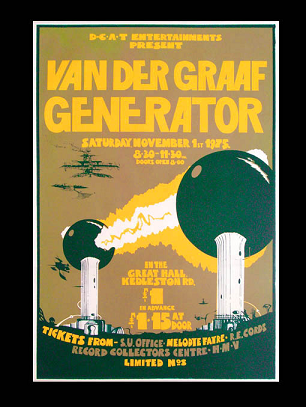
image credit The Movie Poster Art Gallery / http://www.rock-explosion.com/catpage2.html


.

1.

I’m always looking around for ways to describe the leap between two ideas (concepts, people, events, things) that occurs when you make a move in a Sembl game. On the game board, the ideas are shown as circles and the links as lines between them.

In the case of the museum version, the “ideas” are objects in the Museum’s collection – but the same principle applies whether we’re talking objects, concepts, events or people: entities of whatever type go in the circles, the lines between them signify the exploration of their resemblances and differences.
.

2.

Okay.

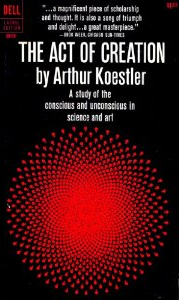
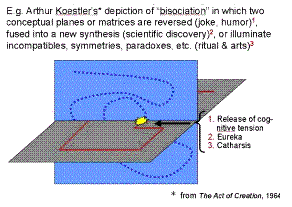
In more technical terms, Arthur Koestler in his classic book about the conceptual structure of creativity, The Act of Creation, diagrammed the intersection of two conceptual frames as representing the place where the joyous aha! of discovery, the gasped ah! of tragedy or the delightful ha! of laughter is generated, and this more recent version of his diagram gets the essence:


.

3.

But wait!

There’s a lot going on here, there’s a distinct leap – think: creative leap, even perhaps leap of faith.

It was the leap between two ideas – electricity and magnetism – that gave Faraday his dynamo, Maxwell his equations, and the modern world almost its whole existence. It was the leap between two ideas – modular forms and elliptic equations – that gave Taniyama his conjecture and Wiles his proof of Fermat‘s Last Theorem.

The leap that intuits similarities, particularly rich similarities between rich concepts in widely separated fields, is the most powerful tool of the thinking mind – and playing Sembl amounts to nothing more or less than a repeated, playful, delightful invitation to make leaps of exactly that kind.

So a Sembl leap of resemblance can be anything from training wheels for creativity to a prize-winning long-jump at the conceptual Olympics.
.

4.

Maria Popova at Brainpickings quotes Steve Jobs:

Creativity is just connecting things.

And she quotes James Webb Young, back in 1939:

Consequently the habit of mind which leads to a search for relationships between facts becomes of the highest importance in the production of ideas.

This isn’t some hidden secret, but it’s not exactly common knowledge either, it’s not something many schools teach — which is why the great anthropologist Gregory Bateson famously told his fellow Regents at the University of California:

Break the pattern which connects the items of learning and you necessarily destroy all quality.

Which is also why Eliot Eisner, Stanford professor and former President of the American Educational Research Association, said of Sembl’s precursor HipBone Games, “the cognitive processes you are interested in developing are critical to a decent education”.
.

5.

And just what does this have to do with Van der Graaf Generators, you might wonder?

There’s a cracking sense of energy discharged when you connect two ideas in a Sembl game move – not unlike the discharge of energy between the spheres of two Van der Graaf Generators picture here:

Imagine the spheres as two ideas in place on a Sembl game board, and the electrical discharge as the excitement of seeing how they mesh together to create that ah!, aha! or ha!

Or watch the whole, ultra-short video from which that image was taken, courtesy of the folks at MIT:


Switch to our mobile site