zenpundit.com » literature

Archive for the ‘literature’ Category

Of the importance of form in intelligence: I

Wednesday, October 3rd, 2012

[ by Charles Cameron — form as pattern recognition, the form of suicide / martyrdom ops, a format for analysts, first in a series on form in intelligence, and maybe the beginnings of an eccentric thinking manual for analysts ]
.

Bear with me for a paragraph or two, while I try to sort something out.

Form is to content as algebra is to arithmetic: does that work for you? Form is one degree more abstract than content: how about that? I don’t think either of these expressions quite captures what I want to say about form and content, but they may help us think about form. Here’s a form:

It’s pretty clearly a diagram of connections of some sort, but exactly what those connections are is unclear as long as the various boxes in the diagram remain empty.

I could fill it with the names of members of a hippie commune that practiced a flexxible approach to free love over a decade or two, from when the founder bought the farm (in the literal sense of real estate) to the point where the last surviving member bought the farm (metaphorically speaking — the farm in the sky).

Or with the names of elements in the human digestive and energetic system…

I mention the latter, because I came across this particular (empty) diagram on a blog post by a certain Jacques Chester about how people get fat, where it was preceded by the words:

A better diagram for bodyweight control will resemble a great big mess

I won’t tell you where I got the other idea from, if you want to know you’ll just have to fantasize, as I did.

**

At least in this case, form means pattern. The diagram above is a pattern, fill it with appropriate verbal or other content and you’ll give it meaning — which can then be disputed or accepted. But the form, the patterning, is somehow antecedent to any particular content.

Take the last words of each line of Shakespeare‘s Sonnet XCVII and you’ll get:

been, year, seen, everywhere, time, increase, prime, decease, me, fruit, thee, mute, cheer, near.

The rhyme scheme is pretty clear: ABAB CDCD EFEF GG.

That’s a form, and all of Shakespeare’s sonnets follow it. Petrarch‘s sonnets by contrast follow the rhyme scheme ABBA ABBA CDECDE.

**

In my practice of thinking, as a poet and as a practitioner of the open source analysis of scriptural sanctions for religious violence, I find the recognition of forms — pattern recognition — to be my central process.

I think what first really brought this home to me was the similarity of form between two reports of terrorist training activities — each in its own way illustrating the idea that the activity to be performed will begin quite naturally on earth, where training is required, but end quite supernaturally in paradise, where it isn’t:

That one’s pretty obvious, right? I mean, if you’ve seen the first instance you would be pretty likely to remember it if you ran across the second…

And what the form means is pretty clear too — martyrdom ops, suicide ops.

But what if you had a note-pad on your desk — or better, a game format on your computer — that gave you those two boxes, free of specific data, and any time you found a weird or anomalous data-point or image you could scribble it or drag-n-drop it into that form, give it a name for easy retrieval, and keep your eyes peeled for parallels, opposites, similars?

I call that format SPECS, by the way, because it allows you to see two similar ideas stereoscopically, so to speak, and thus gain an extra dimension — neat trick, eh?

What if collecting SPECS was part of your training as an analyst, and you practiced the form a few hundred times and kept 150 mind-blowing examples — as Shakespeare did with his ABAB CDCD EFEF GG sonnets?

**

Why, you’d be training yourself in pattern recognition — formal thinking — horizontal thinking — lateral thinking — analogy — thinking by leaps and bounds.

Inteligence happens in the Intelligence Community, and in the human population as well. I can’t speak to the ways in which animal and plant mimicry, or the artistry of birdsong, correspond to pattern recognition, although that would be a fascinating topic for another post.

What I can say is that analogical, horizontal, cross-disciplinary thinking is in its own away more powerful than logical, rational, vertical, silo-bound thinking.

**

In terms of Intelligence and intelligence, the strategies of linear / vertical thinking are like your fingers: it’s your skill at lateral / horizontal thinking that gives your mind an opposable thumb.
Aurora, Samarra, Vermont…

Tuesday, July 24th, 2012

[ By Charles Cameron — the gun issue, complexity, human beings being humans and the world we live in ]
.

As always, I’m a fence-sitter bridge-builder, not wanting to take sides, preferring to talk with them.

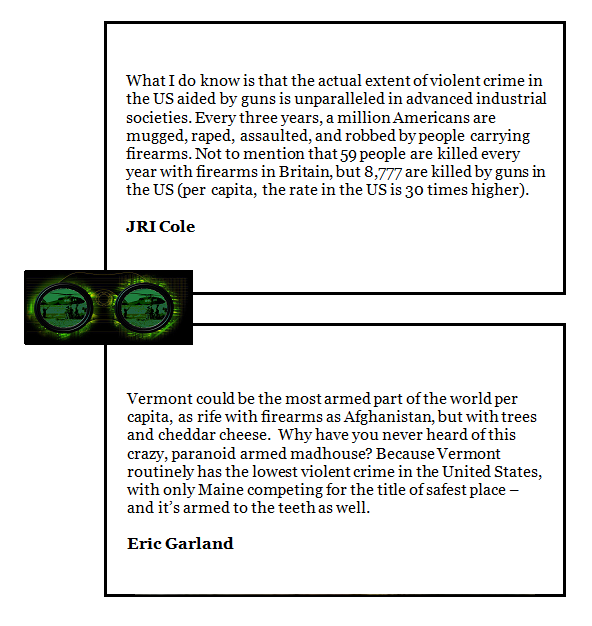
The irritating beauty of these two quotes is that either one taking separately might seem like a “case closed” argument in favor of guns or gun control — but taken together, they show the world to be a dappled place.

Here’s the lead-in to that Vermont quote:

One facet of Vermont life is neither famous nor quaint: Vermonters are armed to the teeth. Guns are absolutely everywhere. Rifles. Pistols. Shotguns. Muzzle-loaders. Semi-automatics. 50 caliber tripod-mount “semi” automatics that could take out aircraft. Every firearm you can possibly imagine. Vermont could be the most armed part of the world per capita, as rife with firearms as Afghanistan, but with trees and cheddar cheese…

Things are weird that way: just when you think you’ve got them figured out, there’s an exception to the rule… a black dot in the white part of the yin-yang symbol… an anomaly that challenges the easy paradigm.

Dappled, as Hopkins puts it.

**

Pied Beauty
by Gerard Manley Hopkins, SJ
.

GLORY be to God for dappled things—
For skies of couple-colour as a brinded cow;
For rose-moles all in stipple upon trout that swim;
Fresh-firecoal chestnut-falls; finches’ wings;
Landscape plotted and pieced—fold, fallow, and plough;
And áll trádes, their gear and tackle and trim.

All things counter, original, spare, strange;
Whatever is fickle, freckled (who knows how?)
With swift, slow; sweet, sour; adazzle, dim;
He fathers-forth whose beauty is past change:
Praise him.

**

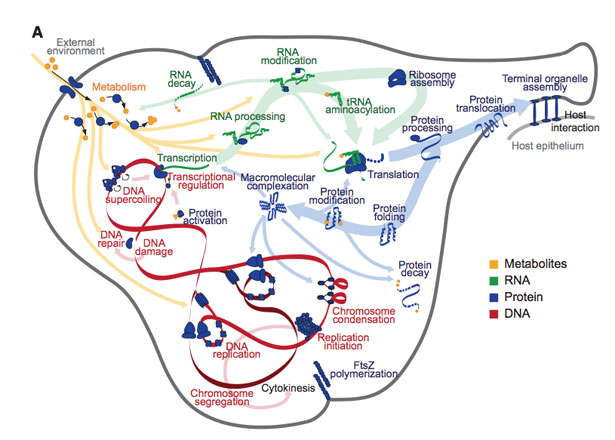
The world is complex: scientists using microscopes and a suite of 128 computers recently (and triumphantly) managed to simulate the genome of one of the smallest micro-organisms in the world, Mycoplasma genitalium (neat name, that):

Alexis Madrigal (another neat name, btw) writes:

“Right now, running a simulation for a single cell to divide only one time takes around 10 hours and generates half a gigabyte of data,” lead scientist Covert told the New York Times. “I find this fact completely fascinating, because I don’t know that anyone has ever asked how much data a living thing truly holds.”

One cell. One division. Half a gig of data. Now figure that millions of bacteria could fit on the head of a pin and that many of them are an order of magnitude more complex than M. genitalium.

Yup. So think how complex the world is. No wonder we name things, divide stuff up into categories — use quite a large chunk of our brains for making distinctions.

But then think how complex the humans studying M. genitalium (still like that name, but this’ll be the last time I mention it) themselves must be… As Madrigal (really a nice name, you can almost sing it) goes on to point out:

Or ponder the idea that the human body is made up of 10 trillion (big, complex) human cells, plus about 90 or 100 trillion bacterial cells. That’s about 100,000,000,000,000 cells in total. That’d take a lot of computers to model, eh? If it were possible, that is.

**

Complexity looks at complexity with a view to modeling it. Simple, you think? Complex, you’d say?

The world’s a subtle place, and I might just go live in Vermont.

But people get shot in Vermont too, from time to time — there’s always a black and bleeding bullet-hole in the white half of the yin yang symbol — this world is hopelessly dappled.

And you know that story Somerset Maugham tells about Samarra?

There was a merchant in Bagdad who sent his servant to market to buy provisions and in a little while the servant came back, white and trembling, and said, Master, just now when I was in the marketplace I was jostled by a woman in the crowd and when I turned I saw it was Death that jostled me. She looked at me and made a threatening gesture, now, lend me your horse, and I will ride away from this city and avoid my fate. I will go to Samarra and there Death will not find me. The merchant lent him his horse, and the servant mounted it, and he dug his spurs in its flanks and as fast as the horse could gallop he went. Then the merchant went down to the marketplace and he saw me standing in the crowd and he came to me and said, Why did you make a threating getsture to my servant when you saw him this morning? That was not a threatening gesture, I said, it was only a start of surprise. I was astonished to see him in Bagdad, for I had an appointment with him tonight in Samarra.

Idries Shah tells a version of the same story as “When Death Came to Baghdad” in his Tales of the Dervishes, but with Samarkand rather than Samarra as the fatal destination.

It just might be the same with Vermont.

Numbers by the numbers: four

Wednesday, July 18th, 2012

[ by Charles Cameron — importance of the ratio form (“this is to that as thus is to so”) as a bridge between domains and silos, creative leaps, the glass bead game, and finally, Chittick’s joke about camels, sex and translations from the Arabic ]
.

.

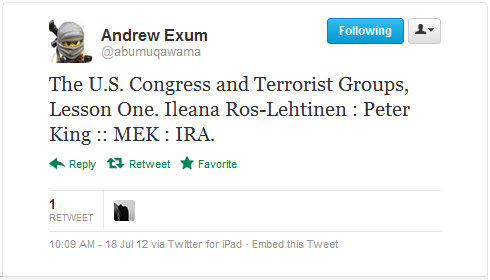
I retweeted this tweet of Andrew Exum‘s to my friend Paul Pilkington because I know he’s working on a project to find out what “this is to that” is to some other “this is to that” — across a wide swathe of human culture.

Note particularly that Exum is using this formal device to illuminate, to give insight, in an area of importance to analysts, strategic thinkers and decision makers.

I’m also retweeting Exum to Paul because I believe Paul’s simple experiment, based as it is on his reading of Hermann Hesse‘s Glass Bead Game, has the capacity to build an architecture of thought (a) crossing all disciplines and (b) spanning the trivial with the profound.

I’m doing something similar with Cath Styles in our Sembl games project — but this time I want to concentrate on Paul’s approach, and since there are four moving parts in an a is to be as c is to d configuration, I’m calling this post Numbers by the numbers: four — number three will just have to wait a while.

**

To get a sense of what Paul is up to, we can go to his Twitter Project page, which describes the fourth in a series of books he’s writing — and also follow him on Twitter, where he posts as Just Knecht.

Two of Paul’s recent tweets express his sense of the task pretty incisively:

The whole of language is the holding up of one unlike thing to compare, contrast and connect with another

Curating is a matter juxtaposition of work against work, artist against artist, place against place – A.Searle on Documenta 13, The Guardian

On his Twitter Project Page, he tells us:

Each tweet is an individual Glass Bead Game move, which is a comparison (metaphor, simile or analogy) across different areas, and may be either a statement or a question.

In question form, these are not unlike analogy questions from SAT tests with an additional dimension of general knowledge, cultural invention and intellectual playfulness. The basic challenge is to work out the relationship between two terms in one context, and apply it in another. Sometimes a tweet will extend an analogy further, which would be the beginning of forming a larger game from an individual move.

Some of the most interesting moves do not have right or wrong answers. Some have canonical or original answers, but they’re not necessarily right. In fact, very often I will post something I’ve picked up from elsewhere which I would love to see improved on, challenged, or at least better explained by others.

He then poses some of the sorts of questions that intrigue him:

Who is the J.H.Prynne of contemporary dance? Like Prynne in contemporary poetry they need to have been ‘out there’ right at the edge of theory and practice for some time, and also deeply steeped in tradition at the same time. Merce Cunningham? Suggestions welcome … And Heston Blumethal or Ferran Adrià might be the Prynne of cookery. But what about the Prynne of contemporary warfare?

What is the equivalent of sonata form in architecture? Goethe and Hegel both said ‘architecture is frozen music’ but neither really explained what they meant. If it is, then is there an architectural equivalent in Western architecture of the key structural form in Western art music? Suggestions welcome …

So, Zenpundit readers — who is the JH Prynne of contemporary warfare?

**

Not so long ago, in Numbers by the numbers: one, I posted a series of self-referential tweets that I’d collected over the last month or two — here I’d like to present some of Paul’s recent tweets:

Let’s start with one that’s a foreign policy insight, arguably as significant to day as it was when Vance first said it:

16 Jul @justknecht
“The Strait of Hormuz is the jugular vein of the West” (Cyrus Vance)

If these tweets can be timeless, they can also be timely:

4 Jul @justknecht
The Higgs boson is the quantum of the Higgs field, just as the photon is the quantum of the electromagnetic field

As they accumulate over time, they can build a conceptual “mesh” that engages an entire field — in this case, recent classical music — while linking it to a variety of other areas:

16 Jul @justknecht
“Boulez’ Derive 2 sounds like birthday cakes ought to” – Philip Clark, Gramophone

22 Jun @justknecht
Wagner was a beautiful sunset that was mistaken for a dawn – Claude Debussy, quoted by Geoffrey Norris in Gramophone

30 May @justknecht
Fauré’s Theme and Variations (no. 9) is like an evening star falling slowly from the sky – Bryce Morrison cites Alfred Cortot in Gramophone

11 May @justknecht
Kraftwerk is the Warhol of pop music – The New Yorker

There’s profundity here:

9 Jun @justknecht
“Space is to place as eternity is to time.” – Joseph Joubert

This could be, as Paul says, “the beginning of forming a larger game from an individual move” — that quote in itself could plausibly be the keystone of an architecture bridging science with religion…

There are historical parallels to consider:

31 May @justknecht
Robert Burton : Oxford :: Jeremy Prynne :: Cambridge

Catty remarks by Nobel laureates:

21 May @justknecht
“Thinking is to humans as swimming is to cats” (Nobel laureate Daniel Kahneman)

Near-tautologies:

21 May @justknecht
Macon Telegraph: Recipes are to food as blueprints are to buildings.

And, ooh, exotic forms of slander!

18 May @justknecht
“[Your daughter] has lovers as numerous as the striking of tablas on Palm Sunday” – Arabic satire by Abu Nawas, 756 – 813 AD

Once again, it’s form that generates insight, not content. Get used to form, play around with it, and content will leap out at you from the page, from the screen.

**

I’m no Arabist myself, but ah! that last quote reminds me irresistibly of the difficulties faced by translators from the Arabic, as recounted by William Chittick in The Self-disclosure of God: Principles of Ibn Al-‘Arabi’s Cosmology (SUNY Press, 1998, pp. xxxv-xxvi.)

An old joke among orientalists tells us that every Arabic word has four meanings: It means what it means, then it means the opposite of what it means, then it has something to do with sex, and finally it designates something to do with a camel …. The rational mind tends to push the meaning of a word away from experience to ‘what it means’ but the imaginal mind finds the self-disclosure of the Real in the sex and the camel … it is in the world’s concrete realities that God is found, not in its abstractions.

I’d been looking for an excuse to post that quote on Zenpundit — now I’ve found it!

A chilling reminder

Wednesday, July 11th, 2012

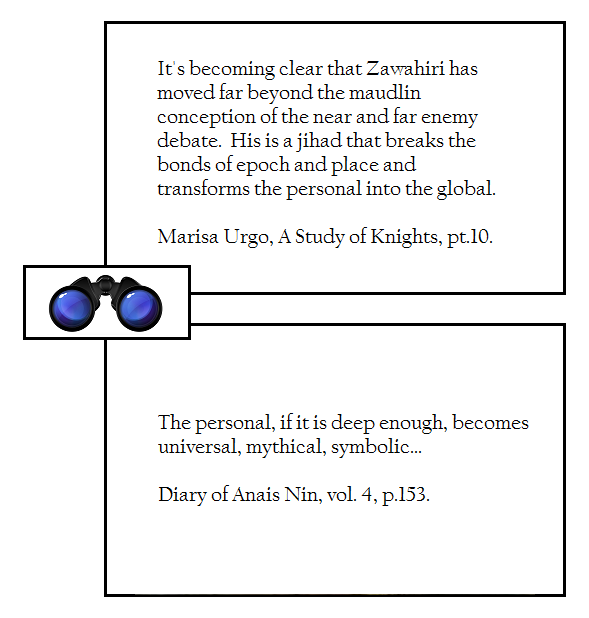
[ by Charles Cameron — Marisa Urgo on Zawahiri ]
.

I have long been familiar with the second quote in this pair, the one by Anais Nin, and regard it as one of the touchstones of my understanding of the creative process. Anais Nin is exactly right in thinking that in terms of the arts, it is the deeply felt personal detail that profoundly touches the artist’s audience, and thus becomes universal.

It was therefore with quite a shock of recognition that I read Marisa Urgo‘s latest post in her series on Zawahiri‘s Knights Under the Banner of the Prophet. If Zawahiri’s spiritual autobiography draws this sort of response from an analyst giving it a close reading, it’s likely something we should be paying attention to.

.

.

Marisa’s series thus far can be read in reverse order here.

Book Review: Thucydides:The Reinvention of History by Donald Kagan

Thursday, July 5th, 2012

Thucydides: The Reinvention of History by Donald Kagan 

Donald Kagan, who has been a professor of history and classics at Yale University almost as long as I have been alive has written a provocative book about Thucydides that challenges both conventional scholarly wisdom regarding the man who shares the title of “The Father of History” and the purpose of the book Thucydides meant to be “a possession forever”, The Peloponnesian War. In Kagan’s interpretation, Thucydides is the father of historical revisionism whose careful methodology furthered a political agenda: to defend the record of the Periclean state in Athens, where democracy was moderated by the wise statesmanship of the old aristocratic elite; and lay the blame for the downfall of Athens at Spartan hands on the vulgar hubris of radical democracy of mob and demagogue.

Thucydides is tightly focused argument about Thucydidean omissions, juxtapositions and treatment of sources and bias in his analytical rendering of military events and debates in the Assembly, not a comprehensive examination of  The Peloponnesian War. Specifically, the treatment of Pericles and Nicias (whom Kagan argues Thucydides favors and whom Kagan blames for failures of strategy and execution, especially the latter) vs. that he meted out to Cleon, Alcibiades and Demosthenes. Kagan criticizes Thucydides for the deliberate omission of speeches of Periclean opponents in debates where he  had been present and purporting to know the thoughts of actors where definitely had been absent, in exile; of faulty military analysis of the situation of the Spartan garrison besieged on Sphacteria due to personal enmity with Cleon and of the original expedition to Syracuse, because of favortism toward Nicias.

On Nicias in particular, a fellow aristocrat in favor of strategic restraint whom Kagan ascribes blame for the disaster in Sicily, did Thucydides seek a radical revision of the contemporary Athenian opinion. It was Thucydides belief that the post-Periclean democracy was a reckless, superstitious and greedy mob that led him, Kagan argues, to craft his narrative as an apologia for the inept statesmanship and incompetent generalship of Nicias that brought Athens to utter ruin in Sicily. Kagan’s accusations of bias on Thucydides part are more persuasive than his contention that the original expedition to Syracuse of sixty ships was a justifiable and sensible endeavor.

Kagan’s charges against Thucydides indirectly raise the larger question of politics in postwar Athens. A democracy shorn of it’s empire, long walls and fleet, defeated in external war but triumphant in brutal civil strife over it’s internal oligarchic enemies, was in all likelihood a dangerous place. Xenophon felt as a follower of Socrates, who had been associated with the reviled Alcibiades and Critias, that it was politic to leave Athens for his march upcountry under the banner of Cyrus. Socrates was unjustly put to death by the democratic faction. Writing from retirement in the luxury of a distant estate was a wiser option for a man of Thucydides’ opinions in that era than a return to the political fray in Athens and in part, would explain his supposed “revisionism”.

Strongly recommended.


Switch to our mobile site