zenpundit.com » Zen

Archive for the ‘Zen’ Category

The Pillar of Cloud and the Pillar of Fire

Thursday, November 15th, 2012

[ by Charles Cameron — IDF terminology and the Gaza conflict, explanations of Exodus, an IDF video, Megillah 10b and the koan “with God on our side” / “with God on all sides” ]
.
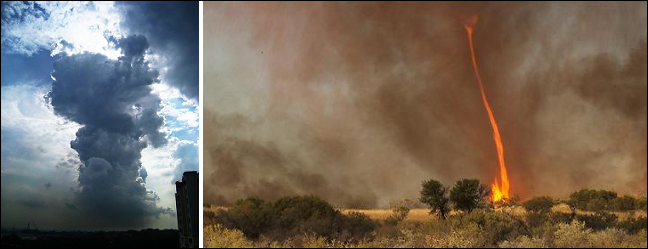
photo credits: Schristia, Cloud; Chris Tangey, Fire

.

I’m curious.

The IDF calls today’s Israeli operation in Gaza “Operation Pillar of Defense” in English, but as John Cook points out in Gawker, uses the term Hebrew term “Pillar of Cloud” in Hebrew.

There’s a great deal of interest here, apart from the difference between their use of non-Biblical terminology in English and Biblical terminology in Hebrew. One point that catches my ear, a poet being a poet, is that the phrase “Pillar of Cloud” is in fact only one half of a double reference…

Thus in Exodus 13.21-22 we read:

And the LORD went before them by day in a pillar of a cloud, to lead them the way; and by night in a pillar of fire, to give them light; to go by day and night: He took not away the pillar of the cloud by day, nor the pillar of fire by night, from before the people.

**

There are various ways of understanding the pillar of cloud and pillar of fire, but it’s pretty clear that there’s only one pillar —

And it came to pass, that in the morning watch the LORD looked unto the host of the Egyptians through the pillar of fire and of the cloud… [Exodus 14.24]

which is called a pillar of cloud by day and a pillar of fire by night, perhaps simply because we are speaking of theophany — the Divine Presence made visible — perhaps because smoke from a brazier is more visible in daylight and flames at night — perhaps because as Hans Goedicke, then chairman of the department of Near Eastern Studies at Johns Hopkins, suggested, the source of both fire and smoke was the eruption of Santorini around 1600 BCE.

The difference in worldviews behind those explanations alone is a matter of considerable interest.

**

Linguistically, however — and this is where the poet being a poet comes in — there are two pillars, and I have to wonder whether the name “Pillar of Fire” is being saved for a later and perhaps more impressive (“shock and awe”) operation, or — in line with the “by day and by night” distinction — refers to the covert side of the same op?

Not that anyone would be likely to give me that information, or that I’d have any use for it if they did.

But the Biblical phrasing is powerful, and “Pillar of Defense” doesn’t make a whole lot of sense — besides, cloud and fire go together in Hebrew in much the same way smoke and mirrors do in English.

Of the three choices, I’d have gone with “Pillar of Fire” myself.

**

An IDF spokesperson, in a response to Cook’s Gawker article, claimed:

I think that every example of Bible quotes you cited has defensive connotations, rather than “vengeful.”

One of those quotes is Exodus 14:24, which I quoted above but will now give in full, along with verse 25:

And it came to pass, that in the morning watch the LORD looked unto the host of the Egyptians through the pillar of fire and of the cloud, and troubled the host of the Egyptians, and took off their chariot wheels, that they drave them heavily: so that the Egyptians said, Let us flee from the face of Israel; for the LORD fighteth for them against the Egyptians.

I think calling that “defensive” is a bit one-sided, but on the other of the two hands in question, so is calling it “vengeful”.

The Israelites saw themselves in the larger context as escaping Egyptian oppression, the Egyptians obviously considered themselves under attack in the short term — just as surely as the people of Gaza must feel under attack by the oppressive Israelis today, while the Israelis clearly feel under attack by terroristic Hamas and its rockets. But hey, the IDF spokesman only offered his explanation that the Pillar of Cloud and Defense was “defensive” as “Just my two cents”…

FWIW, those two verses from Exodus sound just a little like Quran 33.26:

And He brought down those of the People of the Book who supported them from their fortresses and cast terror in their hearts; some you slew, some you made captive. And He bequeathed upon you their lands, their habitations, and their possessions, and a land you never trod. God is powerful over everything.

That’s an ayat that has always interested me, because of the use of the word “terror” found in a number of translations including this one, by AJ Arberry — others have “awe” or “panic”, but “terror” is interesting in the context of its contemporary usage.

**

Here’s the current strike counter strike in two tweets:

**

Okay, let’s get as close to visceral as modern technological warfare permits. After the recent truce was broken and numerous rockets fired into Israel, the IDF fired a missile that killed Hamas military leader Ahmed Jabari, and quickly put the video feed up on YouTube:

**

People are killing and getting killed. Should that be a matter for concern, or delight?

The narrative from which the IDF drew the name of their campaign in Gaza is taken from that of Israel’s escape from Egypt in Exodus, which also includes the parting of the waters and destruction of the Egyptian army:

And the angel of God, which went before the camp of Israel, removed and went behind them; and the pillar of the cloud went from before their face, and stood behind them: And it came between the camp of the Egyptians and the camp of Israel; and it was a cloud and darkness to them, but it gave light by night to these: so that the one came not near the other all the night. And Moses stretched out his hand over the sea; and the Lord caused the sea to go back by a strong east wind all that night, and made the sea dry land, and the waters were divided…. [Exodus 14.19-21]

And it came to pass, that in the morning watch the Lord looked unto the host of the Egyptians through the pillar of fire and of the cloud, and troubled the host of the Egyptians, And took off their chariot wheels, that they drave them heavily: so that the Egyptians said, Let us flee from the face of Israel; for the Lord fighteth for them against the Egyptians. And the Lord said unto Moses, Stretch out thine hand over the sea, that the waters may come again upon the Egyptians, upon their chariots, and upon their horsemen. And Moses stretched forth his hand over the sea, and the sea returned to his strength when the morning appeared; and the Egyptians fled against it; and the Lord overthrew the Egyptians in the midst of the sea. [Exodus 14.24-27]

Here again we see an instance of what I have called the two-fold logic of scriptures: In the Babylonian Talmud, Megillah 10b, R. Johanan tells us:

The ministering angels wanted to chant their hymns, but the Holy One, blessed be He, said, The work of my hands is being drowned in the sea, and shall you chant hymns?

to which R. Eleazar responds:

He himself does not rejoice, but he makes others rejoice.

**

To my mind, what we’re looking at here is a global koan: the immediate and eternal paradox of life and death.

But more on koans shortly.
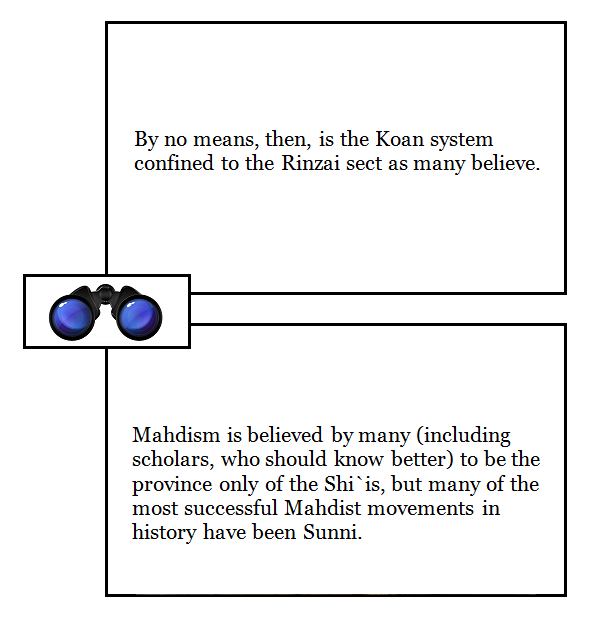
Details, nuances and blind-spots…

Sunday, November 4th, 2012

[ by Charles Cameron — Zen, Mahdism, and the importance of details ]
.

If you hear the phrase, “Details, details” from time to time, you may have noticed it is often accompanied by a sigh.


.

I’m never quite clear on which came first, the saying “God is in the details” or the saying “the Devil is in the details” — but whichever it is, the details are where you’ll find it.

I ran across Philip Kapleau Roshi’s comment on koans (above) in his classic book, The Three Pillars of Zen, the other morning, and it sent me from Zen by rapid mental transit to Mahdism — one of the other termini in my mental system — and to the quote fro m Tim Furnish, one of many to the same effect, which I’ve juxtaposed to it.

If you still think Ahmadinejad (Shiite), and only Ahmadinejad, in terms of Mahdism, then you’ve missed the general point that Furnish is rightly making — and the specific point that Al-Qaeda (Sunni), and not only Al-Qaeda but many Sunnis are also liable to hold strong Mahdist expectations — Abu Musab al-Suri among them.

Because the Whichever-it-is is in the details, the details are the nuances and — when we make decisions without knowing the details, we’re liable to sail right into our blind-spots.

**

Now if you go to a zen master for instruction, you may or may not bee taught shikantaza (“just sitting”) or given a koan (“meditation paradox”) — both descriptions are simplistic; Kapleau Roshi’s book will take you deeper — but one way or another you’ll soon find out, and hopefully you and the master in question can figure things out.

If, on the other hand, you don’t know that Mahdism may be a Sunni as well as a Shiite phenomenon, watch out!

Amplified Mahdist expectation transforms the mental “set” of a jihadist from someone “fighting the good fight” in a generalized way into someone who believes the fight they are fighting is the Culminating War of Good against Evil.

Which, as Furnish’s article’s title, What’s Worse than Violent Jihadists? suggests, is a whole lot more intense.

**

I argued for taking “wide-angle view” at the end of my recent post, Sensitive dependence on initial conditions — here. I’m at the other end of a mental zoom, arguing for precise and nuanced focus on distinctions.

As with Hayakawa‘s Ladder of Abstraction, it pays to be able to work both ends of the spectrum — from the detailed specifics of “my cow Bessie” abstract statistical generalities of “livestock in Colorado” — and beyond.

Ladders will feature one of these days in a “form is insight” post of their own — Hayakawa’s Ladder, and William Blake‘s, and Herman Kahn‘s.

**

Details have their own details, and details are essentially differences — so there’s a lot of zooming in and out to do before you gain clarity. In Gregory Bateson‘s terms, you want to be clear on the differences that make a difference.

Form is Insight: the project

Monday, October 22nd, 2012

[ by Charles Cameron — about the (not yet titled) book (or post-book project) i seem to be writing, which offers a grand slam intro to an array of box-free contemplative and artistic approaches to creative thinking, and hence opens fresh angles on intelligence ]
.

One thing I can promise: whatever this project turns out to be, it won’t be predictable.

credit for this incredible image: Roger Dean

.

This project won’t take you over familiar territory, congratulating you on holding the same opinions as the author and adding in enough choice details to keep you interested. I’m not aiming to teach you the same thing you already know, only better, more interestingly, more precisely, or in greater detail. I’m aiming to question you, challenge you, and give you a whole new range of optics through which to view the world.

**

So, here we go.

I think I am finally at the point where the book (or whatever it is) I’ve been gathering inside me all these years is ready to be written. Some of it has already emerged in earlier posts here on Zenpundit — you don’t known and couldn’t count how many thanks, Mark — and this is certainly where I’ve been developing the style of integrated visuals and verbals that gives the project its flavor — so I’d also like to use my posts here to discuss the thing with you as I go along.

The project is about intelligence in the widest sense, including heart and mind, and with particular focus on creativity. I’m addressing this from two standpoints that mesh together well, and I’m addressing it to two audiences that I believe also mesh together well.

The standpoints are (i) meditation and (ii) the arts, and the audiences are (i) the “intelligence community” and (ii) bright people in general.

I believe that meditation cultivates a spacious mind-set in which we can hold multiple concerns in mind at the same time – the opposing needs of different people, stakeholders, sections of society, the environment, etc – thus seeing things from multiple angles and in balancing & thus balanced ways. And I think the arts serve as the primary means for expressing these balances with all their nuances and shadings, and that techniques from within the arts such as polyphony, chiaroscuro, formal constraint and pattern can teach us to shape multi-faceted insights like these into rich and complex understandings – complex patterns that respond to complex situations. I’ll go into all this in detail as we move along, with examples.

I also believe that this kind of creatively patterned insight — embodying artistic methodology in the context of complex problems with a “fresh” and open mind – will be of interest beyond the intelligence agencies and policy-makers, to business people, artists, and also — importantly — the bright general public, which I take to be a far larger subset of the population than we commonly think, and always eager for reading that doesn’t talk down to them but appreciates their own intelligence and good will.

For now let me just say that I’m very excited, because this seems (at last) to be a project that ties together my game-work with Sembl, the think-tank side of me which has been monitoring religious violence, jihad and terror and working towards nuance, understanding and peace these last dozen years — and my sense of creativity as a writer and poet.

Ripeness is all: I suspect the time for this venture has arrived.

**

Here’s the single page overview I’ve written, with a working title:

Intelligence is Zen: understanding our complex world with koans in mind

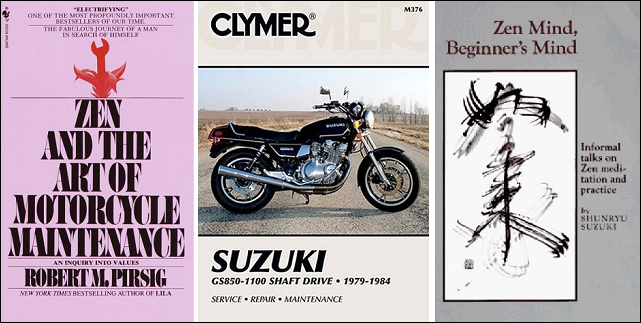
Just a few days ago, the Director of National Intelligence, James Clapper, referenced Pirsig‘s book, Zen and the Art of Motorcycle Maintenance, as key to the Intelligence Community’s work in understanding and adapting to the many, varied, intersecting problems we face in the world today. As I noted, Clapper was focused a bit more on the biker wisdom than the Zen to be found in Pirsig’s book, but he does raise a question I’ve been addressing for some years now:

What does the contemplative mind have to offer in terms of understanding a complex world?

To my mind, the creativity which is all the buzz of the business world, aimed at solving what are called “wicked problems” — problems that feature multiple stakeholders with multiple aims and objectives, aims and objectives which themselves shift over time so the problems are “never the same river twice” – requires a major mental and emotional shift. Reverie and meditation free us up to make the shift: the shift itself is poorly understood.

Our present, mostly linear way of thinking favors either/or side-taking, dubious cause-and-effect expectations which fail to take complex feedback loops into account, followed all too often by a rush to judgment. We need a whole new – old, even ancient – way of thinking.

Our problems are complex because they overlap, they ripple through one another. In Buddhist terms, they are “interdependently arising.” Not surprisingly, the way of thinking that is required to gain a deeper insight into “interdependently arising” problems can be found in explicit form in such contemplative traditions as Madhyamika & Zen, Taoism, Sufism, and their Abrahamic contemplative analogs. At the heart of these systems is fresh thinking – thought refreshed by quiet.

Furthermore, the shaping of insights in an open field of thought is something the world’s artistic traditions have long dealt with, and there are schools of insight not just available but recorded in exquisite detail in the world’s traditions of poetry, music, painting, theater, film… in patterns that are found in nature, in culture, and in the very turbulence we now must learn to flow with.

The project therefore takes a meditation-influenced approach to intelligence, both in the sense in which Clapper would use the word, relating to the intelligence analysis which develops and influences our decision-makers’ understanding of what’s needed, and in the more general sense of those capable folk with bright minds, keen insights, sharp instincts, warm hearts.

I’ll propose a series of ways of looking differently – with application for anyone, whether artist, intel analyst, businessman, policy-maker, or lover – that cut to the essence of creativity: lateral, analogical, holistic thinking, witnessing pattern beneath the surface of things. My examples will be mainly drawn from terrorism, which I have been monitoring for a dozen years: my style is that of a poet and an eccentric Englishman.

My subtext, my subliminal message, will be contemplation and artistry as profound common sense.

One hand Clapping: or is the DNI a Zen Pundit?

Monday, October 15th, 2012

[ by Charles Cameron — silos, motorcycles, zen and the DNI ]
.


.

Pam Benson writing at the CNN Security blog may or may not have had anything to do with the title of her post, Spy chief gets Zen, but she’s presumably responsible for her first paragraph:

You usually don’t associate spying with being Zen, but that’s exactly what the nation’s chief intelligence officer did this week at an intelligence gathering in Orlando, Florida.

Here at Zenpundit we’re naturally prone to both Zen and Punditry, so we like that — but to be honest it’s a little over the top. I’m dropping his entire keynote in at the bottom of this post, but for now let’s just say instead that DNI James R Clapper gets bikers.

Okay, maybe we can go a little further, and say he gets Zen and the Art of Motorcycle Maintenance. That’s not quite Zen, but it’s getting closer. Kristin Quinn‘s piece at Trajectory magazine is titled GEOINT 2012: Zen and the Art of Intelligence, which at least pays hommage to Pirsig’s book, and focuses on Pirsig-zen as it applies to Intelligence…

And that’s a direction we can applaud.

Two questions, then: what is zen, and what is intelligence?

**

Zen is, strictly speaking:

A direct transmission outside the Scriptures,
Not dependent on words and letters,
Directly pointing to one’s own mind
Seeing into one’s own nature.

Those words, however, are something of a scripture, so the transmission isn’t in them — it’s one of those things like ceaseless change, always there, never the same, flexible beyond the capacity of words to capture it — as Laozi remarked at the start of the Dao De Jing, in scribbled response to a border guard who demanded that his scriptures be verbal — “dao ke dao, fei chang dao” — two Chinese phrases English can barely translate.

Where do we go from here, then, if we’re accustomed to think in words?

The zen master Shunryu Suzuki Roshi has one answer in the title of his book Zen Mind, Beginner’s Mind.

Zen takes you back to where your mind is fresh and playful, before it got narrow-minded, siloed and rutted. Zen means wide-angle alertness, from a point prior to preference, assumption and prejudice.

Zen takes your thoughts and emotions to the laundry, while you take a shower. They come back lighter and cleaner, and you’re freshened up and ready to go.

**

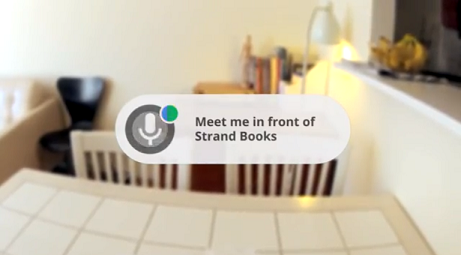
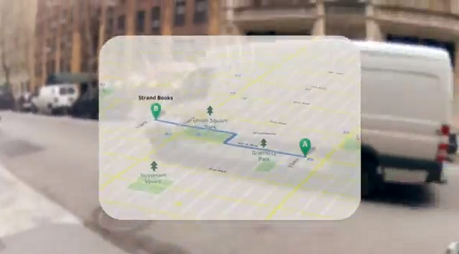
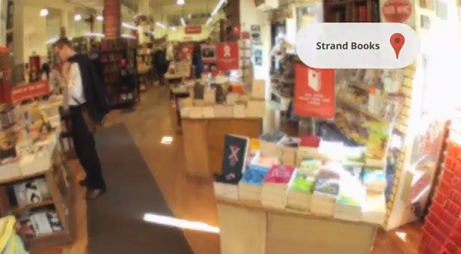
Let me put that another way, using the analogy of Google glasses. Zen takes you behind words: you can still see them, you can see through them. Very quickly, then, since 5 images are worth 5,000 words and take a lot less time to ingest:

Wearing some futuristic Google Glasses, you would be able to…

Let your glasses know you want to go to the Strand Bookstore (great idea, btw!):

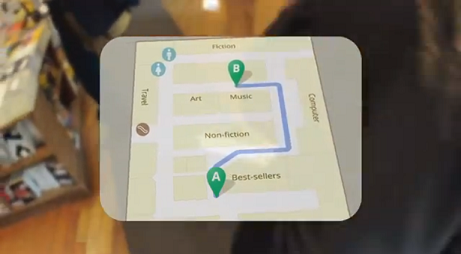
Get yourself a quick map from there to here, visible but superposed on your natural ability to see the street:

Know when you’ve arrived at the bookstore (a) because you can see the books and (b) because your glasses tell you so.

Use a map to navigate to the Music section:

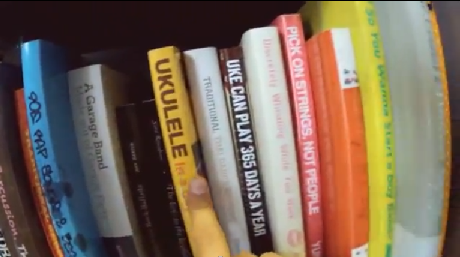
And locate the Ukulele shelf:

When IMO you’d be better off reading about Johann Sebastian Bach — though that’s a matter of personal taste.

With zen, your thoughts and emotions are like head- and heart-mounted displays — you can see them, they can inform your understanding, but you can also see through them, they’re transparent. You can see the world.

**

I’m going to suggest my own definition of intelligence: it’s the ability, given some data point or points, to recognize a variety of salient patterns into which it or they fit, and to create a synthetic understanding of how to move, given that all those salient pattern-fields are in play.

It is seeing in depth, past the surface, where the surface is your assumptions and expectations, and depth is the currents and undercurrents of nuance that your expectations hide.

Let me say that another way: assumptions and preferences — taking sides, being on a team — deprive you of depth. And another: the opposite of surface / superficial thinking is depthful thinking / pattern-recognition.

That, in a nutshell, is why I feel intelligence and zen “go together” even more seamlessly than zen and bikers.

**

Here’s Clapper’s speech:

**

In a future post, I hope to tackle the question of koans — those strange zen riddles, of which the best known may be…

What is the sound of one hand clapping?

An Afghan Buddha koan

Friday, October 5th, 2012

[ by Charles Cameron — for Madhu ]
.

Our friend Madhu has requested that I post poems here on occasion, and this particular poem made me think of her and her request, so here it is:

A copper and gold koan
.

The world happened, the world is drifting away,
the farther away the world floats the deeper into the mists.

In Mes Aynak, Afghanistan, the remains
of a buddhist monastery already eroded by time are adrift,
a sitting buddha is floating into the mist,
headless, gold paint still on his knees and robe,
the devotion has drifted, lifted its focus
to the one without a second, the buddha left
whatever he left in memory, lingering, to gather aromas
of other ideas, realms, dust, archaeology, oblivion,
there is change, ceaseless change,

and adults must decide: is the wealth implied by the copper
beneath the buddha worth more than a trace of halo,
as the moon moves once again across a brilliant night sky.

.
Koans are those brilliant paradoxes zen buddhism uses to pry the mind open, I think they’re important aids to handling complexity, and I have a post about them coming up shortly. Here, it’s enough to say that the issue of copper mining vs archaeology in Mes Aynak seems to me to be a living, breathing koan.

**

It’s awkward, when you write an “ekphrastic” poem, a poem about a painting or photo, to have the image right there when the poem is read, because it trammels the reader’s mind in much the same way that a film can trammel the mind of a reader into “seeing” only the film-maker’s Gandalf, no longer her or his own.

And I’m going on at some length about this, because next up is the image from which that particular poem was built, but I’d like the image to be, as they’d say in the newsprint world, “below the fold” as you read the poem.

So here it is, #4 in a fine series of photos in a Foreign Policy photo essay which I recommend, although I’ve taken this particular (smaller) version from a CNN page, since the subtitle in the lower right corner explains the basic situation handily:

You can hear the archaeologist Brent Huffman, who took the photo, talk about the situation here — local reactions pro and con, who the Taliban are shooting at, the likelihood that the Chinese operation will in fact benefit the locals and more:

The koan of balancing material with immaterial values remains, but in this circumstance the likelihood of local Afghans receiving litter or nothing from the mining project likely tips the scales.

You can petition Afghan President Hamid Karzai for preservation…

But then he’s another wild-card in the continuing Great Game, isn’t it?


Switch to our mobile site