zenpundit.com » Zen

Archive for the ‘Zen’ Category

Mountains and Rivers [with or] Without End

Sunday, April 15th, 2012

[ by Charles Cameron — just poetry — Gary Snyder, Han Shan, Dogen, Thoreau, Smokey & MIT ]

Gary Snyder is the fellow in the upper panel with the mountains behind him. Han Shan — whose name means Cold Mountain, which was also the name of the place he lived — is the fellow showing a poem to his friend in the lower panel. Dogen Zenji is the fellow who gave us the Mountains and Rivers Sutra. Thoreau is the fellow who retired for a while to Walden Pond. Smokey the Bear you know. And MIT is where Gary Snyder received the Henry David Thoreau Prize last Tuesday.

All are worthy of your attention, but in combo they’re unbeatable.

 
MIT:

MIT’s an interesting place to crop up in an account of Snyder — a poet, a Californian living high and away in the Sierras, and one of the first westerners to sit Zen and study in a monastery in Japan… And yet it’s curiously appropriate. Snyder is not here to banish science with poetry, but to enhance poetry with science, science with poetry, and both with his keen eye for context and honest detail.

He’s interested in weather. Understanding weather is in all our interests, but Snyder is actively interested. He’s interested in mountains and rivers, which comes to much the same thing — and he would surely have been interested in this exhibit that opened at MIT on Friday, just three days after his award ceremony there:

I dropped this image in here because it shows mountains and glaciers — but not without end. The loss of glaciation would concern Snyder — we know he’s interested in such things both immediately and in the long term, not only from his ecological writings in prose, but also because there’s a section of his epic Mountains and Rivers Without End that opens with these words:

“The 15 billion cubic kilometers of water on the earth are split by photosynthesis and reconstituted by respiration once every two million years or so.”

Even on that time-scale, Snyder’s interest in such things is personal: that section is titled We Wash Our Bowls in This Water.

So that’s the MIT part of the package.

 
Han Shan:

The terrific tale [link includes poems, too] of how a Chinese official learned that Han Shan and Shih-te, his laughing companion pictured above, were in fact great bodhisattvas though they looked like vagabonds could have come straight out of Jack Kerouac‘s Dharma Bums days. The official describes Han Shan:

He looked like a tramp. His body and face were old and beat. Yet in every word he breathed was a meaning in line with the subtle principles of things, if only you thought of it deeply. Everything he said had a feeling of Tao in it, profound and arcane secrets. His hat was made of birch bark, his clothes were ragged and worn out, and his shoes were wood. Thus men who have made it hide their tracks: unifying categories and interpenetrating things.

And here he describes how he arranged for the publication of Han Shan’s poetry:

I ordered Tao-ch’iao and the other monks to find out how they had lived, to hunt up the poems written on bamboo, wood, stones, and cliffs – and also to collect those written on the walls of people’s houses. There were more than three hundred. On the wall of the Earth-shrine Shih-te had written some gatha (Buddhist verse or song). It was all brought together and made into a book.

Gary Snyder it was, by the way, who turned Kerouac and the Beats onto Buddhism, and who features as Japhy Ryder in Kerouac’s Dharma Bums.

 
Gary Snyder:

Here’s Snyder again:

The first question that arises for me when I see photos of Gary Snyder like the ones above, I’ll admit, is whether it’s somehow axiomatic that his face should be as creased and rugged as the mountains he loves.

That’s a question for the intuition, really — but it may be worth noting that Emily Bronte saw a similar yet somewhat different correspondence between face and land and mentioned it in Wuthering Heights:

Catherine’s face was just like the landscape – shadows and sunshine flitting over it in rapid succession; but the shadows rested longer, and the sunshine was more transient; and her poor little heart reproached itself for even that passing forgetfulness of its cares.

People, and their eventual likeness to the places they live?

Let’s take this a little deeper. With respect to mountains, rivers and sages specifically, the great zen master Dogen teaches us in his Mountains and Rivers Sutra:

From time immemorial the mountains have been the dwelling place of the great sages; wise ones and sages have made the mountains their own chambers, their own body and mind. And through these wise ones and sages the mountains have been actualized. However many great sages and wise ones we suppose have assembled in the mountains, ever since they entered the mountains no one has met a single one of them. There is only the actualization of the life of the mountains; not a single trace of their having entered remains.

 
Dogen Zenji:

Dogen composed the Mountains and Rivers Sutra, which as far as I can tell is not available in book form except as a section of his longer work, the Shobogenzo. Snyder worked from 1956 to 1996 on his long poem series, Mountains and Rivers without End. The Cleveland Art Museum houses a scroll painting from the Northern Sung dynasty, Streams and Mountains Without End:

 
Translation — hey, second cousin to reincarnation?

An ancient Han Shan poem that’s also an early Snyder poem, Snyder here translating Han Shan:

I settled at Cold Mountain long ago,
Already it seems like years and years.
Freely drifting, I prowl the woods and streams
And linger watching things themselves.
Men don’t get this far into the mountains,
White clouds gather and billow.
Thin grass does for a mattress,
The blue sky makes a good quilt.
Happy with a stone under head
Let heaven and earth go about their changes.

Of both men you might say: the dwelling place is where the mind dwells.

 
Smokey the Bear:

Snyder has his own sutra. It is called the Smokey the Bear Sutra, and it’s both fierce and hilarious: I have a beautiful copy in storage somewhere, in the beautiful Fudo Trilogy edition, that Snyder kindly inscribed for me, “Well met”.

It contains the following gloss on mountains and rivers:

My obstinate compassion is schist and basalt and granite, to be mountains, to bring down the rain.

Science, mountains, weather patterns, rivers…

The poetry in Synder’s Mountains and Rivers has its rapids and still waters, its simple poetry and dazzling prose:

A day on the ragged North Pacific coast get soaked by whipping mist, rainsqualls tumbling, mountain mirror ponds, snowfield slush, rock-wash creeks, earfuls of falls, sworls of ridge-edge snowflakes, swift gravelly rivers, tidewater crumbly glaciers, high hanging glaciers, shore-side mud pools, icebergs, streams looping through the tideflats, spume of brine, distant soft rain drooping from a cloud,

sea lions lazing under the surface of the sea…

 
HD Thoreau:

Walden Pond is one of the great power centers of America Snyder mentions in the Smokey the Bear Sutra — and Snyder borrowed one of Thoreau’s lines for a poem of his own:

The sun is but a morning-star: each day represents a new opportunity to recover the nobility of life, another chance to turn aside from use to wonder.

Like Han Shan, Thoreau is among the ancestors. And as Thoreau’s own friend Emerson wrote, “The world is young: the former great men call to us affectionately.”

And what’s this about the former great men? Snyder goes way back before Emerson and Thoreau, and even Han Shan — he once said:

As a poet, I hold the most archaic values on earth. They go back to the late Paleolithic; the fertility of the soil, the magic of animals, the power-vision in solitude, the terrifying intuition and rebirth; the love and ecstasy of the dance, the common work of the tribe.

 
Now:

Perhaps that’s what keeps him relevant, fresh. Once again in Mountains and Rivers Without End he writes:

Alive       in the Sea of Information.

As are we all. How’s that for archaic meets MIT?
Going to Try this App

Sunday, April 15th, 2012

Paper for iPad


Simultaneity I: the palimpsest

Sunday, April 8th, 2012

[ by Charles Cameron — simultaneity in art, life, theology, war and thought ]
.

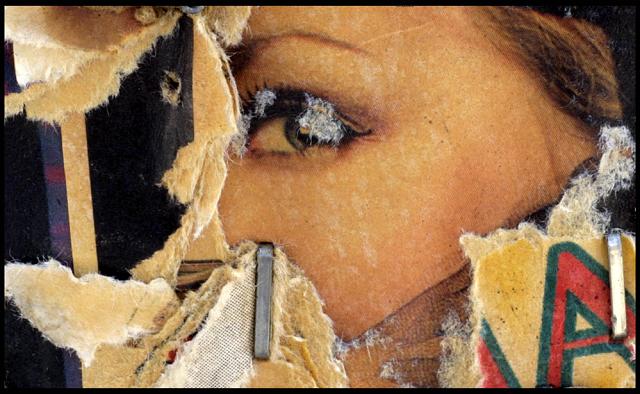
We rip up the past to make room for the present, we staple the present onto the past, we lose much of the meaning our words and images once had in fragments, snatches and colors…


image credit: MR McDonald

Even the staples eventually rust.

*

Still the past can at times be seen in the present, as earlier writing can still be seen in a palimpsest.

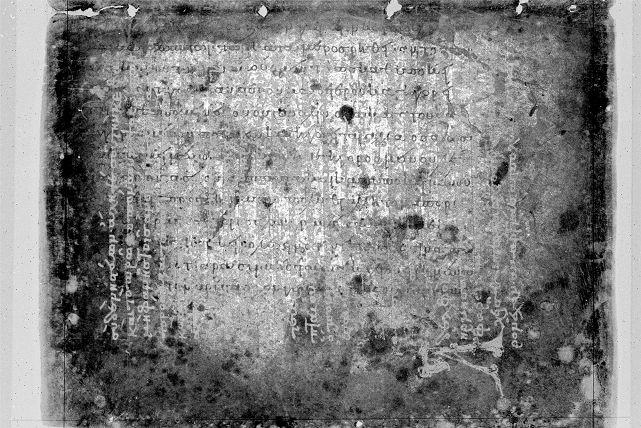
The Archimedes Palimpsest is [and I paraphrase] a Byzantine euchologion or prayer book manuscript, thought to have been completed by April 1229, and probably made in Jerusalem. Much of the parchment the scribes used in making the prayer book came from a earlier book of works by Archimedes, including his “On Floating Bodies” – a treatise of which no other copy survives. It seems the Archimedes manuscript dates back to tenth century Constantinople.


image credit: Archimedes Palimpsest Project

Erase Constantinople from your parchment, cut it and rotate it 90°, and you can build Jerusalem in its place. Peer deeply into prayer using multispectral imaging several hundred years later — and you may find combinatorial mathematics dating back more than two millennia…

What you are seeing in this image above is the workings of a mind two centuries BCE, transcribed in the tenth century CE, and made visible beneath and through other writing from the thirteenth, by twenty-first century tech.

So it is that Archimedes speaks to us today.

*

A palimpsest, then, is a layering of time on time, and the world we walk and talk in is itself a palimpsest.


image credit: MR McDonald

The enduring, you might say, can be seen through the transient — the zebra crossing through the snow.

*

To see two times at once — to see history, accurately or otherwise, as a metaphor for today — is to see simultaneously.

As in Sergey Larenkov‘s celebrated photos, in which World War II and the present day coexist:


image credit: Larenkov, Wrecked tank “Tiger” in Tiergarten park

[ edited to add: Larenkov takes black and white photos from WW II, shoots the same scene in color from the same position today, and masterfully stitches them together digitally to create an image that allows the ghost of the past to seen in the present — brilliant! ]

Here again, as in the magically surreal sculptures of Nancy Fouts, we see the power of mapping one thing onto a kindred other of which Koestler wrote.

*

To tie all this back into the question of Which world is more vivid? This, or the next?Stanley Hauerwas in his book, War and the American Difference: Theological Reflections on Violence and National Identity, suggests:

There is another world that is more real than a world determined by war: the world that has been redeemed by Christ.

He then clarifies his intent in saying:

The statement that there is a world without war in a war-determined world is an eschatological remark. Christians live in two ages in which, as Oliver O’Donovan puts it, “the passing age of the principalities and powers has overlapped with the coming age of God’s kingdom.” O’Donovan calls this the “doctrine of the Two” because it expresses the Christian conviction that Christ has triumphed over the rulers of this age by making the rule of God triumphantly present in the mission of the church. Accordingly the church is not at liberty to withdraw from the world but must undertake its mission in the confident hope of success.

*

Indeed, both Christianity and Zen would say that the greatest palimpsest is the palimpsest in which the transient circumstances of one’s life can all but obliterate the imperishable truth that underlies them — a palimpsest whose deepest layers may be read not with x-rays but by insight.

Christ lived in two times, or more accurately, time and eternity — to him the palimpsest was transparent, and thus he spoke (in John 8:58) what I suspect are the most profound five words in the Gospels:

Before Abraham was, I am.

Happy Easter!

The Said Symphony: move 19

Sunday, March 18th, 2012

[ by Charles Cameron – extended analytic game on Israeli-Palestinian conflict — for those who wish to catch up, our game thus far consists of an intro to the game and game board, followed by moves 1-5, 6-9, then moves 10-11 which together constitute a meditation, moves 12, 13-15, 16-17, and most recently before this, move 18 with cadenza ]

Move 19: The view from above

Move content:

Discussing strategy, the very canny LTG (USMC, Ret’d.) Paul Van Riper had this to say:

What we tend to do is look toward the enemy. We’re only looking one way: from us to them. But the good commanders take two other views. They mentally move forward and look back to themselves. They look from the enemy back to the friendly, and they try to imagine how the enemy might attack them. The third is to get a bird’s-eye view, a top-down view, where you take the whole scene in. The amateur looks one way; the professional looks at least three different ways.

A bird’s-eye view, a hawk’s eye view, a top-down view, an overview, a view from 30,000 feet, a God’s eye view, a view from above, a zoom…

If move 18 and its cadenza gave us a view of the depth of vision or insight that is necessary for a full and rich understanding of the world we live in — its qualitative or spiritual scope, if you like — this next move, with its picnic and drone-sight, addresses its breadth in space and time — materially and quantitatively speaking.

The classic expression of the sheer material scope of the universe was put together by Charles and Ray Eames in their justly celebrated film, Powers of Ten, from which the lower of these two images is drawn:

Here are some other relevant scans of the scope of things, in terms of time and space:

The Scale of the Universe 2
A Brief History of The Universe
The Known Universe
A Time-Lapse Map of Every Nuclear Explosion Since 1945

These are impressive videos to be sure, but as an aside I’ll invite you to ask yourselves how well they compare with this zoom in words, a poem by the zennist, ecologist, essayist and poet Gary Snyder, from his book, Axe Handles: Poems:

Such breadth of vision, such craft.

*

If this “material scope of things” too has a cadenza, it would be that all of this is shot through with some primary oppositions, dappled as the poet Gerard Manley Hopkins would have it, with swift, slow; sweet, sour; adazzle, dim — as indicated in the drone-sight and picnic double image at the head of this move.

This dappling, this constant flux of opposites, takes many forms — day and night lead to the more abstract light and dark, which can then be interpreted morally as good and evil, to which we respond with repulsion and attraction as the case may be, building our worldviews from love or fear…

At different scales the opposites that matter most to us may have different names and shadings, but here I’d just like to draw attention to the dappling of our world with:

competition and cooperation
Darwin‘s natural selection and Kropotkin‘s mutual aid
duel and duet (ah! — a favorite phrasing of mine)
war and peace

Provocatively, we find this dappling in scriptures, too, wherein the ripples of such verses as “The LORD is a man of war: the LORD is his name” (Exodus 15.3) dropped like a stone into the pond of the human mind, meet with the ripples of other verses such as “God is love; and he that dwelleth in love dwelleth in God, and God in him” (I John 4.16).

There are times when we take such oppositions literally, perhaps too literally, and times when we begin to see oppositions as abstract and theoretical end-points to what is in fact a yin-yang process continually unfolding…

Which brings me by a commodius vicus of recirculation to this image of the great opposition between war and peace, its dappling, its unfolding:

Links claimed:

To the Lamb, move 18: this move presents the material scope of the universe in counterpoint to its visionary scope as laid out in move 18 with its cadenza.

To Revelation, move 17 — the word revelation means unveiling, as we have seen, and our sciences and technologies, with their spectra of telescopes, microscopes, cameras and zooms, are unveiling and revealing to us much about the physicality of the world we live in — much that was accounted for in other times and places through intuition, vision and poetry.

This scientific and technical revelation of material existence, for many of us moderns, has largely eclipsed the mode of visionary revelation of move 17 — yet it cannot eradicate it. Implicit in this move, then, is the sense that we carry with us both subjective and objective, inner and outer, qualitative and quantitative understandings — though the data that “sight” and “insight” provide us with may be different in kind, and resolving them may be something of a koan to us, the deep problem in consciousness as philosophers of science have named it — and that we can discount neither one if we are to have and maintain a rich sense of our situation.

Comment:

If the two previous moves have shown us the scope of the universe we co-inhabit, perhaps we should now make our own zoom in, much as James Joyce did when he had the schoolboy Stephen inscribe his name and address in his geography book as Stephen Dedalus, Class of Elements, Clongowes Wood College, Sallins, County Kildare, Ireland, Europe, The World, Universe – an address that Stephen then read both forwards and backwards, finding himself in one direction, and finding in the other that he had no means of knowing what might lie beyond the universe…

Imagine then, skipping rapidly from (unimaginable) cosmos via such things as the intriguingly named End of Greatness to galaxy or nebula…

…solar system and planet — whence we can slow down and zero gently in on the Middle (or as my friend Ralph Birnbaum would call it, the Muddle) East, Israel / Palestine, Jerusalem / Al Quds / the Temple Mount / Noble Sanctuary – and to such matters of contemplative vision and tribal passion as the first, second and projected third Temples, the al-Aqsa mosque.

Our increasing focus will bring us, then, to that the rock which Jews believe marks the place where Abraham bound his son Isaac (the Akedah), and which Muslims believe to be the place of ascent of the Prophet to the celestial realms (the Mi’raj) on his Night Journey (Qur’an, Al-Isra).

Here again myth and history collide, and both visionary and material considerations merge in the heart of the what my friend the Israeli journalist Gershom Gorenberg has justly called “the most contested piece of real estate on earth”.

Iran is a classic wicked problem

Saturday, March 10th, 2012

[ by Charles Cameron — Iran, unknown unknowns, Madhyamika philosophy and a blessed unknowing ]
.


.
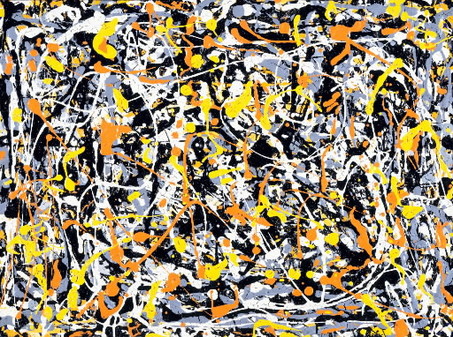
image from Jackson Pollock / AustinKids
an artist’s representation of a wicked problem to be untangled?

1.

Dr. TX Hammes, who will need no introduction to most ZP readers, wrote a few days back in On Bombing Iran, A False Choice:

While there has been some discussion of Iran closing the Straits of Hormuz, there has been no consideration of other Iranian actions – mining harbors overseas (using merchant ships), major attacks on oil production chokepoints globally or major terror attacks using the nuclear equivalent explosive power inherent in many industrial practices. In short, bombing proponents assume Iran will be an essentially supine enemy and not attempt to expand the conflict geographically or chronographically.

Iran is a classic wicked problem. Any “solution” brings a new set of problems. Lacking a solution, the strategist’s job is to think through how to manage such a problem.

My train of thought now departing the National Defense University on Dr Hammes’ platform will make its way with stops at Hans Morgenthau, Jeff Conklin and Richard Feynman to a final destination deep in the heartland of Buddhist Madhyamika philosophy with Elizabeth Mattis-Namgyel.

2.

Drs. Francis J. Gavin and James B. Steinberg‘s recent Foreign Policy piece The Unknown Unknowns carried the subtitle:

If the past half-century of American political history has taught us anything, it’s that we can’t possibly know the consequences of bombing — or not bombing — Iran

and opined:

Based on our experiences — one of us a former senior policymaker, the other a historian of U.S. foreign policy — we are convinced that the “right” answer, but the one you will never read on blogs or hear on any cable news network, is that we simply cannot know ahead of time, with any degree of certainty, what the optimal policy will turn out to be. Why? Even if forecasters could provide probabilities about the likelihood of a narrow, specific event, it is simply beyond the capacity of human foresight to make confident predictions about the short- and long-term global consequences of a military strike against Iran.

3.

It appears that this sense of unknowing has application beyond the specific question of whether or not to bomb Iran. Blog-friend Peter J Munson just the other day quoted Hans Morgenthau in a short SWJ piece titled Gentile: Realities of a Syrian Intervention — using a Morgenthau quote that he also features as an epigraph to his book, Iraq in Transition: The Legacy of Dictatorship and the Prospects for Democracy.

So that’s Iran, Iraq and Syria — but the Morgenthau quote itself, from his Politics among Nations, is even more general in application:

The first lesson the student of international politics must learn and never forget is that the complexities of international affairs make simple solutions and trustworthy prophecies impossible.

Okay?

4.

And it goes further. Love that quote from Laurence J Peters that Jeff Conklin uses as the epigraph to his seminal paper on Wicked Problems:

Some problems are so complex that you have to be highly intelligent and well informed just to be undecided about them

Next up, here’s the Nobel physicist Richard Feynman speaking in The Pleasure of Finding Things Out, a Horizon / Nova interview, illustrating the approach Morgenthau takes to international relations as applicable to the grand issues of philosophy, religion and science:

I can live with doubt and uncertainty and not knowing. I think it’s much more interesting to live not knowing than to have answers which might be wrong. I have approximate answers and possible beliefs and different degrees of certainty about different things, but I’m not absolutely sure of anything and there are many things I don’t know anything about, such as whether it means anything to ask why we’re here, and what the question might mean.

5.

And how far is that from Elizabeth Mattis-Namgyel, student and wife of the lama Dzigar Kongtrul Rinpoche, writing in her book on Madhyamika, The Power of an Open Question (p. 58):

Maybe experiencing complexity brings us closer to reality than does thinking we’ve actually figured things out. False certainty doesn’t finalize anything. Things keep moving and changing. They are influenced by countless variables, twists and turns … never for a moment settling into thingness. So maybe we should question the accuracy or limitations of this kind of false certainty. Conflicting information confuses us only when we’re trying to reach a definite conclusion. But if we’re not trying to reach a conclusion in the first place — if we just observe and pay attention — we may actually have a fuller, more accurate reading of whatever we encounter.

6.

Zen, too, welcomes this “open ended” approach in its working with koans, those mysterious and / or paradoxical riddles and / or poetic statements and / or legal cases for which such teachers as Dogen Zenji had such affection. In the words of Shozan Jack Haubner:

The searching, open-ended nature of koan work yields the kind of answer, however, that frustrates easy analysis, not to mention that most exquisite of all human pleasures: being “right.” For, ultimately, koan practice teaches that as long as a question is alive in the world around us, it should not — indeed, cannot — be settled once and for all within us. Koan practice does not put life’s deepest issues “to bed.” It wakes these issues up within us, waking us up in the process.

or consider this, from Lin Jensen, An Ear to the Ground: Uncovering the living source of Zen ethics:

Judgments on right and wrong are a nearly irresistible enticement to pick sides. And that’s exactly why the old Zen masters warned against becoming a person of right and wrong. It isn’t that the masters were indifferent to questions of ethics, but for them ethical conduct went beyond simply taking the prescribed right side. For these masters, the source of ethical conduct is found in the way things are, circumstance itself: unfiltered immediate reality reveals what is needed.

Policy-makers, of course, can’t suspend judgment indefinitely — but maybe a contemplative approach in general would make them better prepared for snap judgments and sound intuitions when such are called for. Clausewitz [grinning, with an h/t to Zen here]:

When all is said and done, it really is the commander’s coup d’œil, his ability to see things simply, to identify the whole business of war completely with himself, that is the essence of good generalship. Only if the mind works in this comprehensive fashion can it achieve the freedom it needs to dominate events and not be dominated by them.

7.

And let’s go the distance…

Here’s Elizabeth Mattis-Namgyel again, from an online retreat she gave last year for subscribers to Tricycle magazine:

We need to ask, what is love or beauty or pain before we objectify it? what happens when we can abide without conclusions? you know, these are questions for the practitioner, practitioners questions… and I wanted to use one word in Tibetan that I’ve found very useful for myself… and this is the word zöpa.. this translates usually as patience or endurance or tolerance, but there’s this very subtle translation of zöpa, which is the ability to tolerate emptiness basically, which is another ways of saying the ability to tolerate that things don’t exist in one way, that things are so full and infinite and leave you so speechless, and so undefinably grand – and these are just descriptive words, but you have to use some words to communicate, I guess — the ability to bear that, that fullness, like we’ve been talking about, not turning away, not turning away.


Switch to our mobile site