[ by Charles Cameron — a follow up to my post on the Vespers liturgy at Hampton Court Palace ]
.
Boring as hell or blissful as paradise? Religious worship can be either one.
I know that when I was at Wellington College I must have sat through dozens of sermons in which one or another scriptural passage was read in that droning pastoral voice which Alan Bennett so skilfully skewered in his Beyond the Fringe satirical sermon on the text of Genesis 27.11, “Behold, Esau my brother is a hairy man, and I am a smooth man”:
I was a deeply religious kid, but verses like I Samuel 15.3, “Now go and smite Amalek, and utterly destroy all that they have, and spare them not; but slay both man and woman, infant and suckling, ox and sheep, camel and ass” went right past me. I had no qualms back then about Old Testament genocides, pretty much because I didn’t notice them — these were just sacred words, intoned, a strange blend of heaven, lullaby and snooze.
In my piece on the Hampton Court Vespers, I tried to give readers a sense of how things look from a perspective where liturgy and rites and rituals more generally need not be viewed as dry relics of a past best forgotten, but as well-springs of deep personal, interpersonal and transcendent inspiration and communion.
**
Here, I’d like to supplement my attempt with two “cases” that I hope will illustrate the power of liturgy.
When the service began late on Saturday evening the cathedral was dimly lit, all the hangings and the altar cover were black in the color of Good Friday. Then the entire congregation went out into the street and marched slowly around the block. It was very cold. When we returned the cathedral was brilliantly lit and the color of everything was very bright. Easter had arrived.
So — somebody turned the lights on.
But no, it’s more than that, it’s the utter darkness of Christ’s descent from the cross and burial, it is grief physically imposed by that very cold pilgrimage around the block — and it’s the shock, the palpable beauty of the Resurrection dawn.
**
Going back yet a day further, from Good Friday to the Maundy Thursday which in the church’s calendar porecedes it, we can see the similarly profound impact of a simple gesture as my old mentor, Fr. Trevor Huddleston, washes the feet of his students in Sophiatown, the Johannesberg shanty-town where for years he taught and preached. In his own words, drawn from his book Naught for Your Comfort, we read:
On Maundy Thursday, in the Liturgy of the Catholic Church, when the Mass of the day is ended, the priest takes a towel and girds himself with it; he takes a basin in his hands, and kneeling in front of those who have been chosen, he washes their feet and wipes them, kissing them also one by one. So he takes, momentarily, the place of his Master. The centuries are swept away, the Upper Room in the stillness of the night is all around him: “If I, your Lord and Master, have washed your feet, ye ought also to wash one another’s feet.” I have knelt in the sanctuary of our lovely church in Rosettenville and washed the feet of African students, stooping to kiss them. In this also I have known the meaning of identification. The difficulty is to carry the truth out into Johannesberg, into South Africa, into the world.
That world, for Fr Trevor, was the world of South African apartheid. He carried that truth out into Johannesberg and the world in his book, and as President of the Anti-Apartheid Movement — and with what impact! He lived to see apartheid gone.
I say that the consummation of the drama, the perfect and ideal drama, is to be found in the ceremony of the Mass. … And the only dramatic satisfaction that I find now is in a High Mass well performed. Have you not there everything necessary? And indeed, if you consider the ritual of the Church during the cycle of the year, you have the complete drama represented. The Mass is a small drama, having all the unities; but in the Church year you have represented the full drama of creation.
[ by Charles Cameron — Catholic Vespers at Hampton Court, February 2016 ]
.
**
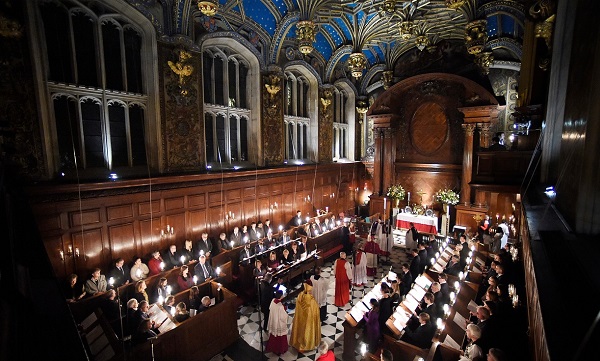
Yesterday, February 9th 2016, the (Cathlic) Cardinal Nichols celebrated the beautiful Vespers liturgy in Henry VIII‘s old chapel at Hampton Court Palace in London, with the (Anglican) Bishop of London and Dean of Her Majesty’s Chapels Royal, Dr Richard Chartres, delivering the sermon:
Almost half a millennium after the Act of Supremacy, which declared the Tudor king as the supreme head of the Church of England and formalised the break with Rome, England’s most senior Catholic cleric celebrated Vespers in the palace’s Chapel Royal on Tuesday evening.
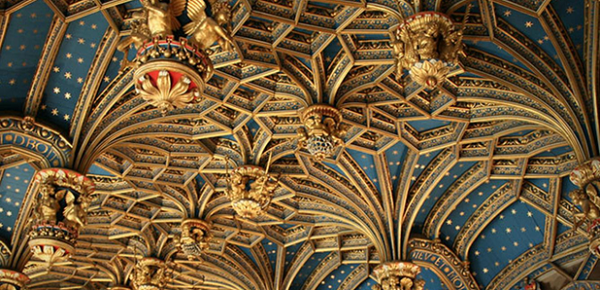
The scent of incense filled the air beneath the chapel’s magnificent blue and gold ceiling as a small procession made its way towards the altar. Vincent Nichols, the Catholic archbishop of Westminster, in a gold mitre and brocade robe, walked a few steps behind Richard Chartres, the Anglican bishop of London and dean of the royal chapels, in a symbolic gesture of reconciliation.
The first Catholic service in the chapel for more than 450 years was hailed as “one for the history books” by John Studzinski of the Genesis Foundation, which jointly organised the event with the Choral Foundation. “Dialogue between faiths is much needed and welcomed in these turbulent times. We need to recognise that we have more in common than not.”
World renowned ensemble ‘The Sixteen’ which specializes in early English polyphonic music, will perform works from the Reformation period, highlighting how – in the cardinal’s words – “music can help us rediscover our roots and shared heritage” [ .. ]
Cardinal Nichols notes that the music has been chosen to fit the history of the Chapel Royal, featuring composers like Thomas Tallis who “lived through all the turbulence of the Reformation of 1535” and the subsequent decades during which, he says, the situation in England was “quite porous and quite subtle”. Tallis and others wrote both Catholic and Anglican music and in many ways, the Cardinal says, “the Chapel Royal captures the fluidity and ambiguity of the age”.
**
So — two senior clerics belonging to rival churches managed to join in prayer — is that such a big thing?
If religion is a semi-cultish fad or superstition, nah. If religion is a major aspect of culture, maybe. If the divisions in Christianity are an offence against the God of Love and a voluntarily imposed obstacle to the workings of Love in the world, then yes, and this is a step in the right ecumenical direction.
From a secular British perspective, leaders of two rival versions of the same superstitions managed to agree with one another long enough to hold a joint press conference and a concert. The concert was first rate, the setting historic, the seating limited – tickets were allotted by ballot – and the whole event worth maybe a human interest column in the day’s news, well behind the bombing of some city in Syria.
Let’s call that the perspective from the ground up.
**
But hold it. The secular mind works from the facts, the “material world” as Madonna put it, with priority given to survival, food, shelter, and other needs – but to the sacred mindset, it is the spiritual world, the world of inspiration and joy that takes priority. Myth, ritual, dream, poetry, romance – these are the elements in human culture which must deeply touch our hearts, our souls — and from that perspective, the event yesterday at Hampton Court was anything but unimportant.
Let’s call this the perspective sub specie aeternitatis — from above. Rene Daumal describes its benefits in his brilliant mountain-climbing novel, Mount Analogue:
What is above knows what is below, but what is below does not know what is above. One climbs, one sees. One descends, one sees no longer, but one has seen. There is an art of conducting oneself in the lower regions by the memory of what one saw higher up. When one can no longer see, one can at least still know.
Monarchy, like religion, is a matter of myth, ritual, dream, poetry, and romance. The stories of the kings and queens of England are replete with myth and legend – King Arthur, Guinevere, Sir Launcelot, the Holy Grail, Glastonbury. The royal year is shot through with ritual – the great Royal weddings, Trooping the Colour and Changing of the Guards, the opening of Parliament, the races at Royal Ascot, the tagging of swans during Swan Upping, and towering about them all, the successive Coronations of sovereigns down the ages.
In sum, the monarchy embodies, for those who see it, the dreams and poetry of the nation, its traditions and its aspirations. And pageantry is at the heart of those dreams, its richest expression, just as liturgy – the performance of the rites and services of the church — is at the heart of the church’s dream, each being the enactment, with all solemnity and symbolic force, of a great ordering and binding principle.
Where the prayerful and celestial liturgy of the church and the grand traditions of the monarchy come together, the spirituality, the pageantry, the music, the gorgeous robing, the sacred architecture and yes, nobility, come together to stir the deep national memory, elevating us to that double sense of identity conveyed in the great hymn, I Vow to Thee, My Country, with words by Sir Cecil Spring-Rice and music by Gustav Holst. This hymn rang out in a multitude of voices at the wedding of Prince William and Kate Middleton, at the Festival of Remembrance, at the funerals of Princess Diana, of Baroness Thatcher and Sir Winston Churchill, and it articulates the sense of a double world – “my country” and “another country”, the material and spiritual worlds in harmonious continuity – which is buried deep in the British consciousness.
I vow to thee, my country, all earthly things above,
Entire and whole and perfect, the service of my love;
The love that asks no question, the love that stands the test,
That lays upon the altar the dearest and the best;
The love that never falters, the love that pays the price,
The love that makes undaunted the final sacrifice.
And there’s another country, I’ve heard of long ago,
Most dear to them that love her, most great to them that know;
We may not count her armies, we may not see her King;
Her fortress is a faithful heart, her pride is suffering;
And soul by soul and silently her shining bounds increase,
And her ways are ways of gentleness, and all her paths are peace.
That “other country” calls to mind Blake’s Albion, the sleeping Britain — the Britain of a possibility that transcends the Gross National Product, and lies at the heart of Britain’s reluctance to give over its sovereignty to the bureaucrats of Brussels.
All this is evoked by the grand ceremonial of Catholic Vespers accompanied by the prayers, incense and choral voices raised in prayer to the gilded rafters of Henry VIII’s Chapel Royal at Hampton Court Palace, where Catholic worship last took place in the reign of “Bloody” Mary Tudor (1553-58). It is, if you will, a foretaste – in high British ceremonial style — of paradise.
And so yes, from a ceremonial, symbolic and mythic perspective, it was and is a big deal. It is a moment rich in the tapestry which interweaves heaven and earth, the sacred and secular realms – not to mention two great rival religious traditions. For yes, it was Catholic against Protestant that warred in Europe and gave us, finally, the Treaty of Westphalia, and the concept of the nation state, Catholic against Protestant that echoed from the Battle of the Boyne to the Belfast Troubles, Catholic against Protestant that sent Guido Fawkes plotting to blow up the Houses of Parliament in an earlier era of sectarian hatred and religious terror…
**
King Henry VIII was granted the title of Defensor Fidei or Defender of the Faith by a grateful Pope Leo X in 1521, in recognition of a treatise, Defense of the Seven Sacraments, which he had written attacking the “reformed” teachings of Martin Luther. In 1530, however, Henry broke from the Papacy and Catholic Church to establish the Church of England under his own royal authority, and was excommunicated and the title papally withdrawn. No matter, the British parliament confirmed Henry in the title soon after in its new sense, as Defender of the Faith of the Church of England – a title which continues to be held by British monarchs to this day.
During the coronation ceremony, the monarch swears an oath to govern the far-flung territories of the Commonwealth “according to their respective laws and customs”, “to cause Law and Justice, in Mercy, to be executed” in all the monarch’s judgments; and to protect the Church of England, of which the monarch is Supreme Governor. At the most recent British coronation, that of Queen Elizabeth II, the Archbishop of Canterbury asked:
Will you to the utmost of your power maintain the Laws of God and the true profession of the Gospel? Will you to the utmost of your power maintain in the United Kingdom the Protestant Reformed Religion established by law? Will you maintain and preserve inviolably the settlement of the Church of England, and the doctrine, worship, discipline, and government thereof, as by law established in England? And will you preserve unto the Bishops and Clergy of England, and to the Churches there committed to their charge, all such rights and privileges, as by law do or shall appertain to them or any of them?
— to which Her Majesty responded:
All this I promise to do. The things which I have here before promised, I will perform and keep. So help me God.
It is the Coronation Oath too, along with the twin sectarian meanings of the title Defensor Fidei, which is in play as we approach afresh the meanings of church and state, constitutional monarchy, in times both ecumenical and sectarian, secular and sacred, traditional, vitally present, and forward looking. The Catholic liturgy of Vespers, celebrated yesterday with all dignity and ceremonial in Henry VIII’s own chapel at Hampton Court is a reminder and a promise of the high spiritual, ritual and cultural possibilities to which our British traditions invite us.
**
**
A video of yesterday’s ceremonial is not yet available, but I imagine this was the Magnificat that Harry Christophers and his choir sang…
I could live my life out under the shelter of such Magnificats.
ISIS is really embracing Fascism. It’s ceremonial public executions actually supercede what the Nazis and Fascists did only symbolically with blood flags and heroic cenotaphs and so on. It is reaching back to something very dark and protean, human sacrifice, as a political symbol. I think [ Moshe] Halbertal’s book On Sacrifice, is a useful reference here on how deep this goes culturally, to the bronze age or earlier.
ISIShas for some time been making quite a perverse spectacle of its executions of prisoners, combatant and non-combatant alike, releasing videos to international fanfare and glorying in the resultant horror and global infamy. The precedent for this macabre “propaganda of the deed“was initially set by the forefather of ISIS, the Jordanian jailbird upjumped to “terrorist mastermind”, the late Abu Musab al-Zarqawi, who originally led al Qaida in Iraq during the American occupation of Iraq. Prior to expiring after U.S. forces dropped a 500 lb bomb on his head, al-Zarqawi pioneered the use of beheading videos, usually featuring himself being filmed incompetently and gruesomely sawing off an orange jumpsuit-clad captive’s head with a large knife, blood spraying everywhere.
Zarqawi’s ghoulish innovation in terrorist messaging admittedly held a certain fascination for the psychopathic segment of Sunni Islamist extremists and it attracted foreign fighters of this nature to Iraq who in turn lionized Zarqawi as “the Sheikh of Slaughterers”; but the beheading videos also generally horrified public opinion in the Muslim world and repelled even hardened jihadis, earning Zarqawi a rebuke from al Qaida number two, Ayman al-Zawahiri:
….Among the things which the feelings of the Muslim populace who love and support you will never find palatable – also- are the scenes of slaughtering the hostages. You shouldn’t be deceived by the praise of some of the zealous young men and their description of you as the shaykh of the slaughterers, etc. They do not express the general view of the admirer and the supporter of the resistance in Iraq, and of you in particular by the favor and blessing of God.
….However, despite all of this, I say to you: that we are in a battle, and that more than half of this battle is taking place in the battlefield of the media. And that we are in a media battle in a race for the hearts and minds of our Umma. And that however far our capabilities reach, they will never be equal to one thousandth of the capabilities of the kingdom of Satan that is waging war on us. And we can kill the captives by bullet. That would achieve that which is sought after without exposing ourselves to the questions and answering to doubts. We don’t need this.
Zarqawi’s Iraqi bloodlust ended only because it was interrupted by theAmerican military, but the leaders of ISIS have carried on. Far from accepting Zawahiri’s advice, they have doubled down, greatly upgrading the marketing of ritualistic murder from Zarqawi’s crude snuff films to slick videos with professional editing and high production values that have become central to the online “brand” of the ISIS “caliphate”. Like the hosts of a sinister game show, ISIS spokesmen have found the time to murdercreatively in order to keep their audience of Islamist terrorist wannabes in the West tuned in and captivate the attention of the global media (though sometimes, things do not work outas planned).
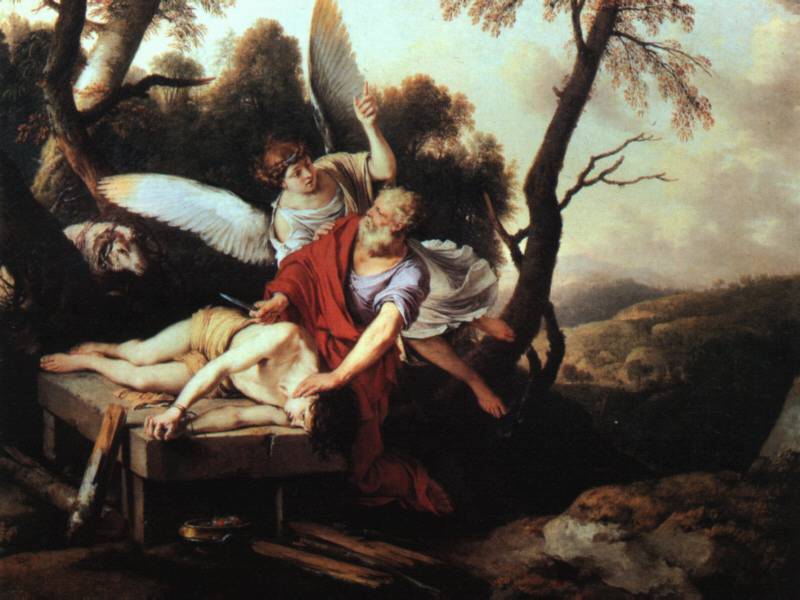
What occurred in many cases is that as civilizations evolved in social complexity, substitutionary practices for human sacrifice developed that served the same impulse, to propitiate and honor their God(s) and create powerful emotional bonds among the participants: animal sacrifice, burialceremonies, mysteries, religious ritual, necromancy, symbolism in theater and political matters of state religion. The Biblical tale of Abraham and Isaac is itself a scriptural admonition to the ancient Hebrews to adopt animal sacrifice as most pleasing to God, a practice the Israelites and Jews of the classical period continued until the destruction of the second temple by the Roman general Titus. From that point on, from the close of the first century AD, Jews and the early, still Judaic, Christians moved away from the practice of animal sacrifice and substituted prayer and theology of salvation, respectively. Sacrifice, especially human sacrifice, became a distinguishing mark of paganism and the subject of Christian crusades in the middle-ages, like the brutal war waged by the Teutonic Knights against the human sacrificing Old Prussians and Lithuanian barbarian tribes.
The end of late medieval European religious warfare and the rise of the Westphalian system after the Thirty Year’s War slowly shifted the symbolic moral center of sacrifice from God to the State, with divine right monarchy serving as a waystation for the incubation of modern nationalism. There was an epistemic shift, as Halbertal argues in On Sacrifice from a sacred and mystical “sacrificing to” the sovereign God borrowed from the examples of Jewish martyrdom by early Christians who shared in the Romans the same persecutors. This shift opened the gates of permissible sacrifices, legitimating a new secular and political “sacrificing for” the glory of the State.
It is a profound difference but occurring within the same phenomena, as illustrated by two quotes:
…And it came to pass after these things, that God did tempt Abraham, and said unto him, Abraham: and he said, Behold, here I am.
And the Lord said, Take now thy son, thine only son Isaac, whom thou lovest, and get thee into the land of Moriah; and offer him there for a burnt offering upon one of the mountains which I will tell thee of.
– Genesis 22:2
And:
….But, in a larger sense, we can not dedicate – we can not consecrate – we can not hallow, this ground – The brave men, living and dead, who struggled here, have hallowed it, far above our poor power to add or detract. The world will little note, nor long remember what we say here; while it can never forget what they did here.
It is rather for us, the living, we here be dedicated to the great task remaining before us – that, from these honored dead we take increased devotion to that cause for which they here, gave the last full measure of devotion – that we here highly resolve these dead shall not have died in vain; that the nation, shall have a new birth of freedom, and that government of the people, by the people, for the people, shall not perish from the earth.
– Abraham Lincoln
Gettysburg and Antietamwere not Mount Moriah. Neither were the Somme or Stalingradthe same as the Tophet. From time of the Patriarch Abraham to the presidency of Abraham Lincoln, nations of men ceased to sacrifice usually helpless others but moved to sacrifice themselves in what they reckoned as the highest cause. Movement away from human sacrifice as practiced by ancient Carthaginian or animal sacrifice as practiced by most peoples of antiquity, including the Jews, to gentler substitutionary practices, Moshe Halbertal has called the “cataclysmic shift” in the history of civilization.
If so, it is a shift that ISIS has begun to reverse.
In their outstanding ISIS: The State of Terror, counterterrorism scholars Jessica Stern and J.M. Berger analyze the dark obsession ISIS has demonstrated in its propaganda messaging with exquisitely orchestrated executions:
….As we have noted, ISIS’s psychological warfare is directed at its potential victims. But it is also directed at those it aims to control. It is deliberately attempting to blunt its follower’s empathy by forcing them to participate in or observe acts of brutality. Over time, this can lead to secondary psychopathy, or a desire to harm others, and contagion of violence. Beheadings are one such tool for blunting empathy.
Berger and Stern are likely correct that the methodical character of ISIS demonstrations of brutality are intended to desensitize the participants and (as they further explained) a tendency to cultivate secondary psychopathology in ISIS recruits, especially the young. A similar process occurred during the Holocaust with Nazi Einsatzgruppen and reserve unit police battalions detailed to assist the SS mobile killing squads on the Eastern front. Many serving in these units, already fanatical National Socialists, became inured to the suffering of women, children and the old who were shot and dumped still alive into mass graves, though some SS men showed signs of PTSD, depression and higher rates of severe alcoholism, desertion and suicide.
The comparison between the genocidal cruelty of the SS and ISIS, while natural, is limited by a very important distinction. However zealous their ideological fanaticism and dedicated in their murderous mission to exterminate European Jewry, the SS lacked the context of moral certainty and the psychological reinforcement effects of religious exaltation enjoyed by ISIS killers. Even the malevolent Heinrich Himmler, in his secret speechto Nazi gauleitersand SS leaders, regarded the Final Solution as a terrible burden that the SS shouldered on behalf of the Fuhrer to assure Germany’s future; a “glorious” crime that Himmler believed must be kept forever hidden from history and the German people.
Not so ISIS, which revels in its bloody terror. Worse, the repetition of garish executions as public celebrations by ISIS, with a vague but constant religious context, devoid of any shred of Islamic legality, inevitably acquire over time the theological characteristics of Halbertal’s “sacrificing to” – what began as harsh jihadi jurisprudence and psychological warfare mutated under conditions of lazy, sociopathic brutality and totemic invocations of Islam into ritual “offering” by ISIS of its prisoners of war as human sacrifices in the manner of the ancient pagans. A perverse blasphemy, but one that draws on a powerfularchetype deeply buried in the human psyche.
ISIS leaders have not only looked into the Abyss, they have descended into and become one with it.
[ by Charles Cameron — two approaches to mathematics, two types of heroism, and their respective complementarities ]
.
I wish to propose a clear analogy between the mathematician Grothendieck‘s two styles of approach to a problem in mathematics, and the Navajo Twin Gods, Monster-Slayer and Child-Born-of-Water.
**
**
Steve Landsburg‘s post, The Generalist, compares two approaches to mathematics, as practiced by two eminent mathematicians:
If there was a nut to be opened, Grothendieck suggested, Serre would find just the right spot to insert a chisel, he’d strike hard and deftly, and if necessary, he’d repeat the process until the nut cracked open. Grothendieck, by contrast, preferred to immerse the nut in the ocean and let time pass. “The shell becomes more flexible through weeks and months — when the time is ripe, hand pressure is enough.”
**
In the paras leading up to this one, Landsburg gives us the insight that these two approaches can be generalized as “zooming in” and “zooming out”:
Imagine a clockmaker, who somehow has been oblivious all his life to many of the simple rules of physics. One day he accidentally drops a clock, which, to his surprise, falls to the ground. Curious, he tries it again—this time on purpose. He drops another clock. It falls to the ground. And another.
Well, this is a wondrous thing indeed. What is it about clocks, he wonders, that makes them fall to the ground? He had thought he’d understood quite a bit about the workings of clocks, but apparently he doesn’t understand them quite as well as he thought he did, because he’s quite unable to explain this whole falling thing. So he plunges himself into a deeper study of the minutiae of gears, springs and winding mechanisms, looking for the key feature that causes clocks to fall.
It should go without saying that our clockmaker is on the wrong track. A better strategy, for this problem anyway, would be to forget all about the inner workings of clocks and ask “What else falls when you drop it?”. A little observation will then reveal that the answer is “pretty much everything”, or better yet “everything that’s heavier than air”. Armed with this knowledge, our clockmaker is poised to discover something about the laws of gravity.
Now imagine a mathematician who stumbles on the curious fact that if you double a prime number and then halve the result, you get back the number you started with. It works for the prime number 2, for 3, for 5, for 7, for 11…. . What is it about primes, the mathematician wonders, that yields this pattern? He begins delving deeper into the properties of prime numbers…
Like our clockmaker, the mathematician is zooming in when he should be zooming out. The right question is not “Why do primes behave this way?” but “What other numbers behave this way?”. Once you notice that the answer is all numbers, you’ve got a good chance of figuring out why they behave this way. As long as you’re focused on the red herring of primeness, you’ve got no chance.
Now, not all problems are like that. Some problems benefit from zooming in, others from zooming out. Grothendieck was the messiah of zooming out — zooming out farther and faster and grander than anyone else would have dared to, always and everywhere. And by luck or by shrewdness, the problems he threw himself into were, time after time, precisely the problems where the zooming-out strategy, pursued apparently past the point of ridiculousness, led to spectacular, unprecedented, indescribable success. As a result, mathematicians today routinely zoom out farther and faster than anyone prior to Grothendieck would have deemed sensible. And sometimes it pays off big.
**
I no longer have — alas — a copy of Where the Two Came to their Father, the first volume in the Bollingen Series, with its suite of 18 sand paintings beautifully rendered in silkscreen by Maud Oakes, but their respective black and blue colorations lead me to suppose that the illustration at the head of this post, taken rom that series, shows the twin heroes, Monster Slayer (black) and Child Born of Water (blue) whose journeys and initiation are the subject of the rituasl “sing” recorded in that book.
The theme of two male hero twins is central to the mythologies of the American continent, according to Jospeh Campbell, who contributed a commentary to Oakes’ recording of Jeff King‘s performance of this ceremony, and lacking both the King > Oakes > Campbell book and Gladys Reichard‘s two volumes on Navaho Religion, I must draw on brief quotes from miscellaneous web sources to dramatize the differences between the twins.
Monster Slayer is the doer of deeds, similar in nature to other masculine, not to say macho, heroes — while Child Born of Water is the contemplative of the pair:
The Sun [Jóhonaa’éí] gave them prayersticks and then told them that the younger of the two (Born for Water) would sit watching these prayersticks while the older (Monster Slayer) went out to kill the monsters. If these prayersticks began to burn, this would signal that his brother was in danger and that he should go to him to help.
A measure of their respective strategies, and of the ways in which the insights of Child Born of Water can succeed where the brute force tactics of Monster SLayer fail, can be gleaned from this section of their story, also I believe taken from Reichard:
When The Twins visited Sun the second time, he said he was willing to help them, but this time he wanted them to return the favor: “I wish you to send your mother to the west that she may make a new home for me.” Whereupon Monster Slayer, believing himself equal to any task, replied, “I will do so.I will send her there.” Then Child-of-the-water reminded them both: “No, Changing Woman is subject to no one? we cannot make promises for her. She must speak for herself? she is her own mistress. But I shall tell her your wishes and plead for you.”
**
One commentator glibly suggests that the joint presentation of the hero as twins is “a clever reminder that progress depends upon cooperation between our mind and our heart” — but the psychologist Dr Howard Teich offers a far more depthful interpretation: that the two twins represent two forms of masculine heroism, one the familiar macho hero of war movies, and the other wiser and subtler, the possessor of traits commonly attributed to the feminine — and hugely undervalued — in our culture.
Dr Teich suggests we must (urgently) abandon the division of virtues into “male” and “female” types, reognize that these types are complementary rather than rivalrous, that both are necessary functions of both males’ and females’ psyches, and begin to integrate the wholeness that both strategies together represent, in our own approaches to our lives in general, to the natural world around us, and indeed to warfare — unsurprisingly, since we first encounter the twins in the ceremonial specifically devised by the Navajo to protect young warriors on their way to battle, and to reintegrate them in harmony and balance on their return.
As Teich puts it:
Monster Slayer and Child Born of Water, as these Twin Heroes are called, are the most sacred of all the legendary heroes in Navaho mythology. It is rare for the Navaho even to speak of the twins; their presence is to be felt rather than observed, and their lessons absorbed rather than applied. Although the lessons the twins hold may be countless, their particular manifestation of a deeper, more complex image of masculinity deserves the reader’s especial attention.
**
I’d like to suggest that in the same way that there are “zooming in” and “zooming out” styles in mathematics, and “monster-slayer” and “born of water” styles of heroism, there are in fact twin traditions of understanding the world which we might term scientific and poetic, or in Teich’s terms — and those of the alchemists — solar and lunar.
A unified or “solunary” vision will encompass the virtues of both.
**
Dr Teich’s review of the King > Oakes > Campbell book under the title A Dual Masculinity was irst piublished in The San Francisco Jung Institute Library Journal, Vol. 13, No. 4, 1995. He now has a book out treating these themes: Solar Light, Lunar Light.
Oh, and please don’t expect me to know anything more about Grothendieck’s mathematics than I read in Landsburg’s article.
Section 2. Representatives shall be apportioned among the several States according to their respective numbers, counting the whole number of persons in each State, excluding Indians not taxed. But when the right to vote at any election for the choice of electors for President and Vice President of the United States, Representatives in Congress, the Executive and Judicial officers of a State, or the members of the Legislature thereof, is denied to any of the male inhabitants of such State, being twenty-one years of age, and citizens of the United States, or in any way abridged, except for participation in rebellion, or other crime, the basis of representation therein shall be reduced in the proportion which the number of such male citizens shall bear to the whole number of male citizens twenty-one years of age in such State.
Zenpundit is a blog dedicated to exploring the intersections of foreign policy, history, military theory, national security,strategic thinking, futurism, cognition and a number of other esoteric pursuits.