zenpundit.com » FBI

Archive for the ‘FBI’ Category

The Hunt for KSM

Thursday, March 15th, 2012

The Hunt for KSM: Inside the Pursuit and Takedown of the Real 9/11 Mastermind by Terry McDermott and Josh Meyer

This courtesy review copy just arrived from Machette Book Group. The authors are investigative journalists, one of whom, Meyer, has extensive experience reporting on terrorism, while McDermott is also the author of the 9-11 highjackers book, Perfect Soldiers. Thumbing through the pages, I note the authors have little time and much contempt for the cherished DoD-State canard that the Pakistani government and the ISI are an ally of the United States, which has already given me a warm feeling.

The review copy index pages are blank, something I usually see only before a book has been finalized for mass printing. Odd.

I will be reading and reviewing this soon – Shlok advises that “it reads like a novel”

Iranian Assassination – Narco-Cartel Plot Charged

Wednesday, October 12th, 2011

The US Attorney General Eric Holder, supported diplomatically by the Kingdom of Saudi Arabia, charged the Iranian government earlier today with a plot to enlist a Mexican narco-cartel to assassinate the Saudi Ambassador to the United States. SECSTATE Hillary Clinton, the FBI Director and President Barack Obama have all weighed in on this issue with strong public statements:

U.S. authorities said they had broken up a plot by two men linked to Iran’s security agencies to assassinate Saudi Ambassador Adel al-Jubeir. One was arrested last month while the other was believed to be in Iran.

Iran denied the charges. But President Barack Obama called the plot a “flagrant violation of U.S. and international law” and Saudi Arabia said it was “despicable.” Revelation of the alleged plot, and the apparent direct ties to the Tehran government, had the potential to further inflame tensions in the Middle East, and the United States said Tehran must be held top account.

Secretary of State Hillary Clinton, in a Reuters interview, expressed hope that countries that have hesitated to enforce existing sanctions on Iran would now “go the extra mile.” At a news conference, FBI Director Robert Mueller said the convoluted plot, involving monitored international calls, Mexican drug money and an attempt to blow up the ambassador in a Washington restaurant, could have been straight from a Hollywood movie.

U.S. Attorney General Eric Holder alleged that the plot was the work of the Islamic Revolutionary Guard Corps, which is the guardian of Iran’s 32-year-old revolution, and the Quds force, its covert, operational arm. “High-up officials in those (Iranian) agencies, which is an integral part of the Iranian government, were responsible for this plot,” Holder told the news conference.

“I think one has to be concerned about the chilling nature of what the Iranian government attempted to do here,” he said….

I confess that I am not quite sure what to make of this story. 

If accurate – the case originated with a DEA confidential informant in Mexico – it would amount to a new stage of reckless boldness by Iran’s hardline Pasdaran clique of security and intelligence agencies run by the Iranian Revolutionary Guards and their retired leadership that have a semi-hegemony over the Iranian regime. It also points to the danger to American national security of a long, basically open, border with a failing state Mexico that is deeply embattled in a polycentric counterinsurgency war with the rapidly morphing narco-cartels (that said, I do not expect the administration to move a policy inch to repair the latter). Why would Iran do this – and in such a harebrained manner?

Some possible motives:

* Internal factionalism – Iran recently released imprisoned American hikers, albeit after a substantial ransom payment. Potentially, this could be viewed in the topsy-turvy world of Iranian Islamist politics as a “goodwill gesture” toward the United States. Historically, such gestures provoke rival factions in Iran to initiate anti-American actions, including acts of terrorism, usually via proxies. If an intel operation was “factional” rather than blessed by a wide elite consensus, it might very well be a marginal idea carried out on a shoe-string.

* Counterpressue – Indirect Iranian skirmishing against the US which is drawing down in Iraq and is pressuring Iran’s ally Syria. Also against the Saudis who brutally suppressed a predominantly Shia “Arab Spring” rising in Bahrain which, if it had succeeded in toppling the regime, would have added Bahrain to the regional “Shia Revival”.

* Opportunism – The Pasdaran leadership may have  believed the stories of American decline, assessed our extensive military commitments and budgetary problems and taken the Obama administration’s temperature and concluded that the benefits of carrying out the assassination outweighed the remote risk direct  of US military retaliation.

Some points to consider:

* Proximity – Iran could more easily, with less risk and with far greater likelihood of success, carry out acts of anti-American terrorism closer to home in Iraq, Lebanon, Afghanistan the Gulf States, even in Saudi Arabia or Egypt.  Acts of terrorism in the American homeland risk a massive overreaction by Washington ( the US only needs the Navy to deal out severe consequences to Iran) which might welcome a legitimate pretext to bomb all of Iran’s suspected nuclear facilities and national security sites.

* Self-Preservation by the Mexican narco-cartels make such cooperation with Iran less likely, having the example of their Colombian predecessors in the 1980’s before them when they raised the ire of the USG sufficiently. The narcos have their hands full fighting the Mexican Army and one another without adding the CIA, Global Predator drones or the SEALs to their plate.

* Friends of MeK – By some miraculous deus ex machina, the cultish, 1970’s era Iranian Marxoid terrorist group, the People’s Mujahedin of Iran (MeK) have spent a wealth of funds to buy the lobbying services of a glittering array of former top US national security officials and general officers – despite being on the State Department’s official terrorist list.

….Among the new faces: former Indiana Congressman Lee Hamilton (D), who once chaired the House Foreign Affairs Committee, and who served as vice chairman of the 9/11 Commission; Ambassador Dell Dailey, who was the State Department’s Coordinator for Counterterrorism from July 2007 to April 2009; General Michael Hayden, director of the CIA from 2006 to 2009; and not one, but two former chairmen of the Joint Chiefs of Staff. Former Attorney General Michael Mukasey, former New Mexico Gov. Bill Richardson, former Under Secretary of Defense for Policy Walter Slocombe and ex-Sen. Robert Torricelli (D-NJ) also spoke.

In what should be a national scandal, those names are not even a comprehensive list of the very influential former politicians, K Street lobbyists and Beltway law firms accepting payments to whisper in the ears of current officials in the national security community, regarding Iran, on behalf of the MeK. Not sure how it is legal to do so either, since aiding a group on the State Department’s list by providing services normally can get you hauled into Federal  court pronto, if you are an ordinary American citizen. A most curious situation….

I have no brief for Iran, the regime is a dedicated enemy of the United States, but a group of exiled Iranian Marxist-terrorists who used to work for Saddam Hussein hardly have our best interests at heart.

It will be interesting to watch this case unfold, but in the meantime, opinions are welcome in the comments, particularly on the Mexican narco-cartel angle.

Hat tip to James Bennett.

Down the rabbit hole: researching the “jikhad”

Thursday, September 22nd, 2011

[ by Charles Cameron — cross-posted from Chicago Boyz – a meander on the perils and promise of research, jihad, typos, books and more ]
.
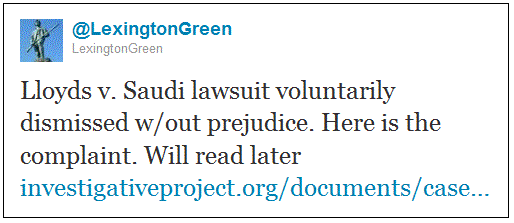
It begins with an email from Lexington Green saying I might be interested in a tweet he had posted earlier this morning:
The Insurance Journal tells us:

Defendants named in the complaint were Kingdom of Saudi Arabia, The Saudi High Commission for Relief of Bosnia & Herzegovina, Saudi Joint Relief Committee for Kosovo and Chechnya, Saudi Red Crescent Society, National Commercial Bank, Al Rajhi Banking and Investment Company. Also included as defendants are three Saudi citizens connected to these organizations, Prince Salman Bin Abdul Aziz Al Saud, Suleiman Abdel Aziz Al Saud and Yassin Al Qadi.

The case is Underwriting Members of Lloyd’s Syndicate 3500 v. Kingdom of Saudi Arabia, 11-00202, U.S. District Court, Western District of Pennsylvania.

Okay, I’m curious. I go to the complaint [.pdf] and start reading… and on page 9, I find:
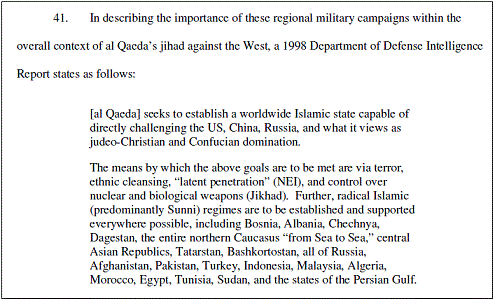
That’s interesting. A DIA report, better look that up. But there’s no reference provided…

So I googled for “latent penetration” NEI which sent me back to versions of the court filing, and then for “latent penetration” and found that Robert W. Schaefer on p. 166 of his book, The Insurgency in Chechnya and the North Caucasus: From Gazavat to Jihad, quotes [with minor variations] from what is obviously the same DIA document and in footnote 29, p 165 identifies it as “Declassified DIA intelligence report NC 3095345, October 16, 1998, 3 (obtained through the Freedom of Information Act).”

Onwards to locate NC 3095345, which can be found here [.pdf] and contains the following relevant text on p. 3:
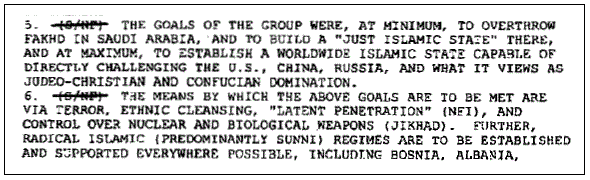
So that’s the source of the description of AQ’s overall plan in the Lloyds complaint.

But what’s “latent penetration”? The DIA document even has it in quote marks – does that make it a technical term?

Back to Google.

The FBI uses the term “latent penetration” – maybe I’m onto something! In their Electronic Biometric Transmission Specification (EBTS) [.pdf] on p. 58 they offer the “following list of TOTs is applicable to latent friction ridge searches transmitted to the FBI”:

fbi-latent-prints.gif

I have to admit – a Latent Penetration Query sounds like just the thing I’m after – but the FBI appears to think of “latent penetration” in terms of fingerprints…

Okay, next up. A quick look at David Waterman and Andrew A. Weiss‘ book, Vertical Integration in Cable Television, (AEI, 1997) tells us:
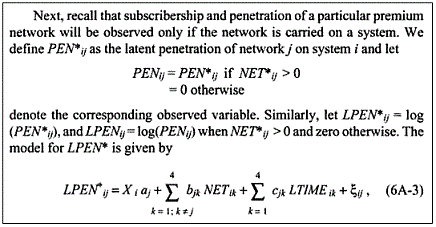
latent-penetration-in-cable-television.gif

That’s all a bit above my head, and in any case I don’t watch cable TV… and the networks in question aren’t terrorist networks, they’re cable networks…

When I add the word “terror” into my search, however, I get directed to Prof. Kostogryzov Andrey‘s paper [.ppt] addressing the question of a “methodical approach for the evaluation of systems vulnerability in conditions of terrorist threats” for a symposium at the University of Texas, Arlington – which sounds promising.

Searching the good professor’s powerpoint for “latent penetration” takes me to slide 36, however, where I read:
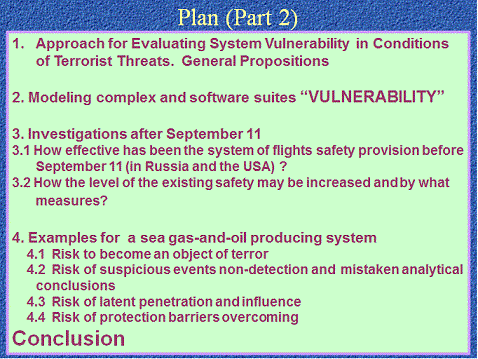
symposium-slide-36.gif

To be honest with you, I don’t feel any closer to understanding “latent penetration” beyond a sort of general “potentially getting inside the opposition” kind of sense.

So let’s get back to NEI – which is what the Lloyds transcription has in parens immediately after the quote-marked phrase “latent penetration” – what’s that about?

Well, on closer examination, it looks as though Lloyds got that wrong, and the DIA document — compare their E’s and F’s in the typed excerpt above and I think you’ll agree — actually says NFI…

Phew! NFI.

What’s that?

The DIA probably classifies its acronyms, but this particular document has been declassified and NFI hasn’t been redacted, so perhaps the Free Dictionary acronym finder will be able to help…

I quickly dismiss such possibilities as National Fatherhood Initiative and get down to my three basic possibilities:

NFI … No Further Information (available)
NFI … National Foreign Intelligence
NFI … No Freaking Idea

The last of these describes my own feelings at this point, although “freaking” would be the milder way to put it. So it’s down to guesswork: I’ll go with #2.

Okay: according to this particular DIA report, AQ “seeks to establish a worldwide Islamic state” by means that include “latent penetration” — I still have only the vaguest idea [OTVI] what that means — and “control over nuclear and biological weapons (Jikhad)”.

Jikhad?

The DIA docu self-describes thus:
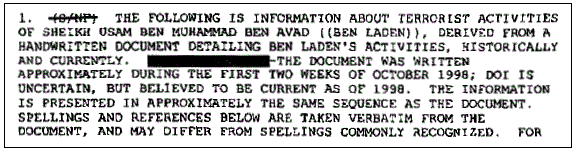
dia-self-descript.gif

Variant spellings, okay…

But I’m wondering if “Jikhad” is one of them…

Back to the search engines, where I discover the word does have prior art in a terrorist – indeed, a specifically AQ — context, to wit:

jikhad-book-cover-med.jpg

$149.95, call it $150 on Amazon, and available for free shipping

Well, you can’t judge a book title by its cover, so I have an inquiry in to the good folks at the University of Calgary library, which has a copy – but I’m guessing “Jikhad” is a typo in both cases, aren’t you?

*

And what grand purpose does all this serve?

None, you may think – the complaint has been withdrawn, as Lex tells us, “without prejudice” – so the issue is, if I may use a legal term despite the fact that IANAL, “moot”.

Unless one is interested in the prices of books these days, or the frequency of spelling vagaries on their printed covers, or possible Arabic words bearing on terrorism that one hasn’t run across previously, or fingerprints, or the reliability of a document of which LTC Schaefer notes (p. 165, n 29):

It is important to note that no evaluation of the information detailed in the report is included in the declassified version; and anyone who deals with intelligence will tell you that text without context is pretext. It is entirely possible that this document was passed to U.S. Intelligence by the Russians in order to bolster the evidence linking the Chechens with Al Qaeda.

On second thoughts, we can learn something here about care in reading sources – about the transmission errors that commonly crop up when texts are translated or transmitted – and about the importance of context.

Text without context is pretext.

That whole paragraph of LTC Schaefer’s is worth the price of admission.

Ali Soufan: AQ, Khorasan and the Black Banners

Saturday, September 17th, 2011

[ by Charles Cameron — yet more black banners, Khorasan, Jerusalem and Armageddon, with the usual strategic implications ]
.
soufan-book-cover.jpg
.

It’s beginning to be embarrassing how obvious the Khorasan / black banner / Mahdism meme is getting these days.  Earlier this week I pointed it out as the basic through-line of Syed Saleem Shahzad‘s Inside Al-Qaeda and the Taliban: Beyond bin Laden and 9/11. Today it’s Ali Soufan‘s turn.

In his book, The Black Banners: The Inside Story of 9/11 and the War Against Al-Qaeda — which I hope to review here — Soufan too makes the apocalyptic significance of AQ’s jihad painfully apparent. Take his title, for instance

Black banners, eh?

Those would presumably be the ones mentioned to Soufan by Abu Jandal, who began to quote the hadith:

If you see the black banners coming from Khurasan, join that army, even if you have to crawl over ice; no power will be able to stop them —

at which point Soufan broke in and completed the hadith for him:

— and they will finally read Baitul Maqdis [Jerusalem], where they will erect their flags.

And in case you missed it, that’s an explicitly end-times, Mahdist hadith, as you can see from (eg) this Hizb-ut-Tahrir-associated site:

Messenger of Allah said: “If you see the Black Banners coming from Khurasan go to them immediately, even if you must crawl over ice, because indeed amongst them is the Caliph, Al Mahdi.” [Narrated on authority of Ibn Majah, Al-Hakim, Ahmad]

Soufan goes on to say:

I was to hear that reputed hadith from many al-Qaeda members I interrogated. It was one of al-Qaeda’s favorites.

Khurasan is a term for a historical region spanning northeastern and eastern Iran and parts of Turkmenistan, Uzbekistan, Tajikistan, Afghanistan, and northwestern Pakistan. Because of the hadith, jihadists believe that this is the region from which they will inflict a major defeat against their enemies — in the Islamic version of Armageddon. Bin Laden’s 1996 declaration of war against the United States – a main text for al-Qaeda members – ends with the dateline “Friday, August 23, 1996, in the Hindu Kush, Afghanistan.” It’s not a coincidence that bin Laden made al-Qaeda’s flag black; he also regularly cited the hadith and referenced Khurasan when recruiting, motivating, and fundraising. Al-Qaeda operatives I interrogated were often convinced that, by joining al-Qaeda, they were fulfilling the words of the Prophet.

It is an indication of how imperfectly we know our enemy that to most people in the West, and even among supposed al-Qaeda experts, the image of the black banners means little…

I could go on, but that’s surely enough.

*

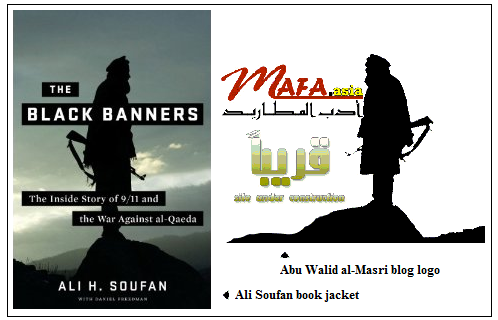
And by the way, who is that man on the cover, anyway?

banners-mafa-juxtaposed.png


Switch to our mobile site