zenpundit.com » movies

Archive for the ‘movies’ Category

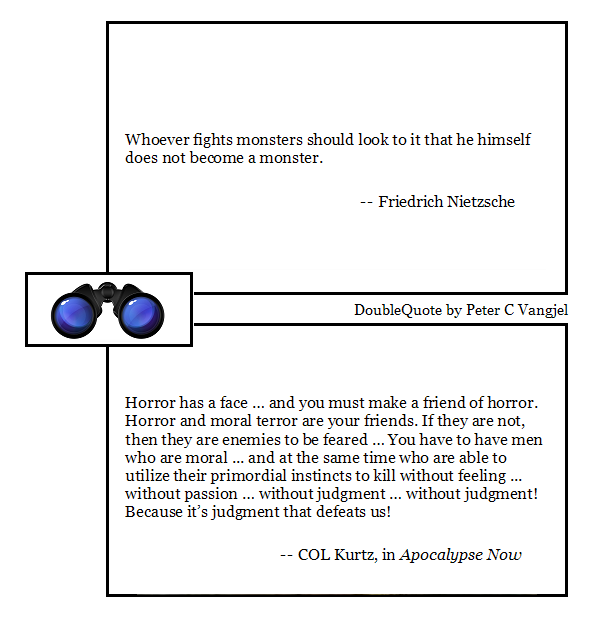
A DoubleQuote from Peter C Vangjel

Wednesday, April 8th, 2015

[ by Charles Cameron — Col Kurtz meets Frederick Nietzsche ]
.

Peter Vangjel tweeted a DoubleQuote yesterday, and I’ve now formatted it and am reposting it here:

SPEC Nietzsche Kurtz

**

I’m always happy to see that others find the DoubleQuote concept serviceable.

What are your views on Col. Kurtz? What did Capt. Willard think of him? And Francis Ford Coppola?

And where would you locate the heart of darkness?

Analysis, and the question of trust

Sunday, March 29th, 2015

[ by Charles Cameron — who was taught to think of “longer term” as extending to our children of the seventh generation ]
.

Here’s the problem:

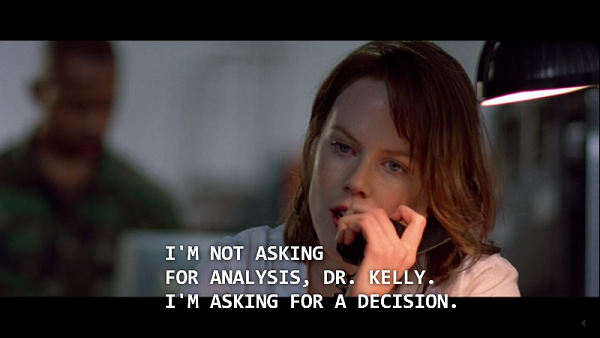
Nicole Kidman as analyst Dr Julia  Kelly in DreamWorks SKG's first movie, The Peacemaker

Nicole Kidman as analyst Dr Julia Kelly gets an order in DreamWorks SKG’s movie, The Peacemaker

**

In the Introduction to Cyber Analogies (Feb 2014, 133 pp., Emily Goldman & John Arquilla, eds) we read:

The project was conceived and carried out to help very senior, busy, responsible people understand topics and issues that are fast-moving and dynamic, and have potentially great consequences for society, security, and world affairs.

I’m never quite sure that “very senior, busy, responsible people” are the right people to task with understanding “topics and issues that are fast-moving and dynamic, and have potentially great consequences for society, security, and world affairs.”

Ahem.

Do I qualify as a heretic yet?

I feel some kinship here with Pundita‘s recent comment:

I venture there are too many Grand Master chess players in America’s defense/diplo establishment and not enough ping pong players.

And the estimated number of exposures varies, I know — but how far would you trust the “very senior, busy, responsible people” who, we now know [1, 2, 3], covered up our poison gas casualties in Iraq?

**

At the expense of strategic analysis..

I’m thinking about all this because there’s a shift under way in intel circles, as described in the recently issued Report of the Congressionally-directed 9/11 Review Commission, The FBI: Protecting the Homeland in the 21st Century:

Once deployed to the field, many of these analysts have been embedded in operational squads in the field, though their work favors support to tactical and case work at the expense of strategic analysis. The FBI launched a more structured Integrated Curriculum Initiative (ICI) in 2014, with the primary goal to develop a comprehensive basic training program for new agents and analysts that teaches them to operate in a threat-based, intelligence-driven, operationally-focused environment.

More explicitly, Scott Shane wrote in C.I.A. Officers and F.B.I. Agents, Meet Your New Partner: The Analyst:

Some people who study intelligence and counterterrorism are concerned that the pendulum could swing too far. Intelligence analysts, said Amy Zegart, a Stanford scholar who studies intelligence, could become too consumed by daily operations and neglect strategic thinking about threats that could be years away.

At the C.I.A., she said, counterterrorism analysts are already “too tactical,” focused on the next drone target. If the same model is now applied to the rest of the agency’s work, other analysts, too, could be caught up in short-term demands, she said. “Who in the U.S. government,” she asked, “is going to be thinking about longer-term threats?”

Longer-term? You mean, longer than the current electoral cycle?

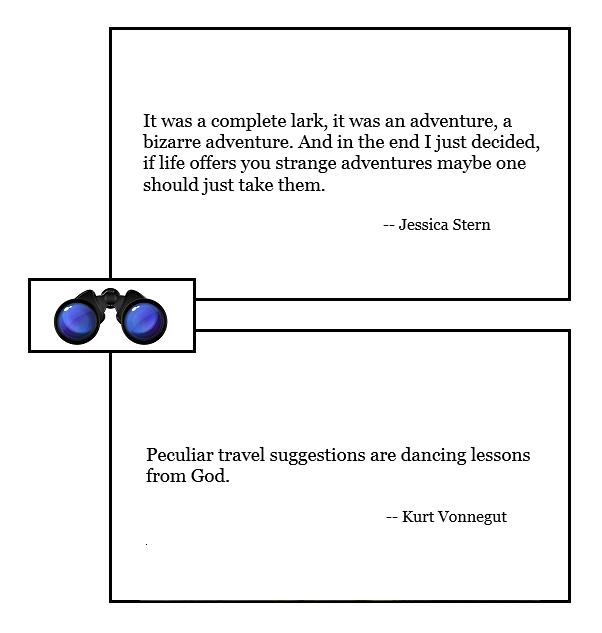
Jessica Stern and dancing lessons

Wednesday, March 25th, 2015

[ by Charles Cameron — a trifle, in which life follows art as one of my favorite Vonnegut / Bokonon quotes comes to life ]
.

SPEC DQ Stern Vonnegut

**

Sources:

  • UN Dispatch, Mark Leon Goldberg interviews Jessica Stern:

    Jessica Stern was a mid level National Security Council staffer when Hollywood literally came calling. Nicole Kidman portrayed a fictionalized version of her work as a nuclear security analyst in the Clinton White House in the film “The Peacemaker” (also starring George Clooney). Stern’s academic and professional life have taken some interesting turns. In the 2000s she published groundbreaking research on what motivates individuals to commit violent acts of terror, and she did so by speaking to actual terrorists. Stern recently published a new book called ISIS: State of Terror, co-authored by J.M. Berger that takes a deep dive into the historic origins of the so-called Islamic State.

    This is a great episode with fun and fascinating stories from a longtime national security wonk. Enjoy.

  • The prophet Bokonon, in Kurt Vonnegut, Cat’s Cradle
  • Jessica Stern, in the quote above, is describing the twists and turns which brought her via the NSC to the set of The Peacemaker. Quite a story, I recommend the interview — and the dance goes on.

    On air conditioning, Bin Laden Sr, Lee Kuan Yew

    Monday, March 23rd, 2015

    [ by Charles Cameron — who thinks of meditation as an air conditioning technique ]
    .

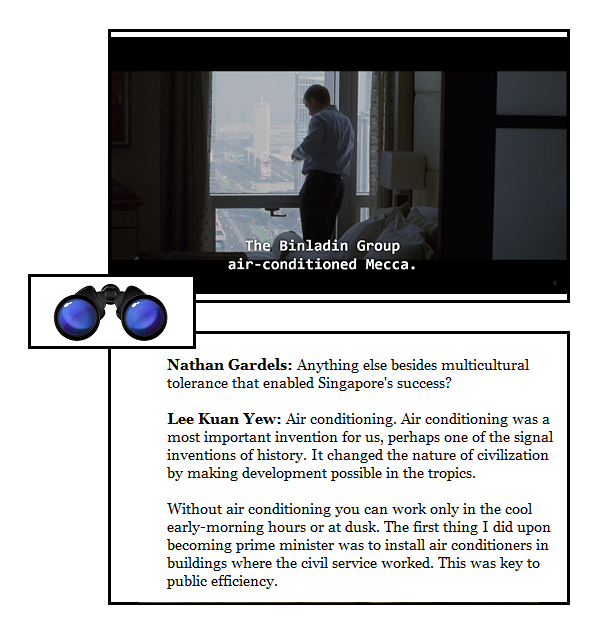
    No proof of anyrthing — just a little food for thought from this morning’s flow:

    SPEC DQ air conditioning

    Sources:

  • Matt Damon, in Syriana, 2005
  • Lee Kuan Yew, 1923-2015, may he rest in peace, interviewed in NPQ, 2010
  • Sunday Surprise: dark beauty in green & red with dragons

    Monday, March 9th, 2015

    [ by Charles Cameron — the color of green cards, the color of blood ]
    .

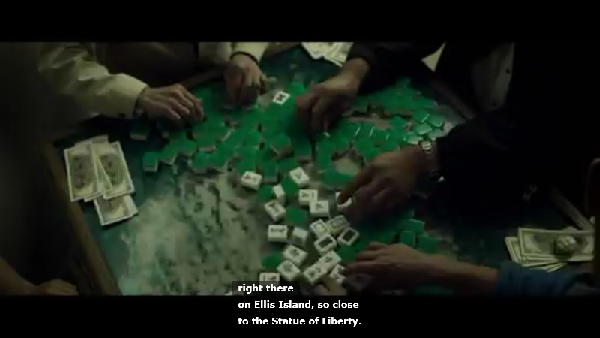
    I was watching Revenge of the Green Dragons, since Scorsese produced, and had very little idea of what I was going to see — the film is an amalgam of Hong Kong action flick and New York City crime thriller, based on a New Yorker aticle about Chinatown gangs in the 1980s and 90s — but the opening titles were run under a brief voice-over account of Ellis Island, and included this shot of some early “green cards” —
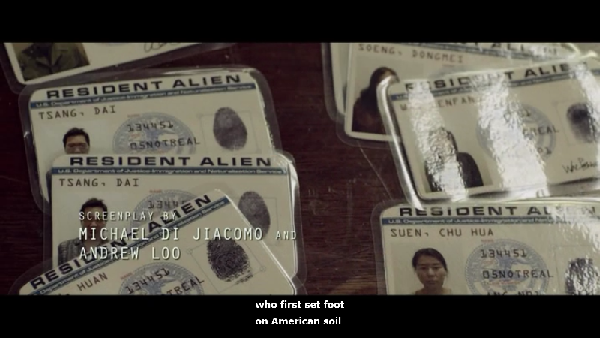
    Green Dragons 01

    followed by this one of Mahjong tiles, definitively green, and roughly equivalent to cards in western gameplay —
    Green Dragons 02

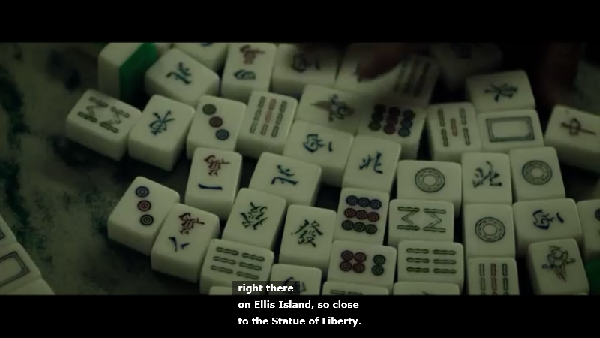
    and this, showing the same tiles face-up —
    Green Dragons 03

    by which point, the greenness, cardness and gameness had my full attention, and at which point I went back and started putting together a series of screencaps, like this one, showing a different but related form of green —
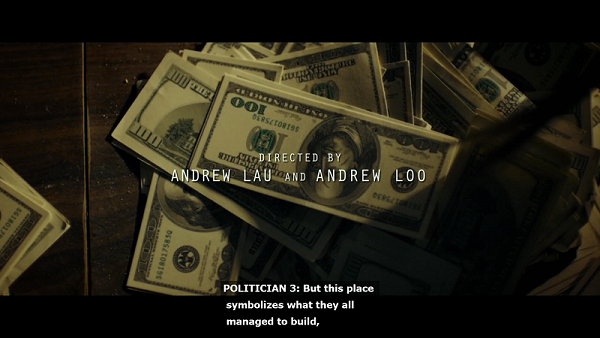
    Green Dragons 04

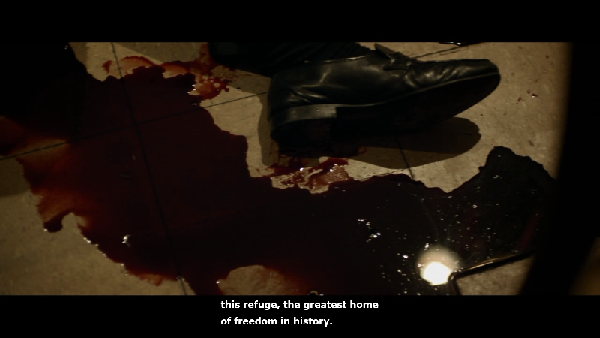
    with a switch to red, green’s complementary color, and the violent theme of the movie —
    Green Dragons 05

    and finally, the film’s title, in red against green.
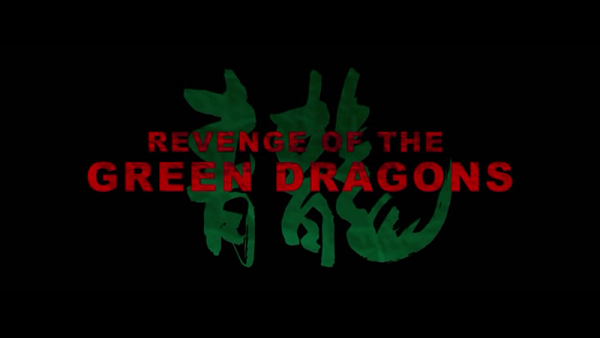
    Green Dragons 06

    I was beginning to like this film.

    **

    I thought of calling this post “Entertaining the heart’s eye” because it’s the emotions that respond to this sort of (formal) care in detail — the film maker is fully conscious of such things, but the viewer’s mind’s eye is preoccupied with narrative (content) and barely notices them. That’s skillful means, that’s the artistry of the medium, that’s how we’re subliminally engaged and move, that’s how it’s done.

    And if narrative is of any interest, as I suggested recently it should be, in terms of trategy, then “how it’s done” — with an emphasis on form rather than content — is key.

    Okay, I had my six screencaps and the tale I’ve just told, and I thought that would be enough, tgether they would make a fine Sunday surprise for ZP. And i thoughy, maybe I can sit back and watch the rest of the film without having to constantly stop and start for screencaps, always a somewhat tedious process.

    **

    But then, as the film proper got under way, there was this shot of —
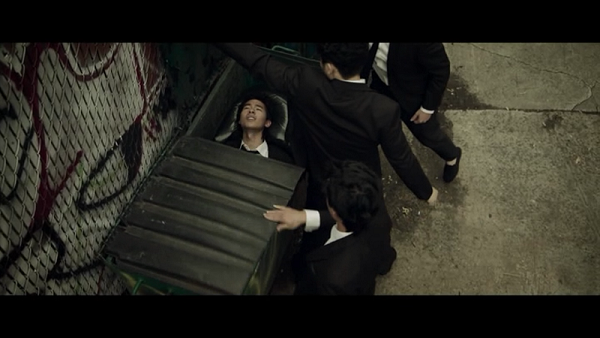
    Green Dragons 7

    a deceased gangster in the dumpster, for all the world as if it was in one of those viewing coffins used for more warmly appreciated mobsters —
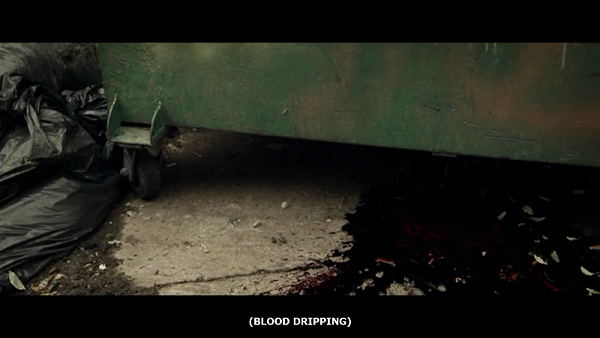
    Green Dragons 8

    but again featuring the film’s characteristic coloring, green, oozing the dark, dark red of blood.

    **

    I was enjoying the film a great deal now, and sat back an allowed myself to move through it as, what, “the speed of film”? But I was in for another shock. There’s a narrative within the narrative, you see, a story told by one brother to the other — and as with all such matrioshka “plays within a play” it is the key to the whole. The elder brother explains to his younger sibling the nature of reality, of strength:

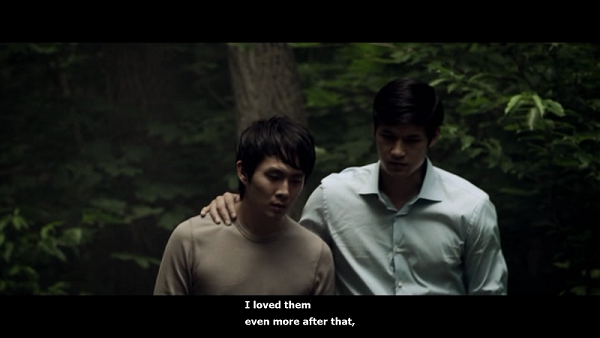
    When I was six, my father took me far into the forest and left me there. Without food, without water. First two days, I cry and I cry. Then, I started to understand the beauty of forest. How big it was. How small I was.

    Soon I come to road, truck take me home. Neither father or mother say anything to me. Not a word.

    I loved them even more after that, because they show me how strong I can be.

    **

    That tale is what the movie is all about, and it is told in forest green.
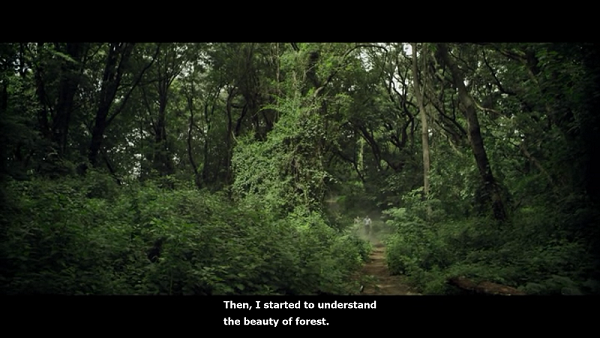
    Green Dragons 9

    The city is left behind, and in otherworldly green Steven tells Sonny this tale as an act of brotherly love —
    Green Dragons 10

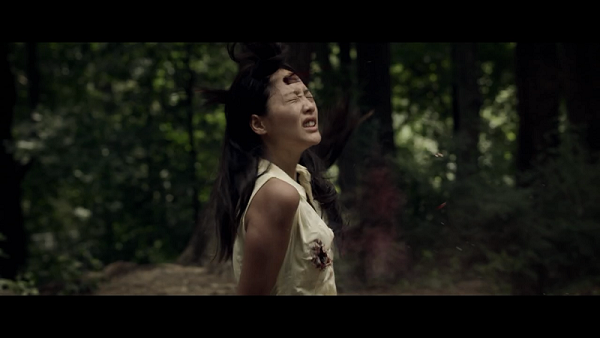
    as they are approaching the glade where Sonny’s love, Tina

    Green Dragons 11

    before Sonny’s horrified and furious eyes — and strictly according to gang logic —
    Green Dragons 12

    is to be executed, spilling that dark red once again into the green.

    **

    I have left out the “story” and given you the “geometry” here — see my recent post on the geometry of the Narcissus / Echo myth.

    Fredric Dannen wrote the New Yorker article on which the film was based, published in 1992. It doesn’t contain the film’s “story within the story” — but it does mention the “forest” —

    They circled around for a while and came across a dirt road. The road ran along the bottom of a ravine and cut through dense woods — an ideal spot for an execution.

    And there’s a flash of brilliant red, too — the real-life Tina’s relatives had placed a red handkerchief in one of her pockets before her cremation:

    According to Chinese custom, if a murder victim is iven something red to wear, the color will “stick to” the killer and he will be caught.

    **

    Read the New Yorker piece, see the film, and keep your eyes peeled for the red in the green.

    Switch to our mobile site