zenpundit.com » Buddhism

Archive for the ‘Buddhism’ Category

Form is Insight: the project

Monday, October 22nd, 2012

[ by Charles Cameron — about the (not yet titled) book (or post-book project) i seem to be writing, which offers a grand slam intro to an array of box-free contemplative and artistic approaches to creative thinking, and hence opens fresh angles on intelligence ]
.

One thing I can promise: whatever this project turns out to be, it won’t be predictable.

credit for this incredible image: Roger Dean

.

This project won’t take you over familiar territory, congratulating you on holding the same opinions as the author and adding in enough choice details to keep you interested. I’m not aiming to teach you the same thing you already know, only better, more interestingly, more precisely, or in greater detail. I’m aiming to question you, challenge you, and give you a whole new range of optics through which to view the world.

**

So, here we go.

I think I am finally at the point where the book (or whatever it is) I’ve been gathering inside me all these years is ready to be written. Some of it has already emerged in earlier posts here on Zenpundit — you don’t known and couldn’t count how many thanks, Mark — and this is certainly where I’ve been developing the style of integrated visuals and verbals that gives the project its flavor — so I’d also like to use my posts here to discuss the thing with you as I go along.

The project is about intelligence in the widest sense, including heart and mind, and with particular focus on creativity. I’m addressing this from two standpoints that mesh together well, and I’m addressing it to two audiences that I believe also mesh together well.

The standpoints are (i) meditation and (ii) the arts, and the audiences are (i) the “intelligence community” and (ii) bright people in general.

I believe that meditation cultivates a spacious mind-set in which we can hold multiple concerns in mind at the same time – the opposing needs of different people, stakeholders, sections of society, the environment, etc – thus seeing things from multiple angles and in balancing & thus balanced ways. And I think the arts serve as the primary means for expressing these balances with all their nuances and shadings, and that techniques from within the arts such as polyphony, chiaroscuro, formal constraint and pattern can teach us to shape multi-faceted insights like these into rich and complex understandings – complex patterns that respond to complex situations. I’ll go into all this in detail as we move along, with examples.

I also believe that this kind of creatively patterned insight — embodying artistic methodology in the context of complex problems with a “fresh” and open mind – will be of interest beyond the intelligence agencies and policy-makers, to business people, artists, and also — importantly — the bright general public, which I take to be a far larger subset of the population than we commonly think, and always eager for reading that doesn’t talk down to them but appreciates their own intelligence and good will.

For now let me just say that I’m very excited, because this seems (at last) to be a project that ties together my game-work with Sembl, the think-tank side of me which has been monitoring religious violence, jihad and terror and working towards nuance, understanding and peace these last dozen years — and my sense of creativity as a writer and poet.

Ripeness is all: I suspect the time for this venture has arrived.

**

Here’s the single page overview I’ve written, with a working title:

Intelligence is Zen: understanding our complex world with koans in mind

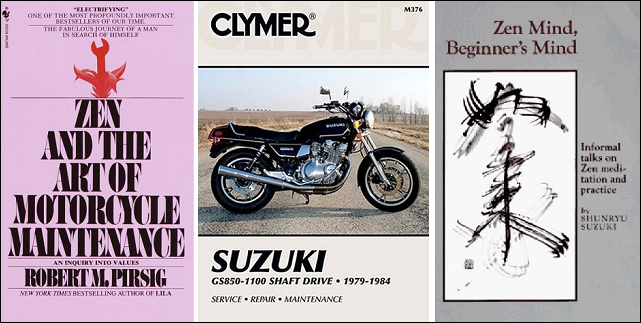
Just a few days ago, the Director of National Intelligence, James Clapper, referenced Pirsig‘s book, Zen and the Art of Motorcycle Maintenance, as key to the Intelligence Community’s work in understanding and adapting to the many, varied, intersecting problems we face in the world today. As I noted, Clapper was focused a bit more on the biker wisdom than the Zen to be found in Pirsig’s book, but he does raise a question I’ve been addressing for some years now:

What does the contemplative mind have to offer in terms of understanding a complex world?

To my mind, the creativity which is all the buzz of the business world, aimed at solving what are called “wicked problems” — problems that feature multiple stakeholders with multiple aims and objectives, aims and objectives which themselves shift over time so the problems are “never the same river twice” – requires a major mental and emotional shift. Reverie and meditation free us up to make the shift: the shift itself is poorly understood.

Our present, mostly linear way of thinking favors either/or side-taking, dubious cause-and-effect expectations which fail to take complex feedback loops into account, followed all too often by a rush to judgment. We need a whole new – old, even ancient – way of thinking.

Our problems are complex because they overlap, they ripple through one another. In Buddhist terms, they are “interdependently arising.” Not surprisingly, the way of thinking that is required to gain a deeper insight into “interdependently arising” problems can be found in explicit form in such contemplative traditions as Madhyamika & Zen, Taoism, Sufism, and their Abrahamic contemplative analogs. At the heart of these systems is fresh thinking – thought refreshed by quiet.

Furthermore, the shaping of insights in an open field of thought is something the world’s artistic traditions have long dealt with, and there are schools of insight not just available but recorded in exquisite detail in the world’s traditions of poetry, music, painting, theater, film… in patterns that are found in nature, in culture, and in the very turbulence we now must learn to flow with.

The project therefore takes a meditation-influenced approach to intelligence, both in the sense in which Clapper would use the word, relating to the intelligence analysis which develops and influences our decision-makers’ understanding of what’s needed, and in the more general sense of those capable folk with bright minds, keen insights, sharp instincts, warm hearts.

I’ll propose a series of ways of looking differently – with application for anyone, whether artist, intel analyst, businessman, policy-maker, or lover – that cut to the essence of creativity: lateral, analogical, holistic thinking, witnessing pattern beneath the surface of things. My examples will be mainly drawn from terrorism, which I have been monitoring for a dozen years: my style is that of a poet and an eccentric Englishman.

My subtext, my subliminal message, will be contemplation and artistry as profound common sense.

One hand Clapping: or is the DNI a Zen Pundit?

Monday, October 15th, 2012

[ by Charles Cameron — silos, motorcycles, zen and the DNI ]
.


.

Pam Benson writing at the CNN Security blog may or may not have had anything to do with the title of her post, Spy chief gets Zen, but she’s presumably responsible for her first paragraph:

You usually don’t associate spying with being Zen, but that’s exactly what the nation’s chief intelligence officer did this week at an intelligence gathering in Orlando, Florida.

Here at Zenpundit we’re naturally prone to both Zen and Punditry, so we like that — but to be honest it’s a little over the top. I’m dropping his entire keynote in at the bottom of this post, but for now let’s just say instead that DNI James R Clapper gets bikers.

Okay, maybe we can go a little further, and say he gets Zen and the Art of Motorcycle Maintenance. That’s not quite Zen, but it’s getting closer. Kristin Quinn‘s piece at Trajectory magazine is titled GEOINT 2012: Zen and the Art of Intelligence, which at least pays hommage to Pirsig’s book, and focuses on Pirsig-zen as it applies to Intelligence…

And that’s a direction we can applaud.

Two questions, then: what is zen, and what is intelligence?

**

Zen is, strictly speaking:

A direct transmission outside the Scriptures,
Not dependent on words and letters,
Directly pointing to one’s own mind
Seeing into one’s own nature.

Those words, however, are something of a scripture, so the transmission isn’t in them — it’s one of those things like ceaseless change, always there, never the same, flexible beyond the capacity of words to capture it — as Laozi remarked at the start of the Dao De Jing, in scribbled response to a border guard who demanded that his scriptures be verbal — “dao ke dao, fei chang dao” — two Chinese phrases English can barely translate.

Where do we go from here, then, if we’re accustomed to think in words?

The zen master Shunryu Suzuki Roshi has one answer in the title of his book Zen Mind, Beginner’s Mind.

Zen takes you back to where your mind is fresh and playful, before it got narrow-minded, siloed and rutted. Zen means wide-angle alertness, from a point prior to preference, assumption and prejudice.

Zen takes your thoughts and emotions to the laundry, while you take a shower. They come back lighter and cleaner, and you’re freshened up and ready to go.

**

Let me put that another way, using the analogy of Google glasses. Zen takes you behind words: you can still see them, you can see through them. Very quickly, then, since 5 images are worth 5,000 words and take a lot less time to ingest:

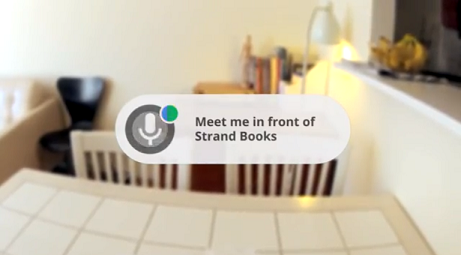
Wearing some futuristic Google Glasses, you would be able to…

Let your glasses know you want to go to the Strand Bookstore (great idea, btw!):

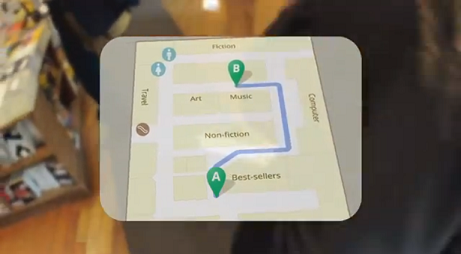
Get yourself a quick map from there to here, visible but superposed on your natural ability to see the street:

Know when you’ve arrived at the bookstore (a) because you can see the books and (b) because your glasses tell you so.

Use a map to navigate to the Music section:

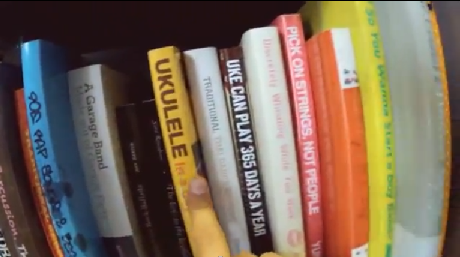
And locate the Ukulele shelf:

When IMO you’d be better off reading about Johann Sebastian Bach — though that’s a matter of personal taste.

With zen, your thoughts and emotions are like head- and heart-mounted displays — you can see them, they can inform your understanding, but you can also see through them, they’re transparent. You can see the world.

**

I’m going to suggest my own definition of intelligence: it’s the ability, given some data point or points, to recognize a variety of salient patterns into which it or they fit, and to create a synthetic understanding of how to move, given that all those salient pattern-fields are in play.

It is seeing in depth, past the surface, where the surface is your assumptions and expectations, and depth is the currents and undercurrents of nuance that your expectations hide.

Let me say that another way: assumptions and preferences — taking sides, being on a team — deprive you of depth. And another: the opposite of surface / superficial thinking is depthful thinking / pattern-recognition.

That, in a nutshell, is why I feel intelligence and zen “go together” even more seamlessly than zen and bikers.

**

Here’s Clapper’s speech:

**

In a future post, I hope to tackle the question of koans — those strange zen riddles, of which the best known may be…

What is the sound of one hand clapping?

An Afghan Buddha koan

Friday, October 5th, 2012

[ by Charles Cameron — for Madhu ]
.

Our friend Madhu has requested that I post poems here on occasion, and this particular poem made me think of her and her request, so here it is:

A copper and gold koan
.

The world happened, the world is drifting away,
the farther away the world floats the deeper into the mists.

In Mes Aynak, Afghanistan, the remains
of a buddhist monastery already eroded by time are adrift,
a sitting buddha is floating into the mist,
headless, gold paint still on his knees and robe,
the devotion has drifted, lifted its focus
to the one without a second, the buddha left
whatever he left in memory, lingering, to gather aromas
of other ideas, realms, dust, archaeology, oblivion,
there is change, ceaseless change,

and adults must decide: is the wealth implied by the copper
beneath the buddha worth more than a trace of halo,
as the moon moves once again across a brilliant night sky.

.
Koans are those brilliant paradoxes zen buddhism uses to pry the mind open, I think they’re important aids to handling complexity, and I have a post about them coming up shortly. Here, it’s enough to say that the issue of copper mining vs archaeology in Mes Aynak seems to me to be a living, breathing koan.

**

It’s awkward, when you write an “ekphrastic” poem, a poem about a painting or photo, to have the image right there when the poem is read, because it trammels the reader’s mind in much the same way that a film can trammel the mind of a reader into “seeing” only the film-maker’s Gandalf, no longer her or his own.

And I’m going on at some length about this, because next up is the image from which that particular poem was built, but I’d like the image to be, as they’d say in the newsprint world, “below the fold” as you read the poem.

So here it is, #4 in a fine series of photos in a Foreign Policy photo essay which I recommend, although I’ve taken this particular (smaller) version from a CNN page, since the subtitle in the lower right corner explains the basic situation handily:

You can hear the archaeologist Brent Huffman, who took the photo, talk about the situation here — local reactions pro and con, who the Taliban are shooting at, the likelihood that the Chinese operation will in fact benefit the locals and more:

The koan of balancing material with immaterial values remains, but in this circumstance the likelihood of local Afghans receiving litter or nothing from the mining project likely tips the scales.

You can petition Afghan President Hamid Karzai for preservation…

But then he’s another wild-card in the continuing Great Game, isn’t it?

The cloak, mantle and authority of the Prophet

Sunday, September 30th, 2012

[ by Charles Cameron — the symbolic importance of Mullah Omar with the cloak of the Prophet, comparative, frankly long, and IMO worth it ]
.
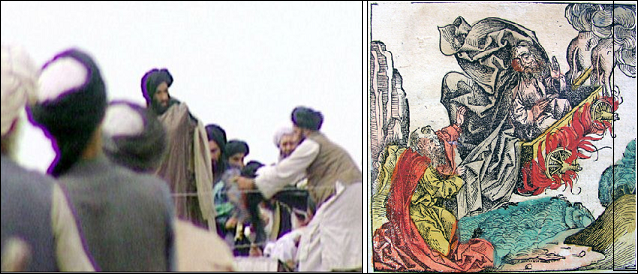
Mullah Omar in Kandahar; Elijah & Elisha from the Nuremberg Chronicle

.
I would like to give you a sense of the significance of an apparently insignificant detail, which I was reminded of today while skimming Charles Kurzman‘s The Missing Martyrs: Why There Are So Few Muslim Terrorists, page 74:

To gain legitimacy as he was taking over Afghanistan,Taliban leader Mulla Muhammad Umar literally wrapped himself in the cloak of the Prophet Muhammad, a cherished relic stored for two centuries at a shrine in Qandahar. He ordered the custodians to unlock the sanctuary, then stood on the roof of a nearby mosque and placed his hands in the cloth as a crowd of supporters chanted “Commander of the Faithful,” a title associated with the first caliphs to succeed the Prophet Muhammad.

To better grasp the significance of the situation, I will first quote from the Jewish and Buddhist scriptures to illuminate the symbolic power that can be vested — interesting word — in a cloak or robe.

**

John Daido Loori is a zen master in whose teishos or teachings I often find insight and delight. Here’s his description of the original transmission of “bowl and robe” in Buddhism, from the Buddha to his disciple Mahakashyapa:

After Buddha died, Ananda became the attendant of Mahakashyapa. One day he asked, “That time on Mount Gudhakutra, when the World-Honored One gave you the bowl and robe, and transmitted the Dharma to you, what else did he give you?” Mahakashyapa called out, “Ananda.” Ananda responded, “Yes, Master?” Mahakashyapa said, “Take down the flagpole.” At that point, Ananda finally had a realization. He realized what Mahakashyapa had realized. So it has been, down through successive generations, mind-to-mind for 2,500 years.

The Buddha’s teaching later passes from India into China, where the transmission continues. Here’s how Hui Neng, in the Platform Sutra, describes his own enlightenment and reception of the teachings:

At midnight the Fifth Patriarch called me into the hall and expounded the Diamond Sutra to me. Hearing it but once, I was immediately awakened, and that night I received the Dharma. None of the others knew anything about it. Then he transmitted to me the Dharma of Sudden Enlightenment and the robe, saying: ‘I make you the Sixth Patriarch. The robe is the proof and is to be handed down from generation to generation. My Dharma must be transmitted from mind to mind. You must make people awaken to themselves.’

**

There’s a remarkable story told in 2 Kings 2.8-15 that concerns the transmission of prophetic gifts by similar means, when the prophet Elijah is carried up into heaven:

And Elijah took his mantle, and wrapped it together, and smote the waters, and they were divided hither and thither, so that they two went over on dry ground. And it came to pass, when they were gone over, that Elijah said unto Elisha, Ask what I shall do for thee, before I be taken away from thee. And Elisha said, I pray thee, let a double portion of thy spirit be upon me. And he said, Thou hast asked a hard thing: nevertheless, if thou see me when I am taken from thee, it shall be so unto thee; but if not, it shall not be so.

And it came to pass, as they still went on, and talked, that, behold, there appeared a chariot of fire, and horses of fire, and parted them both asunder; and Elijah went up by a whirlwind into heaven. And Elisha saw it, and he cried, My father, my father, the chariot of Israel, and the horsemen thereof. And he saw him no more: and he took hold of his own clothes, and rent them in two pieces.

He took up also the mantle of Elijah that fell from him, and went back, and stood by the bank of Jordan; And he took the mantle of Elijah that fell from him, and smote the waters, and said, Where is the Lord God of Elijah? and when he also had smitten the waters, they parted hither and thither: and Elisha went over. And when the sons of the prophets which were to view at Jericho saw him, they said, The spirit of Elijah doth rest on Elisha. And they came to meet him, and bowed themselves to the ground before him.

The beauty, the power in this telling comes from the cloak’s ability to part the waters, as on an earlier occasion Moses‘ staff had done, not merely in the hands on Elijah, but also, once the transmission has been made, in the hands of Elisha. It is that double motif of the parting of the waters that demonstrates the efficacy of the prophetic transmission.

Coming fresh from the Buddha, Mahakashyapa, Hui Neng, Elijah and Elisha, we should be ready to appreciate that the mantle, cloak or robe of a sacred person is imbued with that person’s power — Matthew 14.36 describes crowds bringing the sick to Jesus:

that they might only touch the hem of his garment: and as many as touched were made perfectly whole.

**

In light of these examples, let us consider the reports of the day when Mullah Omar was proclaimed Amir of the Faithful:

There was a tremendous stir in Kandahar: we followed the crowds to a mosque in the city center. The Taliban had been holding an assembly of mullahs from all over Afghanistan. Now the results were about to be made public. Holy war was announced against the government of President Rabbani in Kabul. The head of the Taliban, Mullah Omar, was declared to be the Amir or leader of all Muslims everywhere. Because this was regarded as a key moment for the Afghan nation, Mullah Omar displayed the holy cloak of the Prophet Muhammad to the crowd. It’s kept in Kandahar and shown only in times of crisis. The last time was sixty years ago. Neither the cloak nor the ceremony has ever been filmed before, not has Mullah Omar. People in the crowd threw up their turbans to touch the cloak and be blessed by it. It was like being at some great religious ceremony in the Middle Ages.

That’s from the soundtrack of a video I sadly can’t post here, but which you can see for yourself on a BBC site under the title Mullah Omar reveals the Prophet’s cloak.

Adam Curtis, who posted the clip, describes it thus:

In the early 90s the students returned to Afghanistan and set up the Taliban – to cleanse the country of a revolution that had gone wrong, compromised by the futile idea of modernising Islam. And in April 1996 Mullah Omar went to the Shrine of the Holy Cloak. He took out the cloak for the first time in 60 years and waved it from the roof – just as Amanullah had in 1929 – and announced a jihad against the Islamist factions in Kabul.

The BBC producer Tom Giles and John Simpson were in Kandahar that day – and they captured this extraordinary moment on video.

When King Amanullah had held the cloak above his head in 1929 it symbolised the end of his dreams of creating a modern world in Afghanistan. Now – in 1996 – Omar was saying the same thing – forget the future, listen to the ghosts of your past – and follow their rules.

Let’s note in passing that Omar holds the cloak up — neither in the video clip nor in the two accounts is it suggested that he wore it — and that it had previously been held up by Amanullah Shah in 1929.

**

For the symbolic impact as reported in the West, let’s turn to Tim Weiner‘s piece, Seizing the Prophet’s Mantle: Muhammad Omar, in the NYT of December 7, 2001:

And as the country was falling to the Taliban five and a half years ago, Mullah Omar literally cloaked himself in the trappings of the Prophet Muhammad.

On April 4, 1996, as the Taliban neared total control, he was moved by zeal to unseal a shrine in Kandahar that held a cloak believed to have belonged to the prophet, the founder of Islam. The cloak had not been touched since some time in the 1930’s. He lifted it in the air as he stood on a rooftop, displaying it to a crowd of followers. The event was caught on videotape, one of the very few times that he was ever photographed. He placed the cloak, which only the Prophet was said to have worn, upon his own shoulders.

And at that moment, he declared himself the commander of the faithful, the leader of all Islam. No one had claimed that title since the Fourth Caliph, more than 1,000 years ago.

That’s impressive stuff, and “Seizing the Prophet’s Mantle” and “Omar literally cloaked himself in the trappings of the Prophet” do a decent job of capturing the marriage of literal and symbolic that’s at work here.

But “he placed the cloak … upon his own shoulders”? I’m not so sure.

**

It was a tremulous moment, evidently, even for Omar, as Norimitsu Onishi reported in the NYT a couple of weeks later on December 19, 2001, in A Tale of the Mullah and Muhammad’s Amazing Cloak:

The first time Mullah Muhammad Omar was allowed to enter the Shrine of the Cloak of the Prophet Muhammad here in Kandahar, and cast his gaze on the sacred ancient robe, he trembled. So disoriented was Mullah Omar that as he prepared to pray, he mistook the way toward Mecca.

“He turned to face toward the south,” recalled Qari Shawali, 48, the keeper of the prophet’s cloak. “So I made him change his position to turn toward Mecca.”

I suspect that here we have an indication that Omar was surprised by the event, that he was in fact acclaimed by the assembly of mullahs rather than claiming the robe and title for himself.

However, as the saying goes: Allah is the best of knowers.

**

Mujib Mashal‘s piece, The myth of Mullah Omar on al-Jazeera, 6 June 2012, gives us a few clues as to informed Afghan responses to the event, throwing in the detail that bin Laden was there at the time -– but also informing us that Omar “donned the cloak” and claiming this was the first time in 250 years that this had happened:

To formally announce his leadership in 1996, Mullah Omar, then 36 years old, brought forth the purported cloak of the Prophet Mohammed, one of Afghanistan’s most cherished Islamic relics. For the first time since the reign of Ahmad Shah Abdali more than 250 years before, Omar donned the cloak in the presence of about 1,500 religious leaders, including the late Osama bin Laden.

“Wearing the cloak was a masterstroke,” Sharifi said, adding that it linked the ex-guerrilla fighter to both Abdali and the Prophet. But Wahid Muzhda, an Afghan analyst and one-time high-ranking official in the Taliban foreign ministry, disputes that narrative. “From what I know, from sources close to Omar, and from a chat with the keeper of the shrine [where the cloak is kept], Omar did not wear the cloak.” “With great respect, he held the cloak in front of the religious leaders gathered for allegiance.”

This gesture, more than any other, was the impetus that allowed Mullah Omar, without any deep political or tribal base, to become the iron-fisted ruler of about 90 per cent of Afghanistan until the US invasion in 2001.

**

I know, you’re fatigued and I’m excited: bear with me, let’s hear the story of Ahmad Shah as told by Steve Inskeep on NPR in The Cloak of the Prophet some time in 2002:

According to the version of the legend that I heard, Ahmad Shah traveled to Bokhara — once one of the major centers of Islamic scholarship and culture, now a modern city in the former Soviet state of Uzbekistan . There he saw the sacred Cloak of the Prophet Mohammed, and decided to bring it home. He wanted Kandahar to have the artifact, so he asked to “borrow” the cloak from its keepers.

The keepers knew he might steal it, and told him he must not take the cloak from Bokhara. So Ahmad Shah pointed to a stone in the ground and made a promise. He said, “I will never take the cloak far away from this stone.”

Relieved, the keepers let him take the cloak. Ahmed Shah kept his word, in a sense. He had the stone taken up out of the ground, and had it carried back to Kandahar, along with the cloak, which he never returned. Today, the stone stands on a pedestal near the shrine.

The Cloak of the Prophet is normally hidden from public view. It is taken out only for special occasions. The last such occasion came in 1996, as the Taliban seized control of the country.

The Taliban leader, Mullah Omar, made what was considered a brilliant propaganda move. He took Mohammed’s shroud out of storage and wore it in a public rally, as a way to identify himself with the Prophet, and give himself legitimacy.

That’s an interesting tale in its own right, and reminds me of another Abrahamic treasure, the Stone of Scone, throned above which Scottish and British Kings and Queens are crowned. For your viewing delight: Stone of Destiny.

**

Fast forward to July 1928, a more recent moment when Afghanistan was in crisis.
Adam Curtis reports in The Weird World of Waziristan, 5 April 2010:

Amanullah fled to Kandahar. He knew that his attempt at modernization had failed and to save himself he tried to prove that in reality he was a traditional Islamic monarch. He did it in a final dramatic gesture.

Amanullah went to the Shrine of the Holy Cloak in the centre of Kandahar. He opened up the brass bound chest where the cloak which was reputed to have been the Prophet’s had lain for over a 100 years. Amanullah lifted it above his head and demanded of the mullahs in front of him whether Allah would allow a heretic or an apostate to perform such a sacred act.

**

And so to our most serious analytic effort on the topic, and a couple of indicators of the point I’m so often trying to make, here and in other posts on ZP. Here are Thomas H. Johnson and M. Chris Mason, writing in Terrorism, Insurgency, and Afghanistan as published by the Naval Postgraduate School, where both of them work in the Program for Culture & Conflict Studies:

Omar joined this rogues gallery of politicized insurgent Mullahs by means of a politico-religious stunt that is of enormous importance to the Taliban movement but that is considered insignificant by most Western analysts, if they are aware of it at all. In doing so, he became the epitome of the charismatic leader as described by Max Weber, who he defined as having:

… a certain quality of an individual personality, by virtue of which he is set apart from ordinary men and treated as endowed with supernatural, superhuman, or at least specifically exceptional powers or qualities. These are such as are not accessible to the ordinary person, but are regarded as of divine origin or as exemplary, and on the basis of them the individual concerned is treated as a leader.

The event in question was Omar’s removal in 1994 of a sacred garment -— believed by many Afghans to be the original cloak worn by the Prophet Mohammed -– from its sanctuary in Kandahar, and actually wearing it while standing atop a mosque in the city. Whereas Omar had been a nonentity before this piece of religious theatre, the audacious stunt catapulted him to a level of mystical power (at least among the 90 percent of Pahstuns who are illiterate) in a manner that is almost impossible for Westerners to understand, and it resulted in his being proclaimed locally the Amir-ul Momineen, the Leader of the Faithful — not just of the Afghans but of all Muslims.

I would draw your particular attention to this phrase:

a politico-religious stunt that is of enormous importance to the Taliban movement but that is considered insignificant by most Western analysts, if they are aware of it at all.

Why? Why do we continually overlook such indications of the depth of feeling that animates the Taliban? Perhaps another analogy, from closer to home, will help us here.

I’m not sure that I’d call the exposition of the Shroud of Turin a “piece of religious theatre” or an “audacious stunt” — even if Pope Benedict, famously concerned at the secularization of Europe, visited it and remarked both on the Shroud as an icon of the death and burial of Christ, and of our era’s participation in the “death of God” “after the two World Wars, the lagers and the gulags, Hiroshima and Nagasaki”:

Jesus remained in the tomb until dawn of the day after the Sabbath and the Turin Shroud presents to us an image of how his body lay in the tomb during that period which was chronologically brief (about a day and a half), but immense, infinite in its value and in its significance.

You may regard the Son of God and the Prophet of Allah as similar figures or utterly different: but to understand the emotions roused by Mullah Omar’s gesture, these correspondences drawn from other religious traditions may provide a useful place to start.

**

As for myself, I have a poet’s reverence for symbols, but I recognize that it is what they symbolize that is important — and so I’ll close as I began, with the Buddhist robe and bowl and another delighful teisho from Abbot Loori:

Ming was chasing after Hui-neng, determined to retrieve the bowl and robe of Bodhidharma from him. Finally, when he caught up to Hui-neng, the Sixth Ancestor put down the robe and bowl and said, “This robe was given to me on faith. How can it be fought for by force? I leave it for you to take it.” Ming tried to pick up the robe and bowl but couldn’t—they were as heavy as a mountain. He fell to his knees, trembling, and said, “I come for the teachings, not the robe. Please teach me, oh lay brother.” Completely open, completely receptive, completely ready, he was a man teetering on the brink of realization. Immediately, the Sixth Ancestor struck. “Think neither good nor evil,” he said. “At that very moment, what is the true self of monastic Ming?”

Gloria Mundi Rapid Transit

Sunday, September 2nd, 2012

[ by Charles Cameron — that’s the thing: only what’s deep survives ]
.


.

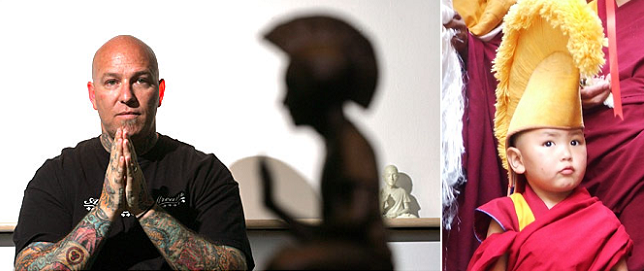
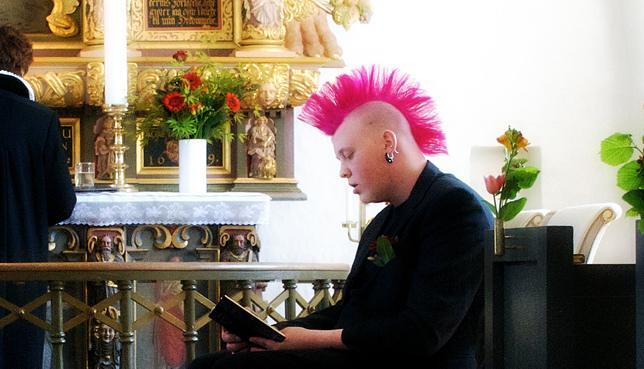
I don’t think the shadow on the wall behind and to the right of Noah Levine (above, left) is wearing a mohawk — I think it’s the shadow of a Tibetan monk wearing the kind of headdress you’ll see on the young Tulku (above, right)… but even so, the picture does remind me of this one, which I posted a few days ago, titled “choir punk”:
.


.

The similarities are more than visual, however — and they’re instructive.

**

As you may recall, the lower of the two images is one that I used to illustrate my opening post on the topic of Pussy Riot, and it illustrates the theme that punk and Orthodoxy have something important in common. The upper image (left) shows another punk who got religion — in this case, Buddhism. His name is Stephen Levine, and he’s the guy who set the Dharma Punx wheel rolling, coming out of a life of prison, punk and crack addiction into the stillness of meditation in much the same way that the punk monks featured in that earlier piece came out of their own nihilism, punk and despair into the stillness of contemplation…

From nihilism to peace.

I’ve never been into punk music myself, I’m a Bach and Gregorian Chant man — but what’s striking me here is the sense that punk knows the first thing there is to know: that the things we do to try to keep ourselves happy necessarily ring hollow after some time. Possessions, status — these things may appease us for a while, but they don’t truly satisfy.

The punk knows this, and the monk knows this — whether the monk in question is Buddhist or Christian or whatever. Only the monk makes the discovery that leads out of contemptus mundi into the alternative strategy.

**

And somehow, you need to reach full tilt boogie to get there, howsoever full tilt boogie may be defined in your own case, and whatever form the contemplative, relaxed, inward life may take.

Here are two versions of what it takes:

Samuel Johnson, I’d say, is seeing something very close to either one of these when he says:

Depend upon it, Sir, when a man knows he is to be hanged in a fortnight, it concentrates his mind wonderfully.

**

A close brush with death — or sure knowledge of one’s mortality. A red-hot iron ball stuck in your throat. Rock bottom…

All of these things can concentrate the mind wonderfully, and the concentrated mind can do things, can allow things that the bothered mind would get insanely bothered by.

You may wear rose-tinted glasses for a while, and get away with it. You can try out the dark glasses of ironic superiority. Both ways of looking involve a measure of self-delusion, however, for they catch surfaces and miss the depths.

At times — when you or someone you love gets an unexpected and advanced cancer diagnosis, say, or you lose your house to the bank — the illusions get stripped away, and you simply see. And what you see will either be enough to make you cry and rage, or enough to make you dance and sing.

Because when the illusions get stripped away, only what’s deep survives.

**

I’d like to take this just a step further.

The old Lakota medicine man Archie Fire Lame Deer told his biographer, Richard Erdoes:

I am no wino or pishko, but I am no saint either. A medicine man shouldn’t be a saint. He should experience and feel all the ups and downs, the despair and joy, the magic and the reality, the courage and the fear, of his people. He should be able to sink as low as a bug, or soar as high as an eagle. Unless he can experience both, he is no good as a medicine man.

I don’t suppose anything I say in words can get this exactly right anyway, but I’ll try.

If you try to give advice to someone who is suffering more than you have ever suffered, your advice is liable to come across as uncomprehending and shallow. You have to have known your own blues to sing the blues. And you have to be in peace to convey peace…

And that, it seems to me, is what allows monks to hear and understand and talk, peer to peer, with punks — and that’s what allows punks to become monks.

**

Noah Levin’s book, Dharma Punx, is available on Amazon, as is the DVD of Meditate and Destroy, the 2007 documentary about him.

**

Punk may still not be my kind of music — but I’m beginning to see the punk mohawk as a kind of instinctive tonsure…


Switch to our mobile site