zenpundit.com » Buddhism

Archive for the ‘Buddhism’ Category

Buddha statues: idols or icons?

Saturday, May 19th, 2012

[ by Charles Cameron — Pat Robertson, the Taliban, Bamiyan, Buddha statues, a Zen tale, Petraeus and Pastor Jones ]
.


credits: (a) wikipedia under cc license, (b) dharmashop
.

Here, by way of context, is a story posted on the Treeleaf Zendo site, and widely discussed in the Catholic blogosphere:

On a cold winter night, a big snow storm hit the city and the temple where Dan Xia served as a Monk got snowed in. Cut off from outside traffic, the coal delivery man could not get to the Zen Monastery. Soon it ran out of heating fuel after a few days and everybody was shivering in the cold. The monks could not even cook their meals.

Dan Xia began to remove the wooden Buddha Statues from the display and put them into the fireplace.

“What are you doing?” the monks were shocked to see that the holy Buddha Statues were being burnt inside the fire place. “You are burning our holy religious artifacts! You are insulting the Buddha!”

“Are these statues alive and do they have any Buddha nature?” asked Master Dan Xia.

“Of course not,” replied the monks. “They are made of wood. They cannot have Buddha Nature.”

“OK. Then they are just pieces of firewood and therefore can be used as heating fuel,” said Master Dan Xia. “Can you pass me another piece of firewood please? I need some warmth.”

The next day, the snow storm had gone and Dan Xia went into town and brought back some replacement Buddha Statues. After putting them on the displays, he began to kneel down and burn incense sticks to them.

“Are you worshiping firewood?” ask the monks who are confused for what he was doing.

“No. I am treating these statues as holy artifacts and am honouring the Buddha.” replied Dan Xia.

*

In light of that, compare and contrast this recent video of Pat Robertson:

with this video (I don’t think you need to see all of it, just a taste perhaps?) titled The Beheading of the Buddha, posted on YouTube and “presented” by Al-Muhaajiroun:

and both of those with this third video, of Pastor Jones, discussing both his own burning of the Qur’an and GEN Petraeus‘ powerful and intelligent response…

*

I think we should discuss these matters in an open and respectful way, and hope that this post will provide an appropriately respectful and open-minded framing for such a discussion.

As to my own view – I see a consideration that whatever opens us up to compassion and clarity is an icon and a grace, and another consideration that whatever closes us off from clarity and compassion is an idol or a poison…

***

For those of a scholarly bent, here’s a downloadable fatwa on the Taliban’s destruction of the great Buddhas of Bamiyan — from which the screen-grab below is taken:

Of swastikas, meanders and the mapping of complexity

Wednesday, May 16th, 2012

[ by Charles Cameron — a meander from the symbolism of the Greek neo-Nazi party to the complex flow of the great Mississippi River ]
.


.

As every red (or blue) blooded conspiracist knows, there’s a swastika-shaped building on the US Naval Amphibious Base Coronado near San Diego, CA.

That might of course mean the US Navy is under the spell of Hinduism or Buddhism, each of which makes use of the swastika for reasons that have nothing to do with the Nazis and more perhaps to do with simple geometric shapes and their near-universal use in rituals:

*

I mention this, because symbolism is important, because the Greek right-wing party that did well in the recent elections has a flag that has been compared with the Nazi swastika, and because conspiracy theories, though informative markers of shifts in the collective unconscious in their own right, are also useful tools in the shame and blame game.

The Greek party concerned (Chryssi Avghi or Golden Dawn) points out that the central symbol of its flag (left) is taken from an ancient Greek “meander” (note similarities in the various common designs, middle) and not from the Nazi flag (right) – even though it’s curious that they choose the same black on white on red colors, isn’t it?

In my view the flag is suggestive, not conclusive: it’s their holocaust denial that proves the point.

*

Anyway, it’s likely that none of that would have been interesting enough for me to post it, had my quirky researches not also pointed me to a far more interesting graphic.

Regular readers here will remember that I have an interest in graphical representations of complexity, and posted a piece titled Of railroad tracks and polyphonic thinking a while ago, in which I took the metaphor of trains of thought far too literally, and used railroad imagery to suggest a few ideas about complexity…

My researches into the Greek “meander” patterns were intriguing — but it was stumbling across this image from a post at the Ontario-based Onsite Review that decided me (and I think that’s the right usage, we are decided, we don’t decide) that I really did need to make this post.

Consider: it’s the mighty Mississippi, seen as it meanders across time:

The Onsite Review’s attribution is to Harold N. Fisk, Ancient Courses. Mississippi River Meander Belt, 1944. Their comment for this image reads:

The greek key pattern is sometimes called the meander, after the Maeander River, now called the Büyük Menderes River that flows from central Turkey to the Aegean. It winds through the Maeandrian plain in the manner of most prairie rivers, cutting into soft banks and creating oxbows.

We know a certain amount scientifically about river meanders, just as we know quite a bit about perturbations in the flow of liquids — but not enough, never quite enough to know where the river of time will take us next.

The map above illustrates the flows of a fairly simple complexity: take a good look at it. The thought-flows of a human are liable to be far more complex.

Mountains and Rivers [with or] Without End

Sunday, April 15th, 2012

[ by Charles Cameron — just poetry — Gary Snyder, Han Shan, Dogen, Thoreau, Smokey & MIT ]

Gary Snyder is the fellow in the upper panel with the mountains behind him. Han Shan — whose name means Cold Mountain, which was also the name of the place he lived — is the fellow showing a poem to his friend in the lower panel. Dogen Zenji is the fellow who gave us the Mountains and Rivers Sutra. Thoreau is the fellow who retired for a while to Walden Pond. Smokey the Bear you know. And MIT is where Gary Snyder received the Henry David Thoreau Prize last Tuesday.

All are worthy of your attention, but in combo they’re unbeatable.

 
MIT:

MIT’s an interesting place to crop up in an account of Snyder — a poet, a Californian living high and away in the Sierras, and one of the first westerners to sit Zen and study in a monastery in Japan… And yet it’s curiously appropriate. Snyder is not here to banish science with poetry, but to enhance poetry with science, science with poetry, and both with his keen eye for context and honest detail.

He’s interested in weather. Understanding weather is in all our interests, but Snyder is actively interested. He’s interested in mountains and rivers, which comes to much the same thing — and he would surely have been interested in this exhibit that opened at MIT on Friday, just three days after his award ceremony there:

I dropped this image in here because it shows mountains and glaciers — but not without end. The loss of glaciation would concern Snyder — we know he’s interested in such things both immediately and in the long term, not only from his ecological writings in prose, but also because there’s a section of his epic Mountains and Rivers Without End that opens with these words:

“The 15 billion cubic kilometers of water on the earth are split by photosynthesis and reconstituted by respiration once every two million years or so.”

Even on that time-scale, Snyder’s interest in such things is personal: that section is titled We Wash Our Bowls in This Water.

So that’s the MIT part of the package.

 
Han Shan:

The terrific tale [link includes poems, too] of how a Chinese official learned that Han Shan and Shih-te, his laughing companion pictured above, were in fact great bodhisattvas though they looked like vagabonds could have come straight out of Jack Kerouac‘s Dharma Bums days. The official describes Han Shan:

He looked like a tramp. His body and face were old and beat. Yet in every word he breathed was a meaning in line with the subtle principles of things, if only you thought of it deeply. Everything he said had a feeling of Tao in it, profound and arcane secrets. His hat was made of birch bark, his clothes were ragged and worn out, and his shoes were wood. Thus men who have made it hide their tracks: unifying categories and interpenetrating things.

And here he describes how he arranged for the publication of Han Shan’s poetry:

I ordered Tao-ch’iao and the other monks to find out how they had lived, to hunt up the poems written on bamboo, wood, stones, and cliffs – and also to collect those written on the walls of people’s houses. There were more than three hundred. On the wall of the Earth-shrine Shih-te had written some gatha (Buddhist verse or song). It was all brought together and made into a book.

Gary Snyder it was, by the way, who turned Kerouac and the Beats onto Buddhism, and who features as Japhy Ryder in Kerouac’s Dharma Bums.

 
Gary Snyder:

Here’s Snyder again:

The first question that arises for me when I see photos of Gary Snyder like the ones above, I’ll admit, is whether it’s somehow axiomatic that his face should be as creased and rugged as the mountains he loves.

That’s a question for the intuition, really — but it may be worth noting that Emily Bronte saw a similar yet somewhat different correspondence between face and land and mentioned it in Wuthering Heights:

Catherine’s face was just like the landscape – shadows and sunshine flitting over it in rapid succession; but the shadows rested longer, and the sunshine was more transient; and her poor little heart reproached itself for even that passing forgetfulness of its cares.

People, and their eventual likeness to the places they live?

Let’s take this a little deeper. With respect to mountains, rivers and sages specifically, the great zen master Dogen teaches us in his Mountains and Rivers Sutra:

From time immemorial the mountains have been the dwelling place of the great sages; wise ones and sages have made the mountains their own chambers, their own body and mind. And through these wise ones and sages the mountains have been actualized. However many great sages and wise ones we suppose have assembled in the mountains, ever since they entered the mountains no one has met a single one of them. There is only the actualization of the life of the mountains; not a single trace of their having entered remains.

 
Dogen Zenji:

Dogen composed the Mountains and Rivers Sutra, which as far as I can tell is not available in book form except as a section of his longer work, the Shobogenzo. Snyder worked from 1956 to 1996 on his long poem series, Mountains and Rivers without End. The Cleveland Art Museum houses a scroll painting from the Northern Sung dynasty, Streams and Mountains Without End:

 
Translation — hey, second cousin to reincarnation?

An ancient Han Shan poem that’s also an early Snyder poem, Snyder here translating Han Shan:

I settled at Cold Mountain long ago,
Already it seems like years and years.
Freely drifting, I prowl the woods and streams
And linger watching things themselves.
Men don’t get this far into the mountains,
White clouds gather and billow.
Thin grass does for a mattress,
The blue sky makes a good quilt.
Happy with a stone under head
Let heaven and earth go about their changes.

Of both men you might say: the dwelling place is where the mind dwells.

 
Smokey the Bear:

Snyder has his own sutra. It is called the Smokey the Bear Sutra, and it’s both fierce and hilarious: I have a beautiful copy in storage somewhere, in the beautiful Fudo Trilogy edition, that Snyder kindly inscribed for me, “Well met”.

It contains the following gloss on mountains and rivers:

My obstinate compassion is schist and basalt and granite, to be mountains, to bring down the rain.

Science, mountains, weather patterns, rivers…

The poetry in Synder’s Mountains and Rivers has its rapids and still waters, its simple poetry and dazzling prose:

A day on the ragged North Pacific coast get soaked by whipping mist, rainsqualls tumbling, mountain mirror ponds, snowfield slush, rock-wash creeks, earfuls of falls, sworls of ridge-edge snowflakes, swift gravelly rivers, tidewater crumbly glaciers, high hanging glaciers, shore-side mud pools, icebergs, streams looping through the tideflats, spume of brine, distant soft rain drooping from a cloud,

sea lions lazing under the surface of the sea…

 
HD Thoreau:

Walden Pond is one of the great power centers of America Snyder mentions in the Smokey the Bear Sutra — and Snyder borrowed one of Thoreau’s lines for a poem of his own:

The sun is but a morning-star: each day represents a new opportunity to recover the nobility of life, another chance to turn aside from use to wonder.

Like Han Shan, Thoreau is among the ancestors. And as Thoreau’s own friend Emerson wrote, “The world is young: the former great men call to us affectionately.”

And what’s this about the former great men? Snyder goes way back before Emerson and Thoreau, and even Han Shan — he once said:

As a poet, I hold the most archaic values on earth. They go back to the late Paleolithic; the fertility of the soil, the magic of animals, the power-vision in solitude, the terrifying intuition and rebirth; the love and ecstasy of the dance, the common work of the tribe.

 
Now:

Perhaps that’s what keeps him relevant, fresh. Once again in Mountains and Rivers Without End he writes:

Alive       in the Sea of Information.

As are we all. How’s that for archaic meets MIT?

One for Madhu — A Meditation in Time of War

Friday, March 23rd, 2012

[ by Charles Cameron — a poem of mine, with continuing exploration of Koestler’s notion of creativity at the intersection of fields, showing how three thoughts are braided in a single polyphony ]
.

A Meditation in Time of War
.

It is for the artist to see skeleton behind flesh
when depicting war, tho’ beauty too
deserves a hint of her inevitable decay,
flesh being heir to dust and dust its progeny:

nothing is so mechanical visioned in paint
as the tubing that supplies a gas mask with air,
yet the throat is no different, constricted
by an urgency to breathe as breath snuffs out:

gone, gone, paragon, quintessence of dust, svaha!

.

William Butler Yeats has a well-known poem with the same title, so I am borrowing from, flattering, and wondering whether I might sneak under the same mantle as a member of the illustrious departed here.

And Madhu, friend and friend of this blog, encouraged me some while back to post poems here on occasion, so this one is for her by way of a response.

I also wanted to post this particular poem here, though, because its last line nicely illustrates the same notion of overlapping or juxtaposed elements that Koestler claims lies at the heart of the creative process which I have been exploring in my recent posts on Klimt, on Nancy Fouts, and constellational thinking.

Because yes, I now have a book project under way, and it concerns the development of a new style of multifaceted, complex / simplex thinking.

*

The first lines of my poem were triggered by one of those fleeting glances at a blog logo — in this case, the logo of the Kings of War blog from London, which I’ve shaved down a bit to give you a taste of here:
.


.

It’s impressive, eye-catching — and then you get used to it.

So a couple of nights ago when I glimpsed it, I slowed down enough to take a quick but deliberate look, came away with an impression — not necessarily accurate as to detail, but giving me my emotional response to the piece — and worked and played to get it into words, making this what I believe is technically called an ekphrastic poem, a poem about a painting.

The original painting is a mural — José Clemente Orozco‘s Catharsis (1934), from the Museo Palacio de Bellas Artes in Mexico City.

So that, with a little wandering of the mind, is what gives us the first eight lines. It’s the ninth and last line I want to comment on, here.

*

That last line reads:

gone, gone, paragon, quintessence of dust, svaha!

And what’s happening here that delights me, and that gives the poem either a perplexing close or a powerful one, depending on the associations which the reader brings to bear on it, “happens” as follows:

I am letting two, or you might say three, streams of language that are very dear to me braid together in that last line.

There’s the mantra that sums up the entire Prajnaparamita or Perfection of Wisdom literature — a major strand in Buddhist teachings — at the end of the Heart Sutra:

Gate, gate, paragate, parasamgate, bodhi, svaha!

There’s the English translation of the same, which Thich Nhat Hanh explains thus:

Gate means gone. Gone from suffering to the liberation of suffering. Gone from forgetfulness to mindfulness. Gone from duality into non-duality. Gate gate means gone, gone. Paragate means gone all the way to the other shore. So this mantra is said in a very strong way. Gone, gone, gone all the way over. In Parasamgate sam means everyone, the sangha, the entire community of beings. Everyone gone over to the other shore. Bodhi is the light inside, enlightenment, or awakening. You see it and the vision of reality liberates you. And svaha is a cry of joy or excitement, like “Welcome!” or “Hallelujah!” “Gone, gone, gone all the way over, everyone gone to the other shore, enlightenment, svaha!”

— and which I remember from my days at Oxford in Edward Conze‘s much earlier English version:

Gone, gone, gone beyond, gone altogether beyond…

And there’s this, from Hamlet, Act 2 scene 2:

What a piece of work is a man! how noble in reason! how infinite in faculty! in form and moving how express and admirable! in action how like an angel! in apprehension how like a god! the beauty of the world! the paragon of animals! And yet, to me, what is this quintessence of dust?

*

So “gate, gate, paragate” gives me “gone, gone, paragon…” — and “paragon” brings me to “paragon of animals … quintessence of dust”.

If you have all three of these utterances in mind — and each one of them is memorable the way a passage in Isaiah or Job, or some great Churchillian speech, or phrase in Melville or Dickens can be memorable — they will all three be present, braided together as a single music, a polyphony, a constellation of meanings, in that one last line.

Roll them on your tongue, taste the beauty in each one of them, the nobility, the evanescence of this human life. And now read the poem through again.

Nancy Fouts and the heart of the matter

Thursday, March 22nd, 2012

[ by Charles Cameron — Nancy Fouts, sculpture, juxtaposition, essence of creativity, pocket universes, Arthur Koestler, Mark Turner ]
.

Nancy Fouts is an American artist based in London. I ran across her work a while ago thanks to Michael Weaver on Google+, and was immediately struck by the intensity of her images, each one of which seemed like a landmark from a larger geography, more precisely focused and dense with meaning than our own world usually appears to be.

First impression:

.
The first image I saw was of a snail on the straight edge of a razor blade (above, left) — an image out of the script of Apocalypse Now to be sure, but presented by Fouts in sharp detail and unadorned by any other context, visually, direct from eye to mind and heart.

This may be the image many people first see of her work — very, very striking, exquisite, terrifying if you allow it to be so, and yet as clear and simple, almost, as a single drop of water on a leaf.

Singer and song:

.
But it was this next image that conquered me:

The juxtaposition is impeccable: sewing machine, record on turntable – and the overlap between the two, the link, the vesica piscis between them, is the needle.

The music of Bach, Handel, and Vivaldi — particularly on harpsichord — has been disparagingly called “sewing-machine music”. If that phrase gave rise to this marvelous image, perhaps the slight can be forgiven.

The sewing-machine? It’s a Singer. And in what must surely be an ironic, gender-influenced choice coming to us from an artist so assured and exacting — the music that the needle draws from the groove of the record is, as you can tell from the record label, the music of His Master’s Voice.

Philosophical aside:

.
I have pointed before to this diagram from Mark Turner‘s The artful mind: cognitive science and the riddle of human creativity, based on those in Arthur Koestler‘s The Act of Creation (eg those on pp 35 and 37):
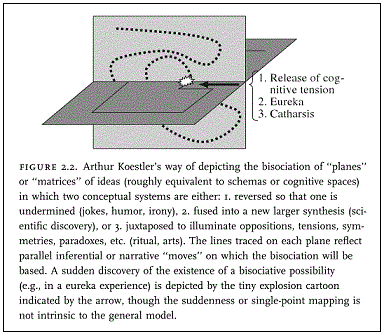
koestler-model.gif

It shows the essence of the creative act — the “release of cognitive tension” that occurs when some form of analogy, similitude, overlap allows the mind to join conceptual clusters from two fields in a “creative leap”.

Nancy Fouts’ work doesn’t merely make use of such twinned field overlaps, it makes twinned fields with overlap the defining quality of her works.

She is aiming right at the heart of the creative process. And it shows.

Moving further afield:

.
In that earlier post of mine, I talked about Ada, Countess of Lovelace, and noted that her analogy between Charles Babbage‘s Analytical Engine and Jacquard‘s mechanical loom, famously expressed by her thus:

The Analytical Engine … weaves algebraic patterns, just as the Jacquard-loom weaves flowers and leaves.

was precisely the creative leap that led to the us of punched card systems in computation from Babbage to Watson…

I could give other examples. The Taniyama-Shimura conjecture which formed the basis of Andrew Wiles‘ proof of Fermat‘s Last Theorem, bridges two previously distinct branches of mathematics precisely by showing that for every elliptic curve, there is a related modular form

And no, I don’t understand the mathematics. But I understand the concept of twinned fields, and the power of their overlap.

Some favorite tropes:

.
Back, then, to Nancy Fouts:

One thing that interests me about her work is that she has a few simple “essences” that she returns to time and again: in this case, bees, forms that resemble honeycombs, and by implication, honey.

In my own work, making similar connections between what we might paradoxically call “kindred ideas in unrelated fields” — I might set Nancy’s honeybees across from the verse from the Upanishads [Brihadaranyaka, fifth Brahmana, 14] which says:

This Self is the honey of all beings, and all beings are the honey of this Self.

Another of Nancy’s tropes connects nature and music…

The piercing:

.
And thimbles, those miniature emblems of armor and protection, are another recurring theme:

Let’s take a look at that last image, of the thimble transpierced by a needle.

I believe it has a history — again, accessible via an associative leap. Here are three images of the “wounded healer” motif, two of them specifically images of the Inuit shaman who has harpooned himself — a motif which the anthropologist and zen roshi Joan Halifax writes “captures the essence of the shaman’s submission to a higher order of knowing”:

Armor, the defenses we have in place to protect our selves, and vulnerability, the ability to to allow our selves to be wounded, so that the “self” which is “the honey of all beings” may shine through us. The paradox of Selflessness and Self.

Koan and sacrament:

.
Among wounded healers, we might count the crucified Christ, his side pierced by the spear of a Roman soldier — and here I might suggest that Fouts contrasts (image below, left) the self-sacrifice at the heart of Christianity with the pugilistic approaches of some proponents of his message:

And the image of Christ (right) balancing on a high wire?

Again I’m reminded of the language of shamanism. The anthropologist Barbara Myerhoff studied the religious beliefs and practices of the Huichol or Wixaritari of the Mexican Sierra Madre Occidental, with Ramon Medina Silva, a mara’akame or shaman of the tribe.

In her book, Peyote Hunt: The Sacred Journey of the Huichol Indians, she describes a feat of balance that Ramon performed, which appeared to serve a “sacramental” function for his people – providing them with what Cranmer‘s Book of Common Prayer calls “an outward and visible sign of an inward and spiritual grace”:

One afternoon Ramon led us to a steep barranca, cut by a rapid waterfall cascading perhaps a thousand feet over jagged, slippery rocks. At the edge of the fall Ramon removed his sandals and told us that this was a special place for shamans. We watched in astonishment as he proceeded to leap across the waterfall, from rock to rock, pausing frequently, his body bent forward, his arms spread out, his head thrown back, entirely birdlike, poised motionlessly on one foot. He disappeared, reemerged, leaped about, and finally achieved the other side. We outsiders were terrified and puzzled but none of the Huichols seemed at all worried. The wife of one of the older Huichol men indicated that her husband had started to become a mara’akame but had failed because he lacked balance.

It’s easy to read the description — but by no means as easy to keep one’s balance — something that Fouts’ image perhaps suggests more vividly than words easily can.

Richard de Mille describes the mara’akame‘s function in Huichol society as to “cross the great chasm separating the ordinary world from the otherworld beyond,” and suggests that Medina Silva’s feat of acrobatics on the barranca that day is to be understood as offering “a concrete demonstration in this world standing for spiritual balance in that world.”

Myerhoff herself was never entirely sure whether Medina Silva was “rehearsing his equilibrium,” or giving it “public ceremonial expression” that afternoon: it is clear, however, that for the Huichols, such feats of balance possess a resonance and meaning that extends beyond the “merely” physical.

Bringing the viewer into the picture

.
I may of course be projecting some of my own ideas onto Nancy Fouts’ work — and indeed, perhaps that’s the point.

She has some pretty fierce observations to make concerning matters religious — Christian, Buddhist and other — and I’ll leave those who are interested to make their own discoveries on her website. I don’t doubt there are places where her sympathies and my own overlap, and others where we differ.

Fouts speaks a direct and visceral language of images — and her juxtapositions, carefully chosen and choreographed as they are, provoke us to feel and think.

Thank you, Nancy.

No need to reach for the gun, fellas — but that’s art.

_________________________________________________________________________________________

credits for images of Harpooned Shaman: Charlie Ugyuk (left); David Ruben (right).


Switch to our mobile site