zenpundit.com » nature

Archive for the ‘nature’ Category

The great northern thaw

Tuesday, August 9th, 2016

[ by Charles Cameron — okay, methane, yes, for starters — now add some radioactive waste and anthrax to the brew ]
.

Two recent items that caught my eye:
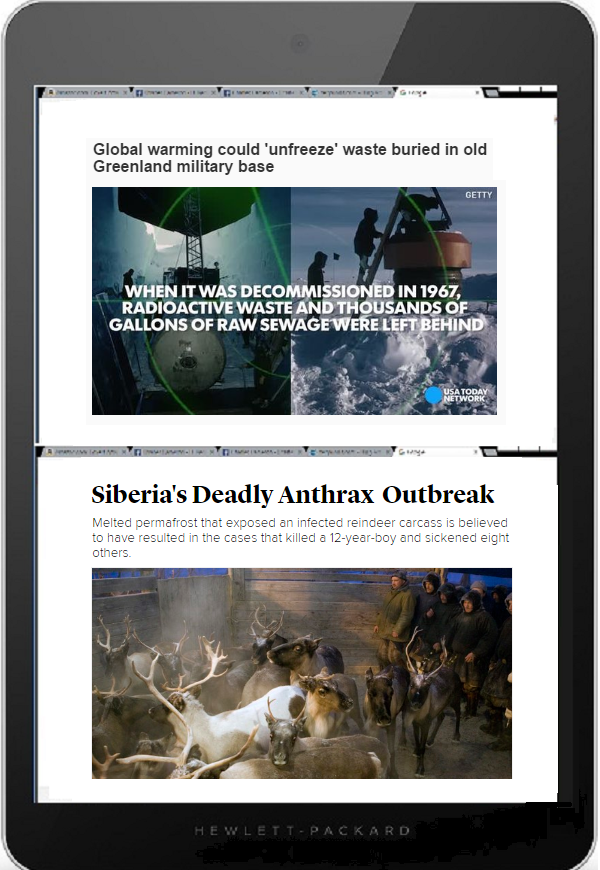
Tablet DQ Thaw raindeer and radioactivity

Sources:

  • USA Today, Global warming could ‘unfreeze’ waste buried in old Greenland military base
  • The Atlantic, Siberia’s Deadly Anthrax Outbreak
  • **

    More generally, we non-expert interested folk have known for a while — assuming, say, we read the New York Times piece, As Permafrost Thaws, Scientists Study the Risks, back in 2011 — that loss of permafrost was hazardous to planetary health:

    Experts have long known that northern lands were a storehouse of frozen carbon, locked up in the form of leaves, roots and other organic matter trapped in icy soil — a mix that, when thawed, can produce methane and carbon dioxide, gases that trap heat and warm the planet. But they have been stunned in recent years to realize just how much organic debris is there.

    A recent estimate suggests that the perennially frozen ground known as permafrost, which underlies nearly a quarter of the Northern Hemisphere, contains twice as much carbon as the entire atmosphere.

    Temperatures are warming across much of that region, primarily, scientists believe, because of the rapid human release of greenhouse gases. Permafrost is warming, too. Some has already thawed, and other signs are emerging that the frozen carbon may be becoming unstable. [ .. ]

    If a substantial amount of the carbon should enter the atmosphere, it would intensify the planetary warming. An especially worrisome possibility is that a significant proportion will emerge not as carbon dioxide, the gas that usually forms when organic material breaks down, but as methane, produced when the breakdown occurs in lakes or wetlands. Methane is especially potent at trapping the sun’s heat, and the potential for large new methane emissions in the Arctic is one of the biggest wild cards in climate science.

    **

    Okay, now we can also think about rotting reindeer carcases and radioactive waste.

    I can’t see Russia from my house, but it looks as though the Russians have the reindeer anthrax issue well in hand, and the “once top-secret subterranean U.S. nuclear base in northern Greenland” with its “radioactive coolant, PCBs, and raw sewage that the military originally believed would stay entombed for millennia” seems to pale in comparison with the possibilities of methane discharge — Cheryl Rofer could no doubt estimate the comparative risks far better than I — so this post is not intended as a scare-alert, but as yet another example of a category that interests me way more than most — which is why I’d like to direct it:

    Attn: Department of Blindspots and Unintended Consequences

    .
    Sunday reprise: of trees and books

    Monday, August 8th, 2016

    [ by Charles Cameron — a brief essay on the Umbertification of texts ]
    .

    There’s an engaging page in the Oxford Dictionaries site called When is a book a tree? which deals, among other things, with the question of whether the origins of the word book and beech are the same.

    In this post, I’d like to quote you a paragraph about books, and several about trees — specifically, in England’s Epping Forest — considering how what you learn about might interestingly relate to the other — trees to books and books to trees.

    **

    Of books:

    A paragraph from Rebecca Solnit‘s The Faraway Nearby via Maria Popova‘s Brain Pickings

    I disappeared into books when I was very young, disappeared into them like someone running into the woods. What surprised and still surprises me is that there was another side to the forest of stories and the solitude, that I came out that other side and met people there. Writers are solitaries by vocation and necessity. I sometimes think the test is not so much talent, which is not as rare as people think, but purpose or vocation, which manifests in part as the ability to endure a lot of solitude and keep working. Before writers are writers they are readers, living in books, through books, in the lives of others that are also the heads of others, in that act that is so intimate and yet so alone.

    **

    Of woods:

    Selected paragraphs from The Secrets of the Wood Wide Web:

    In this way, individual plants are joined to one another by an underground hyphal network: a dazzlingly complex and collaborative structure that has become known as the Wood Wide Web.

    All of these trees will have mycorrhizal fungi growing into their roots. You could imagine the fungi themselves as forming a massive underground tree, or as a cobweb of fine filaments, acting as a sort of prosthesis to the trees, a further root system, extending outwards into the soil, acquiring nutrients and floating them back to the plants, as the plants fix carbon in their leaves and send sugar to their roots, and out into the fungi. And this is all happening right under our feet.

    The implications of the Wood Wide Web far exceed this basic exchange of goods between plant and fungi, however. The fungal network also allows plants to distribute resources—sugar, nitrogen, and phosphorus—between one another. A dying tree might divest itself of its resources to the benefit of the community, for example, or a young seedling in a heavily shaded understory might be supported with extra resources by its stronger neighbors.

    The revelation of the Wood Wide Web’s existence, and the increased understanding of its functions, raises big questions—about where species begin and end? about whether a forest might be better imagined as a single super-organism, rather than a grouping of independent individualistic ones? and about what trading, sharing, or even friendship might mean among plants.

    **

    Trees and books, libraries and forests — interleave them.

    Sunday surprise: Damages and House of Cards

    Sunday, August 7th, 2016

    [ by Charles Cameron — two opening credit sequeces that rhyme, also sheep & starlings ]
    .

    As you know, I’m interested in twinnings of various sorts — the sound twinnings we call rhyme, visual twinnings in films we call graphic match, the contrapuntal twinnings of melody in canons and fugues, the twinnings when history “rhymes” — oh, and the ever popular plagiarism. Recently I’ve been watching the TV show Damages — an old friend is in it — and having the eerie feeling every time the opening credits rolled that they were just like the opening credits from House of Cards. So I thought I’d look them up, and see if they’d been put together by the same team.

    **

    Damages:

    House of Cards:

    I didn’t get as far as finding out who put them together, but I did run across a blog post by Alicatte from 2013 titled House of Cards Opening: Deja Damages which more than amply vindicated my far less detailed intuition.

    **

    And while it’s still Sunday, let’s take a look at another couple of videos that have some twinning to them. A friend of mine, Bob Crosby — ecological engineer par excellence — of Biorealis, posted them on a private group with the fake names I’ll give you above each one:

    An aerial view of the American electorate being herded by corporate media pundits…

    and:

    An EEG video of neurons forming a thought...

    Have fun..

    Sunday surprise the second — the Laws of Nature and Nature’s God

    Sunday, July 3rd, 2016

    [ by Charles Cameron — wishing you all blessings on the Fourth ]
    .

    My eye was caught today by yet another disaster — which in turn reminded me of tomorrow, the Fourth of July. It’s just one example among many:

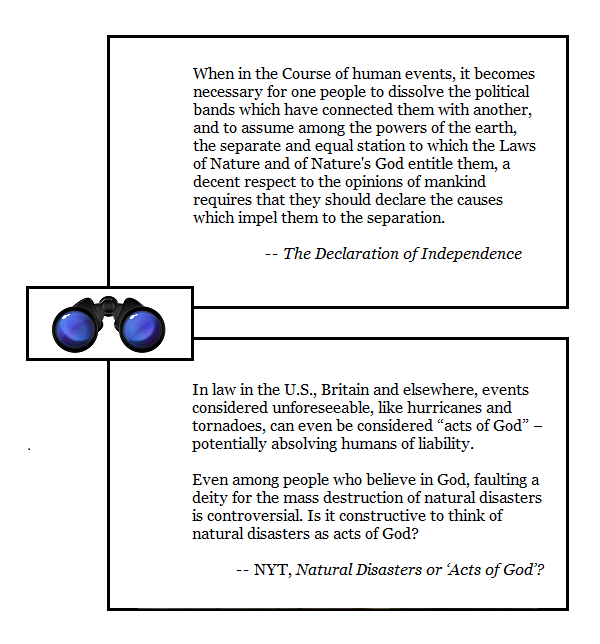
    — but it brings up again the question of whether we think in terms of “acts of God” or “laws of Nature” or — somehow — both. And that’s where thw roding of the Constitution comes in, with the phrase “the Laws of Nature and of Nature’s God”:

    Nature and Nature's God DQ

    **

    If I used that phrasing — “the Laws of Nature and of Nature’s God” — today, I might well be attempting to please or at least placate readers who variously:

  • believe in a God separate from and superior to Nature, and author of Nature’s laws
  • believe in a God essentially indistinguishable from Nature, wholly immanent, &
  • disbelieve in any kind of God, but recognize Nature as a catchall term for the Whole System.
  • I don’t suppose that would necessarily be the case in 1776, though, and wonder whether the phrase should be read as:

    the Laws — of Nature and of Nature’s God

    or:

    the Laws of Nature — and of Nature’s God

    and if the second, whether the and marks a distinction between Nature and nature’s God, or also covers the possibility of their being one and the same.

    And once we’ve cleared that up, and bearing in mind that John Donne could write “At the round earth’s imagin’d corners” — thus conflating the old, imaginative, square earth with the new, scientific, spherical one — how feasible do you think it is to hold simultaneously the idea that a given earthquake, hurricane, tsunami or volcanic eruption is an act of God and a natural disaster?

    A worldview paradox?

    **
    Sources:

  • July 4, 1776, The unanimous Declaration of the thirteen united States of America
  • November 18, 2013, Room for Debate: Natural Disasters or ‘Acts of God’?
  • Mancala games in culture & nature

    Tuesday, May 17th, 2016

    [ by Charles Cameron — I would rather play with the woodpeckers than with the humans ]
    .

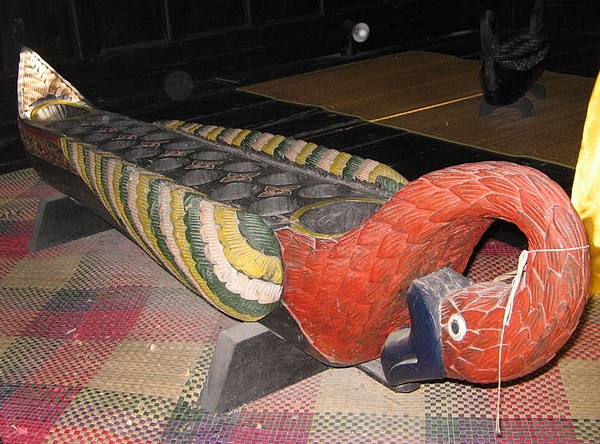
    Mancala games are games in which “seeds” are places in a series of “holes” in a board, often a carved wooden board, according to mathematical principles of play and capture. Wikipedia:

    Most mancala games share a common general game play. Players begin by placing a certain number of seeds, prescribed for the particular game, in each of the pits on the game board. A player may count their stones to plot the game. A turn consists of removing all seeds from a pit, “sowing” the seeds (placing one in each of the following pits in sequence) and capturing based on the state of board. This leads to the English phrase “count and capture” sometimes used to describe the gameplay. Although the details differ greatly, this general sequence applies to all games.

    ¶¶

    Equipment is typically a board, constructed of various materials, with a series of holes arranged in rows, usually two or four. The materials include clay and other shape-able materials. Some games are more often played with holes dug in the earth, or carved in stone. The holes may be referred to as “depressions”, “pits”, or “houses”. Sometimes, large holes on the ends of the board, called stores, are used for holding the pieces.

    Playing pieces are seeds, beans, stones, cowry shells, half-marbles or other small undifferentiated counters that are placed in and transferred about the holes during play.

    ¶¶

    Among the earliest evidence of the game are fragments of a pottery board and several rock cuts found in Aksumite areas in Matara (in Eritrea) and Yeha (in Ethiopia), which are dated by archaeologists to between the 6th and 7th century AD; the game may have been mentioned by Giyorgis of Segla in his 14th century Ge’ez text Mysteries of Heaven and Earth, where he refers to a game called qarqis, a term used in Ge’ez to refer to both Gebet’a (mancala) and Sant’araz (modern sent’erazh, Ethiopian chess).

    Nota Bene:

    Even when played with glass beads, mancala games are not even close to the Glass Bead Game as Hermann Hesse describes it, since their moves have nothing to do with cultural citation or meanings, let along their contrapuntal connections and correspondences, but are indifferent markers, inherently fungible.

    **

    It was 3 Quarks Daily that introduced me to the avian version of mancala games in a post that read:

    Acorn woodpeckers drill into trees not in order to find acorns, but in order to make holes in which they can store acorns for later use, especially during the winter.

    As the acorn dries out, it decreases in size, and the woodpecker moves it to a smaller hole. The birds spend an awful lot of time tending to their granaries in this way, transferring acorns from hole to hole as if engaged in some complicated game of solitaire.

    Multiple acorn woodpeckers work together to maintain a single granary, which may be located in a man-made structure – a fence or a wooden building – as well as in a tree trunk. And whereas most woodpecker species are monogamous, acorn woodpeckers take a communal approach to family life. In the bird world, this is called cooperative breeding. Acorn woodpeckers live in groups of up to seven breeding males and three breeding females, plus as many as ten non-breeding helpers. Helpers are young birds who stick around to help their parents raise future broods; only about five per cent of bird species operate in this way.

    **

    Conclusion:

    For myself, I would rather play with the woodpeckers than with the humans.

    Even so, a humanly-wrought board can be very lovely:

    swan mancala board


    Switch to our mobile site