zenpundit.com » poetry

Archive for the ‘poetry’ Category

Encryption, the mind and voice

Monday, February 29th, 2016

[ by Charles Cameron — paging birds and fishes, Chuang Tzu and Wm Blake ]
.

Dwight Furrow, Wine Tasting and Objectivity:

The question is whether flavors are “in the wine” or “in the mind”. On the one hand, there are objectively measurable chemical compounds in wine that reliably affect our taste and olfactory mechanisms—pyrazines cause bell pepper aromas in Cabernet Sauvignon, malic acid explains apple aromas in Chardonnay, tannins cause a puckering response, etc. But we know that human beings differ quite substantially in how they perceive wine flavors. Even trained and experienced wine critics disagree about what they are tasting and how to evaluate wine. This disagreement among experts leads many to claim that wine tasting is therefore purely subjective, just a matter of individual opinion. According to subjectivism, each person’s response is utterly unique and there is no reason to think that when I taste something, someone else ought to taste the same thing. Statements about wine flavor are statements about one’s subjective states, not about the wine. Thus, there are no standards for evaluating wine quality.

**

Is each mind inherently closed to every other, much as the bird’s mind is closed to ours in Blake‘s aphorism —

How do you know but every bird that cuts the airy way, is an immense world of delight, closed by your senses five?

— albeit not always so joyful?

In more contemporary terms — Is there encryption of the mind?

**

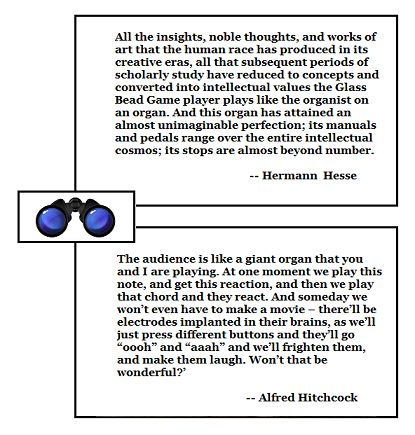
I ask this in light of the DoubleQuote I posted a few days ago comparing Hesse and Hitchcock in terms of their metaphoric uses of “organ” — in, I hasten to add, the Bach sense of the word:

SPEC-Hesse-Hitchcock-organs sm

Here’s what I’m thinking. Hesse’s game influences the mind, as does art, but it is non-invasive; Hitchcock applauds the potential for art to move in a more invasive direction, as if by force rather than by enticement.

“”

Humans — or at least the philosophers and philosopher tagalongs among them — can’t even tell if what one human sees as “red” is what another sees as “red” — let alone what a given Burgundy tastes like on another’s palate.

If this means, more generally, that minds are effectively encrypted by virtue of their differences in wiring acquired with parentage, age and experience, then our communications media -– language, the arts, literature, number — would appear to be the available decryption keys, selectively available to the minds in question.

**

Chuang-Tsu has this tale to tell:

Men claim that Mao-ch’iang and Lady Li were beautiful, but if fish saw them they would dive to the bottom of the stream, if birds saw them they would fly away, and if deer saw them they would break into a run. Of these four, which knows how to fix the standard of beauty for the world?

And this..

Chuang Tzu and Hui Tzu were strolling along the dam of the Hao River when Chuang Tzu said, “See how the minnows come out and dart around where they please! That’s what fish really enjoy!”

Hui Tzu said, “You’re not a fish – how do you know what fish enjoy?”

Chuang Tzu said, “You’re not I, so how do you know I don’t know what fish enjoy?”

Hui Tzu said, “I’m not you, so I certainly don’t know what you know. On the other hand, you’re certainly not a fish – so that still proves you don’t know what fish enjoy!”

Chuang Tzu said, “Let’s go back to your original question, please. You asked me how I know what fish enjoy – so you already knew I knew it when you asked the question. I know it by standing here beside the Hao.”

**

Chuang Tzu said, “You’re not I, so how do you know I don’t know what fish enjoy?”

Blake said, “How do you know but every bird that cuts the airy way, is an immense world of delight, closed by your senses five?”

Islamic State vs Saudi Arabia — Cole Bunzel’s new paper

Friday, February 26th, 2016

[ by Charles Cameron — contextualizing IS in terms of KSA, Abd al-wahhab and the Prophet, also an interior / eternal aspect of the “end times” ]
.


Cole Bunzel, speaking with Charlie Rose

**

As a poet, I keep my eyes peeled for the superposition of opposites in a small space. John Donne‘s great phrase, “At the round earth’s imagin’d corners, blow / Your trumpets, angels” manages to superpose the imaginary and actual, sacred and soon-to-be profane, flat earth and globe, in just four words, Shakespeare is even more concise with Rosalind‘s “you insult, exult, and all at once” in As You Like It, and Dylan Thomas is after the same effect in his line “Curse, bless me now with your fierce tears, I pray” in Do Not Go Gentle.

The poet is after a world in miniature, the balance of contraries. And so it is that I was stopped dead in my tracks on reading Cole Bunzel‘s sentence at the end of the second paragraph of the Introduction to his new paper, The Kingdom and the Caliphate: Duel of the Islamic States:

One of those territories increasingly in its sights is Saudi Arabia, home to Islam’s holiest places and one-quarter of the world’s known oil reserves.

Bunzel is a PhD student writing a paper for the Carnegie Endowment for International Peace, so I’m expecting to be informed, yes, but this immediate, strong duality catches my attention — and it’s followed immediately with another at the start of his third paragraph:

The competition between the jihadi statelet and the Gulf monarchy is playing out on two levels, one ideological and one material.

The ideological and the material — holy places and oil reserves — in both phrasing we can recognize the world in a nutshell. And Bunzel will sharpen that sense of duality throughout, by contrasting Saudi Arabia, where possession of the resources has arguably warped the purity of creed as Abd al-Wahhab prtoposed it, with the Islamic State, which at least as it sees itself has maintained that “original” purity, and is now in a struggle for the resources to propagate its vision of Tawhid across the face of the earth.

As Bunzel puts it:

The comparison worth noting is the one in the minds of the Islamic State’s jihadi thinkers, the idea that Saudi Arabia is a failed version of the Islamic State. As they see it, Saudi Arabia started out, way back in the mid-eighteenth century, as something much like the Islamic State but gradually lost its way, abandoning its expansionist tendencies and sacrificing the aggressive spirit of early Wahhabism at the altar of modernity. This worldview is the starting point for understanding the contest between the kingdom and the caliphate, two very different versions of Islamic states competing over a shared religious heritage and territory.

Kingdom and caliphate: again, the elegant duality.

**

Let’s see now, how this duality — proclaimed, indeed in Bunzel’s title, The Kingdom and the Caliphate: Duel of the Islamic States — plays out in his analysis:

The new king has described Saudi Arabia as the purest model of an Islamic state, saying it is modeled on the example of the Prophet Muhammad’s state in seventh-century Arabia. “The first Islamic state rose upon the Quran, the prophetic sunna [that is, the Prophet’s normative practice], and Islamic principles of justice, security, and equality,” he stated in a lecture in 2011. “The Saudi state was established on the very same principles, following the model of that first Islamic state.” What is more, the Saudi state is faithful to the dawa (mission) of Muhammad ibn Abd al-Wahhab, meaning Wahhabism, upholding the “banner of tawhid” and “calling to the pure faith — pure of innovation and practices having no basis in the Quran, sunna, and statements of the Pious Forbears.”

The Islamic State makes the same claims for itself. It, too, models itself on the first Islamic state, as its early leadership stated upon its founding in October 2006: “We announce the establishment of this state, relying on the example of the Prophet when he left Mecca for Medina and established the Islamic state there, notwithstanding the alliance of the idolaters and the People of the Book against him.” Another early statement appealed to the Wahhabi mission, claiming that the Islamic State would “restore the excellence of tawhid to the land” and “purify the land of idolatry [shirk].”

Compare and contrast — it’s one of the oldest tricks in the intellectual book, and maybe the most powerful.

And it’s right there — the material in conjunction with the spiritual — from the beginning:

This first Saudi-Wahhabi state was the product of an agreement reached between the chieftain Muhammad ibn Saud and the preacher Muhammad ibn Abd al-Wahhab in the small desert oasis of Diriyah in central Arabia. The two leaders agreed to support each other, the Al Saud supporting the Wahhabi mission and the Wahhabi missionaries supporting Saudi political authority.

Religion and politics, politics and religion. Church and state, we might say, Caesar and God.

**

But I shouldn’t inflict too much by way of this “dual” poetic formalism on my readers…

Bunzel details the three states at the juncture of Wahhabism and the House of Saud — “the first (1744–1818), the second (1824–1891), and the third (1902–present)” and proposes that we are now witnessing somethiung not unlike the genesis of a fourth:

Indeed, the Islamic State is a kind of fourth Wahhabi state, given its clear adoption and promotion of Wahhabi teachings.

But while the opposition Bunzel studies is between his third and fourth variants of Wahhabi-statehood, the analogy claimed in each of those cases is with the first.

Given that the House of al-Saud is the military partner of al-Wahhab-derived theology in the first three cases, their claim to contimuity with the first Wahhabi state, and thus also with the Prophet’s original state in Medina, is readily made:

The new king has described Saudi Arabia as the purest model of an Islamic state, saying it is modeled on the example of the Prophet Muhammad’s state in seventh-century Arabia. “The first Islamic state rose upon the Quran, the prophetic sunna [that is, the Prophet’s normative practice], and Islamic principles of justice, security, and equality,” he stated in a lecture in 2011. “The Saudi state was established on the very same principles, following the model of that first Islamic state.” What is more, the Saudi state is faithful to the dawa (mission) of Muhammad ibn Abd al-Wahhab, meaning Wahhabism, upholding the “banner of tawhid” and “calling to the pure faith — pure of innovation and practices having no basis in the Quran, sunna, and statements of the Pious Forbears.”

Similarly, Bunzel notes, IS has claimed since its beginnings in late 2006:

We announce the establishment of this state, relying on the example of the Prophet when he left Mecca for Medina and established the Islamic state there, notwithstanding the alliance of the idolaters and the People of the Book against him.

While IS aspires not only to theological continuity but to a greater theological fidelity to al-Wahhab’s original Wahhabi state than the current regime, it regards the current state of the House of al-Saud as depraved and corrupt, in a manner quite different from the Prophet’s Medinan state — ridiculing it as “Al Salul” after “a leader of the so-called ‘hypocrites’ of early Islam who are repeatedly denounced in the Quran.”

The Saudi claim to be a Wahhabi state largely derives, let me suggest, from the al-Saud side of the original Wahhabi-Saudi alliance, while the Islamic State’s claim rests uniquely on the doctrine of al-Wahhab, viewed as a reformer who returned Islam to its original purity.

Indeed, Bunzel can cite an article “distributed by the Islamic State’s semiofficial al-Battar Media Agency” as describing thee IS mission as “an extension of Sheikh [Muhammad ibn Abd al-Wahhab’s] mission.” And the similarity extends not just to that mission, but also to the opposition it arouses:

The author, who goes by Abu Hamid al-Barqawi, drew attention to the similar accusations made against the two states by their respective enemies, namely accusations of excess in the takfir (excommunication) and killing of fellow Muslims. He noted that both states were denounced as Kharijites, an early radical Muslim sect.

Thus we see, from the perspective of the Islamic state, another dualism repeating itself across history: this time between the original Companions of the Prophet and the abhorred Kharijite heretics, and the present followers of al-Baghdadi’s claim to the Caliphate and the Kharijite House of al-Saud.

In a further twist, both the House of al-Saud and Al-Qaida’s local branch, Jabhat al-Nusra, have accused the Islamic State precisely of being Kharijites, the Saudi Sheikh Abdul Aziz Al ash-Sheikh terming IS Kharijites who “believed that killing Muslims was not a crime, and we do not consider either of them Muslims”, while Jabhat’s spiritual adviser, Sami al-Aridi, has said:

The swords that God ordered us to use are many. One of these swords is the one pointed at Kharijites. This group [IS] has provided solid proof that it is Kharijite.

And who, again, are the Kharijites? I have quoted before now this hadith reported in Abu Dawud:

The Messenger of Allah, peace and blessings be upon him, said, “There will be dissension and division in my nation and a people will come with beautiful words but evil deeds. They recite the Quran but it will not pass beyond their throats. They will leave the religion as an arrow leaves its target and they will not return until the arrow returns to its notch. They are the worst of the creation. Blessed are those who fight them and are killed by them. They call to the Book of Allah but they have nothing to do with it. Whoever fights them is better to Allah than them.”

**

There is, of course, much more to Bunzel’s paper than I have captured here, but I would like to comment on one final issue, the one which I always return to — that of the end times, or eschatology. Bunzel writes:

The Islamic State’s apocalyptic dimension also lacks a mainstream Wahhabi precedent. As William McCants, a scholar of jihadism at the Brookings Institution, has set out in detail in a book on the subject, the group views itself as fulfilling a prophecy in which the caliphate will be restored shortly before the end of the world. While the Saudi Wahhabis and the Islamic State Wahhabis share an understanding of end times, only the latter view themselves as living in them.

In the light of our discussion above of the respective Islamic States of the Prophet himself at Medina, Abd al-Wahhab in conjunction with the original Saudi state, and the current Wahhabism of Baghdadi’s Caliphate, this naturally raises the question as to whether the Prophet’s Medina was an eschatological state, a topic which David Cook briefly addresses in the Introduction to Muslim Apocalyptic in his Studies in Muslim Apocalyptic:

The research of some scholars has indicated that Muhammad himself was impelled by a powerful belief in the proximity of the Last Day. For example, the Prophet is quoted as saying that some that see him will live to see the Dajjal (the Muslim anti-Christ).

Cook footnotes this claim with the following intriguing comment:

Though I do not wish to overspeculate as to the significance of this belief upon Muslim history, one cannot help but notice that the question of why Muhammad did not designate a successor is frequently asked. Perhaps the answer lies in the fact that he genuinely did not believe that there would be time enough before the end of the world for anyone to succeed him. The very fact of some sort of will would show a lack of faith in the immediacy of the End.

Christianity, similarly, can be seen as an apocalyptic movement from its origin, with Christ similarly telling his followers “The time is fulfilled, and the kingdom of God is at hand: repent ye, and believe the gospel” (Mark 1.15) and “Verily I say unto you, That there be some of them that stand here, which shall not taste of death, till they have seen the kingdom of God come with power” (Mark 9.1).

**

Here if I may, I shall turn speculative and poetic.

In his extraordinary reading of the Quran in The Apocalypse of Islam, Norman O Brown views the history of Islam as comprising “a series of decisive (requiring decision) apocalyptic moments, moments that will recur throughout a history that has no set end-point”:

These moments must (through the action, the cooperation with God’s call by the believer’s response) break through the crust of the familiar way of doing business (whether globalized or traditional), and lead one to an action that will necessarily be historical and personal (towards purification) because the drive of God’s will is always towards unity, both within and without.

The Islamic world today clearly anticipates the end times in the future, perhaps near, perhaps far, its date and hour necessarily unknown, and expects it to come upon us after various notable signs of the time have occurred –- the Shia with the return of the expected Twelfth Imam, now in ghayba or occultation, and the Sunni with the coming of the Mahdi and of the Prophet Issa (Jesus).

With regard to those notable signs, at 47.18 in the Arberry translation the Quran asks:

Are they looking for aught but the Hour, that it shall come upon them suddenly? Already its tokens have come; so, when it has come to them, how shall they have their Reminder?

Brown quotes Louis Massignon as calling Sura 18, The Cave, “the apocalypse of Islam” — and further suggests we should not apply enlightenment notions of linear time to a book, the Quran, which is itself both Revelation and Word. The poet Allama Muhammad Iqbal, in a phrase reminiscent of earlier Jewish and Christian texts, says of the Quran, “whole centuries are involved in its moments.”

Brown writes:

There is an apocalyptic or eschatological style: every Sura is an epiphany and a portent; a warning, “plain tokens that haply we may take heed” (XXIV, 1). The apocalyptic style is totum simul, simultaneous totality; the whole in every part. Hodgson on the Koran: “almost every element which goes to make up its message is somehow present in any given passage.”

Mathematicians will no doubt note the resonance here with the principle of holography, Buddhists with the Hua-Yen concept of the Jewel Net of Indra.

Brown, again referencing Massignon, who along with Henry Corbin was one of the major sources of his insight into Islam:

Massignon calls Sura XVIII the apocalypse of Islam. But Sura XVIII is a resume, epitome of the whole Koran. The Koran is not like the Bible, historical; running from Genesis to Apocalypse. The Koran is altogether apocalyptic. The Koran backs off from that linear organization of time, revelation, and history which became the backbone of orthodox Christianity … Islam is wholly apocalyptic or eschatological, and its eschatology is not teleology. The moment of decision, the Hour of Judgment, is not reached at the end of a line; nor by a predestined cycle of cosmic recurrence; eschatology can break out at any moment.

The End is in the Beginning — or as Eliot would have it, “And the end and the beginning were always there. Before the beginning and after the end.”

In the first sura on the Quran, al-Fatihah, The Opening, God is described first as “the All-merciful, the All-compassionate” (1.3), then as “Master of the Day of Doom” (1.4), and only then is there mention of humanity, in the words “Thee only we serve; to Thee alone we pray for succour” (1.5). According to a hadith reported in Tirmidhi, the Prophet said, “I was sent in the presence of the Final Hour.” To be present at the End, to be present at the Beginning — both are reminiscent of Christ’s extraordinary trans-temporal remark — perhaps the deepest teaching in the gospels, a true koan

Before Abraham was, I am.

Two profound instances of ceremonial (liturgical) impact

Thursday, February 18th, 2016

[ by Charles Cameron — a follow up to my post on the Vespers liturgy at Hampton Court Palace ]
.

Boring as hell or blissful as paradise? Religious worship can be either one.

I know that when I was at Wellington College I must have sat through dozens of sermons in which one or another scriptural passage was read in that droning pastoral voice which Alan Bennett so skilfully skewered in his Beyond the Fringe satirical sermon on the text of Genesis 27.11, “Behold, Esau my brother is a hairy man, and I am a smooth man”:

I was a deeply religious kid, but verses like I Samuel 15.3, “Now go and smite Amalek, and utterly destroy all that they have, and spare them not; but slay both man and woman, infant and suckling, ox and sheep, camel and ass” went right past me. I had no qualms back then about Old Testament genocides, pretty much because I didn’t notice them — these were just sacred words, intoned, a strange blend of heaven, lullaby and snooze.

In my piece on the Hampton Court Vespers, I tried to give readers a sense of how things look from a perspective where liturgy and rites and rituals more generally need not be viewed as dry relics of a past best forgotten, but as well-springs of deep personal, interpersonal and transcendent inspiration and communion.

**

Here, I’d like to supplement my attempt with two “cases” that I hope will illustrate the power of liturgy.

the first I found a few days back in Peter Berger‘s essay, Eastern Orthodox Cacophony in America:

When the service began late on Saturday evening the cathedral was dimly lit, all the hangings and the altar cover were black in the color of Good Friday. Then the entire congregation went out into the street and marched slowly around the block. It was very cold. When we returned the cathedral was brilliantly lit and the color of everything was very bright. Easter had arrived.

So — somebody turned the lights on.

But no, it’s more than that, it’s the utter darkness of Christ’s descent from the cross and burial, it is grief physically imposed by that very cold pilgrimage around the block — and it’s the shock, the palpable beauty of the Resurrection dawn.

**

Going back yet a day further, from Good Friday to the Maundy Thursday which in the church’s calendar porecedes it, we can see the similarly profound impact of a simple gesture as my old mentor, Fr. Trevor Huddleston, washes the feet of his students in Sophiatown, the Johannesberg shanty-town where for years he taught and preached. In his own words, drawn from his book Naught for Your Comfort, we read:

On Maundy Thursday, in the Liturgy of the Catholic Church, when the Mass of the day is ended, the priest takes a towel and girds himself with it; he takes a basin in his hands, and kneeling in front of those who have been chosen, he washes their feet and wipes them, kissing them also one by one. So he takes, momentarily, the place of his Master. The centuries are swept away, the Upper Room in the stillness of the night is all around him: “If I, your Lord and Master, have washed your feet, ye ought also to wash one another’s feet.” I have knelt in the sanctuary of our lovely church in Rosettenville and washed the feet of African students, stooping to kiss them. In this also I have known the meaning of identification. The difficulty is to carry the truth out into Johannesberg, into South Africa, into the world.

That world, for Fr Trevor, was the world of South African apartheid. He carried that truth out into Johannesberg and the world in his book, and as President of the Anti-Apartheid Movement — and with what impact! He lived to see apartheid gone.

**

In closing, let me quote TS Eliot who wrote, in his Dialogue on Dramatic Poetry:

I say that the consummation of the drama, the perfect and ideal drama, is to be found in the ceremony of the Mass. … And the only dramatic satisfaction that I find now is in a High Mass well performed. Have you not there everything necessary? And indeed, if you consider the ritual of the Church during the cycle of the year, you have the complete drama represented. The Mass is a small drama, having all the unities; but in the Church year you have represented the full drama of creation.

On the horrors of apocalyptic warfare, 1: its sheer intensity

Wednesday, February 17th, 2016

[ by Charles Cameron — first in a series of four posts on the central theme of a proposed book ]
.

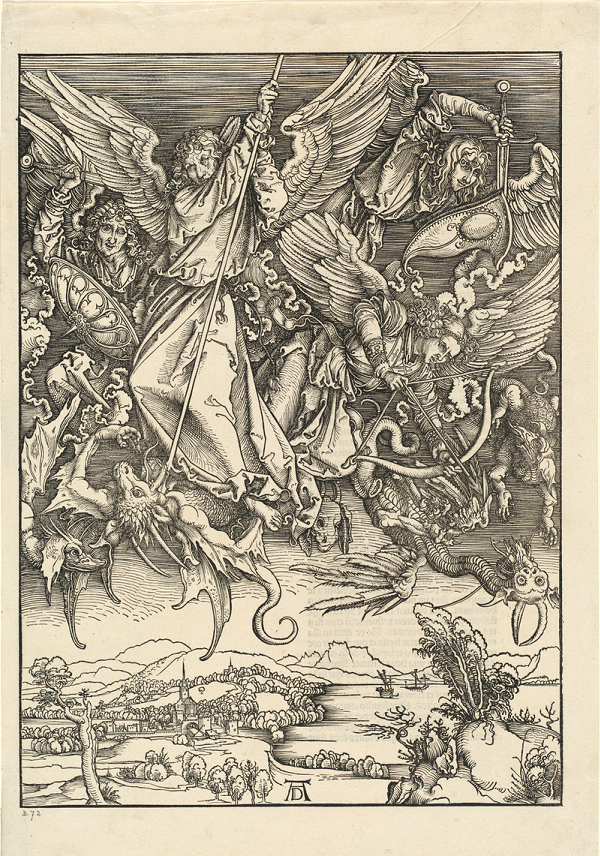
Saint Michael Fighting the Dragon

In a previous post, I introduced my work on a book proposal concerning Coronation: The Magic and Romance of Monarchy. The second book proposal I’ve put together, which is also currently in the hands of an agent and making the publishing rounds, is titled Jihad and the Passion of ISIS: Making Sense of Religious Violence.

**

We now have, I believe, a strong undertanding of the Islamic State and its origins in such books as Stern & Berger, ISIS: The State of Terror, Jason Burke, The New Threat, Joby Warrick, Black Flags: The Rise of ISIS, and Weiss & Hassan, ISIS: Inside the Army of Terror. Delving directly into the key issue that interests me personally, the eschatology of the Islamic State, we have Will McCants‘ definitive The ISIS Apocalypse. My own contribution will hopefully supplement these riches, and McCants’ book in particular, with a comparative overview of religious violence across continents and centuries, and a particular focus on the passions engendered in both religious and secular movements when the definitive transformation of the world seems close at hand.

What follows is the first section of a four-part exploration of the horrors of apocalyptic war.

**

I’ve attempted to give a sense of those passions in my post So: how does it feel at World’s End? — invoking Sylvia Plath‘s extraordinary couplet:

By the roots of my hair some god got hold of me.
I sizzled in his blue volts like a desert prophet.

That’s the intensity of the feeling aroused, I’d suggest, in the throngs who followed Muhammad Ahmad al-Mahdi to Khartoum, and Winston Churchill in his book The River War, conveys the intensity of their jihad in these words:

the force of fanatical passion is far greater than that exerted by any philosophical belief, its function is just the same. It gives men something which they think is sublime to fight for..

Churchill is really pretty astounding on the topic of the Mahdi — a messianic figure in a religion he characterized as laying dreadful curses on its votaries inclouding “the fanatical frenzy, which is as dangerous in a man as hydrophobia in a dog”, and a warrior of whom he said that a future Arab historian should place him “foremost among the heroes of his race”.

Here is another Churchillian description of that “fanatical frenzy”:

Then came the Mahdi .. it should not be forgotten that he put life and soul into the hearts of his countrymen and freed his native land of foreigners. The poor miserable natives, eating only a handful of grain, toiling half-naked and without hope, found a new, if terrible magnificence added to life. Within their humble breasts the spirit of the Mahdi roused the fires of patriotism and religion. Life became filled with thrilling, exhilarating terrors. They existed in a new and wonderful world of imagination. While they lived there were great things to be done; and when they died, whether it were slaying the Egyptians or charging the British squares, a Paradise which they could understand awaited them.

**

Let me make the general point more explicit. Dr Tim Furnish, a frequent commentator on these pages and author of Holiest Wars: Islamic Mahdis, Their Jihads, and Osama bin Laden, opens his book as I have cited frequently with this analogy:

Islamic messianic insurrections are qualitatively different from mere fundamentalist ones such as bedevil the world today, despite their surface similarities. In fact, Muslim messianic movements are to fundamentalist uprisings what nuclear weapons are to conventional ones: triggered by the same detonating agents, but far more powerful in scope and effect.

Will McCants makes it very clear in his The ISIS Apocalypse that the Islamic State as we currently encounter it is a caliphal movement rather than a Mahdist one, in other words that it is in an earlier stage of the same process leading eventually to the Mahdi’s arrival — although its propaganda, quoting its “founding father” Abu Musab al-Zarqawi, is clearly apocalyptic…

**

Up next: On the horrors of apocalyptic warfare, 2: to spark a messianic fire

Polishing the heart: full circle

Sunday, February 14th, 2016

[ by Charles Cameron — happy daze! from Joan Halifax via Henry Corbin to Hui Neng & David Remnick ]
.

From Roshi Joan Halifax:

**

Steven Nouriani, The Meeting of Two Rivers, in Copenhagen 2013 – 100 Years On:

As Corbin (1969) indicated, the heart is thought to be like a mirror in which every moment the various manifestations of the Divine Forms can be reflected on a microcosmic level. The more we polish the heart, the more we develop the Himma (aptitude) to experience Divine epiphanies out of Mundus Imaginalis.

Henry Corbin, Creative Imagination in the Sufism of Ibn Arabi, p 222.

In its unveiled state, the heart of the gnostic is like a mirror in which the microcosm from of the Divine Being is reflected

**

Sachiko Murata, Chinese Gleams of Sufi Light, p. 225, n. 8:

The Sufi path is rather to empty oneself of all causes, to “polish the heart” by cleansing it of the rust of things, and to find God’s light in the heart.

**

Luang Pu Thuat, quoted in Dharma Legacy of Ajaan Dune Atulo:

To make yourself a good-looking wandering monk isn’t proper at all. It goes against the purpose of going out to wander. Each of you should reflect a great deal on this. The purpose of wandering in meditation is only one thing: to train and polish the heart so that it’s free of defilements. To go wandering in meditation only in body, but without taking along the heart, is nothing excellent at all.

**

Morihei Ueshiba, founder of Aikido:

The only cure for materialism is the cleansing of the six senses (eyes, ears, nose, tongue, body, and mind). If the senses are clogged, one’s perception is stifled. The more it is stifled, the more contaminated the senses become. This creates disorder in the world, and that is the greatest evil of all. Polish the heart, free the six senses and let them function without obstruction, and your entire body and soul will glow.

**

Shen-hsiu, in The Platform Sutra: The Zen Teaching of Hui-neng, Red Pine, tr.:

The venerable Shen-hsiu held up a lantern and wrote his gatha on the middle of the south corridor wall at midnight, and no one saw him. His gatha went:

The body is a bodhi tree
the mind is like a standing mirror
always try to keep it clean
don’t let it gather dust.

to which Hui Neng‘s responds, from the same source:

Unless you know your own mind, studying the Dharma is useless. But once you know your mind and see your nature, you understand what is truly important. My gatha went:

Bodhi doesn’t have any trees
this mirror doesn’t have a stand
our buddha nature is forever pure
where do you get this dust?

Then I composed another one:

The mind is the bodhi tree
the body is the mirror’s stand
the mirror itself is so clean
dust has no place to land.

**

BBC, Valentine’s Day: Countries that don’t love February romance

Last year, there were clashes at a university in Peshawar over Valentine’s Day.
Liberal students were celebrating with red balloons and cake while another group felt such a show was un-Islamic.
Dozens of students threw rocks in the scuffle, leading to gunshots being fired by both sides and rooms in a student dormitory being set on fire.

**

David Remnick, Dangerous Liaisons:

Love is wonderful; Valentine’s Day, less so. Often, it’s cheesy and boring. Here’s your antidote: a collection of stories about dangerous love, doomed love, and other forms of bad romance. … Consider these pieces a Valentine from us.

**

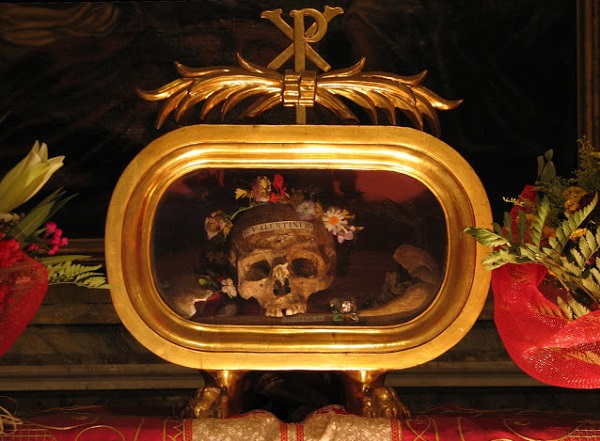
Veneration of relics:

2262875989_948afb24d8_b
Relics of St. Valentine, Santa Maria in Cosmedin, Rome, photo by Fr Lawrence Lew OP


Switch to our mobile site